
La storia di Frýdek Synagogue (Frýdek-Místek)
Frýdek, on the Silesian bank of the Ostravice, and Místek, on the Moravian bank, were separate towns until they were merged in 1943; today they form the city of Frýdek-Místek in the Moravian-Silesian Region. Jews are first recorded in the area in the seventeenth century, but a real community grew only in the second half of the nineteenth, when Jewish families moved in and Jewish entrepreneurs, above all the Landsberger family, helped build the local textile industry. An Israelite religious association, founded in 1863 with its seat in Místek, gathered members from both towns, and in 1864-65 they built a shared synagogue in Frýdek, designed by Ambrož Zapletal. It stood on the street now called Revoluční, opposite the pilgrimage basilica of the Visitation of the Virgin Mary, with the community's Jewish school directly beside it. One German source says the building was replaced or remodelled in 1896, but this is uncertain. The synagogue remained the religious centre of a community of about 470 people until the Second World War. On the night before 16 June 1939, three months after Nazi Germany occupied Bohemia and Moravia, it was set on fire and gutted, and the ruin was removed in 1940. The school building beside it survived.
Where it stood for nearly 75 years
Historic: Frýdek (Friedek), Austrian Silesia, opposite the pilgrimage church, beside the Jewish school; house number unknown. Today: Revoluční street, Frýdek, 738 01 Frýdek-Místek, opposite the basilica of the Visitation of the Virgin Mary (approximate).
Apri la mappa grande →La comunità ebraica
Jews are mentioned in the Frýdek area as early as 1632. A merchant spoke of a 'Frideker Synagoge' in 1797-98, though the historian Daniel Baránek doubts it was a dedicated building, and in 1823 the Jews of Frýdek and Koloredov formed a prayer society. Families settled in numbers only after the mid-nineteenth century. An Israelite religious association (Israelitischer Kultusverein) was founded in 1863 with its seat in Místek and members in both towns. In 1890 Frýdek had 262 Jews and Místek 227, and in that year the two congregations were united into a single community. Jewish manufacturers played a large part in the region's textile industry; the Landsbergers were the best known. The community kept a Jewish school from about 1865 and laid out a cemetery in 1882 with an Art Nouveau gate. A 2012 study by a Charles University historian describes the community as reaching its peak before the First World War, when many members declared Jewish nationality, and notes that Zionists failed to form a cohesive group there in the 1920s. The Great Depression damaged its economic base. In 1930 the joint community numbered 468, with close to 1,000 Jews in the wider district.
Architettura e design
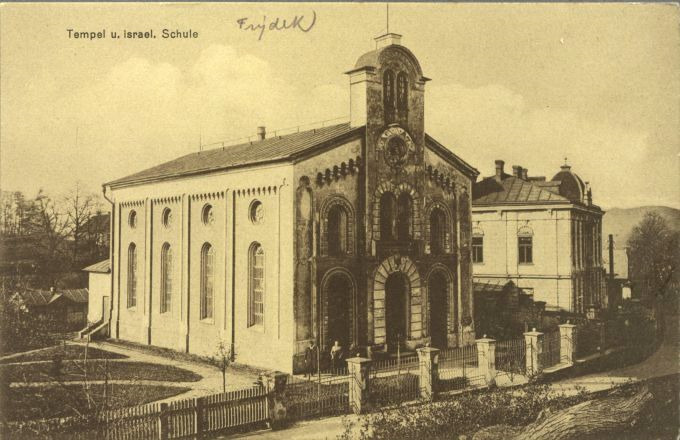
The only view found is a postcard of about 1910 captioned 'Tempel u. israel. Schule'. It shows a free-standing rendered hall with a pitched roof, its long side wall pierced by tall round-arched windows set between shallow pilasters, with smaller round openings above, and a band of small arches under the eaves. The entrance front is treated as a central tower-like bay rising above the roof, with a triple arched portal at ground level, paired round-arched windows and a rose window above, and a small arched belfry-like lantern topped by a cupola and finial. Small arched friezes edge the gable. These round-arched forms place the building in the Romanesque Revival manner common in Central European synagogues of the 1860s. A low fence with stone posts enclosed the forecourt, and to the right stood the two-storey Jewish school with its own small dome. The design is attributed to Ambrož Zapletal. A German source suggests a rebuilding or new building in 1896, which is not confirmed. Seating capacity, the interior arrangement and the position of the women's gallery are unknown.
La vita nella sinagoga
The synagogue served two towns that for decades kept separate congregations under one religious association: the association founded in 1863 had its seat in Místek, while the house of prayer stood in Frýdek. After the merger of 1890 it became the main synagogue of the united community. The community school, founded about 1865, stood right beside it, so religious teaching and worship shared one site. In the early twentieth century the congregation was largely assimilated and prosperous; its members included textile manufacturers and merchants, and Zionist activists tried without lasting success to organise within it in the 1920s. In spring 1938 refugees from Austria joined the congregation, and in late summer and autumn 1938 more arrived from the Sudeten areas annexed by Germany. The names of the rabbis and cantors who served in the synagogue, its rite and the details of its services were not found in the sources read.
Distruzione
The Munich Agreement of 1938 sharpened local tensions: Czech fascists were strong in the area, and there were antisemitic demonstrations and boycotts of Jewish shops despite police intervention. Nazi German forces occupied the town in March 1939. On the night before 16 June 1939 the synagogue was set on fire; a geocache history of the site gives the night of 13 to 14 June. The Reichenberg newspaper Die Zeit reported on 16 June under the headline 'Judentempel eingeäschert' that the fire had spread through the whole building, destroying its interior and part of its structure, and called the cause unknown; the Neue Zürcher Zeitung, citing the Havas agency in Prague, reported on 18 June that the synagogue had been destroyed. An abstract of a 2021 architecture thesis at Brno University of Technology states that it was burned by 'fanaticized Germans', which points to local Nazis or the occupiers, but no source read names the individuals responsible or describes any police investigation. The burnt-out ruin was removed completely about a year later, in 1940.
Il destino della comunità
About 300 Jews still lived in the joint community in 1940. In autumn 1939 members of the community were deported by the Nazis together with Jews from Moravská Ostrava to Nisko on the San, in occupied Poland. In mid-September 1942 about 280 Jewish residents were transported to the Theresienstadt ghetto, and most of them were sent on from there to the Treblinka extermination camp and murdered. The 2012 study of the community dates the deportations of its members from September 1942 to early 1945. The number of survivors is unknown, and no congregation was re-established after the war. The Jewish cemetery was used for the last burials in the early 1950s, became overgrown, and was brought back to public attention by volunteer projects in 1999 and 2003; its former ritual purification house is now a Seventh-day Adventist prayer room.
Il luogo oggi
The synagogue stood on today's Revoluční street in Frýdek, opposite the basilica of the Visitation of the Virgin Mary. According to the 2021 Brno University of Technology thesis, the plot is an undeveloped area with no significant monument; the thesis proposed a new synagogue for the site as a design exercise only. The former Jewish school that stood beside the synagogue survives and is used as company offices. The exact footprint has not been located on a cadastral map, so the map pin marks the stretch of Revoluční street nearest the basilica rather than the plot itself.
Nomi importanti
Ambrož Zapletal
UnknownArchitect of the synagogue (1864-65)German Wikipedia's article on the Frýdek synagogue, which draws on Klaus-Dieter Alicke's lexicon of Jewish communities, names Ambrož Zapletal as the architect whose plans were used for the synagogue built in 1864-65 on today's Revoluční street. No other details of his life or work, his training, or other buildings he designed were found in the sources read during this research, and his dates and place of activity remain unknown.
Biografia o fonte →Hai qualcosa da condividere?
Fotografie, documenti, storie di famiglia o ricordi di questa sinagoga e della sua comunità aiutano a mantenerne viva la storia.
- Synagoge (Frýdek)
- Friedeck-Mistek (Mähren)
- Burning of the synagogue in Friedeck (press reports, 16-18 June 1939)
- Bývalá synagoga Frýdek (geocache GC6B45N)
- Nová synagoga Frýdek-Místek (master's thesis, 2021)
- Židovská náboženská obec Frýdek-Místek v letech 1918-1942. Asimilace Židů do většinové společnosti (2012, vol. 20 no. 2, pp. 139-176)
- Život mimo ghetto: Zrod židovského náboženského společenství na Frýdecku a Místecku (Historica Olomucensia 41, 2012, pp. 193-216)
- The Jewish cemetery in Frýdek-Místek
- Ve stínu frýdecké synagogy (Polášek, 1997), bibliographic record
- Revoluční, Frýdek (OpenStreetMap way 206328325)
Share a memory or thought
No comments yet. Be the first to add one.