
Historia Galanta Synagogue
Galanta, Galánta in Hungarian, is a district town east of Bratislava on the old Vienna to Budapest railway. Jews lived there from the early eighteenth century under the protection of the Esterházy counts, and by the late nineteenth century they made up almost a third of the population. The community leased its first house of prayer from the count in 1729, and a synagogue was built in the eighteenth century; the regional heritage register dates that first building to about 1758. In 1898 the local paper Galántai Újság reported the construction of a new synagogue on Új utca (New Street), and in 1899 it was dedicated. The Pinkas Hakehillot describes it as beautiful and large, 16 by 22 metres, in the classic style. A postcard gallery attributes the design to the architect Dezső Milch. The street also held a Jewish school, a rabbinical school and a kosher restaurant. Galanta was a centre of Torah learning with a well-known yeshiva, and from 1891 its Orthodox Jews were divided into two officially recognised congregations, a situation unique in Slovakia. After the Second World War the survivors restored the building and used it for some three decades, until it was pulled down in the 1970s.
Where it stood for nearly 80 years
Historic: Új utca, Galánta (house number unknown). Today: Štúrova ulica, Galanta, among blocks of flats where the foundations are marked (approximate; pin is the midpoint of the Štúrova street segment returned by OpenStreetMap, not the plot itself).
Otwórz większą mapę →Społeczność żydowska
A tombstone of 1726 in the old cemetery is the earliest trace of Jewish settlement. In 1728 fifteen families, 69 people, were registered, already organised as a community headed by Shimon Leibel, and in January 1729 Count Franz Esterházy granted them a charter of privileges, a leased prayer house, land for the cemetery and permission to build a mikveh. Galanta became a rabbinical seat in the eighteenth century, and its rabbis later included Aryeh Leib Telsch-Tauber, Eliezer Paskus and Hillel Lichtenstein, who founded the yeshiva. The Jewish population grew from 307 in 1787 to 937 in 1900 and 1,274 in 1930, about 29 per cent of the town. Jews owned most of the town's shops in 1921, along with two banks, a flour mill, a brickworks, an enamel factory and a sausage works. After the Hungarian communal split of 1869 the community joined the Orthodox organisation. A dispute over the rabbinate in 1891 divided it into two Orthodox congregations, which in 1922 numbered 611 and 495 souls, each with its own rabbi, yeshiva and school, while sharing the cemetery and charitable societies.
Architektura i projekt
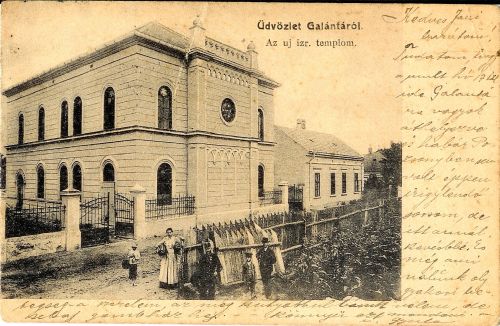
The only description in the sources read is the Pinkas Hakehillot's: a beautiful and large building of 16 by 22 metres in the classic style. A postcard captioned 'Üdvözlet Galántáról! Az uj izr. templom' (Greetings from Galánta! The new Israelite temple) shows a two-storey rendered building set behind a fence of masonry piers and iron railings. The long side has two tiers of tall round-arched windows. The entrance front is divided into a projecting central bay flanked by narrower side bays; the centre has a round-arched door below a round window, with arched blind friezes, and it rises into a stepped attic with small finials at the corners. A plain cornice runs round the building and a lower pitched-roof house stands beside it. The arrangement of two window tiers suggests a women's gallery inside, but no interior view or plan was found, so the layout, seating and decoration are unknown. The architect is given as Dezső Milch only by the judaica.cz postcard gallery; no other source read confirms it.
Życie w synagodze
The sources do not say which of Galanta's two Orthodox congregations built or used the 1899 synagogue; each congregation is described as having its own synagogue, Talmud Torah and yeshiva. The town was one of the important Torah centres of Hungary: the yeshiva founded by Hillel Lichtenstein grew under Rabbi Joseph Zvi Duschinsky, rabbi of the larger congregation from 1891 to 1921, and in 1922 it had 230 students under Rabbi Jehoshua Buxbaum, while Rabbi Benjamin Seidel ran a second yeshiva for the smaller congregation. Both congregations kept five-year Hungarian-language elementary schools, and Agudas Yisrael, its youth movements and the Beit Yaakov girls' movement were active alongside a strong Zionist movement led by Mizrachi. After 1945 this synagogue was the one the returning survivors restored. Under Rabbi Isidor (Yitzchak) Katz and the community president Jakub Stern it again held services, alongside a restored mikveh and a kosher public kitchen for the needy.
Zniszczenie
No source read records damage to the building during the Second World War. In June 1944 it stood at the centre of the Galanta ghetto, and after the deportations it stood empty until the survivors returned in 1945 and restored it. Most of them emigrated to Israel in 1948 and 1949, but a small community kept using the synagogue. According to the Hungarian heritage register of southern Slovakia, it served the community until 1976, when it was demolished because it did not fit the socialist urban plan for the town; flats now stand on the site. The Pinkas Hakehillot says only that it was destroyed in the 1970s, and other sources give 1975 or 'after 1970'. It was thus pulled down under Communist rule as part of the redevelopment of the town centre; none of the sources read names the particular council or office that ordered it, or the firm that carried it out. After it was gone, the community converted a private house into a prayer room.
Los społeczności
Galanta was annexed to Hungary in November 1938. From 1941 about 215 Jewish men were taken into Hungarian forced labour battalions. After the Nazi German occupation of Hungary in March 1944 there were 1,105 Jews in the town. On 5 June 1944 the Hungarian authorities set up a ghetto around the synagogue, holding all of Galanta's Jews and about 600 more from nearby communities. A few days later they were moved to a camp at Komárno, and on 13 June 1944 they were deported to Auschwitz. Among them were the rabbis of both congregations, Jehoshua Buxbaum and Benjamin Ber Seidel, and the judges Yosef Yechiel Seidel and Yakov Buxbaum. About 1,800 Jews from Galanta and the surrounding area were murdered; after the war a mass grave of about 60 Jews killed near the town at the end of the war was found. Some 250 survivors returned, and 272 Jews lived in Galanta in 1947. Most emigrated to Israel in 1948-1949, but a small community remained, led by Rabbi Isidor Katz, then Adolf Schultz and Gavriel Loewinger.
Miejsce dzisiaj
The synagogue stood on Új utca, today Štúrova ulica, in the town centre. According to the heritage register, its marked foundations can still be seen among the blocks of flats built on the site. A Holocaust memorial by the sculptor Péter Szulík was unveiled there on 29 June 2003. No other remains of the building are recorded. The site of the older eighteenth-century synagogue, demolished after 1945, is given by the same source as that of today's Mladosť shopping centre. The Jewish community of Galanta still exists and worships in a prayer room in a converted house; the new Jewish cemetery is still in use.
Ważne postacie
Dezső Milch
UnknownArchitect of the 1899 synagogue (attributed)The judaica.cz gallery of Slovak synagogue postcards names Dezső Milch as the architect of the Galanta synagogue dedicated in 1899, a large classical-style building of 16 by 22 metres on Új utca. No other source read in this research confirms the attribution or gives details of his life or other works, so it should be treated as a single-source attribution until checked against Borský's survey of Slovak synagogue architecture.
Biografia lub źródło →Isidor (Yitzchak) Katz
UnknownRabbi of the renewed Galanta community after 1945Katz was rabbi of the Jewish community re-founded in Galanta by about 250 survivors after the Second World War. Under him the community restored the synagogue and the ritual bath, opened a kosher public kitchen and gave its children religious education. When most members emigrated to Israel in 1948-1949 he remained at the head of the small community that went on using the synagogue.
Biografia lub źródło →Adolf Schultz
UnknownLong-serving head of the postwar Galanta communityAccording to the Pinkas Hakehillot, Schultz followed Rabbi Isidor Katz as head of the small Jewish community of Galanta and led it for a long period in the Communist era, the decades in which the restored synagogue remained in use before its demolition in the 1970s. He was succeeded by Gavriel Loewinger. Nothing more about his life was found.
Biografia lub źródło →Czy masz coś do przekazania?
Zdjęcia, dokumenty, historie rodzinne lub wspomnienia o tej synagodze i jej społeczności pomagają zachować jej historię.
- Galanta (Pinkas Hakehillot Slovakia, pp. 128-132, trans. Madeleine Isenberg)
- Zsinagóga és holokauszt-emlékmű Galántán (Synagogue and Holocaust Memorial in Galanta), record 3181
- Slovakia synagogues, part 1 (postcard gallery): 'Galanta, Gálánta, 1899'
- List of synagogues in Slovakia (Trnava Region table)
- Galanta
- Committee of the Orthodox Jewish religious community in Galanta (photo, 1920)
- Štúrova, Galanta (OpenStreetMap way 496723524)
Share a memory or thought
No comments yet. Be the first to add one.