
История Gamla Synagogue
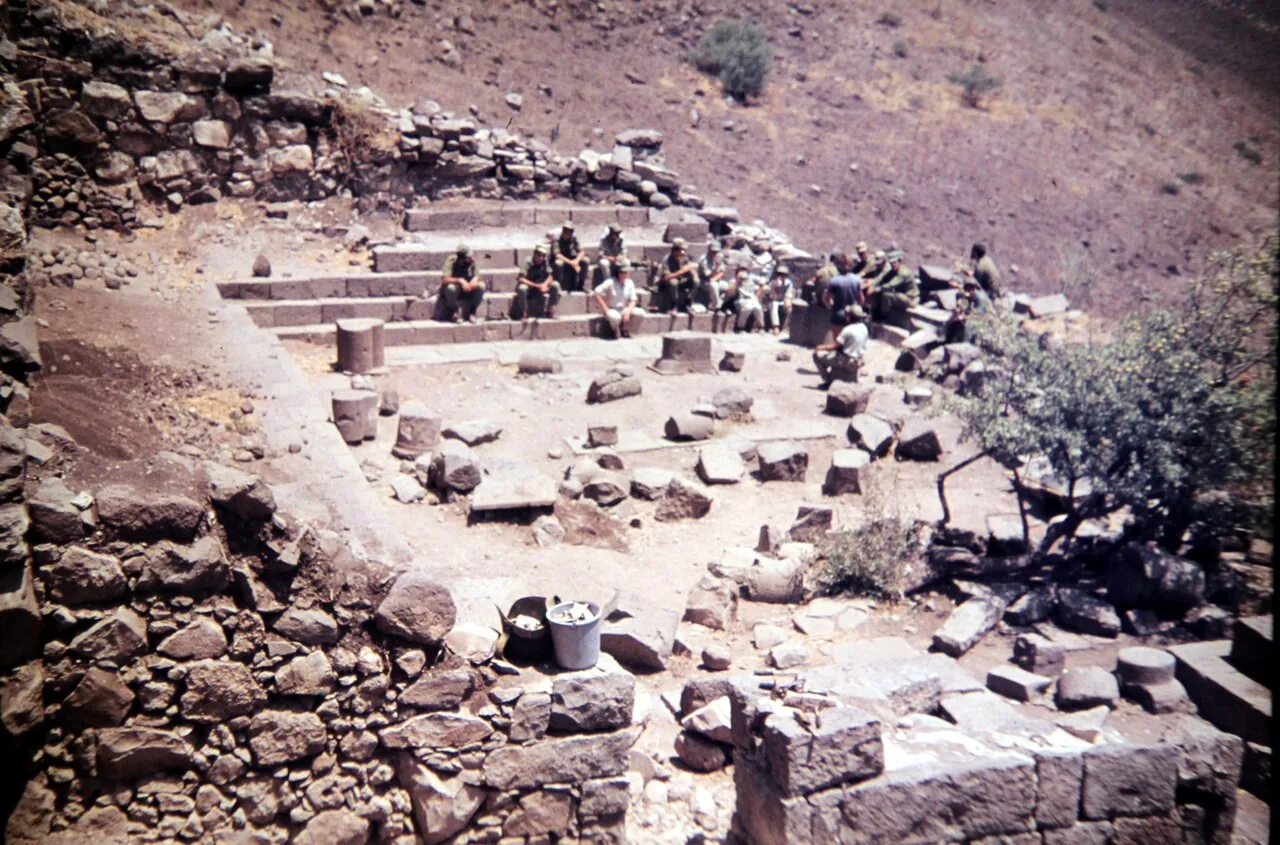
Gamla, the Gamala of Josephus, stood on a steep ridge in the Golan about ten kilometres inland from the Sea of Galilee; Josephus says its shape, like a camel, gave the town its name. The site, also called Tell es-Salām, was located in the 1968 survey of the Golan, and Shmarya Gutmann began digging in 1976. In his first season he uncovered, just inside the eastern town wall, a large public hall of dressed basalt with stepped benches along its walls and a rectangle of columns. A ritual bath beside it and the public character of the building led to its identification as a synagogue. Gutmann's excavations ran until 1989; Danny Syon and Zvi Yavor of the Israel Antiquities Authority returned from 1997 to 2000 and published the architecture in 2010.
Gutmann thought the hall went back to Alexander Jannaeus. A probe by Syon and Yavor under the floor showed that the building as it stands is no earlier than the end of Herod's reign and probably later, which places it in the late first century BCE or the early first century CE. Its life was short. In autumn 67 CE, during the First Jewish Revolt, the Roman army under Vespasian besieged and took Gamla. The wall was breached a short way below the synagogue; ballista stones and arrowheads lay in and around the hall, and its roof burned. Nobody rebuilt the town.
Where it stood for roughly 35 to 100 years
Gamla Nature Reserve, Golan Heights: ruins of ancient Gamla (Tell es-Salām), just inside the eastern town wall. There is no street address; the pin is approximate.
Открыть большую карту →Еврейская община
The synagogue served the town of Gamla itself. According to the Wikipedia article on the site, Gamla began as a Seleucid fort and came under Hasmonean rule when Alexander Jannaeus took it in about 81 BCE; its walls enclosed roughly 180 dunams and it was known for olive oil. Josephus describes houses built thick and close to one another on the steep slope. The excavations found ritual baths, stone vessels and Herodian lamps, and 6,314 coins, of which about 63 per cent were Hasmonean. Danny Syon writes that, because the site was never resettled, it gives an almost unparalleled view of Jewish life at the end of the Second Temple period. On the eve of the revolt the town was in the hands of King Agrippa II. Josephus says it was at first loyal to Rome and turned to revolt under the influence of refugees. None of the sources read mentions an inscription from the synagogue, and no donor, officer or teacher of the congregation is known by name. The size of the town's population and the number of people who used the hall are unknown.
Архитектура и дизайн
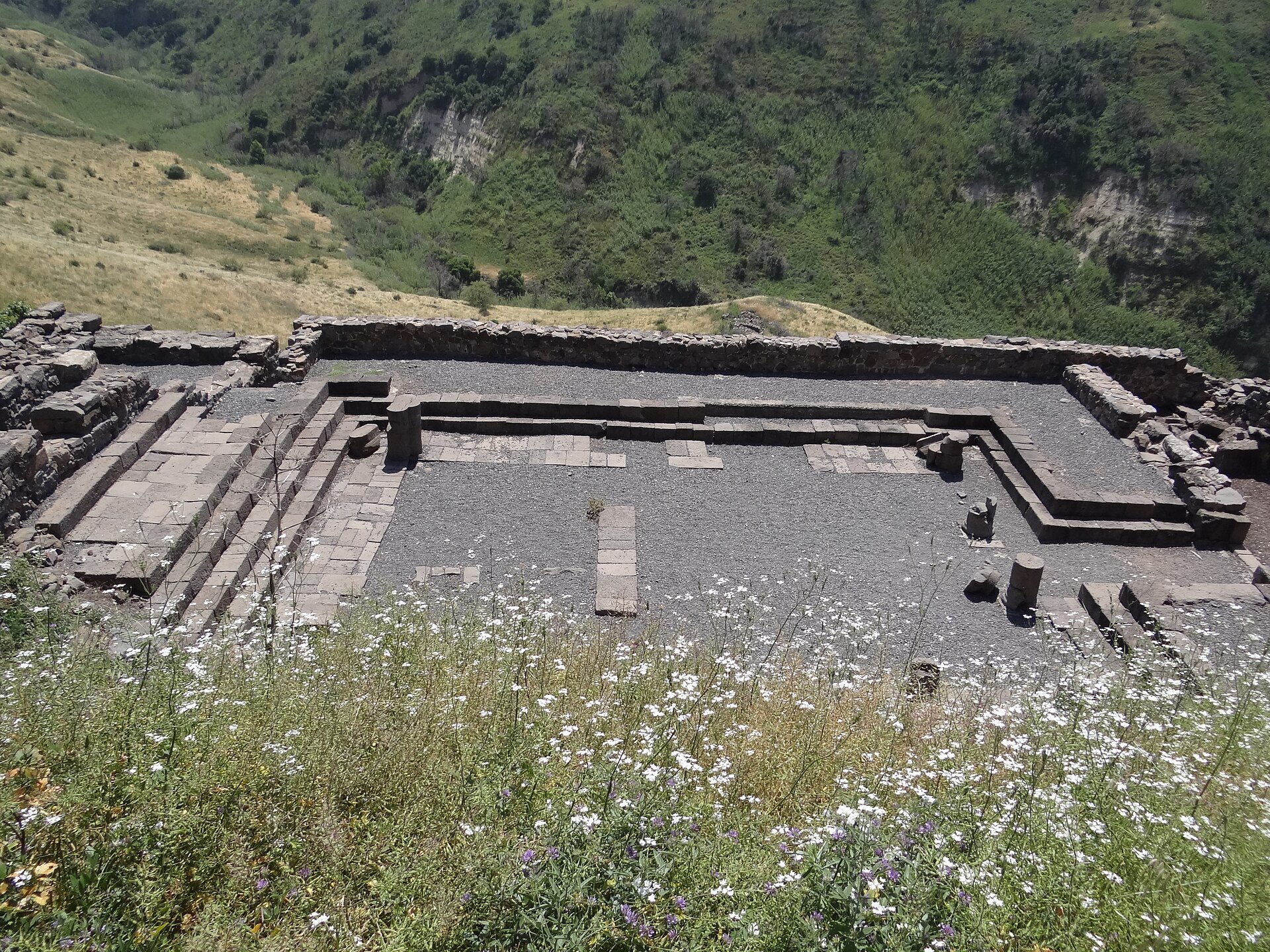
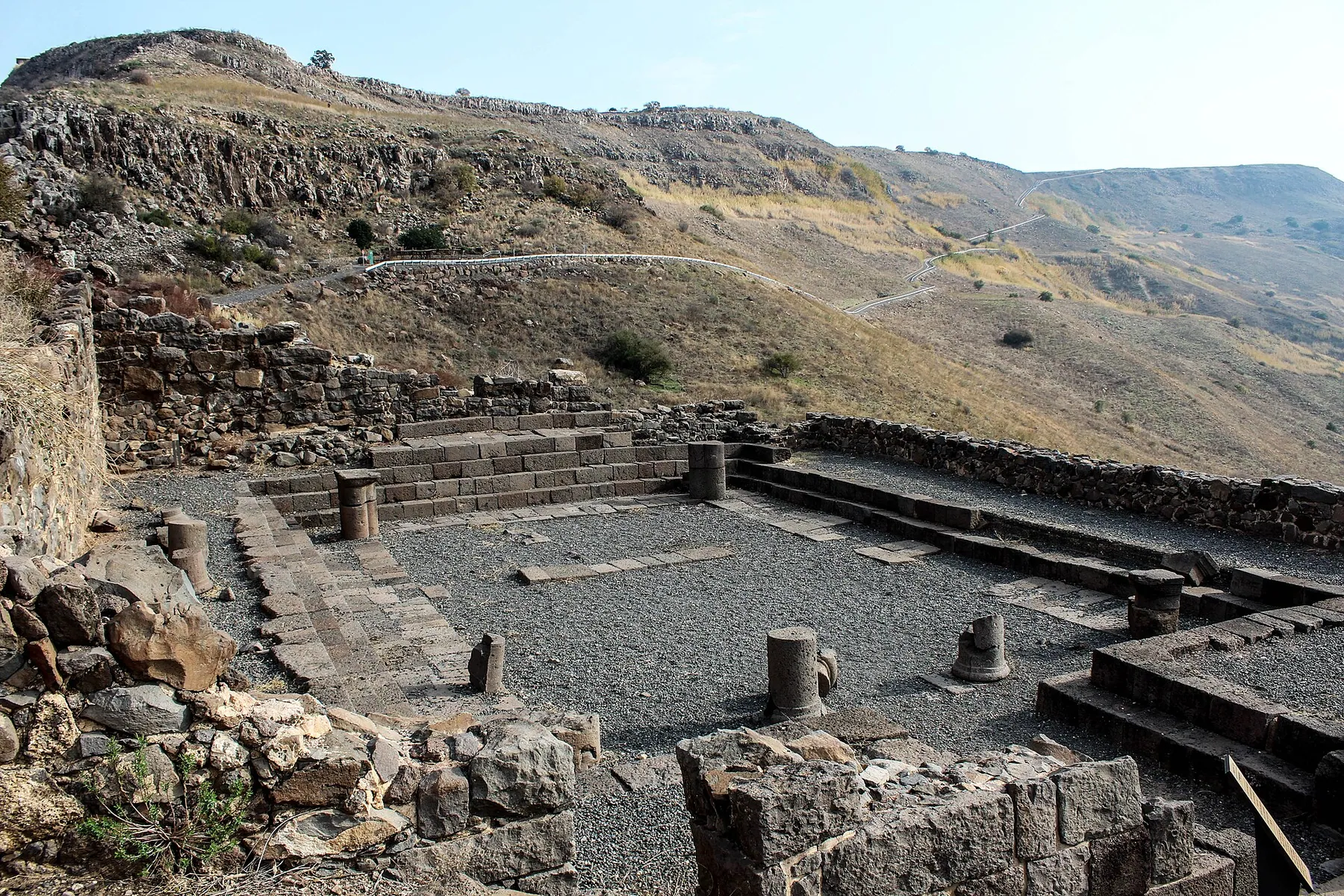
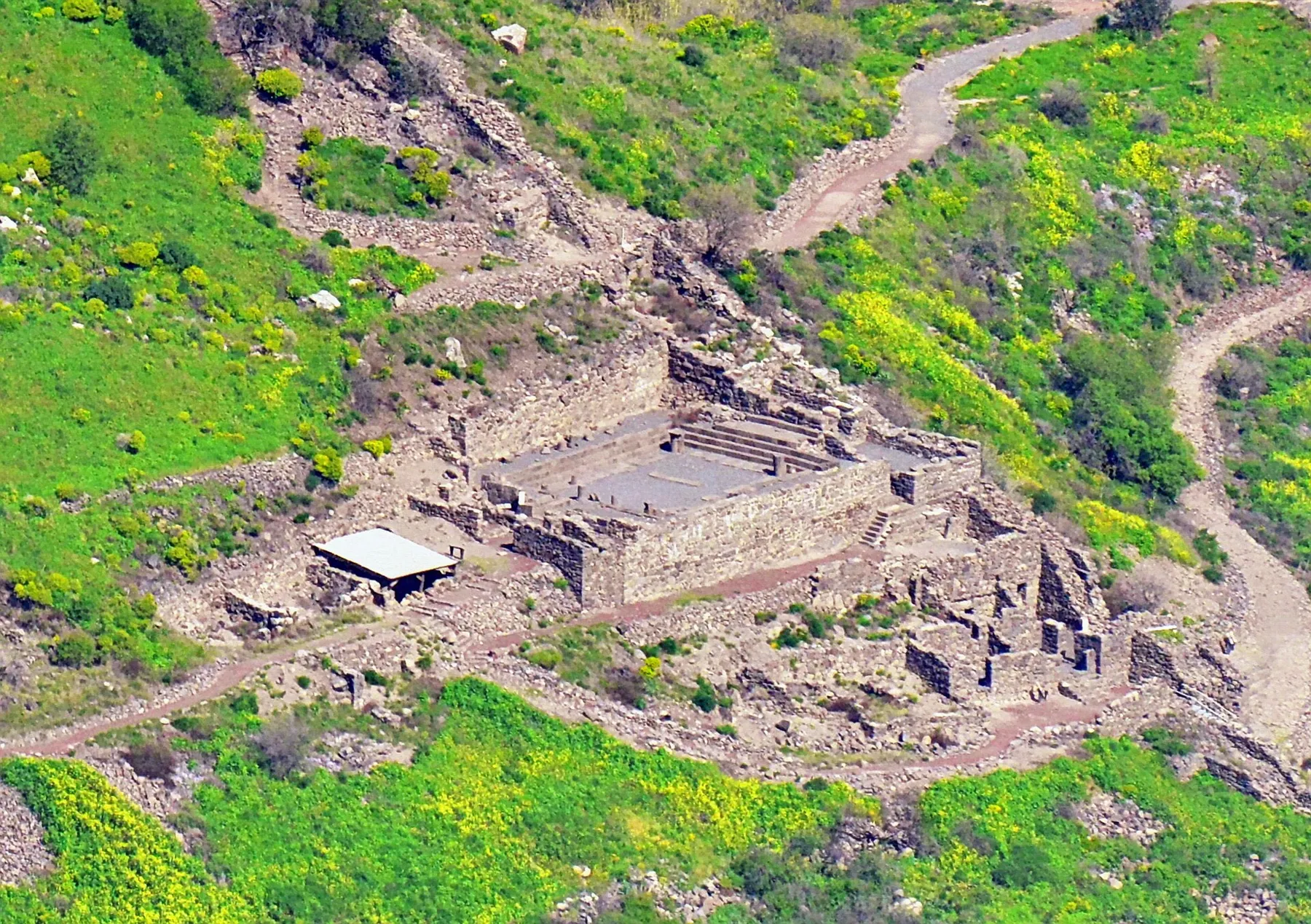
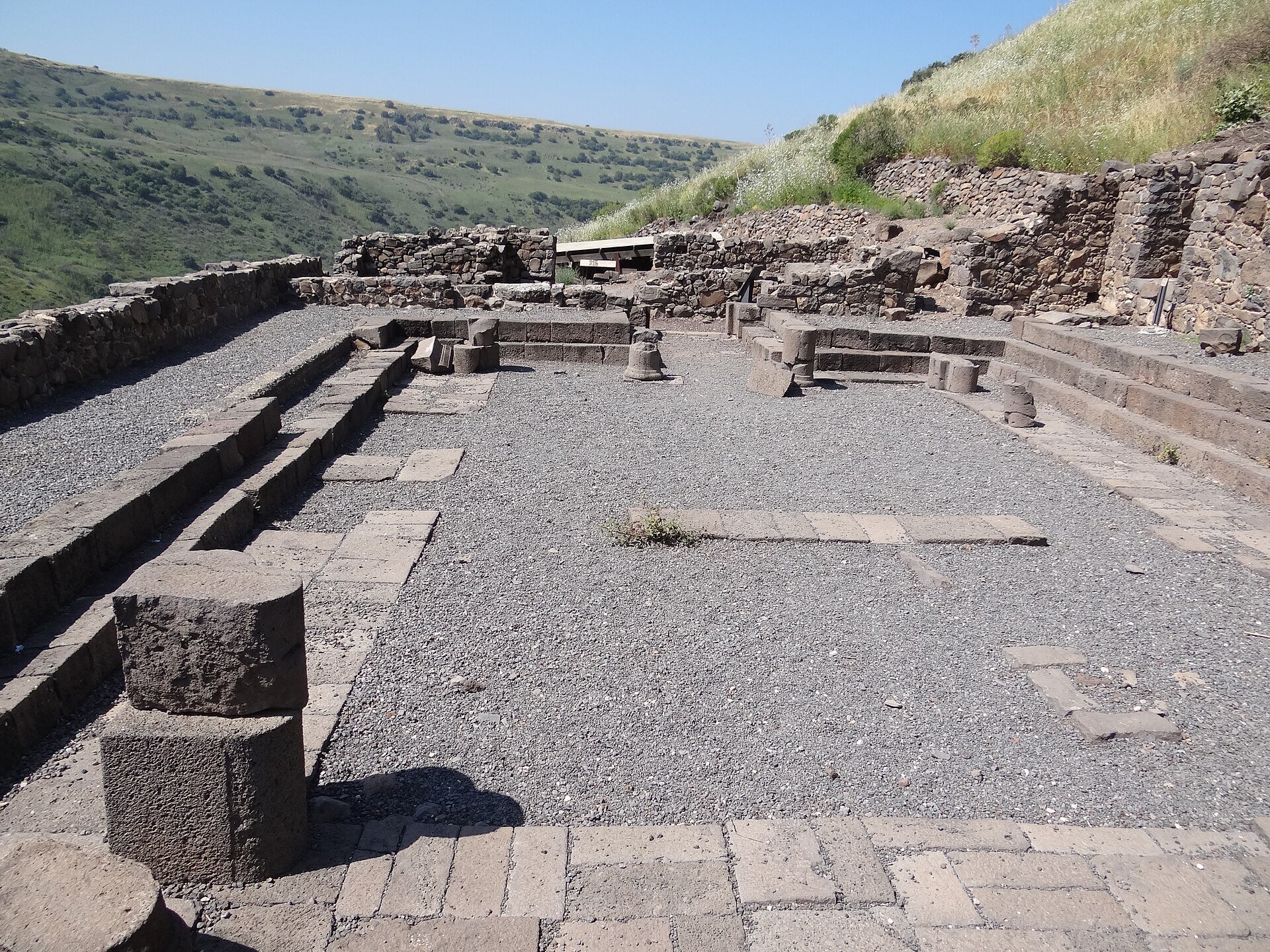
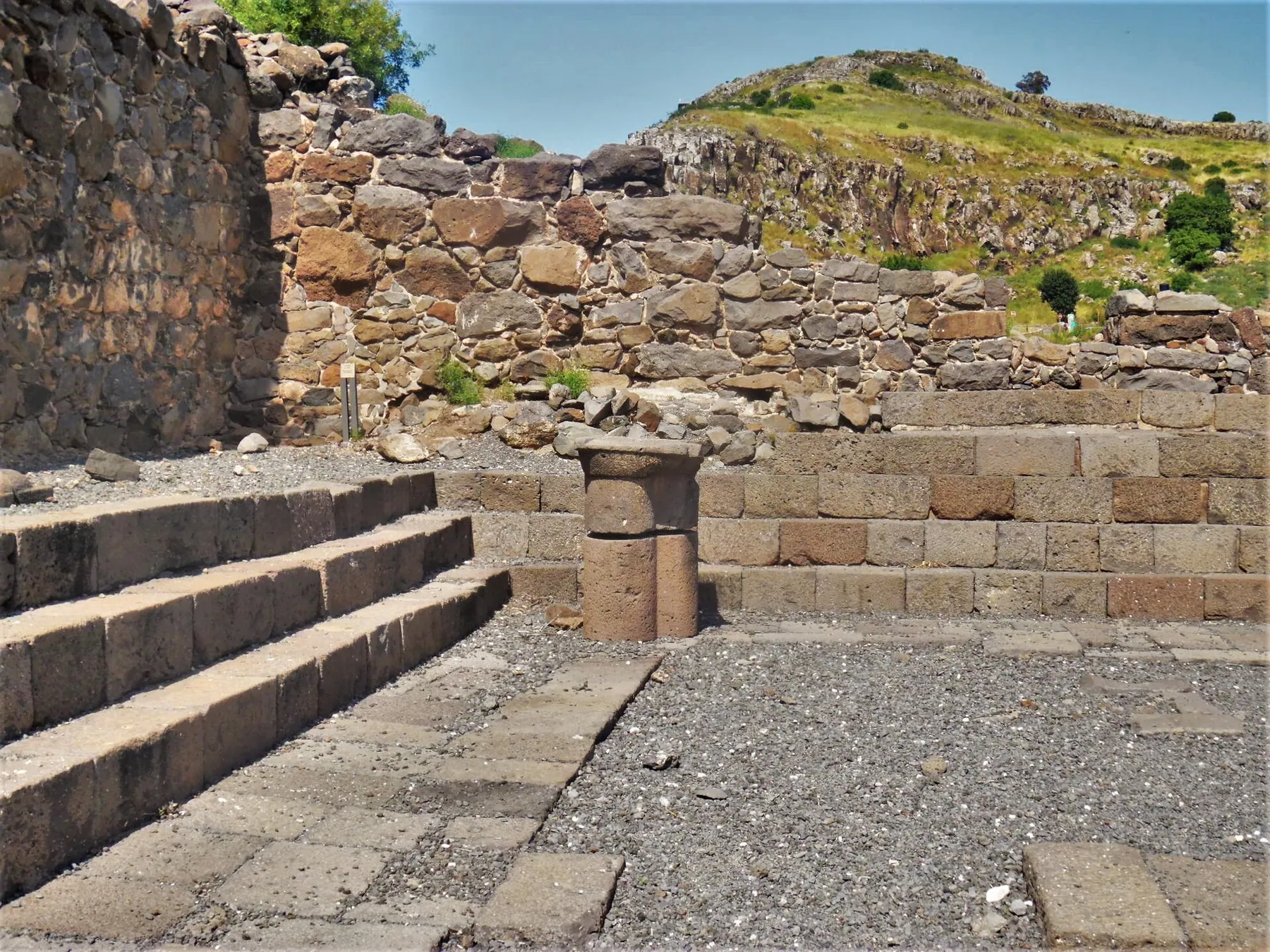
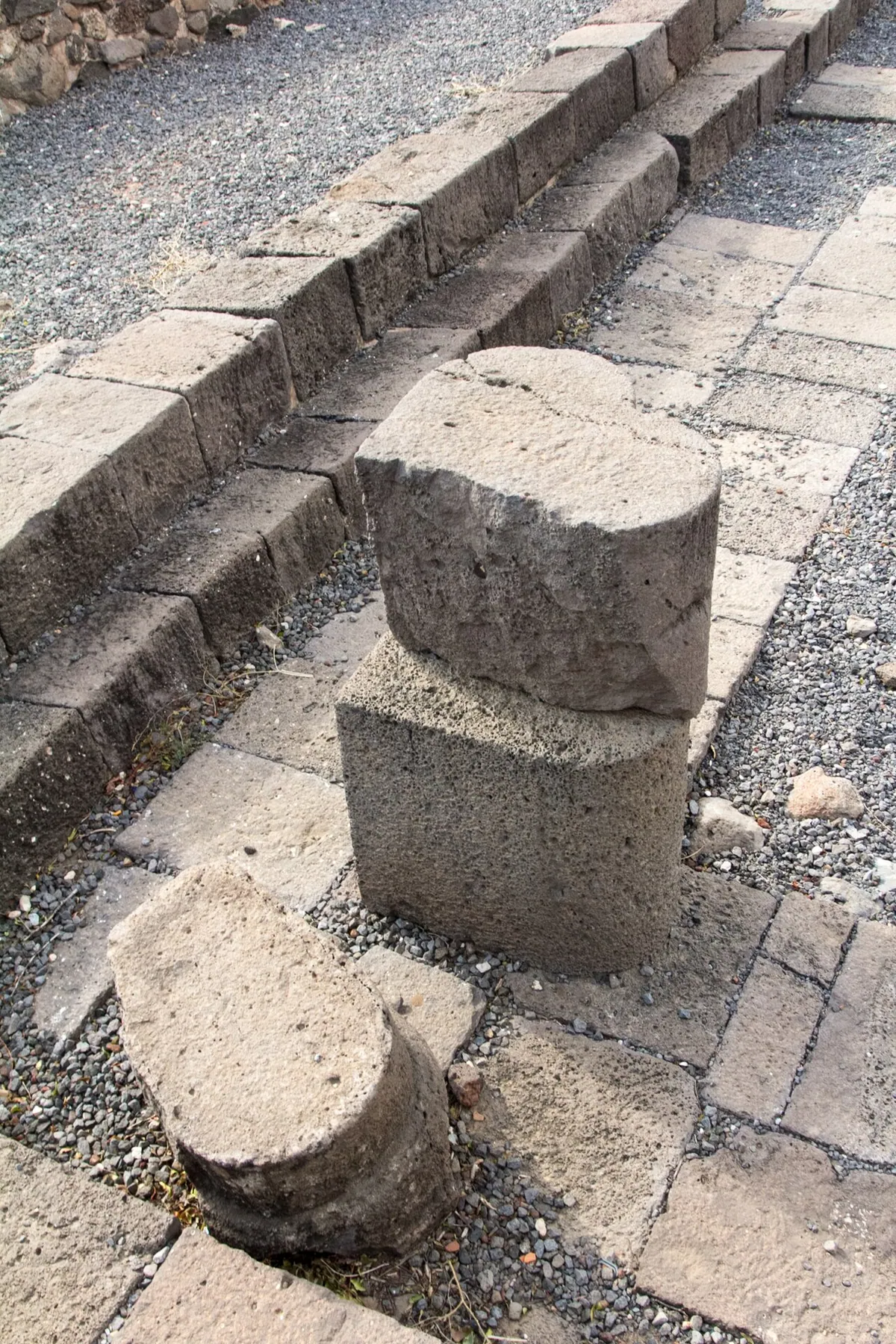
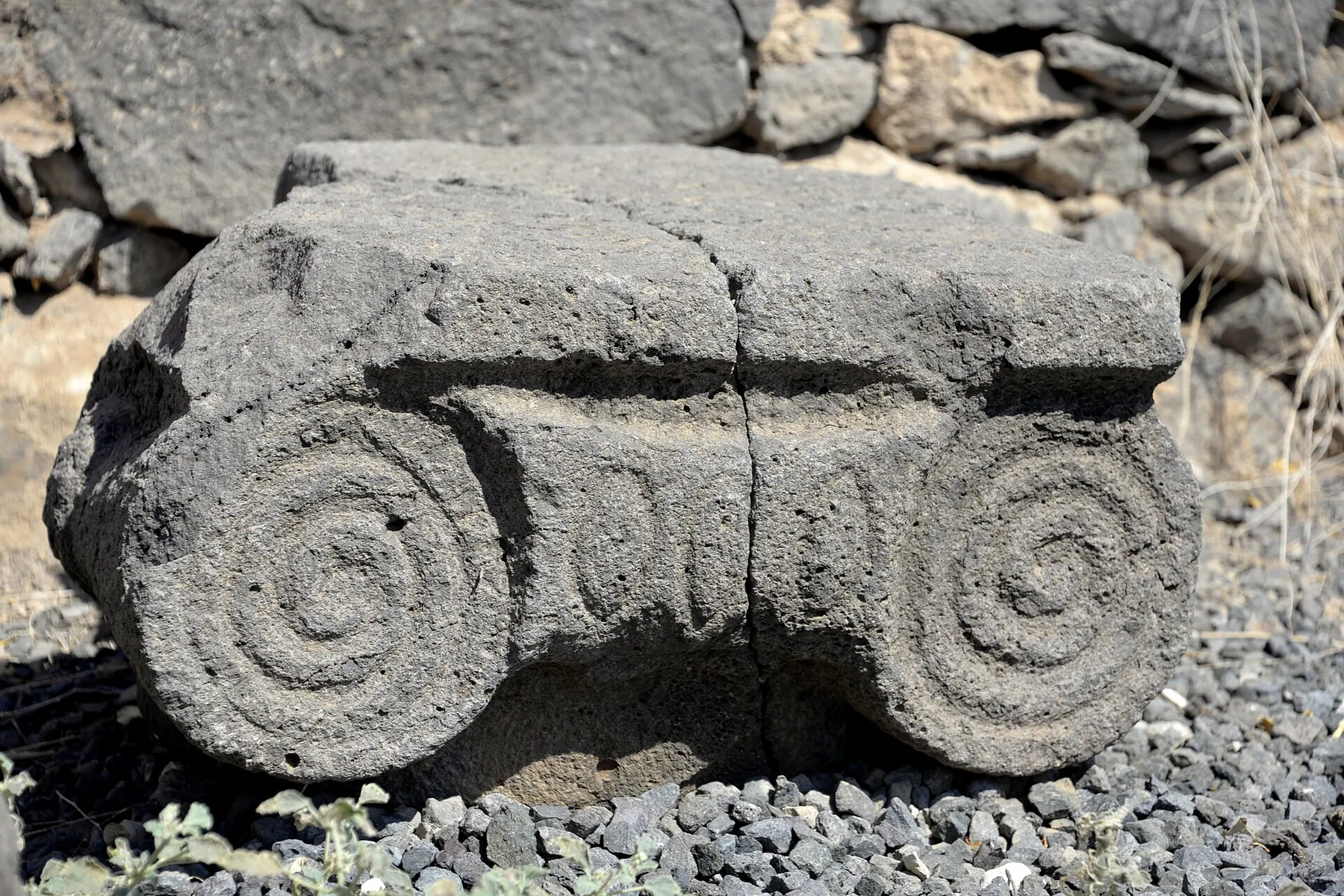
The building is a rectangle of dressed basalt, usually given as 25.5 by 17 metres, with its long axis running north-east to south-west; one source gives the main hall as 22 by 17 metres. Stepped benches of basalt ashlars run along the walls. The sources count them differently, as three rows, four rows, or three to five, with a walkway behind. Inside the benches a rectangle of columns, sixteen according to one description, carried the roof. The columns were built of round basalt drums, except at the four corners, where the drums are heart-shaped in section; the order is described as Doric. The centre of the hall was unpaved. The entrance was through a double doorway on the south-west side. A plastered basin adjoins the eastern wall, fed by a plastered channel that entered through the town wall and a room east of the hall, probably ran on along the eastern and northern walls, and emptied into a ritual bath west of the building. The Biblical Archaeology Society's caption says a wooden roof burned in 67 CE; Leen Ritmeyer reconstructs a flat roof of basalt slabs. The builder is unknown.
Жизнь в синагоге
There are no texts or inscriptions from the building, so what happened inside has to be read from the remains. Benches on all four sides face an open centre, the arrangement of an assembly hall in which people sat looking at one another and at whoever stood in the middle. A stepped ritual bath lies beside the hall and was fed by the same water channel as the basin against its eastern wall. The excavators call the room east of the hall, against the town wall, a study room. BibleWalks describes a niche in the wall beside the entrance as a place for Torah scrolls; that is an interpretation, and nothing found in it is reported. What was read or taught here, how the hall was governed and who led it are unknown. The building's last use is better documented. Danny Syon reports that on the eve of the siege the synagogue appears to have been turned into a dwelling for refugees: a number of meagre fireplaces and large quantities of cooking pots and storage jars were found along the platform by the northern wall.
Разрушение
The Roman army destroyed the synagogue when it took Gamla in 67 CE. Josephus, who had fortified the town as rebel commander in Galilee, says Gamla first held out for seven months against the troops of Agrippa II. Vespasian then brought up three legions, the fifth, tenth and fifteenth. The synagogue stood against the eastern town wall; Syon notes that rooms along the wall, including the study room beside the hall, were filled with stones to thicken it. A first assault broke in and was thrown back with heavy Roman losses. Later three soldiers of the fifteenth legion undermined a tower by night, and on the 23rd of Hyperberetaios, in September or October 67, the Romans took the town. The excavations bear this out. Syon records the wall broken almost to its foundations in the area below the synagogue, with some 300 arrowheads and 180 ballista balls around the breach, and 157 ballista balls in the synagogue hall alone. Charred wood, iron nails and a layer of ash are reported from inside. The ruin was left as it fell.
Судьба общины
Josephus gives the only account of what happened to the people. The town, he says, had filled with those who fled to it for safety. When the Romans broke in for the last time the inhabitants retreated up the ridge to the citadel; a storm blew against them and carried the Roman missiles. He writes that the Romans killed four thousand, sparing not even infants, and that five thousand more threw themselves down the precipice. In the translation read, only two women of the family of Philip son of Jacimus, an officer of Agrippa II, escaped. He names Chares and Joseph as the leading men of the defence. These figures cannot be checked. Syon notes that the excavations produced almost no human remains, only a single lower jawbone found with an arrowhead, and that the latest coins date to 64 CE. No source read says what became of anyone who got away. Gamla was abandoned and never rebuilt, so there was no later congregation on the site, which was identified again only in the twentieth century.
Место сегодня
The ruins lie in the Gamla Nature Reserve in the Golan Heights, managed by the Israel Nature and Parks Authority. The synagogue survives as an excavated ruin open to the sky. Recent photographs show that its basalt outer walls stand a few courses high, the stepped benches are in place, and several column drums, including heart-shaped corner pieces, stand on the floor. The work of 1997 to 2000 was part of a project to prepare the site for visitors. An observation terrace in the reserve looks down on the ancient town and the synagogue, and a steep trail leads to the ruins; the authority's Hebrew page says the access road to the town is closed and the approach is on foot. Finds from Gamla, including arrowheads, ballista stones and coins, are shown at the Golan Archaeological Museum in Katzrin.
Вам есть чем поделиться?
Фотографии, документы, семейные истории и воспоминания об этой синагоге и её общине помогают сохранить её историю.
- The Wars of the Jews, Book IV, chapter 1 (the siege and taking of Gamala)
- Gamala (entry in The New Encyclopedia of Archaeological Excavations in the Holy Land, update volume)
- Gamla: City of Refuge
- Image details: the synagogue at Gamla (caption to a photograph courtesy of the Gamla Excavations)
- Gamla (site record)
- Gamla II: The Architecture. The Shmarya Gutmann Excavations 1976-1988 (publication record)
- Archaeology in Israel: Gamla (reproducing the Israel Ministry of Foreign Affairs page 'Gamala: Jewish City on the Golan')
- Gamala: Jewish City on the Golan (Archaeological Sites in Israel)
- Gamla
- Gamla Synagogue
- Gamla
- The 2,000-year-old synagogue at Gamla, the oldest yet found in Israel
- The Gamla Synagogue
- Gamla Nature Reserve
- שמורת טבע גמלא (Gamla Nature Reserve, Hebrew page)
- Category: Gamla Synagogue
- Gamla (OpenStreetMap node 1596307984, historic ruins)
Share a memory or thought
No comments yet. Be the first to add one.