

הסיפור של Gaza Maiumas Synagogue
Maiumas was the harbour of ancient Gaza, and the synagogue stood there on the seashore, in what is now the Rimal district of Gaza City. Its remains came to light in 1965, when Gaza was under Egyptian rule. 'Abd el-Mohsen el-Khashab, who dug the site for the Egyptian Department of Antiquities, took the building for a fifth-century church. In 1966 Michael Avi-Yonah, and in 1967 Marc Philonenko, showed that it was a synagogue: the donors in the Greek inscription have Jewish names, the inscription calls the building the most holy place, and the musician in the best-known panel is labelled 'David' in Hebrew letters.
After Israel captured Gaza in the Six-Day War, Asher Ovadiah excavated the site in August and September 1967 for the Israel Department of Antiquities and Museums, and returned in 1976. He uncovered a nearly square basilica of about 26 by 23 metres, with a nave and two aisles on each side, paved with mosaics. The inscription is dated 508-509 CE. Ovadiah found that the synagogue had been built over an earlier building destroyed by fire and that it too was burned at the end of its life, probably in the first half of the seventh century. In 1974 the David panel was lifted and taken to the Israel Museum in Jerusalem; other parts of the floor are shown at the Museum of the Good Samaritan.
Where it stood for roughly 90 to 190 years
Historic: Maiumas, the port of ancient Gaza, on the seashore. Today: Rimal district, Gaza City, near the coast; no street address found (approximate).
פתיחת מפה גדולה ←הקהילה היהודית
Very little is recorded about the Jews who built this synagogue. The Encyclopaedia Judaica notes that Jews were settled in Gaza in the Talmudic period, although the city was regarded as lying outside the halakhic boundaries of the Land of Israel. It points to a relief of a menorah, shofar, lulav and etrog on a pillar of the Great Mosque of Gaza, together with Hebrew and Greek inscriptions, as evidence of a considerable Jewish population. The synagogue stood in the harbour settlement, which the same source calls the New City (Neapolis), at a time when Christianity was the ruling religion of Gaza. The only members known by name are the donors of the mosaic, Menahem and Yeshua, sons of the late Yishay (Jesse), who are described in the inscription as wood merchants. The inscription says nothing more about them. The size of the community, its leaders and its teachers are unknown.
אדריכלות ועיצוב
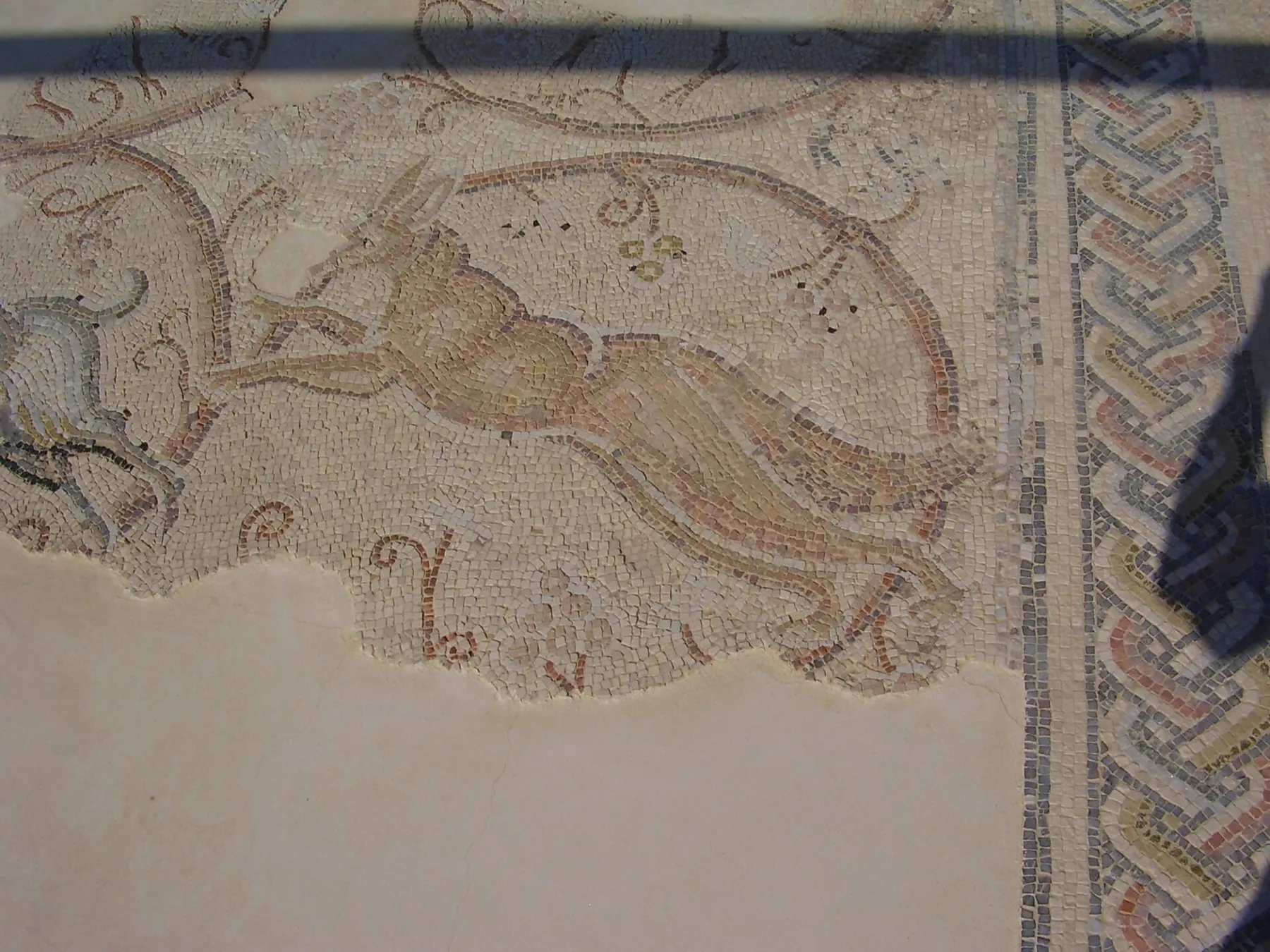
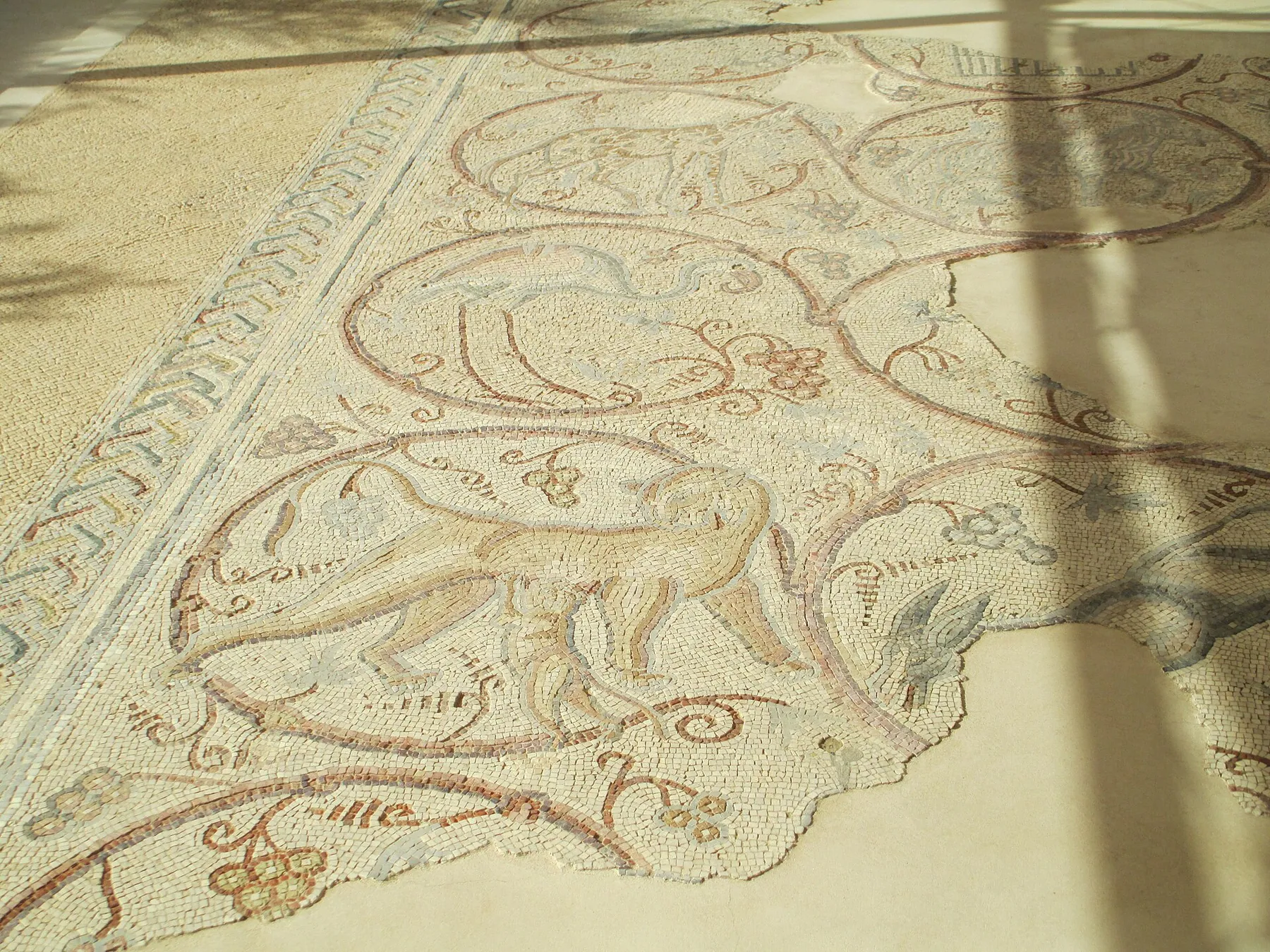
The building is known from its excavated floor and foundations; no source read describes standing walls. Summaries of Asher Ovadiah's reports describe a basilica with a central nave flanked by two aisles on each side and three entrances. Its size is given as about 26 by 23 metres in one summary and about 26 by 30 metres in another, which calls it the largest synagogue known in the region; one says it ran east to west, the other south-east to north-west with the main doors on the north-west. The floor was paved with mosaics. The David panel, about 3 metres high and 1.9 metres wide, shows the king seated in Byzantine royal dress with a halo, playing a lyre to listening animals, with his name in Hebrew. It follows the usual image of Orpheus. Elsewhere on the floor a carpet of vine scrolls formed medallions holding animals, among them a lioness suckling her cub and a leaping tigress; a Greek dedicatory inscription flanked by two peacocks lay beside it. Fragments of a chancel screen and an inscribed marble basin were also found. The architect and the seating capacity are unknown.
החיים בבית הכנסת
What is known of worship here comes from the floor and a few carved stones. The dedicatory inscription is in Greek, while the name beside the lyre player is written in Hebrew. The inscription records that Menahem and Yeshua, sons of the late Yishay, wood merchants, gave the mosaic as a sign of admiration for the most holy place, and it dates the gift to the month of Loos in the year 569, which scholars equate with 508-509 CE. The congregation accepted a floor with human and animal figures in its prayer hall. David is shown as a king with a halo, playing to listening animals, a picture taken over from the Greek figure of Orpheus. A catalogue of the inscriptions from the site lists fragments of a chancel screen, an inscribed marble basin and a pillar inscribed in both Greek and Hebrew or Aramaic, but the sources read do not say how these were used. No source read describes the ark or the seating, and no rabbi, cantor or official of the congregation is named.
הרס
The synagogue ended in fire. Asher Ovadiah, who returned to the site in 1976, found that it had been burned in its final period, and he dated the fire probably to the first half of the seventh century. He suggested that it might coincide with the Sasanian Persian conquest or with the Arab conquest of the region; the Encyclopaedia Judaica places the Arab victory over the Byzantines near Gaza in 635, with the city falling soon afterwards. No source read names who set the fire or says whether it was deliberate. Ovadiah also found that the synagogue stood on top of an earlier building that had itself been destroyed by fire. The floor then lay buried until 1965. Further harm came after its discovery: by 1967 the face and left hand of the David figure had been lost. The Jerusalem Post says the face was damaged shortly after the discovery, without naming who did it.
גורל הקהילה
The burning of the synagogue was not the end of Jewish life in Gaza. According to the Encyclopaedia Judaica, the Jewish and Samaritan communities flourished under Arab rule after the conquest, and in the eighth century Rabbi Moses, one of the masoretes, lived in the city. After the Crusaders destroyed Gaza the Jewish community ceased to exist, and nothing more is heard of it until the fourteenth century. In 1481 the traveller Meshullam of Volterra found sixty Jewish householders in Gaza, and the community was very numerous in the sixteenth and seventeenth centuries under Ottoman rule. The last Jews left the town in 1929 because of anti-Jewish Arab riots. What became of the particular congregation that prayed in the harbour synagogue, whether its members moved into the main city, left, or built again elsewhere, is not recorded in any source read.
האתר כיום
The site lies in the Rimal district of Gaza City, near the shore. The English Wikipedia article describes it as in ruins. The floor is no longer there in full: the David panel was removed in 1974 by the Israel Department of Antiquities and Museums and taken to the Israel Museum in Jerusalem, where it stayed in store until it was cleaned and the missing head recreated from old photographs in 1992. Other sections of the floor, with a replica of the David panel, are shown at the Museum of the Good Samaritan near Ma'ale Adumim, which opened in 2009. The Jerusalem Post reported in November 2023 that Israeli soldiers were said to have prayed at the site during the war in Gaza; no photographs were published. No source read describes the physical condition of the site since then.
שמות בולטים
Menahem son of Yishay
active 508-509 CEDonor of the mosaic floor; wood merchantMenahem is named with his brother Yeshua in the Greek inscription set into the synagogue floor. It says that the two, sons of the late Yishay (Jesse) and wood merchants by trade, gave the mosaic as a sign of admiration for the most holy place, in the month of Loos of the year 569, that is 508-509 CE. Their Jewish names helped scholars to recognise the building as a synagogue. Nothing else is known of him.
ביוגרפיה או מקור ←Yeshua son of Yishay
active 508-509 CEDonor of the mosaic floor; wood merchantYeshua is named with his brother Menahem in the Greek dedicatory inscription of the synagogue floor, which a later description places between two peacocks beside the vine-scroll carpet. The brothers, sons of the late Yishay (Jesse), are called wood merchants, and the inscription dates their gift of the mosaic to 508-509 CE. They are the only members of the congregation known by name. Nothing else is known of him.
ביוגרפיה או מקור ←יש לכם משהו לתרום?
תמונות, מסמכים, סיפורי משפחה וזיכרונות מבית הכנסת ומהקהילה שלו עוזרים לשמור על ההיסטוריה שלו בחיים.
- Gaza synagogue
- Gaza (Encyclopaedia Judaica article)
- IDF soldiers pray in ancient 6th century Gaza synagogue for first time in decades
- Gaza Synagogue Mosaic, 6th century CE
- Synagogue Complete (building 39, Gaza)
- King David's Head from Gaza Synagogue Restored
- IDF soldiers establish new synagogue in Gaza Strip
- Ancient Gaza Synagogue
- File:King David as Orpheus in a synagogue mosaic - Google Art Project.jpg
- File:PikiWiki Israel 15077 Mosaic from the ancient synagogue in Gaza.JPG
- File:PikiWiki Israel 28470 Good Samaritan Museum.JPG
Share a memory or thought
No comments yet. Be the first to add one.