
История Giraltovce Synagogue
Giraltovce (Hungarian Girált) lies on the Topľa river in the Svidník district of the Prešov region, on the road between Prešov and Svidník. Jews from Galicia settled here from about 1750, and for a long time the small community depended on the rabbinate of Hanušovce, some 12 km to the south. It grew through the nineteenth century, and in 1921 the census counted 259 Jews in a town of 1,127 people.
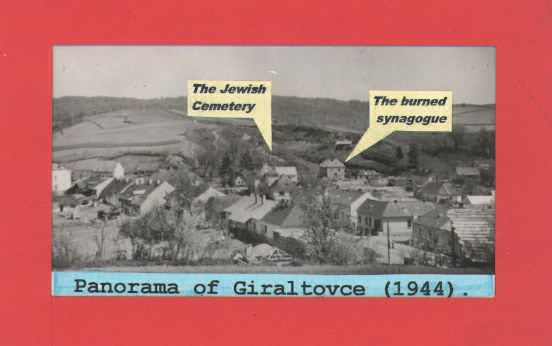
The synagogue was the community's only purpose-built house of worship. The KehilaLinks history of Giraltovce, compiled by the survivor Gabi Lana from Yad Vashem records and a Slovak town history of 1992, says it was built in 1900, with a ritual bath added a few years later; a regional tourism page puts it at the turn of the nineteenth and twentieth centuries, while Maroš Borský's catalogue of Slovak synagogues gives only 'nineteenth century'. Nothing is known of its architect or size. The congregation used it for about four decades before the deportations of 1942. Sources disagree on how it ended: the KehilaLinks site says it was destroyed during the war and labels it 'the burned synagogue' on a town panorama it dates to 1944, while Borský and a published list of Slovak synagogues say it was demolished after the Second World War. It no longer exists.
Where it stood for nearly 50 years
Historic: Girált (Giraltovce), Sáros county; street and plot unknown, on the slope near the Jewish cemetery according to a 1944 annotated panorama. Today: unknown; placeholder pin at the centre of 087 01 Giraltovce, Svidník district (approximate).
Открыть большую карту →Еврейская община
According to the KehilaLinks history, the first Jews came to Giraltovce from Galicia around 1750; in 1786 there were 21 Jews living in three houses, 3.2 per cent of the population. The community belonged to the rabbinate of Hanušovce. In 1828 there were 46 Jews, in 1842 documents name Josef Friedmann, Lazar Gewürz, Abraham Gottlieb and the widow Lichtenstein, and by 1848 the number had risen to 137. Elek Fényes's gazetteer of 1851 counted only 40. A Jewish school opened in 1890 under the principal Jakob Zukermann and merged in 1900 with the Lutheran school. The censuses of 1921 and 1930 recorded 259 and 265 Jews. Most were Orthodox and lived from trade and crafts as tailors, shoemakers, carpenters and shopkeepers; Jews owned the inn, the mill, the sawmill and the power station, and in 1924 the Lichtenstein family brought electricity to Giraltovce and two neighbouring villages. Bnei Akiva and Betar were the leading Zionist youth movements. In February 1942 there were 356 Jews in 62 families.
Архитектура и дизайн
Very little is known about the building. No plan, description or interior view has been found, and the architect, the builder, the seating capacity and the exact plot are unknown. The only view used here is a distant panorama of the town that the KehilaLinks site dates to 1944, in which a caption arrow points to 'the burned synagogue' on the slope beyond the main street, near the Jewish cemetery; at that size it shows only a pale, roofed building among houses and trees. Maroš Borský's dissertation reproduces one further photograph, which he describes as the eastern façade of a synagogue with two round-arched windows flanking the ark and a large Baroque-style gable typical of older synagogues in the region. Borský himself warns, however, that this picture may in fact show the rear of the Old Synagogue of Humenné, so its features cannot safely be attributed to Giraltovce. The date of about 1900 given by the local history would make the building one of the later village synagogues of the Šariš area, but its style is unknown.
Жизнь в синагоге
The congregation was mainly Orthodox and had no rabbi of its own for much of its history, being attached to the rabbinate of Hanušovce. Lay leaders ran it: in the 1920s and 1930s the heads of the community were Mór Stark, Ignác Haendler, Isidor Lichtenstein and Nute Schoenfeld. Religious services and ritual slaughter were in the hands of the Deutsch family, whose head Josef is listed as shochet; the KehilaLinks community survey says that Deutsch was both the cantor and the ritual slaughterer. Children learned in two chadarim, one kept by the baker Mendlovic, who also attended Talmud study sessions, and one run by Yidl Deutsch in a group of houses on a hill called the Mayer. On Fridays housewives sent their cholent pots to Mendlovic's bakery, and on Saturday mornings children carried the hot dishes home. A mikve was built a few years after the synagogue on the right bank of the Radomka stream, so that its water came from a natural source. The Jewish cemetery on the hill above the town served Giraltovce and the smaller communities nearby until the last burial in 1942.
Разрушение
The synagogue stood empty after the deportations of spring 1942. How and when it was destroyed is disputed. The KehilaLinks history states that the synagogue was destroyed during the war, and the same site shows a panorama of Giraltovce dated 1944 with the building captioned 'the burned synagogue'. Neither says who set it on fire or when. In March 1944 the remaining Jews of the district were moved west because the front was approaching, and the Soviet army entered Giraltovce on 18 January 1945, so the building may have burned during the occupation of the empty Jewish properties or in the fighting, but no source says so. Maroš Borský's catalogue and a published list of Slovak synagogues record instead that it was demolished after the Second World War, and the list gives 1950, which may be a placeholder. A regional tourism page says only that it was demolished. Who demolished it, or cleared the ruins, is not recorded. According to KehilaLinks, the houses of the Jews were also demolished in the years after the war.
Судьба общины
In March 1939 Giraltovce became part of the Slovak State, a client of Nazi Germany. Antisemitic laws pushed Jews out of schools, offices and economic life, Jewish businesses were handed to 'Aryan' owners, and young men were drafted into the forced-labour Sixth Battalion of the Slovak army. In March 1942 the Slovak authorities began deporting Jews to the Nazi extermination camps in occupied Poland, first young women and men and then whole families. By May 1942, 452 Jews had been deported from Giraltovce and the surrounding villages: 84 men aged 16 to 55, 123 women, 115 children and 130 older men. In March 1944 the remaining Jews of the district were evacuated to western Slovakia, most of them to a camp. Some young Jewish men fought with a partisan group in the nearby forests. According to KehilaLinks, only 73 of the 356 Jews of Giraltovce survived; its compiler elsewhere gives 60 of 351. A few returned and soon left for Israel or the United States. Jankel Deutsch, a former partisan, was the only Jew who stayed in the town until his death.
Место сегодня
The exact plot of the synagogue has not been identified in any source consulted. The 1944 panorama places it on the slope beyond the main street, not far from the Jewish cemetery, but no surviving fragment is recorded, and the houses of the former Jewish quarter were pulled down after the war. The map pin for this entry is a placeholder at the centre of Giraltovce. The Jewish cemetery on the hill above the town survives, with gravestones up to two hundred years old, and was restored from 2007 by former residents and their descendants together with the town. A Holocaust memorial wall listing the Jewish families of Giraltovce was unveiled at the cemetery in 2008.
Значимые имена
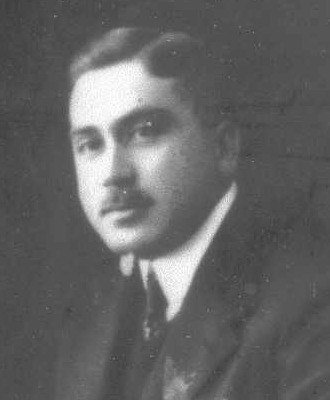
Isidor Lichtenstein (Lana)
UnknownHead of the Giraltovce Jewish community in the 1920s and 1930sLichtenstein is named on the KehilaLinks history as one of the heads of the Giraltovce community in the 1920s and 1930s, alongside Mór Stark, Ignác Haendler and Nute Schoenfeld. The elder son of a family of mill owners, he ran a flour mill, sawmill and power station in nearby Marhaň, and his family electrified Giraltovce in 1924. Their property was confiscated under the Slovak State and later under the Communists. He was the father of Gabi Lana, who compiled the town's memorial website.
Биография или источник →Josef Deutsch
UnknownShochet (ritual slaughterer) and, per family tradition, cantor of the Giraltovce congregationThe KehilaLinks survey of the Giraltovce community in February 1942 lists Josef Deutsch as the shochet, and states that Deutsch was both the cantor and the ritual slaughterer of the community. He therefore led prayers in the synagogue in its last years of use. Another family member, Yidl Deutsch, kept a cheder. The only member of the family to survive was Jankel Deutsch, who fought with the partisans and remained in Giraltovce until his death.
Биография или источник →Mór Stark
UnknownHead of the Giraltovce Jewish community in the 1920s and 1930sStark is named in the KehilaLinks history of Giraltovce, compiled from Yad Vashem records and the 1992 town history, as one of the four men who headed the mainly Orthodox Jewish community in the 1920s and 1930s, together with Ignác Haendler, Isidor Lichtenstein and Nute Schoenfeld. As a lay leader of a congregation without its own rabbi he shared responsibility for the synagogue. Nothing more about his life or fate was found.
Биография или источник →Вам есть чем поделиться?
Фотографии, документы, семейные истории и воспоминания об этой синагоге и её общине помогают сохранить её историю.
- Giraltovce (Girált), Slovakia: Jewish history; The Shoah period; The Community (February 1942); Preface
- The Shoah Period (Giraltovce)
- The Community, February 1942 (Giraltovce)
- Giraltovce home page and Preface
- Synagogue Architecture in Slovakia: Towards Creating a Memorial Landscape of Lost Community (catalogue entry S0P1901, Giraltovce, p. 203)
- List of synagogues in Slovakia
- Jewish cemetery Giraltovce
- Girált (Hungarian Wikipedia)
- Giraltovce (OpenStreetMap relation 2321625)
Share a memory or thought
No comments yet. Be the first to add one.