
La storia di Groß-Enzersdorf Synagogue
Groß-Enzersdorf is a small walled town on the Marchfeld plain just east of Vienna, in the Gänserndorf district of Lower Austria. Jewish families began settling there around 1860, and the town became the seat of one of the fifteen Jewish communities (Kultusgemeinden) of Lower Austria, with a district that took in the surrounding villages. The synagogue stood at what is now Kaiser Franz Josef-Straße 11. Its building date is uncertain: a plaque on the site and the ANU Museum both give 1865, while the Documentation Centre of Austrian Resistance (DÖW) records a prayer house built in 1898 that became the synagogue when the community was formally founded in 1907.
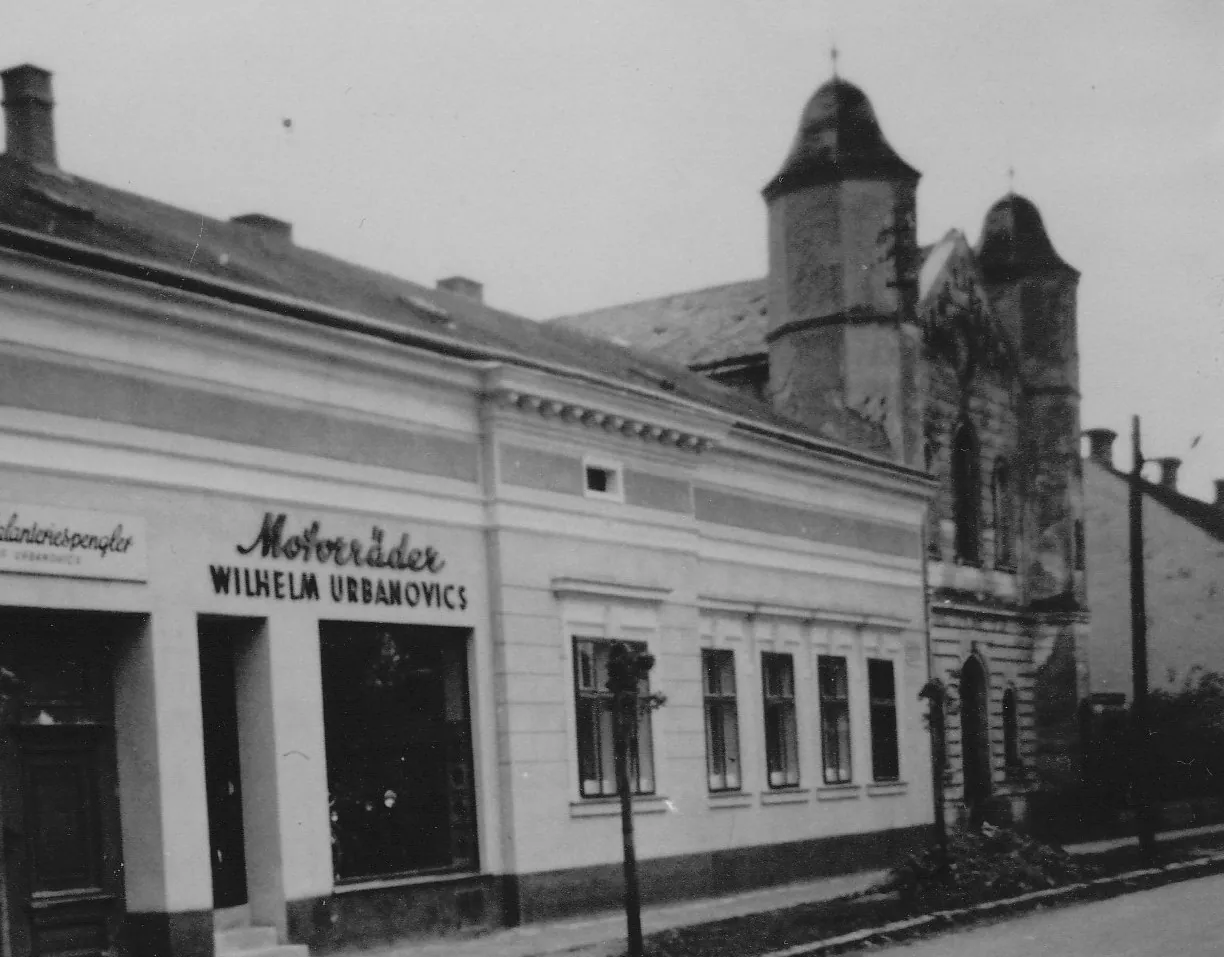
The one photograph found shows a tall gabled street front set back behind a neighbouring house, flanked by two towers with bell-shaped caps and pierced by round-arched windows. In October 1938 the local Nazi party forced the community's last head, Dr. Karl Katz, to give the building away to the Deutscher Turnerbund, a gymnastics association. On 10 November 1938 the town's Jews were held inside it for a day. Afterwards the building was used for storage. It survived the war but decayed and was pulled down in the early 1960s; who demolished it is not recorded.
Where it stood for nearly 100 years
Historic and present: Kaiser Franz Josef-Straße 11, 2301 Groß-Enzersdorf, Lower Austria (address given by de.wikipedia and the DÖW memorial survey; plot of the former synagogue, pin approximate within the plot).
Apri la mappa grande →La comunità ebraica
The ANU Museum dates the first Jewish families in Groß-Enzersdorf to around 1860; the DÖW memorial survey gives 1865 as the start of Jewish settlement. Accounts of the community's legal foundation differ: ANU gives 1898, the DÖW survey 1907. Christoph Lind counts Groß-Enzersdorf among the fifteen Israelitische Kultusgemeinden that existed in Lower Austria before the First World War, with a district that also covered the surrounding countryside. The community kept a cemetery, which the Jewish cemeteries fund dates to 1880, and supported Jewish associations including the Maccabi sports movement. In 1932 it numbered 221 people. It had no rabbi of its own: rabbis from Mödling, Floridsdorf and Vienna's Leopoldstadt served it, and Adolf Kritner was teacher of religion and cantor. From 1930 to 1938 the community was headed by the veterinarian Dr. Karl Katz, whose house at Elisabethstraße 7 was taken over in 1938 by the local Nazi party branch. The community's 31 register volumes were handed to the Vienna community's registry office in May 1940.
Architettura e design
No plans, interior photographs or description of the interior survive, as the 2017 TU Wien thesis by Pepa Nalbantova notes; her reconstruction rested on historical exterior photographs and cadastral plans. The single photograph found, published by the Groß-Enzersdorf Topothek, shows the building in poor condition, standing back from the street line behind a one-storey house. Its street front is a tall gable wall framed by two square towers that become octagonal higher up and end in bell-shaped, onion-like caps with small finials. Between the towers a stepped gable rises above a group of tall round-arched windows, and further round-arched openings, including a doorway, appear at ground level. The rendering on the towers is weathered and partly overgrown. The arrangement, a twin-towered front with round arches, follows the historicist manner common in Central European synagogues of the late nineteenth century. The architect, builder, seating capacity and the layout of the prayer hall and women's gallery are unknown.
La vita nella sinagoga
Little is recorded about services in the building. The community was too small to employ a rabbi, so rabbinical duties were carried out by visiting rabbis: Dr. Albert Schweiger from Mödling, Dr. M. Rosenmann from Floridsdorf, and a Dr. Funk from Vienna's Leopoldstadt. Adolf Kritner served the congregation as cantor and also taught religion to the community's children, so the synagogue was the place both of worship and of religious instruction. The community's records, 31 volumes of births, marriages and deaths, were kept locally until 1940. In the 1930s the congregation was led by Dr. Karl Katz, a veterinarian who lived at Elisabethstraße 7. No description of the furnishings, the Torah ark or the order of worship has been found, and nothing is known about whether the congregation followed a traditional or a reformed rite.
Distruzione
On 29 October 1938, before the November Pogrom, the local branch of the Nazi party (NSDAP) forced the community head, Dr. Karl Katz, to 'donate' the synagogue to the Deutscher Turnerbund, officially 'for charitable purposes and the physical training of German youth in Groß-Enzersdorf'. On 10 November 1938 the building served as a place of confinement: Jews seized from their homes during the night by the Nazis were driven away on trucks, brought back and locked in the synagogue until the evening. No source found reports that it was set on fire. Afterwards the gymnastics association took it over, and the 2017 TU Wien thesis records that it was used as storage. The building came through the war, but it was left to decay. Lind's DÖW study dates its demolition to 1961; the DÖW memorial survey says the dilapidated building was demolished between 1961 and 1965, and the plaque on the site says it stood until 1963. Who carried out the demolition is not recorded in the sources found.
Il destino della comunità
Pressure began immediately after the Anschluss of March 1938. In the first week three Jewish men were forced to paint the word 'Jude' and a Star of David on Jewish shops, houses and flats, and a large black board on the main square named townspeople who still bought from Jews. Karl Katz was arrested in June 1938. Around 3 a.m. on 10 November 1938 the Jews of the town were taken from their homes and gathered in a side room of the municipal inn on the main square, loaded onto two trucks, driven towards Winden am See in Burgenland and left on an open road. About an hour later they were brought back through Vienna and locked in the synagogue. At about 10 p.m. the men and boys were taken to Vienna; the women and children were held for five days in a cowshed and then expelled to Vienna. Katz was expelled at the end of 1938 and emigrated to Ecuador and later the United States. The community was dissolved and absorbed into the Vienna community by 1 August 1940. According to the plaque on the site, 86 members of the community were murdered in Nazi camps.
Il luogo oggi
The synagogue stood at Kaiser Franz Josef-Straße 11, in the centre of Groß-Enzersdorf. Nothing of the building is known to survive. Since 1996 a plaque on the garden wall of the property has recorded that the synagogue built in 1865 stood there until 1963 and remembers the 86 members of the community who were murdered. The present use of the plot was not described in the sources read; OpenStreetMap shows a building at number 11. The Jewish cemetery, laid out in 1880, survives in Robert-Stolz-Gasse as a protected monument with 65 gravestones, most of the others having been smashed or removed in the Nazi period; it belongs to the Jewish Community of Vienna.
Nomi importanti
Karl Katz
UnknownHead (Vorsteher) of the Groß-Enzersdorf Jewish community, 1930-1938Dr. Karl Katz, a veterinarian, led the community from 1930 until 1938 and lived at Elisabethstraße 7. On 29 October 1938 the local Nazi party forced him to hand the synagogue over to the Deutscher Turnerbund. He was arrested in June 1938, expelled at the end of that year, and emigrated first to Ecuador and later to the United States. His report is one of the sources for the events of November 1938.
Biografia o fonte →Adolf Kritner
UnknownCantor and teacher of religionThe ANU Museum names Adolf Kritner as the community's religion teacher and cantor. Since the small congregation had no rabbi of its own, he led the singing of services in the synagogue and gave the children their religious instruction, while visiting rabbis from Mödling, Floridsdorf and Vienna's Leopoldstadt performed rabbinical functions. The years of his service and his later fate were not found.
Biografia o fonte →Hai qualcosa da condividere?
Fotografie, documenti, storie di famiglia o ricordi di questa sinagoga e della sua comunità aiutano a mantenerne viva la storia.
- "Der letzte Jude hat den Tempel verlassen": Juden in Niederösterreich 1938-1945 (summary PDF, Groß-Enzersdorf passages pp. 47-58)
- Gedenken und Mahnen in Niederösterreich: Bezirk Gänserndorf (Groß-Enzersdorf entries)
- Groß-Enzersdorf
- Virtuelle Rekonstruktion der Synagogen in Krumbach und Groß Enzersdorf
- Gross Enzersdorf (Jewish Communities of Austria, modern era)
- Jewish Cemetery Groß-Enzersdorf
- GEJIDE: Groß-Enzersdorfs Jewish Community in the Digital Memory Space
- Kaiser Franz Josef-Straße 11, Groß-Enzersdorf (OpenStreetMap way 254645068)
Share a memory or thought
No comments yet. Be the first to add one.