
Historia Status Quo Synagogue of Gyöngyös (1872)
Gyöngyös, a market town in Heves county where Jewish merchants and vineyard owners were prominent in trade, had one of the largest Status Quo Ante congregations in Hungary. Its first known synagogue, a Classicist hall designed by the local master builder Károly Rábel, went up in 1816 on the bank of the Nagy-patak stream and still stands. After the national Jewish congress of 1868-69 most members refused to join either the Congress or the Orthodox organisation and kept their existing arrangements. In 1872 this majority built a second, richly ornamented synagogue directly beside the old one, and for the next half century services alternated between the two buildings.
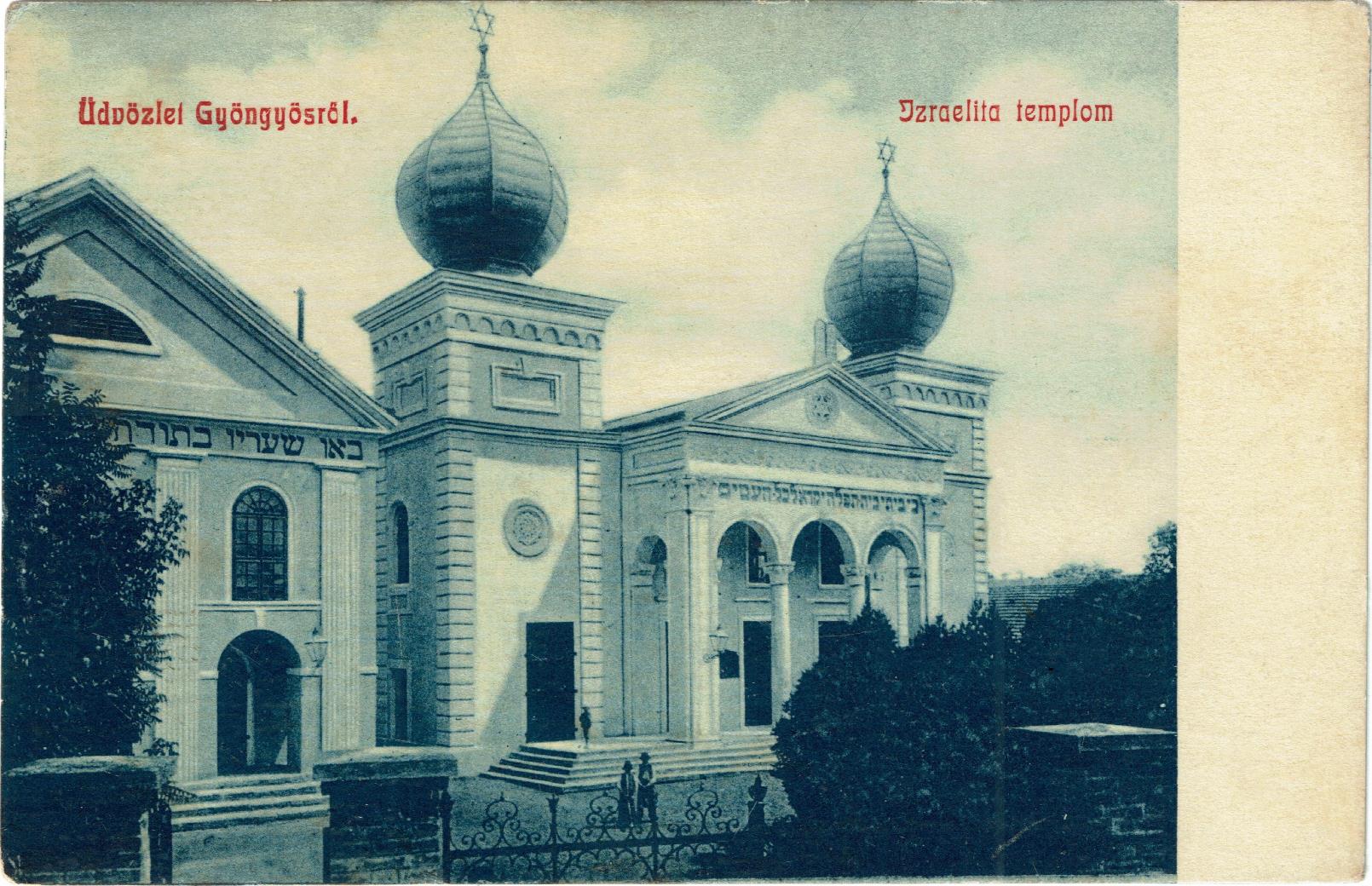
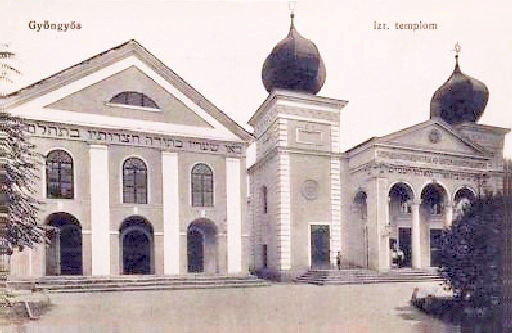
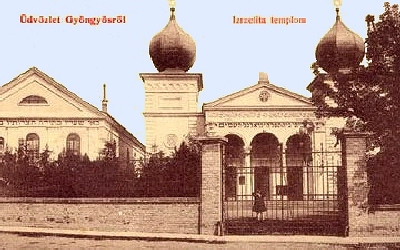
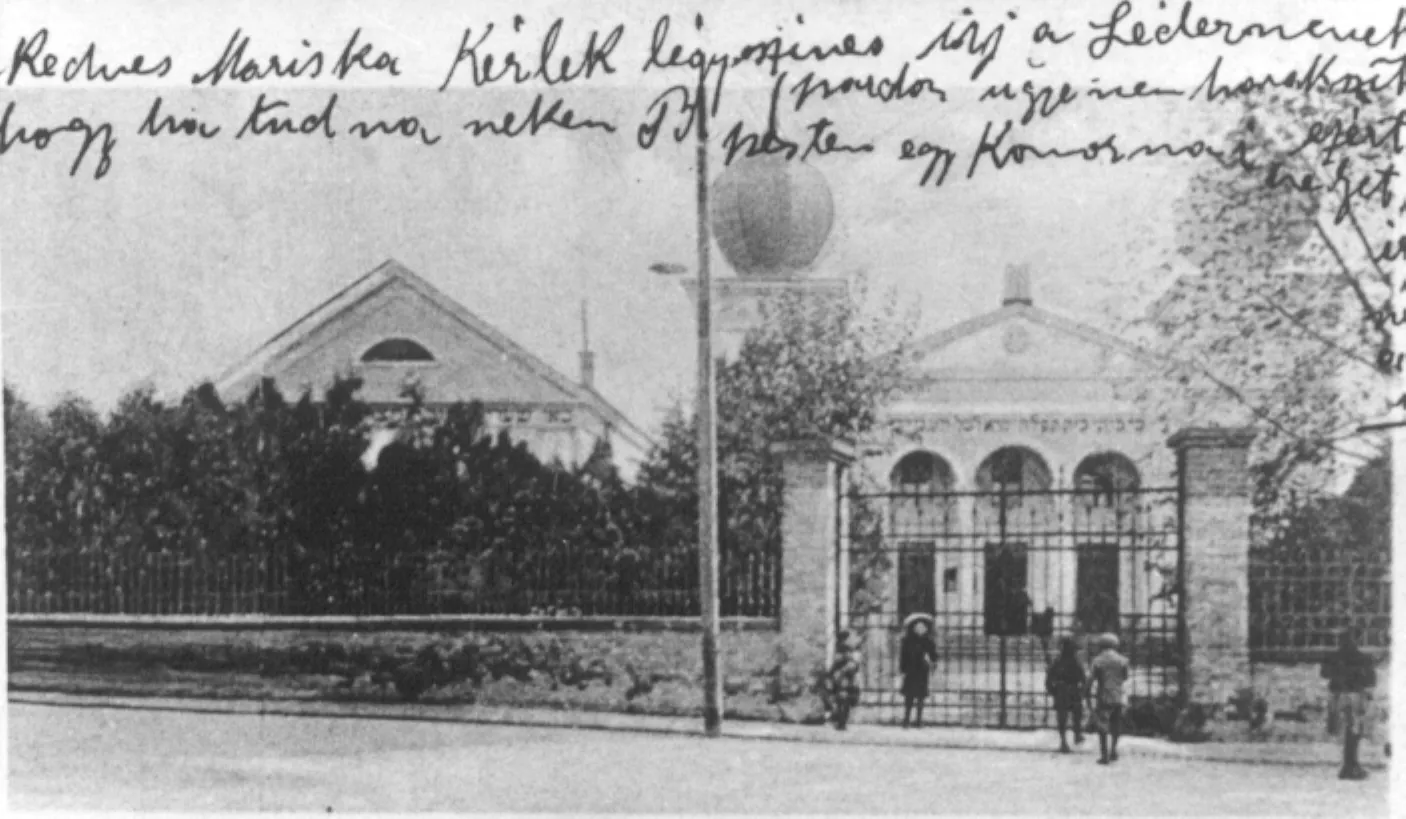
Postcards printed before the First World War show the pair side by side behind an iron fence: the plain pedimented front of 1816 on the left and, on the right, the newer building with a three-arched portico set between two square towers crowned by onion domes. The synagogue was renovated, enlarged and rededicated in 1897.
On 21 May 1917 a fire that began at the municipal hospital was driven across the town by a dry wind and destroyed 559 houses. The synagogue complex burned with them. Nobody set the fire deliberately; investigators ruled out arson. The gutted building of 1872 was not restored. Its remains were removed, and in 1929-30 the congregation built the far larger synagogue of Lipót Baumhorn and György Somogyi in its place.
Where it stood for 45 years
Historic: beside the 1816 synagogue on the bank of the Nagy-patak stream, Gyöngyös (Gazda 1991 gives the address as Bartók Béla tér). Today: plot of the 1930 synagogue, Eszperantó utca 6, 3200 Gyöngyös. Approximate.
Otwórz większą mapę →Społeczność żydowska
Jews are recorded at Gyöngyös from the fifteenth century, and an organised community existed by the late eighteenth: the Chevra Kadisha burial society was founded in 1795 and the first synagogue followed in 1816. In 1846 it was the largest Jewish community in Heves county and paid 675 forints a year in toleration tax. It opened an elementary school in 1839, handed over to the town in 1888, and a Talmud Torah endowed by Áron Brack in 1859. Anikó Gazda's tables give 385 Jews in 1851 and 2,312 in 1910; around 1900 the community numbered about 2,000, roughly nine tenths of them Status Quo Ante. A minority seceded to form a separate Orthodox congregation, an event the sources date variously between 1870 and the early 1880s; in 1909 the Status Quo community had 450 members and the Orthodox 65. Members were merchants, vineyard owners, millers, distillers, bankers, lawyers and doctors, and several sat on the town council. In the First World War 430 men of the community served and 34 were killed.
Architektura i projekt
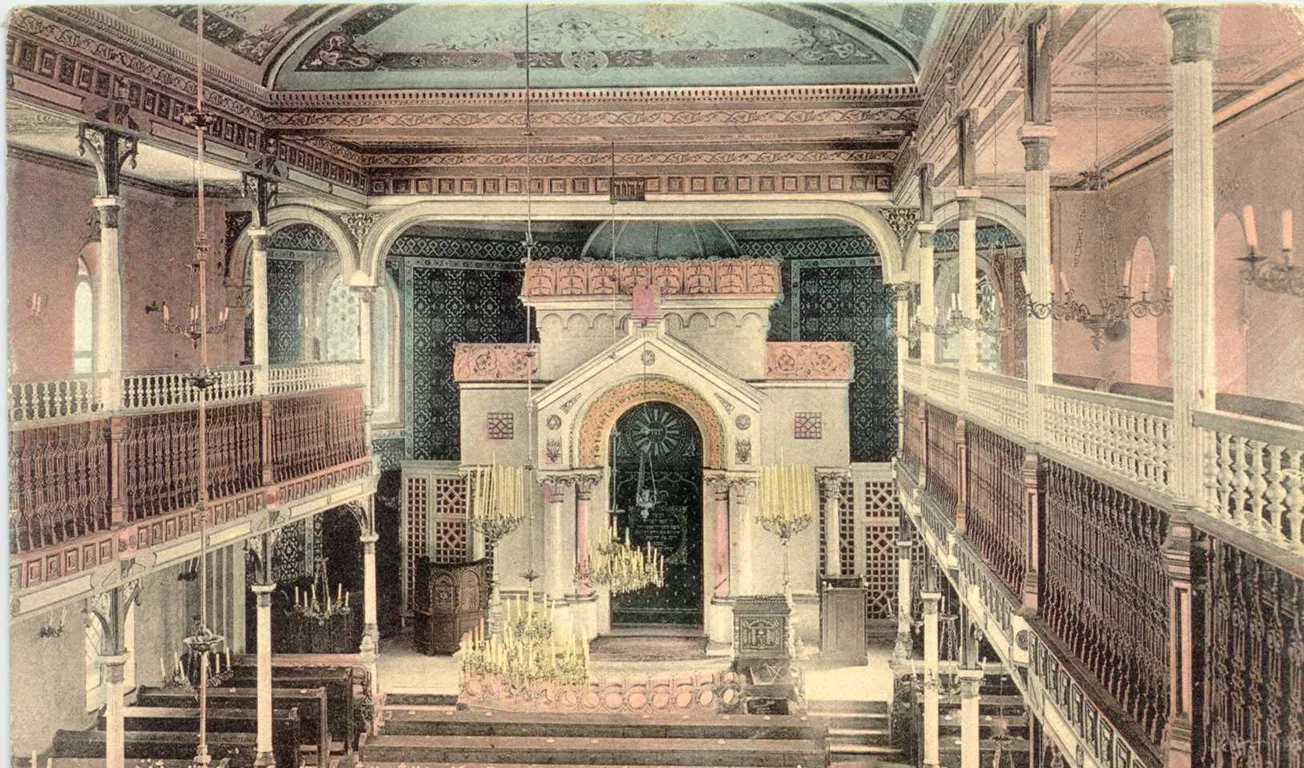
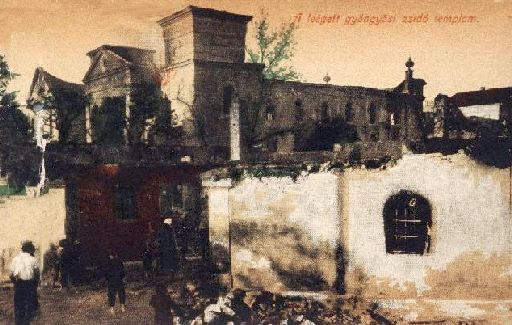
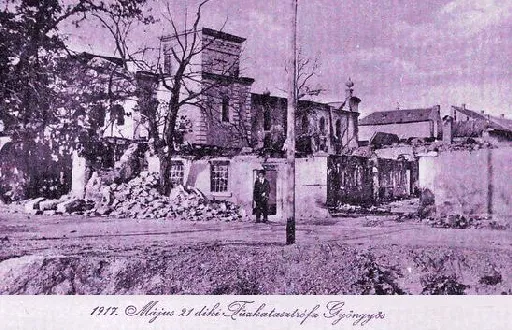
No architect, builder or seating figure has been found for the synagogue, and its appearance is known only from postcards. It stood immediately to the right of the 1816 synagogue as seen from the street, set back behind a forecourt closed by brick piers and a wrought-iron fence. The entrance front had a portico of three round arches on columns, reached by a flight of steps, with a Hebrew inscription on the frieze from Isaiah 56:7, "for My house shall be called a house of prayer for all peoples", and a low pediment carrying a round medallion. On either side rose a square tower with banded corners, a small blind arcade under the cornice and a round rosette, each topped by a ribbed onion dome and a Star of David. Photographs taken after the fire show long side walls pierced by a row of round-arched windows. A coloured postcard that probably shows the interior has galleries on three sides carried on slender columns, ornate gallery grilles, a painted flat ceiling and a pedimented Ark set in an arched recess. What the 1897 enlargement added is not recorded in the sources read.
Życie w synagodze
The congregation was Status Quo Ante, the name for Hungarian communities that kept their pre-1868 arrangements and joined neither the Congress (Neolog) nor the Orthodox national organisation. When the Orthodox minority seceded, the communal buildings stayed with the Status Quo majority, which held services alternately in the old synagogue and the new one beside it. Rabbi Lázár Fürst, in office from 1853 to 1893 and founder of a yeshiva in the town, led the community when the synagogue was built. His successor, L. Hermann Feigl, took office in 1897, the year in which the renovated and enlarged synagogue was rededicated, and served until 1944. The lay presidents of these decades were József Bogdány, Ignác Bernát, László Spitzer (1897-1901), Ignác Kálmán (1901-1906) and Jakab Rusz (1906-1924). During the First World War Feigl obtained permission for Jewish soldiers stationed in the town to attend Friday evening services, and the Chevra Kadisha ran a 25-bed military hospital. By the 1920s the community also maintained a Bikur Cholim society for the sick and two women's charitable societies.
Zniszczenie
The synagogue was destroyed by an accident, not by an attack. At about a quarter to five on the afternoon of 21 May 1917 a spark from a chimney set fire to the roof of the municipal hospital's laundry, and a strong dry wind carried the flames across the town centre; the authorities ruled out arson. Many of the town's firemen were away at the front. In Gyöngyös 559 houses burned, with 21 more in neighbouring Gyöngyöspüspöki; eleven deaths were reported at first and 22 in a later summary, and about 8,000 of the 20,000 inhabitants lost their homes. The stream beside the synagogue was dammed to supply water, but only a few buckets collected, and what a local historian calls the huge Israelite temple complex burned out together with the community's offices and the Jewish poorhouse. Postcards of the ruin show roofless walls and towers stripped of their domes. The older synagogue remained standing and was in use again by the 1930s; the shell of the 1872 building was pulled down. When, and by whom, is not stated in the sources read; it had gone by the time the new synagogue went up on the site in 1929-30.
Los społeczności
The congregation rebuilt after 1917: a temporary prayer house and staff housing were ready by 1920, the ritual bath followed, and the new synagogue was dedicated in 1930. Gazda's tables record 2,072 Jews in the town in 1941. After the Nazi German occupation of Hungary on 19 March 1944 the Hungarian authorities imposed the yellow star, closed 93 Jewish shops and, by mid-May, confined 1,824 Jews from Gyöngyös, with others from the district, in a ghetto of miners' houses in the Újtelep quarter. On 1 June men fit for work were taken for forced labour. On 8 June the rest were moved to the sugar factory at Hatvan and from there deported by train through Kassa to Auschwitz-Birkenau, where they arrived on 12 June and most were murdered on arrival. About 500 to 550 people survived, mainly men in labour service. The community counted 461 members in 1946 and 414 in 1949, of whom 312 were Status Quo and 102 Orthodox. Most later left for Budapest, Israel or the West.
Miejsce dzisiaj
The plot is occupied by the synagogue that replaced the burned building: the domed structure by Lipót Baumhorn and György Somogyi, dedicated in 1930, at Eszperantó utca 6. The 1816 synagogue still stands next to it; it was converted after 1960 into the town's television studio. In 1959 the national Jewish office sold both buildings; the 1930 synagogue served for decades as a furniture store, was entered in the municipal heritage register in 2015 and has since been renovated for cultural use. Nothing of the 1872 synagogue is reported to survive above ground, and no marker for it is recorded in the sources read. A small prayer house opened in 1964 at the nearby corner of Gárdonyi Géza utca and Kőrösi Csoma Sándor utca.
Ważne postacie
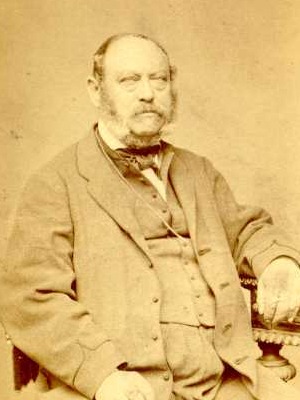
Lipót Hirschl
Unknown; photographed 1869President of the Gyöngyös congregation at the time of the 1868-69 congressHirschl represented Gyöngyös at the national Jewish congress of 1868-69 and served on its preparatory committee. As president he led the congregation through the dispute that followed, in which only about thirty members wanted to join the Congress organisation and the majority stayed Status Quo Ante. That majority built the new synagogue in 1872. Whether he was still president when it was built is not stated in the sources read.
Biografia lub źródło →Lázár (Eleazar) Fürst
Unknown; rabbi of Gyöngyös 1853-1893Rabbi of the Gyöngyös community when the synagogue was builtFürst became rabbi of Gyöngyös in 1853 and held the post for four decades, to 1893. He founded a yeshiva in the town and remained with the Status Quo Ante majority after the congress of 1868-69, so the new synagogue of 1872 was built and first used under his rabbinate, alongside the older building of 1816. His birth and death dates were not found in the sources read.
Biografia lub źródło →L. Hermann Feigl (Feigl Lajos Hermann)
Unknown; rabbi of Gyöngyös 1897-1944Chief rabbi of the Status Quo Ante congregation, 1897-1944Feigl was appointed in 1897, the year the renovated and enlarged synagogue was rededicated, and preached in it for twenty years until it burned in 1917. During the First World War he obtained permission for Jewish soldiers to attend Friday evening services, and he sat on the town council. He was still chief rabbi in 1929 and in 1944, when he was a member of the ghetto's Jewish Council.
Biografia lub źródło →László Spitzer
UnknownPresident of the congregation, 1897-1901Spitzer is listed in the Magyar Zsidó Lexikon as president of the Gyöngyös congregation from 1897 to 1901. His term opened in the year the renovated and enlarged Status Quo synagogue was rededicated and Rabbi Feigl took office. The same source names a László Spitzer as a director of the town's Commercial and Agricultural Bank in the 1920s; whether this is the same man is not stated.
Biografia lub źródło →Jakab Rusz
UnknownPresident of the congregation, 1906-1924Rusz headed the congregation when the synagogue and the other communal buildings burned on 21 May 1917. The Magyar Zsidó Lexikon credits his energy with the rebuilding of a temporary prayer house and housing for the community's officials by 1920, despite war and revolution. He owned vineyards at Visonta and in 1929 was still on the board as the officer responsible for religious affairs.
Biografia lub źródło →Czy masz coś do przekazania?
Zdjęcia, dokumenty, historie rodzinne lub wspomnienia o tej synagodze i jej społeczności pomagają zachować jej historię.
- Zsinagógák és zsidó községek Magyarországon (Heves county table, p. 27)
- Gyöngyös (Heves megyei holokauszt, települések)
- Gyöngyös (entry in Magyar Zsidó Lexikon, 1929)
- Az 1917. évi gyöngyösi tűzvész
- Gyöngyös: Religious Life (KehilaLinks)
- Gyöngyös: Holocaust (KehilaLinks)
- Gyöngyös, Hungary (KehilaLinks main page)
- A gyöngyösi zsidóság története (2nd ed., 1999), pp. 1-41 and list of illustrations
- Az ország második legnagyobb vidéki zsinagógája egy bezárt bútorbolt
- A gyöngyösi zsinagóga
- Zsinagóga (Gyöngyösi Értéktár)
- Történelem (Gyöngyös város)
- Gyöngyös (Encyclopaedia Judaica)
- Gyöngyösi satus quo (régi) zsinagóga (postcard, inv. F01.441)
- Gyöngyösi régi zsinagóga belső tere (coloured postcard, inv. F78.58)
- Gyöngyös: Régi és új zsinagóga (makett), a régi ifjúsági templom (photo, 1935, inv. F70.148)
- Hirschl Lipót fényképe (inv. F98.59)
- A gyöngyösi zsidó imaház felavatási ünnepsége (photo, 1964)
- File:Gyöngyös. Izraelita templom.jpg
- Magyarországi zsinagógák listája
- List of synagogues in Hungary
- Gyöngyösi zsinagóga (article coordinates)
- régi zsinagóga, Gyöngyös (OpenStreetMap way 875762852)
Share a memory or thought
No comments yet. Be the first to add one.