
הסיפור של Haarlem Synagogue (Lange Begijnestraat)
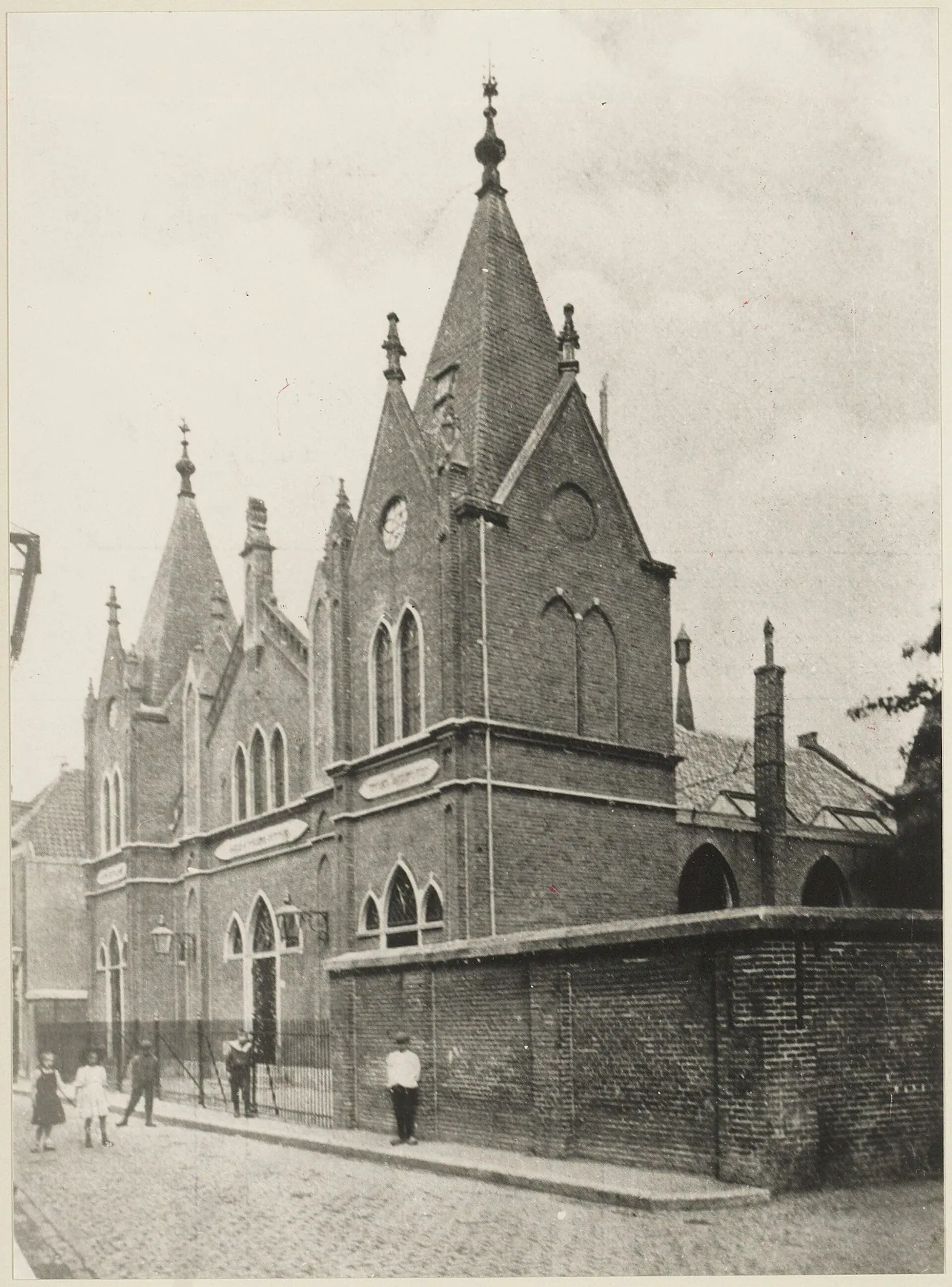
Haarlem's Jews first worshipped in a room on the upper floor of a house by the Begijnhof, now the Goudsmidspleintje, licensed by the city in 1765. As the community grew in the early nineteenth century that room became too small, and the congregation bought a plot on the Lange Begijnestraat, at the corner of the Wijde Appelaarsteeg in the old town north of the Grote Markt. The municipality and the province of Noord-Holland agreed to contribute to the cost and the national government also took part. Sources differ on the opening: one account says the new synagogue was inaugurated in June 1840, while the Jewish Cultural Quarter, the inscription later placed on the site and the local history society give 1841. In 1896 the building was enlarged from 190 to 340 seats and given two towers, the form in which it appears in photographs of 1911 and 1919. For half a century the synagogue was the centre of Jewish life in Haarlem under Rabbi Simon Philip de Vries, and it celebrated its 90th anniversary in 1931. It was closed in 1943, used as a paper store by the printing firm Joh. Enschedé, sold to that firm after the war, gutted by fire in April 1953 and later pulled down. The theatre complex known as the Schuur now occupies the site.
Where it stood for 112 years
Historic: Lange Begijnestraat, corner of the Wijde Appelaarsteeg, Haarlem (house number unknown). Today: site of the Schuur theatre and film centre, Lange Begijnestraat 9, 2011 HH Haarlem (approximate).
פתיחת מפה גדולה ←הקהילה היהודית
Jews were living in Haarlem by the eighteenth century; in 1765 they were allowed a prayer room and in 1766 the city formally permitted the organisation of a Jewish community. The Jewish Cultural Quarter gives 198 Jews in Haarlem in 1798, 166 in 1809 and 418 in 1840, the year before the Lange Begijnestraat synagogue opened. Growth continued through the century, to 571 in 1869 and 819 in 1899, which is why the building had to be enlarged in 1896. By 1930 the community, including the surrounding area, numbered 1,130 people. It was governed by a church council (kerkenraad) and a board (kerkbestuur) and supported a range of charitable and educational societies. From 1892 Haarlem had its own rabbi, Simon Philip de Vries, a rabbi and Zionist who for about fifty years was the pivot of Jewish life in the town. In 1937 Philip Frank was installed as chief rabbi of Noord-Holland, based in Haarlem, and succeeded De Vries as the community's spiritual leader.
אדריכלות ועיצוב
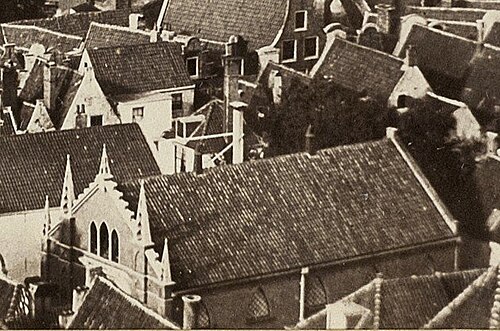
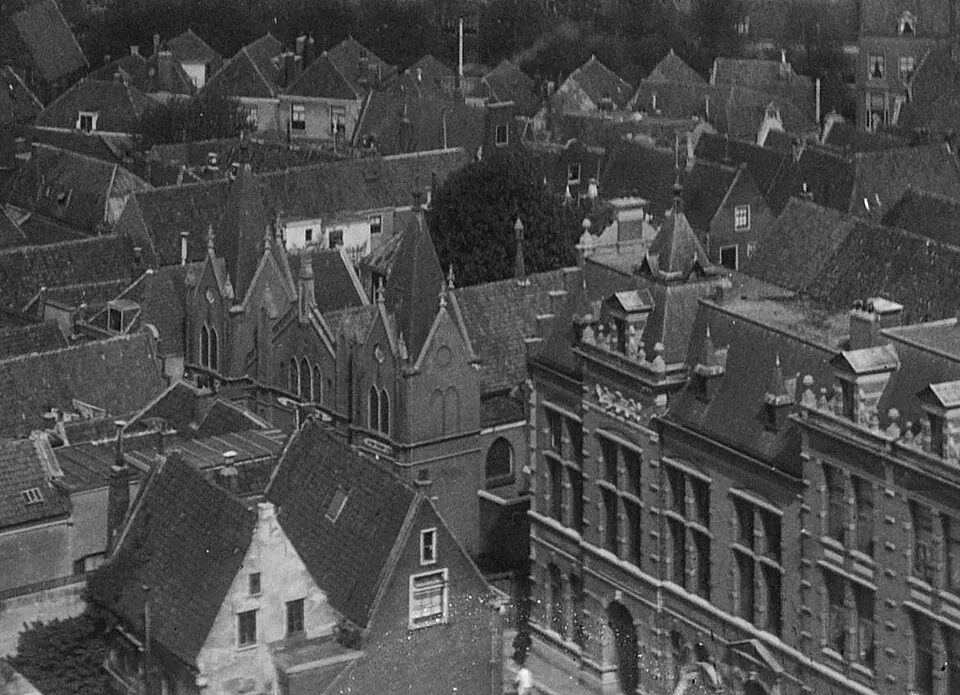
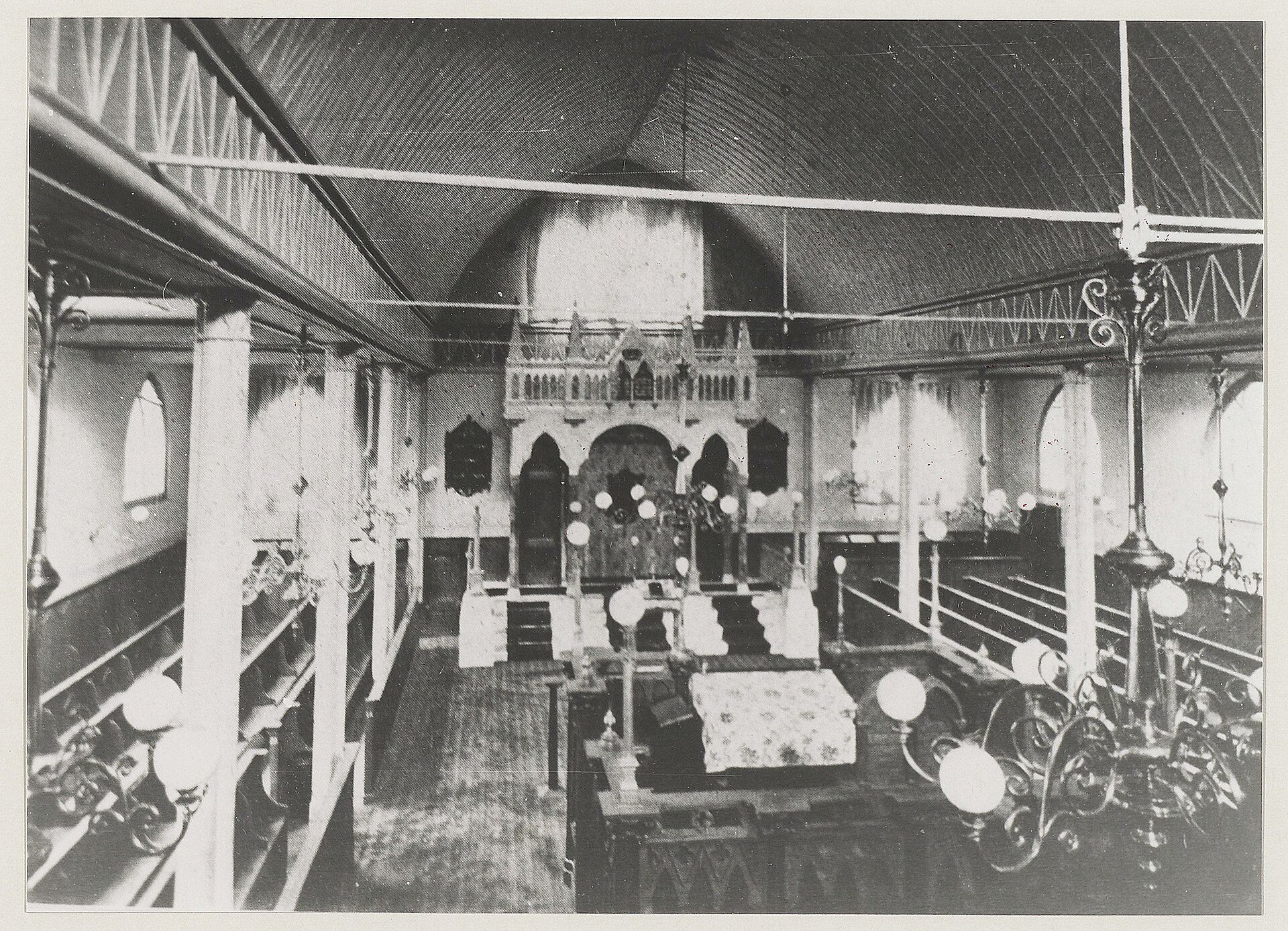
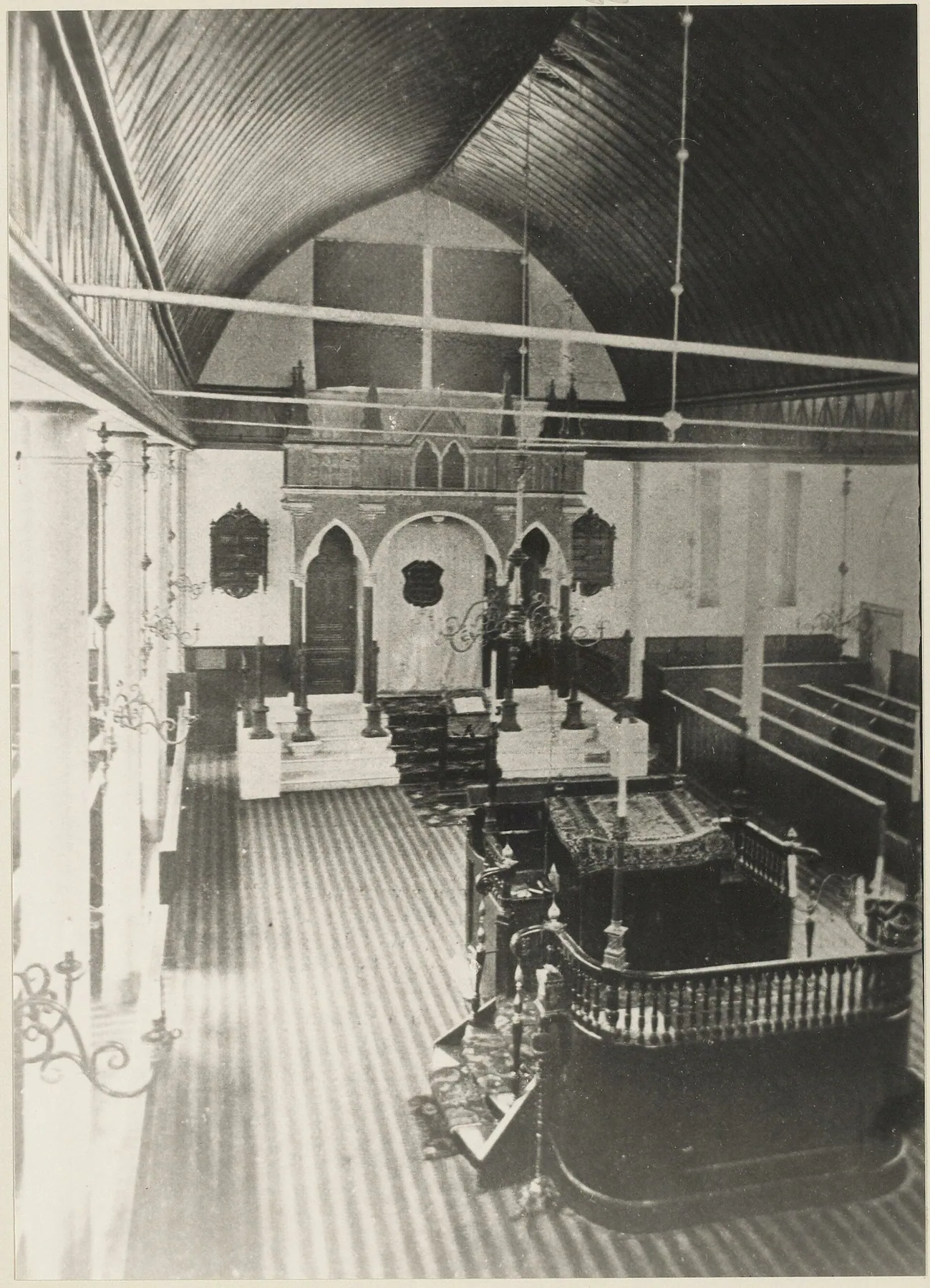
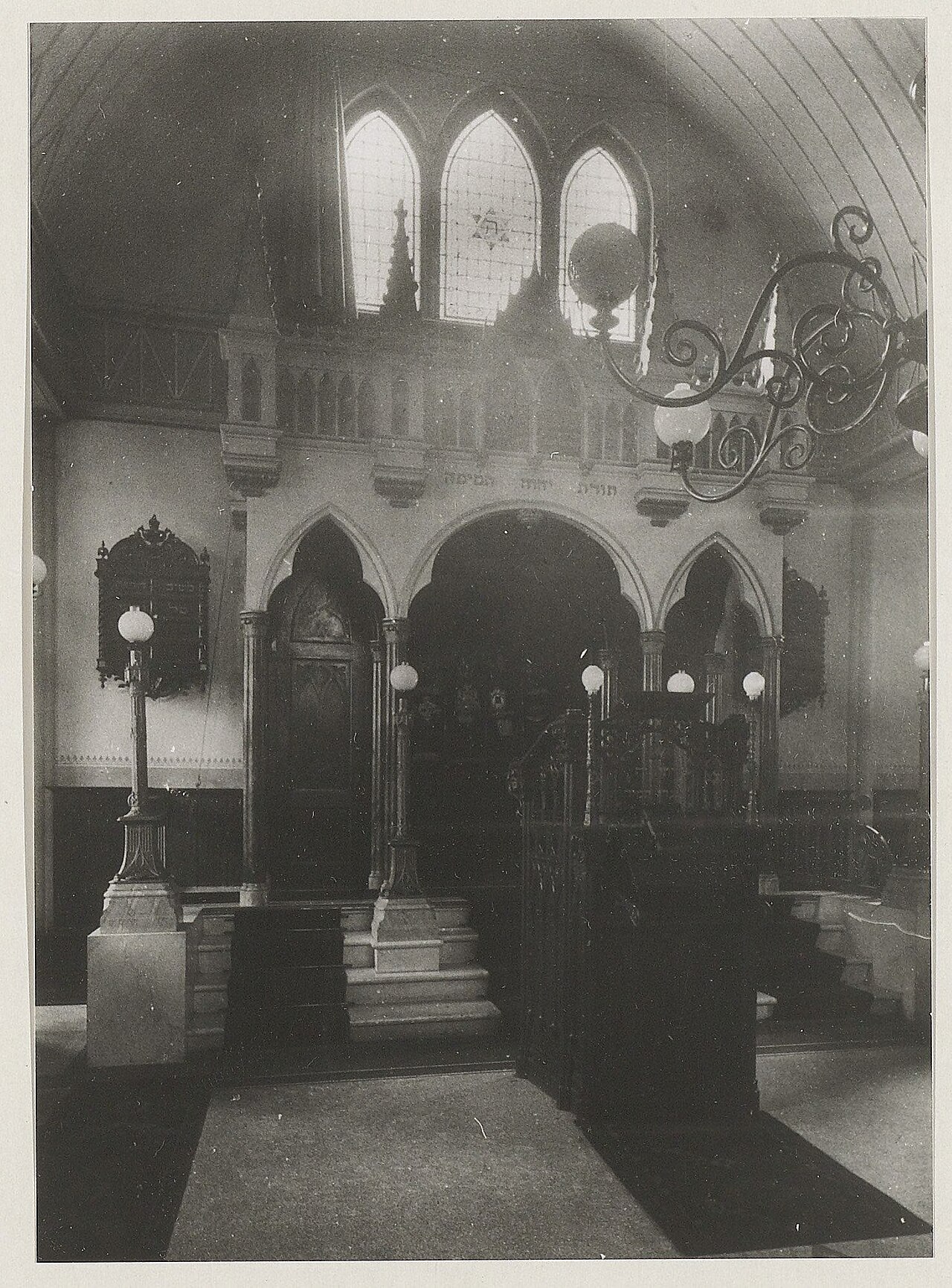
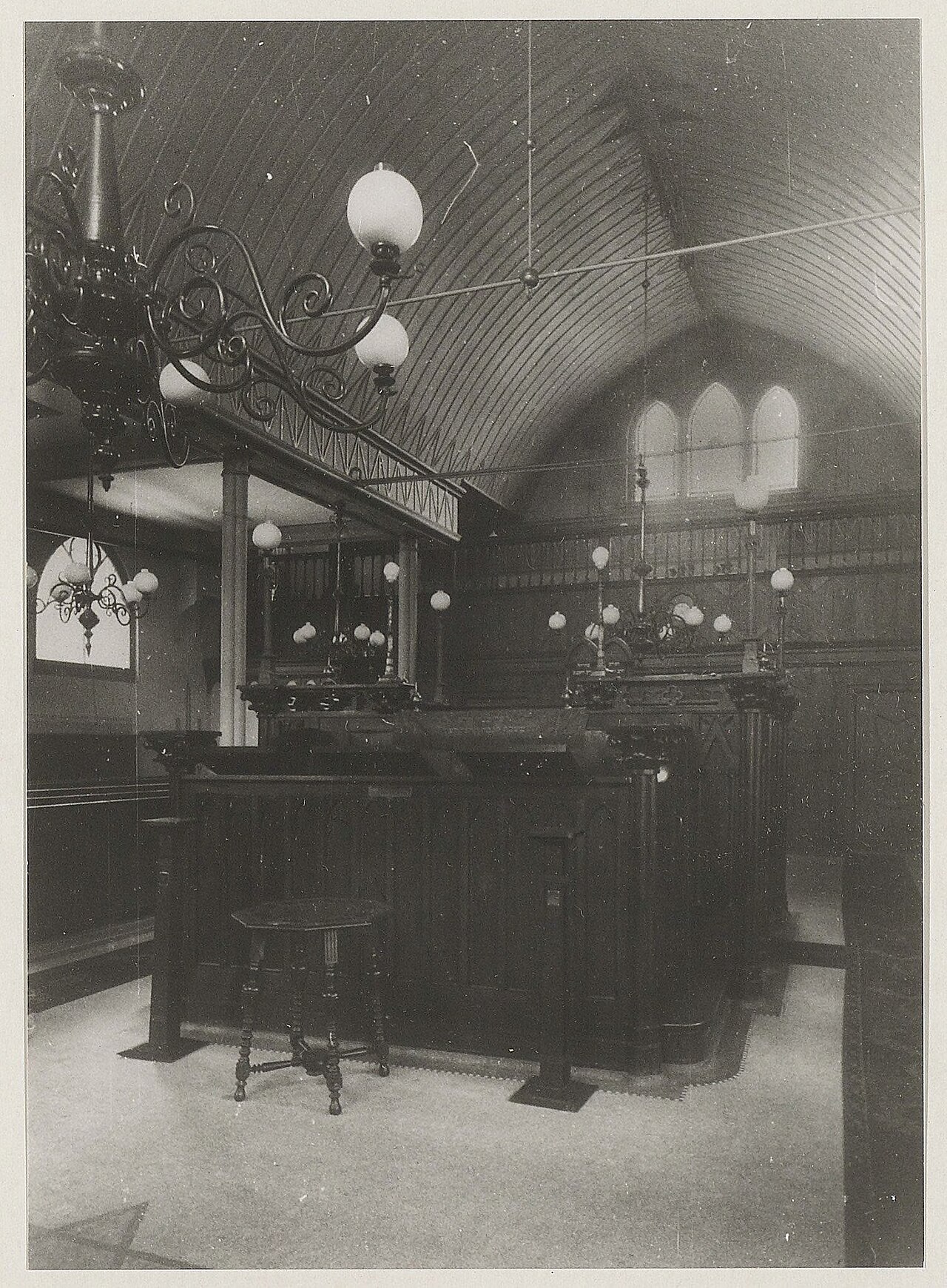
The architect of the 1841 building and of the 1896 enlargement is not named in any source consulted. The earliest view, an albumen print of 1858 taken from the tower of St Bavo, appears to show the original synagogue as a long tiled hall with a stepped Gothic gable crowned with pinnacles and lit by pointed windows. Photographs from 1911 show the enlarged building from the street corner: a brick front with two tall, slender spires of unequal height, the larger one with a clock-like round window, steep gables, lancet windows and string courses, behind a high boundary wall. Inside, the 1911 and 1919 photographs show a wide hall under a timber barrel-shaped ceiling, with slender iron columns carrying a women's gallery along the sides and the west end. At the east end a raised platform reached by steps led to the Holy Ark, framed by pointed arches and an arcaded screen beneath three stained-glass lancet windows. The bimah, a large panelled reading desk with railings, stood in the centre, surrounded by rows of benches, and the hall was lit by gas or electric chandeliers.
החיים בבית הכנסת
The Ark with the Torah scrolls stood, as required, on the east wall facing Jerusalem. A local account describes the building as having a special atmosphere. Simon Philip de Vries, rabbi from 1892, led worship here for nearly five decades; he was also a Zionist. The congregation marked the synagogue's 90th anniversary in June 1931 with a group portrait of its members around De Vries and his wife. In 1937 the installation of Philip Frank as chief rabbi of Noord-Holland drew invited guests to Haarlem. When the synagogue reached its centenary in 1941, under Nazi German occupation, the community had already begun to guard the building: from February 1941 it was watched to prevent its destruction or arson. Its stained-glass windows survived the building and were later reused in the synagogue on the Lanckhorstlaan in Heemstede, consecrated in 2014.
הרס
The synagogue went out of use in 1943, when the deportations had emptied Jewish Haarlem. Members had already taken the Torah scrolls and other sacred objects to safety, and the scrolls survived the war. The building itself was looted; no source consulted names who carried out the looting. It was taken over by the Commissariaat voor niet-commerciële vereenigingen en stichtingen, an agency of the Nazi German occupation, and was then rented by the printing firm Joh. Enschedé, which used it to store paper and cardboard. After the liberation in 1945 the building was not returned smoothly to the small surviving congregation, and restoring it was judged too expensive. The community sold it to Enschedé and used the proceeds to buy a villa in the Kenaupark, opened as a synagogue in December 1949. In the early morning of 11 April 1953 the former synagogue burned out; the cause of the fire is not known. The ruin was demolished afterwards, but neither the date of demolition nor who carried it out is recorded in the sources found.
גורל הקהילה
After the Nazi German invasion of May 1940, Haarlem's Jews lived under the occupation's growing anti-Jewish measures. Deportations from Haarlem began in August 1942, and according to the Dutch Jewry Database all Jews remaining in the town had been deported by February 1943; the same source estimates about one thousand deportees. The Jewish Cultural Quarter puts the number at more than a thousand people from Haarlem, of whom only about ten returned from the camps. Chief Rabbi Philip Frank was among the prominent Jewish residents of Haarlem who were killed, in 1943, and Rabbi Simon Philip de Vries died in 1944. After the liberation a small congregation was re-formed. In 1949 it bought premises at Kenaupark 7 for a synagogue, a school and offices, part of the conversion being paid by the war damages commission. The community counted 260 people in 1951, 184 in 1971 and 71 in 1998.
האתר כיום
The site at the corner of the Lange Begijnestraat and the Wijde Appelaarsteeg was absorbed into the premises of the printing firm Joh. Enschedé. When Enschedé moved to the Waarderpolder industrial area, the block was redeveloped, and the Schuur, a theatre and film centre at Lange Begijnestraat 9, was built on the spot where the synagogue had stood. Nothing of the synagogue building survives on the site. Since 1980 a memorial stone in the wall of the Schuur on the Wijde Appelaarsteeg recalls the synagogue and the deported Jews of Haarlem.
שמות בולטים
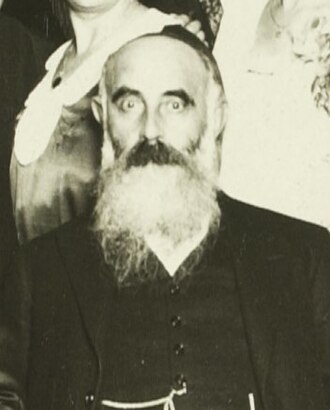
Simon Philip de Vries
1870-1944Rabbi of Haarlem, 1892-1940De Vries became Haarlem's first resident rabbi in 1892 and served the Lange Begijnestraat synagogue until 1940, the period in which it was enlarged and reached its largest congregation. Local historians call him the pivot of Haarlem Jewish life for about fifty years. A Zionist, he is pictured with his wife at the centre of the group photograph taken for the synagogue's 90th anniversary in June 1931. He died in 1944.
ביוגרפיה או מקור ←Philip Frank
1910-1943Chief rabbi of Noord-Holland, based in Haarlem, 1937-1943Frank was installed as chief rabbi of Noord-Holland in Haarlem in 1937 and succeeded Simon Philip de Vries as the community's rabbi in 1940. He led the congregation of the Lange Begijnestraat synagogue through the first years of the Nazi German occupation, when the building was put under guard and its sacred objects were taken to safety. He was killed in 1943 and is named with De Vries on the memorial stone at the site.
ביוגרפיה או מקור ←יש לכם משהו לתרום?
תמונות, מסמכים, סיפורי משפחה וזיכרונות מבית הכנסת ומהקהילה שלו עוזרים לשמור על ההיסטוריה שלו בחיים.
Share a memory or thought
No comments yet. Be the first to add one.