

La storia di Hamat Gader Synagogue
Hamat Gader, called el-Hammeh in Arabic and Emmatha in Greek, lies on the north bank of the Yarmuk river, where hot springs supplied a large bath complex. The synagogue stood on a mound known as Tell Bani. The Palestine Department of Antiquities exposed it at the beginning of the summer of 1932, and that November a Hebrew University expedition directed by Eleazar L. Sukenik excavated it; his report, The Ancient Synagogue of El-Hammeh, appeared in 1935. Gideon Foerster dug there again in 1982 and 1983, and a final report on the synagogue by Y. Arbel and P. Porat was published in 2024.
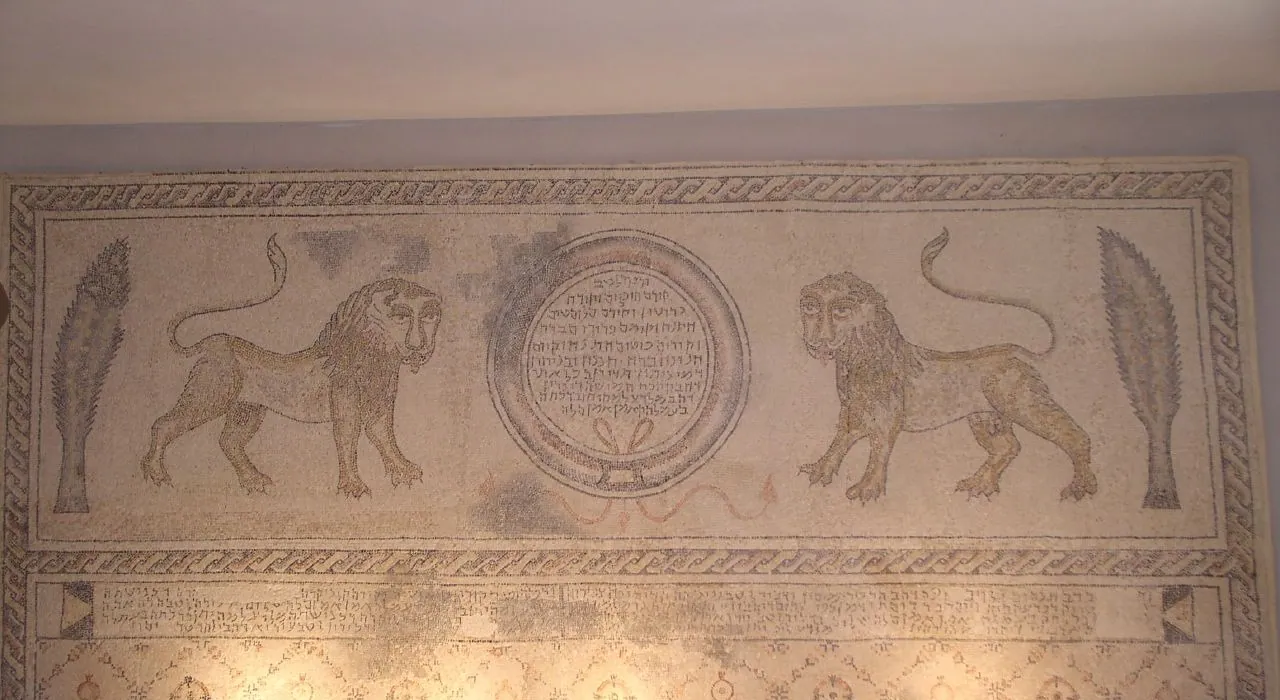
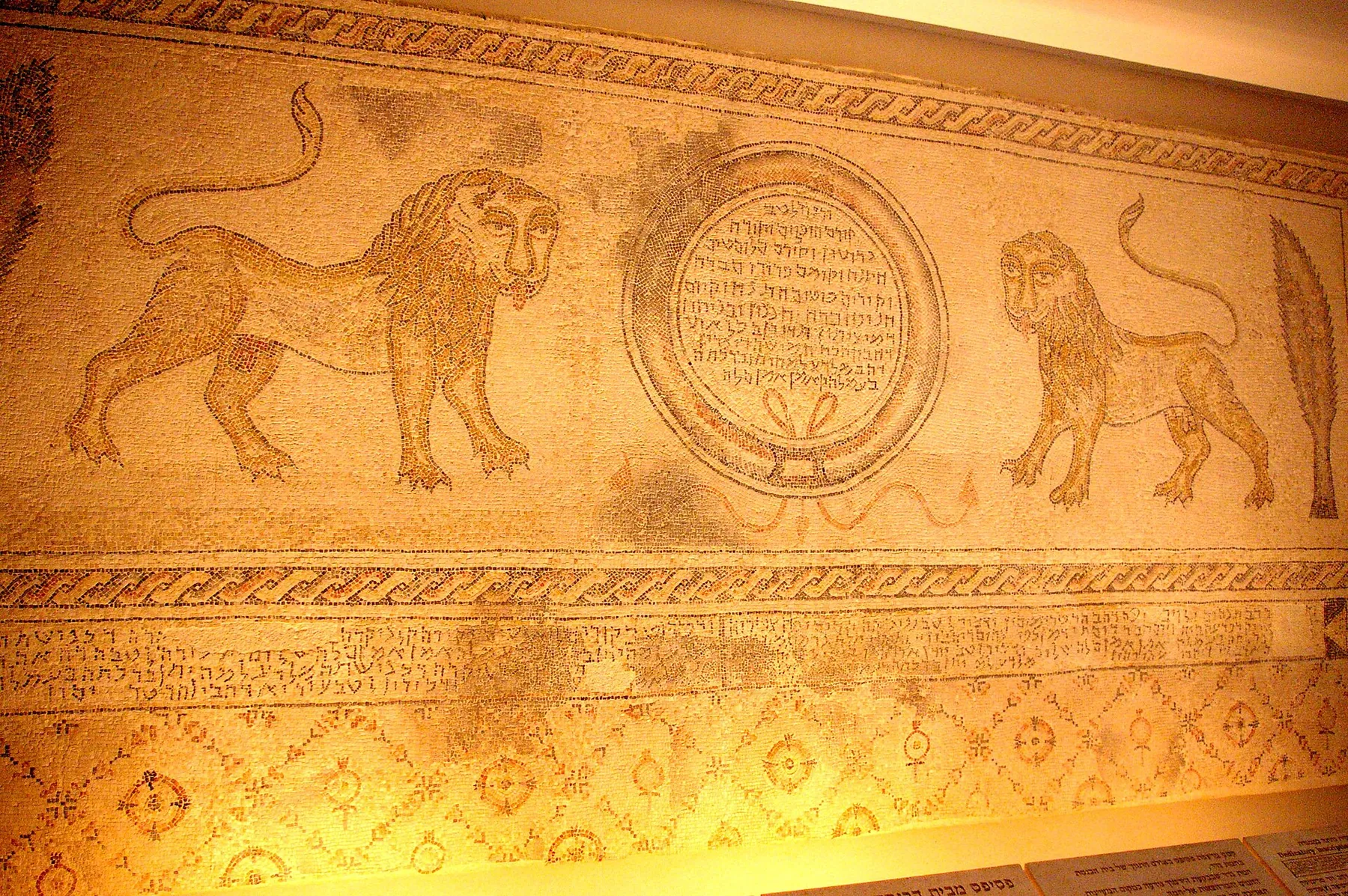
Sukenik found an almost square hall about thirteen metres across, divided by rows of columns, with a raised platform and an apse on the south side towards Jerusalem. The mosaic floor carried four Aramaic inscriptions blessing donors, among them a family headed by Oples and Protone, a rabbi named Tanhum the Levite, and men from Sepphoris, Capernaum, Emmaus and Arbela. Two lions flank the main inscription. Published dates for the hall run from the fourth to the sixth century CE.
No source consulted states when the synagogue went out of use or what destroyed it. The neighbouring baths were restored in 663 CE and are usually said to have been ruined by the earthquake of 749. Part of the lion mosaic is now displayed at the entrance to the Supreme Court in Jerusalem, and nothing of the building can be seen on the site.
Where it stood
Tell Bani, within the Hamat Gader hot-springs resort on the north bank of the Yarmuk river (Golan region), reached by an unnamed road from Sha'ar HaGolan; no street address. Approximate.
Apri la mappa grande →La comunità ebraica
No source consulted describes a resident congregation by name or size. The Israeli Foreign Ministry's account says the synagogue was built for the many Jews who came to the baths, and the Center for Online Judaic Studies adds that Jews are said to have settled at Hamat Gader before Alexander Jannaeus conquered it, and that in the second century CE, according to the Talmud, scholars gathered there in the bathing season and were joined by Judah ha-Nasi. The mosaic inscriptions are the only direct record of the people behind the building. They are written in Jewish Palestinian Aramaic, but many of the donors bear Greek or Latin names and titles: Kyris (lord) Oples and Kyra (lady) Protone with their son-in-law Sallustius, their son the comes Pheroros and another son-in-law, Photios; Leontius and Kalinike; and a Patricus of Kefar Aqabyah. Others have Semitic names, such as Haninah son of Hananon, Rav Tanhum the Levite, Yoseh son of Dositheus of Kefar Nahum (Capernaum) and Adda son of Tanhum of Apheka. Several donors came from other towns, and the people of Arbela gave as a group; the inscriptions have been cited as evidence of visitors from elsewhere.
Architettura e design
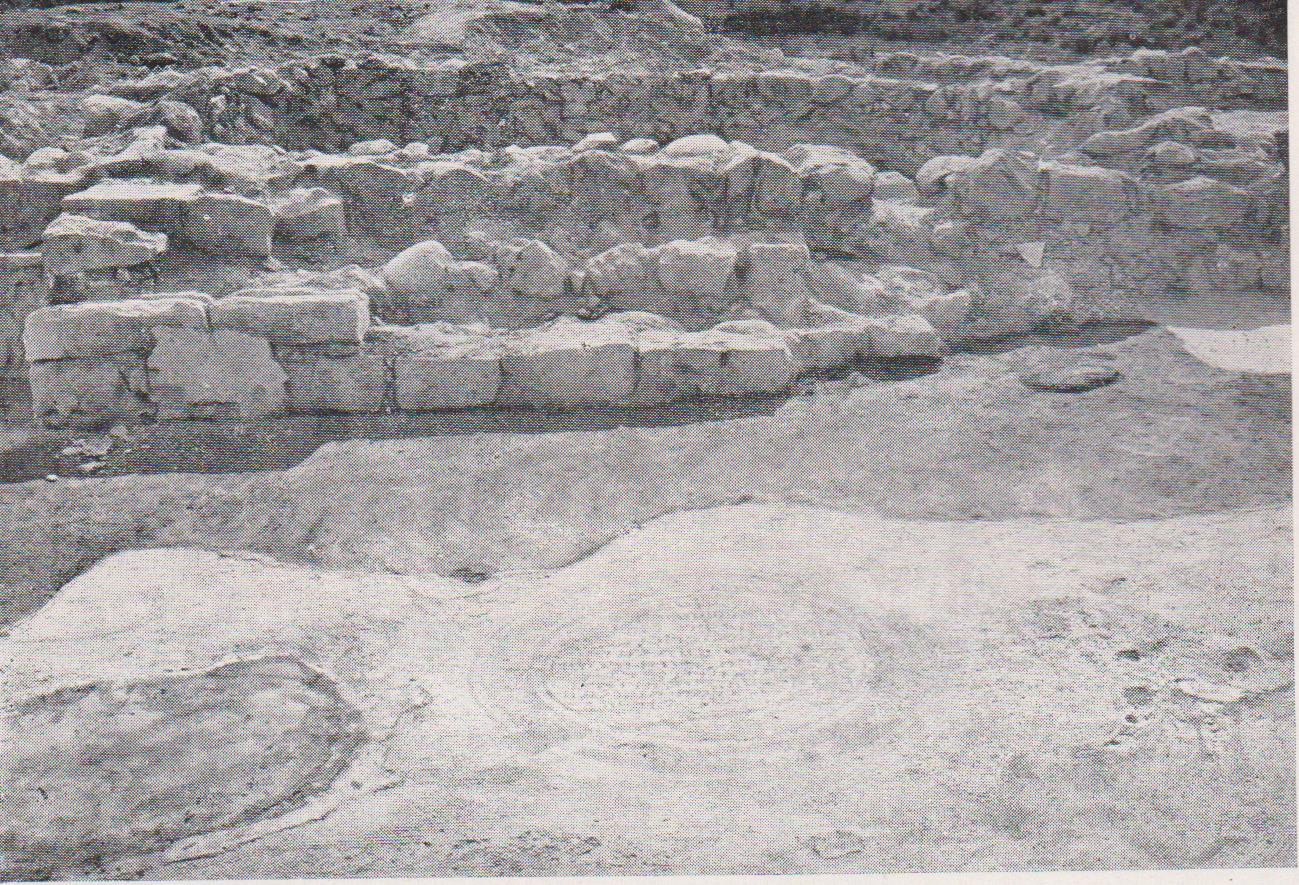
The synagogue complex was enclosed by a wall 32.5 metres long and included paved rooms and courtyards around the prayer hall. The hall was almost square, 13.90 by 13 metres in the Israeli Foreign Ministry's account. Rows of columns divided it into a central space and aisles: the first press report, of January 1933, speaks of two rows and supposes a gallery for women, while later descriptions give three rows. In the south wall, towards Jerusalem, was a semicircular apse, which the excavators took to be the place of the Torah ark, with a raised bema in front of it. Fragments of a marble chancel screen, one carved with a menorah inside a wreath, lay in the collapse debris, and a Greek inscription from the screen was also found. Two narrow corridors led into the hall. A room to the east with a stone bench along its walls may have been used for study or by women. The mosaic floor, largely geometric, had three panels framed in guilloche along the nave. Beneath it were two older floors, one of plain white mosaic 1.4 metres down and one of opus sectile dated to the later fourth century.
La vita nella sinagoga
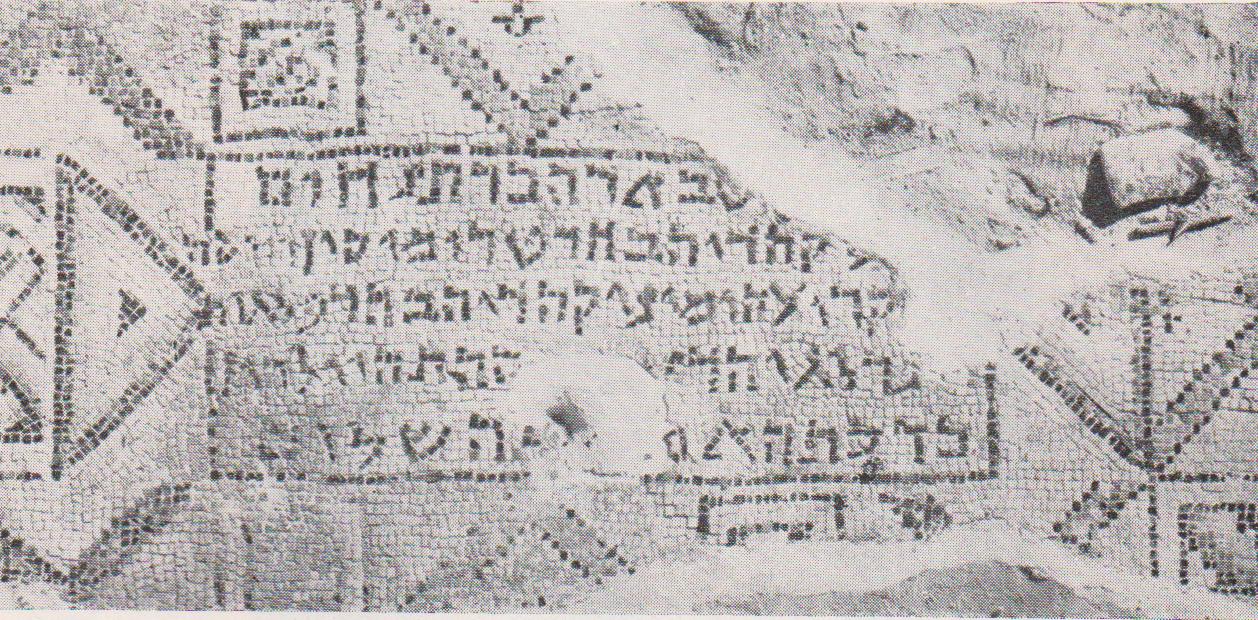
Worshippers faced south, towards the bema, the apse and Jerusalem, and every inscription in the floor was laid so as to be read from that direction. The panel nearest the bema was the only one with figures: two lions, with cypress trees behind them, flank a wreath that encloses the principal dedication. It asks that Oples, Protone and their family be remembered for good, says that their acts of charity are constant everywhere and that they gave five gold coins, and ends: 'May the King of the Universe bestow the blessing upon their work', followed by Amen, Amen, Selah. Two further texts in framed tablets below the lions list smaller gifts, among them one tremissis from Rav Tanhum the Levite, one denarius from an unnamed righteous woman and a gift from the townspeople, a reading that is uncertain. A fourth inscription, in the northern panel, records contributions towards the mosaic itself. The Warsaw epigraphic database assigns the inscriptions to the sixth century. The room with benches beside the hall may have been used for study. Nothing else is recorded about services, officials or customs in the synagogue.
Distruzione
No source consulted gives a date, a cause or a culprit for the end of the Hamat Gader synagogue. The Warsaw epigraphic database says only that the hall is generally placed between the fifth and seventh centuries, that this dating is uncertain, and that the chancel screen fragments were found in collapse debris. The 1933 press report of Sukenik's excavation describes the plan and the finds but not how the building ended. Better documented is the fate of the neighbouring baths. They were renovated under the Umayyad caliph Mu'awiya in 663 CE, possibly after earthquake damage, and are usually said to have remained in use until the earthquake of 749 CE destroyed them; Jodi Magness has argued that the collapse belongs instead to the earthquake of 1033. One account has the baths abandoned and buried in silt in the ninth century. Whether the synagogue fell in an earthquake, had already been abandoned, or ended in some other way is not stated in the sources consulted, so no cause is named here. The final report on the synagogue by Y. Arbel and P. Porat, published in 2024, may answer the question.
Il destino della comunità
What became of the Jews who prayed at Hamat Gader is unknown. The inscriptions, which the Warsaw epigraphic database dates to the sixth century, are the latest direct evidence of them. They show donors able to give gold coins, some of them holding titles such as comes, and linked with other places, among them Sepphoris, Capernaum, Emmaus and Arbela. No source consulted records an expulsion, a massacre or the conversion of the building to another use, and none says whether Jews still used the synagogue when the baths were restored under Umayyad rule in 663 CE. The baths themselves stayed in use into the eighth century and are said to have been abandoned in the ninth. The synagogue is not heard of again until the Palestine Department of Antiquities uncovered it on Tell Bani in 1932. The date of the last service, the fate of the congregation and the reason the building was given up all remain unknown.
Il luogo oggi
The site lies on Tell Bani inside the Hamat Gader spa and resort, which charges an entrance fee. The Kinneret College website on ancient synagogues reports that no remains are visible there at present, and the English Wikipedia article says that the excavated remains have been closed to the public since the 1980s for reasons of safety and conservation, a restoration plan having been drafted but not carried out. The mosaic floor was partly removed. The panel with the two lions and the wreathed inscription, with the donor inscriptions below it, is mounted on a wall at the entrance to the Supreme Court of Israel in Jerusalem. Sukenik's photographs of 1932 remain the main visual record of the building as excavated.
Nomi importanti
Oples (Hoples)
Unknown; named in an inscription dated to the 6th c. CEPrincipal donor named in the wreath inscription of the mosaic floorOples, given the title Kyris (lord), is named first among the donors in the Aramaic dedication set in a wreath between the two lions, directly in front of the bema. The text asks that he, Protone, two sons-in-law, a son and a further donor be remembered for good, praises their constant charity and records that they gave five gold coins. Nothing else is known of him, and the same name is also transliterated Hoples.
Biografia o fonte →Protone (Proton)
Unknown; named in an inscription dated to the 6th c. CEDonor named with Oples in the wreath inscriptionProtone, given the title Kyra (lady), is named immediately after Oples in the principal dedication of the mosaic floor and was probably his wife, a relationship the Warsaw database marks as uncertain. She shared in the family's gift of five gold coins to the synagogue. She is one of three women recorded among the donors, with Kalinike and an unnamed righteous woman who gave one denarius.
Biografia o fonte →Rav Tanhum the Levite
Unknown; named in an inscription dated to the 6th c. CEDonor with the title Rav named in the mosaic floorRav Tanhum the Levite is the first donor named in the right-hand tablet below the lion panel of the mosaic floor. The inscription asks that he be remembered for good and records that he gave one tremissis. He is the only donor at Hamat Gader given the title Rav, and the Warsaw database classes him as a religious authority; whether he held any office in this synagogue is unknown.
Biografia o fonte →Yudan of Emmaus
Unknown; named in an inscription dated to the 6th c. CEDonor named in the mosaic floor, possibly an architectYudan of Emmaus is blessed in the right-hand tablet below the lion panel for a gift of three scruples, a sum whose reading is uncertain. The word describing him has been read as 'architect', a reading the Warsaw database marks with a question mark. If it is right he may have been a builder by trade, but no source says that he designed or built this synagogue.
Biografia o fonte →Leontius and Kalinike
Unknown; named in an inscription dated to the 6th c. CEDonors named in the left-hand tablet of the mosaic floorLeontius, titled lord, and Kalinike, titled lady, are named together in the left-hand tablet below the lion panel as donors who gave a number of denarii in honour of the synagogue; the figure is lost where the mosaic is damaged. The inscription does not state how they were related or where they came from, and nothing else is known of them.
Biografia o fonte →Hai qualcosa da condividere?
Fotografie, documenti, storie di famiglia o ricordi di questa sinagoga e della sua comunità aiutano a mantenerne viva la storia.
- Hamat Gader
- Hamat Gader (The Bornblum Eretz Israel Website for the Study of Ancient Synagogues)
- Synagogue Complete (building no. 10, Hammat Gader; Emmatha)
- Inscription no. 12 (wreath inscription, Hammat Gader synagogue)
- Inscription no. 147 (right tabula ansata, Hammat Gader synagogue)
- Inscription no. 148 (left tabula ansata, Hammat Gader synagogue)
- Inscription no. 149 (northern panel, Hammat Gader synagogue)
- Archaeology in Israel: Hamat Gader
- Hammat Gader Synagogue, 450 CE
- J. D. B. News Letter (29 January 1933)
- Hammat Gader (archaeoseismic site page)
- Aramaic Inscription on Mosaic from Ḥammat Gader, Golan
- Hammat Gader synagogue mosaic (photograph by Olevy)
- Hammat Gader synagogue mosaic (photograph by savtadotty)
Share a memory or thought
No comments yet. Be the first to add one.