
הסיפור של Hammat Tiberias Synagogue
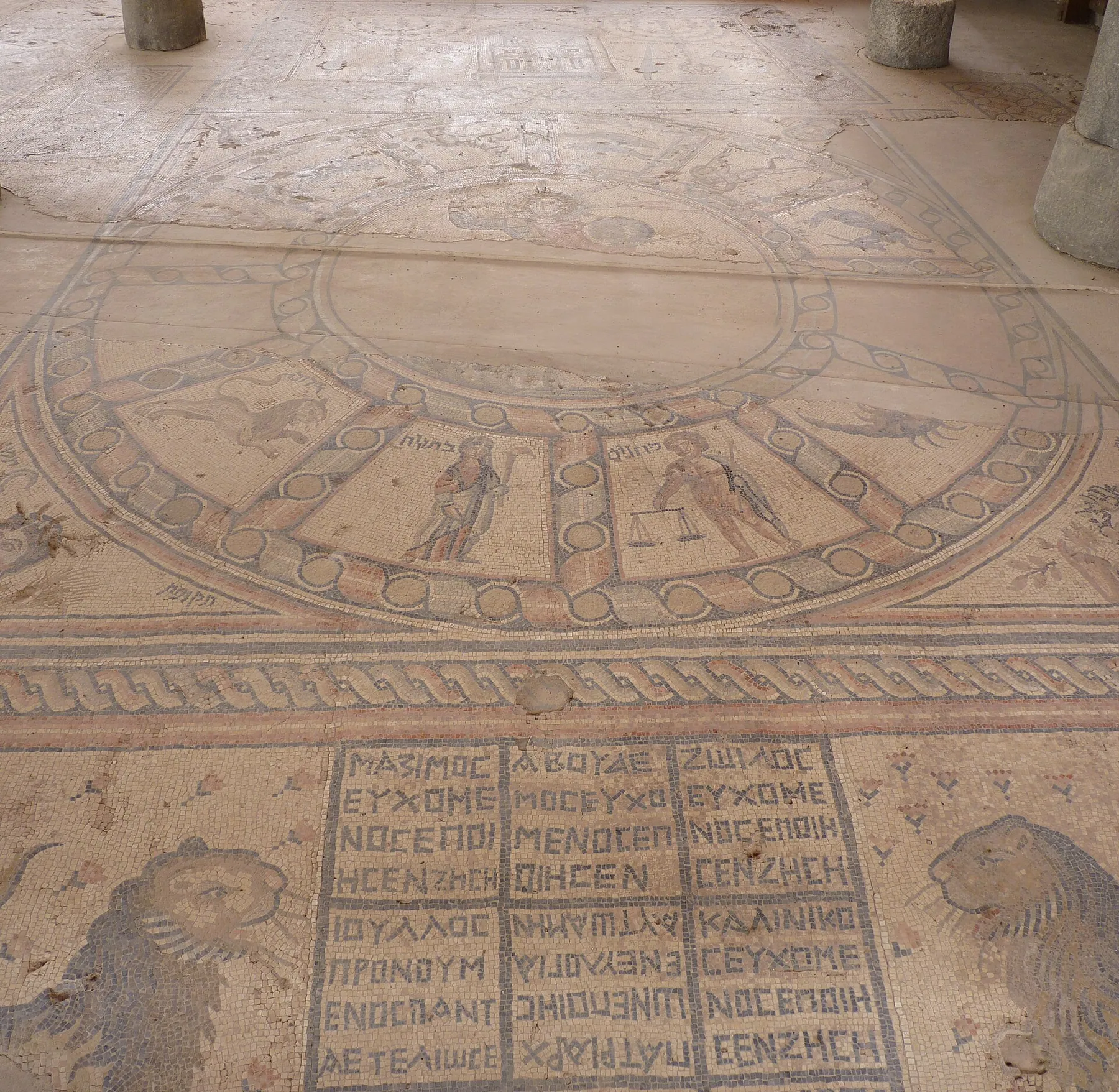
Hammat Tiberias lies on the western shore of the Sea of Galilee, at the hot springs just south of ancient Tiberias, with which it was joined, apparently in the first century CE. Moshe Dothan excavated a sequence of buildings against the southern city wall in 1961-1963 for the Israel Department of Antiquities. At the bottom was a large public building of the first or second century. Over it came a synagogue which the Israel Nature and Parks Authority dates to about 230 CE, and over that the hall this entry describes: a broadhouse of about 15 by 13 metres whose nave was paved in the fourth century with a three-panel mosaic showing a Torah shrine between two menorahs, a zodiac wheel around the sun god Helios, and Greek donor inscriptions guarded by two lions. One donor, Severos, is called a pupil of 'the most illustrious patriarchs', and the building is named after him.
Dothan concluded that this synagogue was destroyed in the fifth century, by an earthquake. A larger basilica was then built over it, rebuilt in early Islamic times, and finally destroyed about the middle of the eighth century. Jodi Magness has challenged these dates and the earthquake. The mosaic was left in place and can be seen under a modern shelter in Hamat Tiberias National Park. A second, northern synagogue, dug by Nahum Slouschz in 1921, is a separate building.
Where it stood
Ancient Hammath, against the southern city wall of Tiberias. Today: Hamat Tiberias (Hammat Tverya) National Park, Road 90 / Eliezer Kaplan Boulevard, between kilometre marks 412 and 413, south of Tiberias, Northern District, Israel. The pin is the site coordinate published for this synagogue by the Bornblum Eretz Israel Synagogues website (close to exact; not checked against a plan).
פתיחת מפה גדולה ←הקהילה היהודית
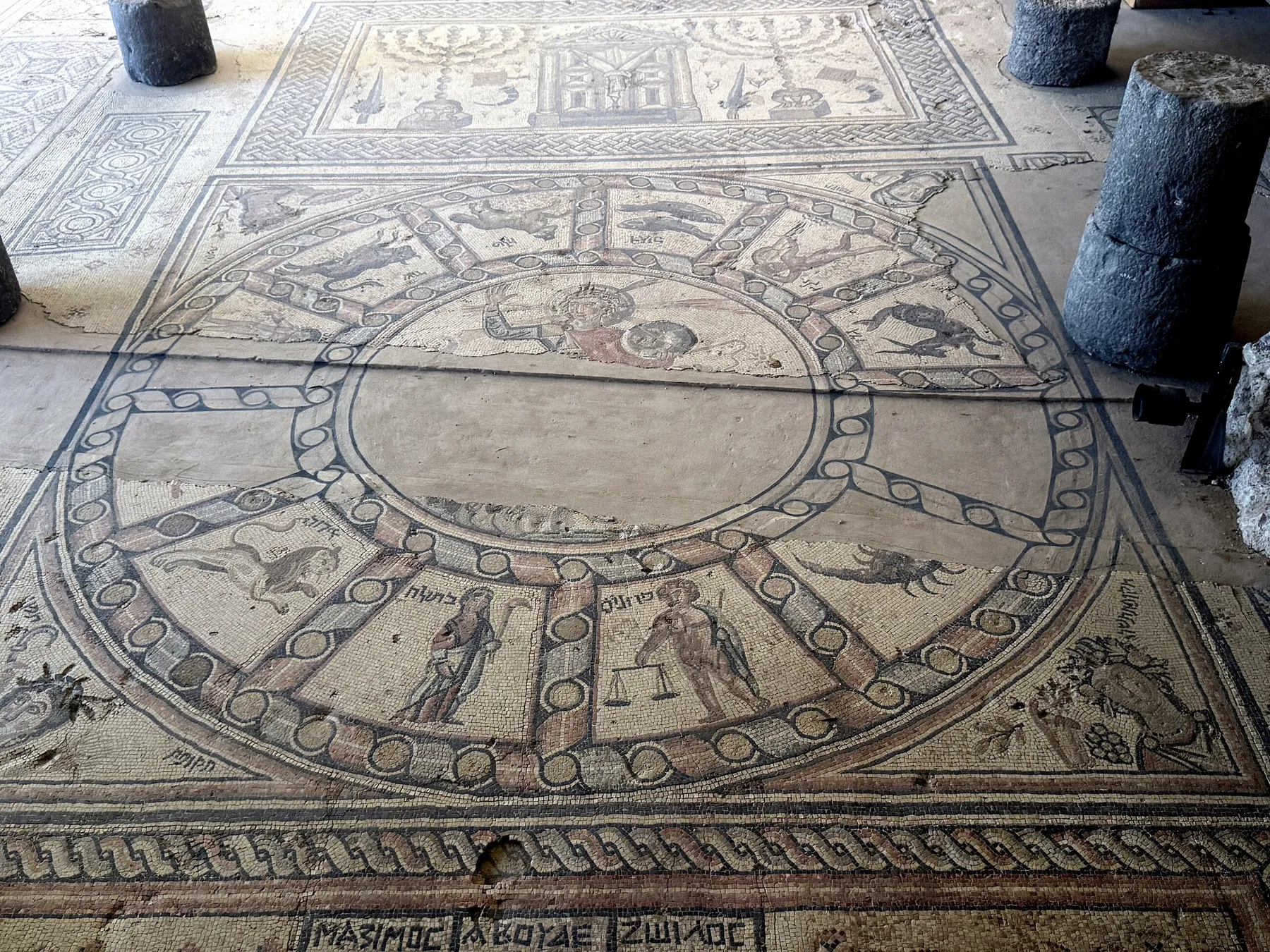
The congregation's size is unknown, and no ancient text read for this entry names the building; the evidence is the town and the floor. Hammath was a spa town: seventeen hot springs rise here, and by the first century CE it had apparently merged with neighbouring Tiberias. Tiberias was the seat of the Sanhedrin from 193 CE, and of the Jewish patriarchs until the patriarchate was abolished around 429 CE; Dothan read Severos's title, 'pupil of the most illustrious patriarchs', as one given to high officials of the patriarchal court. The donors named in the nave are Maximos, Aboudemos, Zoilos, Kalinikos, Siortasis, Profoturos, Severos and Ioullos. All the personal names are Greek in form and most dedications are in Greek, while the zodiac signs and seasons are labelled in Hebrew and one blessing is in Aramaic. That mixture, with Helios and nude figures on the floor, has been read as a sign of Jews living confidently alongside Hellenistic culture. The Encyclopaedia Judaica also notes that Rabbi Meir lived at Hammath, though nothing links him to this hall. After the patriarchate ended Hammath declined, but it survived as a city supported by its springs.
אדריכלות ועיצוב
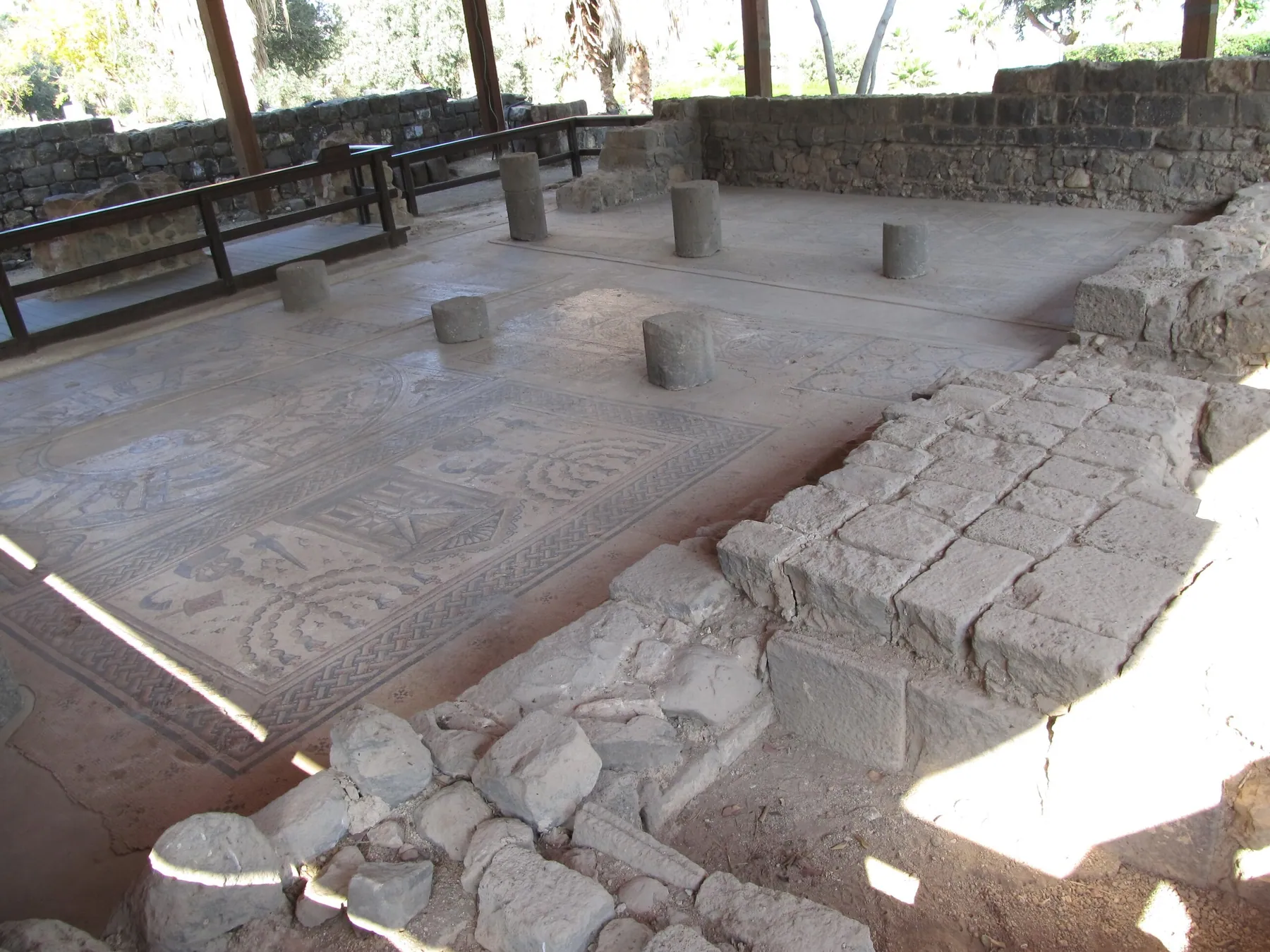
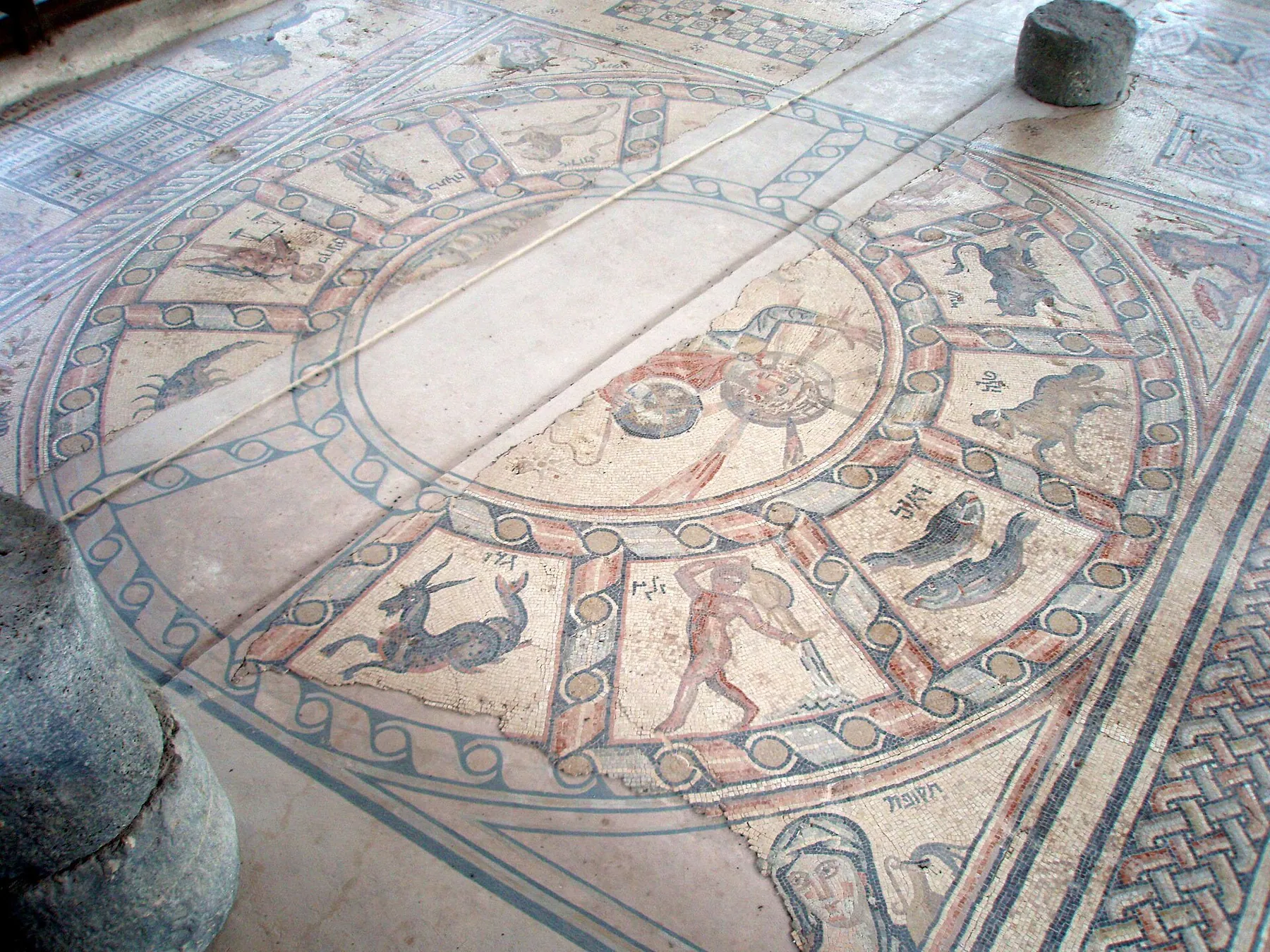
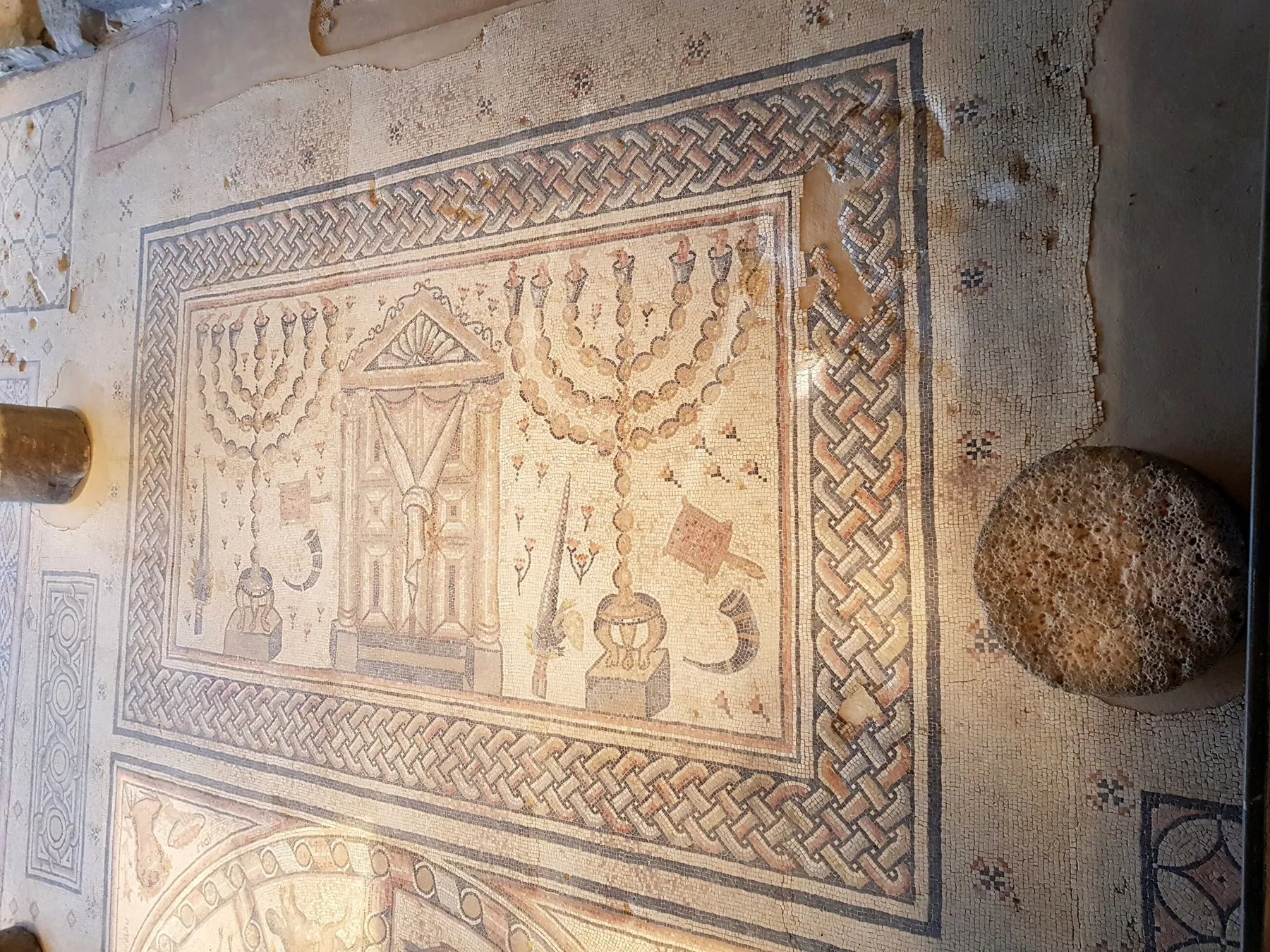
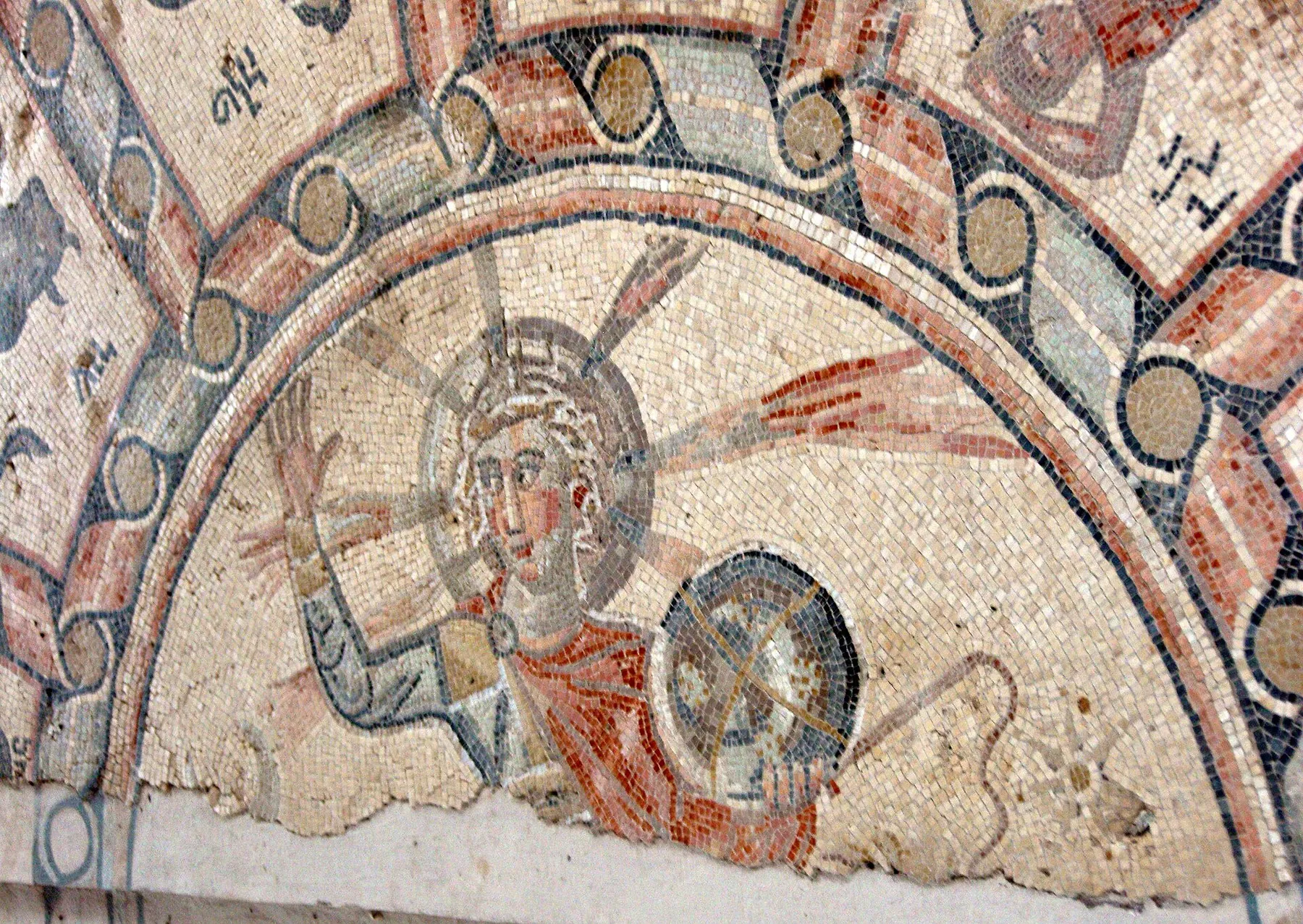
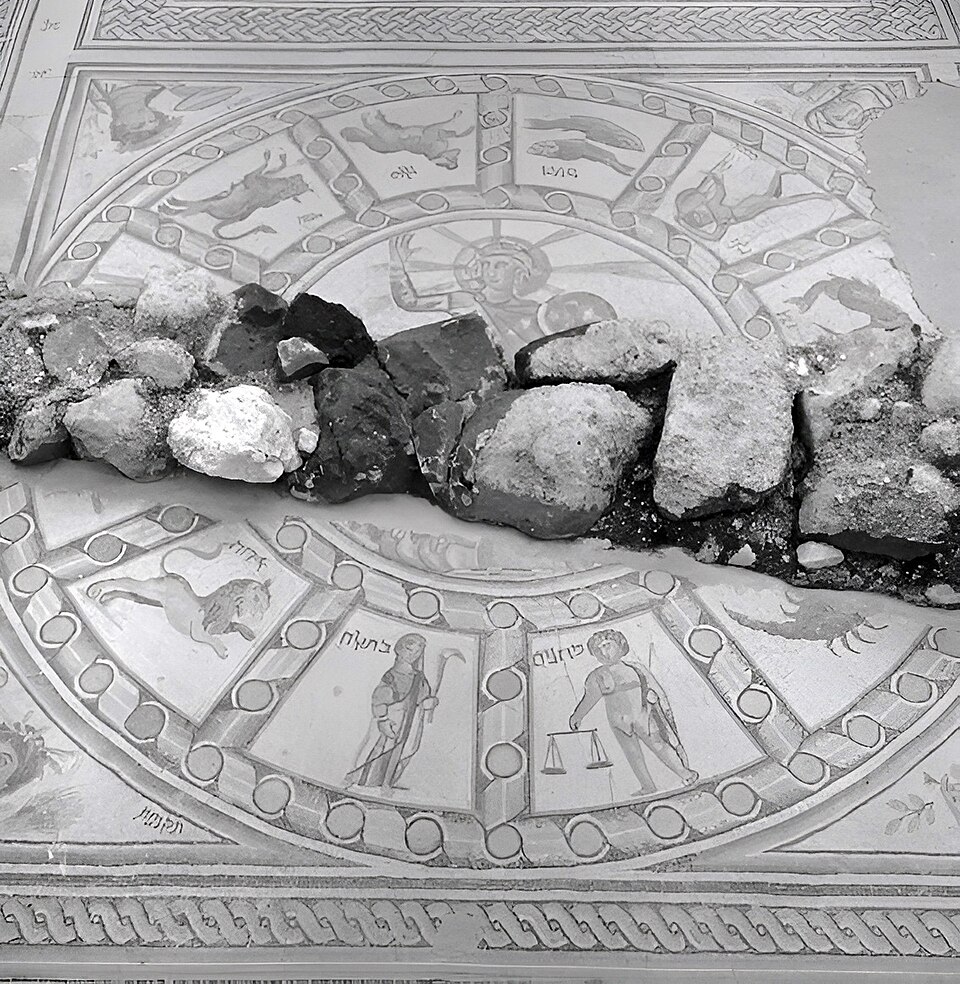
The Severus synagogue (Dothan's Level IIA) was a broadhouse of about 15 by 13 metres, oriented south-east to north-west. Three rows of three columns divided it into four parallel halls; the widest, second from the west, was the nave. Dothan's summary places a raised niche for the Torah ark at the southern end, reached by a step from the nave. Nave and aisles were paved with mosaics in some thirty hues. The nave floor has three panels. The southern one shows a gabled Torah shrine with a knotted curtain between two seven-branched menorahs, with lulav, etrog, shofar and incense shovel. The central panel is a zodiac wheel with Hebrew labels around Helios in his chariot, one hand raised and a globe and whip in the other, with busts of the four seasons in the corners; nine of the twelve signs survive. The northern panel has nine squares of Greek dedications between two lions. The eastern aisles have geometric carpets with further inscriptions. A photograph of 1971 shows a rough wall of a later phase still lying across the zodiac. The designer and the seating capacity are unknown; an overseer, Ioullos, is named.
החיים בבית הכנסת
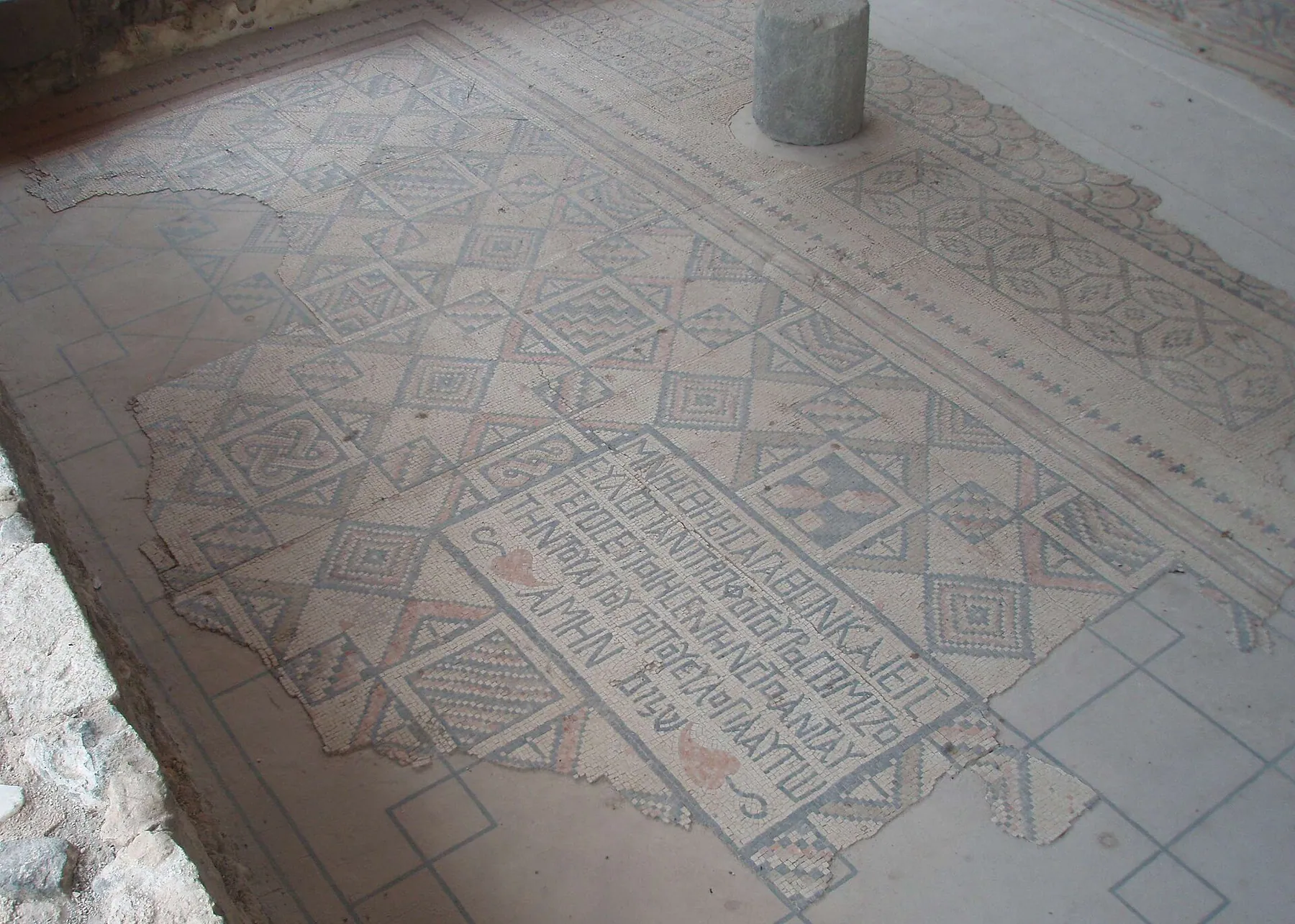
The floor is the main record of what happened here. Its southern panel shows what stood before the congregation: a Torah shrine with closed doors and a curtain, between lit menorahs, with a lulav, etrog, shofar and incense shovel. Giving was public and commemorated. In the nave, six men are each recorded in Greek as having fulfilled a vow, with a blessing added for several of them; Severos 'fulfilled it' as well, and 'Ioullos the supervisor completed the whole work'. In the east aisle a Greek text asks that Profoturos the elder, who made this aisle 'of the holy place', be remembered for good and for blessing, and it ends with the Hebrew word shalom. An Aramaic text in the same aisle wishes peace on 'anyone who has offered charity in this holy place' and blesses anyone who will, closing 'Amen, Amen, Selah'. So the hall was called a holy place, vows were paid to it, and Greek, Aramaic and Hebrew were all in use. The order of prayer, who led it and how many attended are unknown.
הרס
The first synagogue on the spot (Level IIB) ended, in Dothan's view, in an earthquake of the early fourth century; the Parks Authority says only that it was apparently destroyed in the third century. The Severus synagogue (Level IIA) was, in Dothan's words, 'evidently destroyed in the fifth century', and he attributed this to the earthquake of 419 CE; the Parks Authority likewise speaks of an earthquake at the beginning of the fifth century. Jodi Magness argued in 2005 that the building was laid out only in the late fourth or early fifth century and was used until the third quarter of the fifth century or later, and she does not accept an earthquake as the cause. No human attacker is named by any source read. A basilica (Level IB) was then built over the mosaic; Dothan thought it was destroyed in the first half of the seventh century. Its successor (Level IA), with everything around it, was destroyed 'in approximately the middle of the eighth century, and never rebuilt', an end attributed to the earthquake of 749 CE. Magness puts that last phase in the ninth or tenth century.
גורל הקהילה
Jewish worship continued on the spot after the Severus synagogue fell. A larger basilica with a nave, two aisles, an apse reached by three steps and an upper gallery was built over it; sources date it variously to the fifth or the sixth century. The synagogue's 'treasury' was hidden in the floor of a room on its west side. After the patriarchate was abolished around 429 CE the town declined but, in Dothan's account, kept going on the income of its hot springs. The synagogue was rebuilt once more at the start of Umayyad rule, with a new geometric mosaic that included a menorah; lamps with Arabic inscriptions and a jug with an Aramaic text about a gift of oil from Sepphoris belong to this last phase. Dothan put its end, with the rest of the quarter, in the mid-eighth century; nothing was rebuilt, and squatters used the ruins as dwellings and silos between the twelfth and fifteenth centuries. Magness dates the last synagogue to the ninth or tenth century, and the Parks Authority says the third synagogue functioned until the eleventh. What became of this congregation's members is unknown.
האתר כיום
The remains are inside Hamat Tiberias National Park (Hammat Tverya), on the western shore of the Sea of Galilee south of Tiberias, entered from Road 90. The fourth-century mosaic lies in place under a modern roofed shelter, surrounded by low basalt walls, column stumps and a block of later masonry, and visitors view it from a railed walkway. Beside the synagogue are remains of the southern city wall and gate, and the park also holds the Hamam Suleiman, a bathhouse of 1780 that now serves as a museum. The northern synagogue found in 1921 is not visible: the Bornblum Eretz Israel Synagogues website records it as lying under a modern hotel, and a limestone menorah from it is in the Israel Museum.
שמות בולטים
Severos (Severus)
4th century CEDonor named in the nave mosaic; 'pupil of the most illustrious patriarchs'Severos appears in the Greek dedications of the nave floor as a 'disciple of the most illustrious patriarchs' who fulfilled his vow, and a further Greek text credits him with completing the work. Moshe Dothan took the title to be one given to high officials at the court of the Jewish patriarchs in Tiberias. Because his name recurs, the excavators called the building the Synagogue of Severus. Nothing else is known of him.
ביוגרפיה או מקור ←Ioullos (Julius)
4th century CESupervisor (overseer) of the building work, named in the nave mosaicThe last line of the Greek dedications in the northern panel of the nave, in Dothan's translation, reads 'Ioullos the supervisor completed the whole work'. Dothan's encyclopaedia summary calls him Julius the parnas, a synagogue official, and says praise is given to him together with Severos. He is the only person connected by name with carrying out the building, but his exact office is uncertain and nothing more is recorded about him.
ביוגרפיה או מקור ←Profoturos (Profuturus) the elder
4th century CEDonor of an aisle, named in the east-aisle mosaicA Greek panel in the east aisle, 116 by 68 centimetres, asks that Profoturos the elder be remembered for good and for blessing because he made this aisle (stoa) 'of the holy place', and closes with a blessing, 'Amen', and the Hebrew word shalom. He is also listed among the men in the nave who fulfilled a vow. The Warsaw epigraphic database dates the panel to 270-325 CE.
ביוגרפיה או מקור ←יש לכם משהו לתרום?
תמונות, מסמכים, סיפורי משפחה וזיכרונות מבית הכנסת ומהקהילה שלו עוזרים לשמור על ההיסטוריה שלו בחיים.
- Hammath Tiberias Synagogue (site page, reproducing M. Dothan's entry in The New Encyclopedia of Archaeological Excavations in the Holy Land, 1993, with Magness 2005 and Weiss 2009)
- Hammath Tiberias Synagogue: Stratum IIA Earthquake (?)
- Hammath Tiberias Synagogue: Stratum IA Earthquake (?)
- Hammath Tiberias Synagogue: Stratum IIB Earthquake (?)
- Hamat Tiberias National Park
- Hamat Tiberias
- Hammath Tiberias
- Hammath Tiberias North
- Greek Inscriptions on Mosaic from Hammat Tiberias, Lower Galilee
- Aramaic Inscription from Hammat Tiberias, Lower Galilee
- Inscription 143: bilingual mosaic inscription of Profoturos, east aisle, Hammath Tiberias
- Building 11: Synagogue at Hammath Tiberias
- Hammath (Encyclopaedia Judaica)
- Hammat Tiberias: introduction
- Synagogue Excavation Reveals Stunning Mosaic of Zodiac and Torah Ark
- Hammath Tiberias, vol. II: Late Synagogues (publisher's page)
- The Historical Background of the Zodiac Mosaic Calendar in the Lower Synagogue at Hammath-Tiberias (abstract)
- Hammat Tiberias (Zodiac Synagogue)
- Category: Hamat Tiberias mosaic
Share a memory or thought
No comments yet. Be the first to add one.