
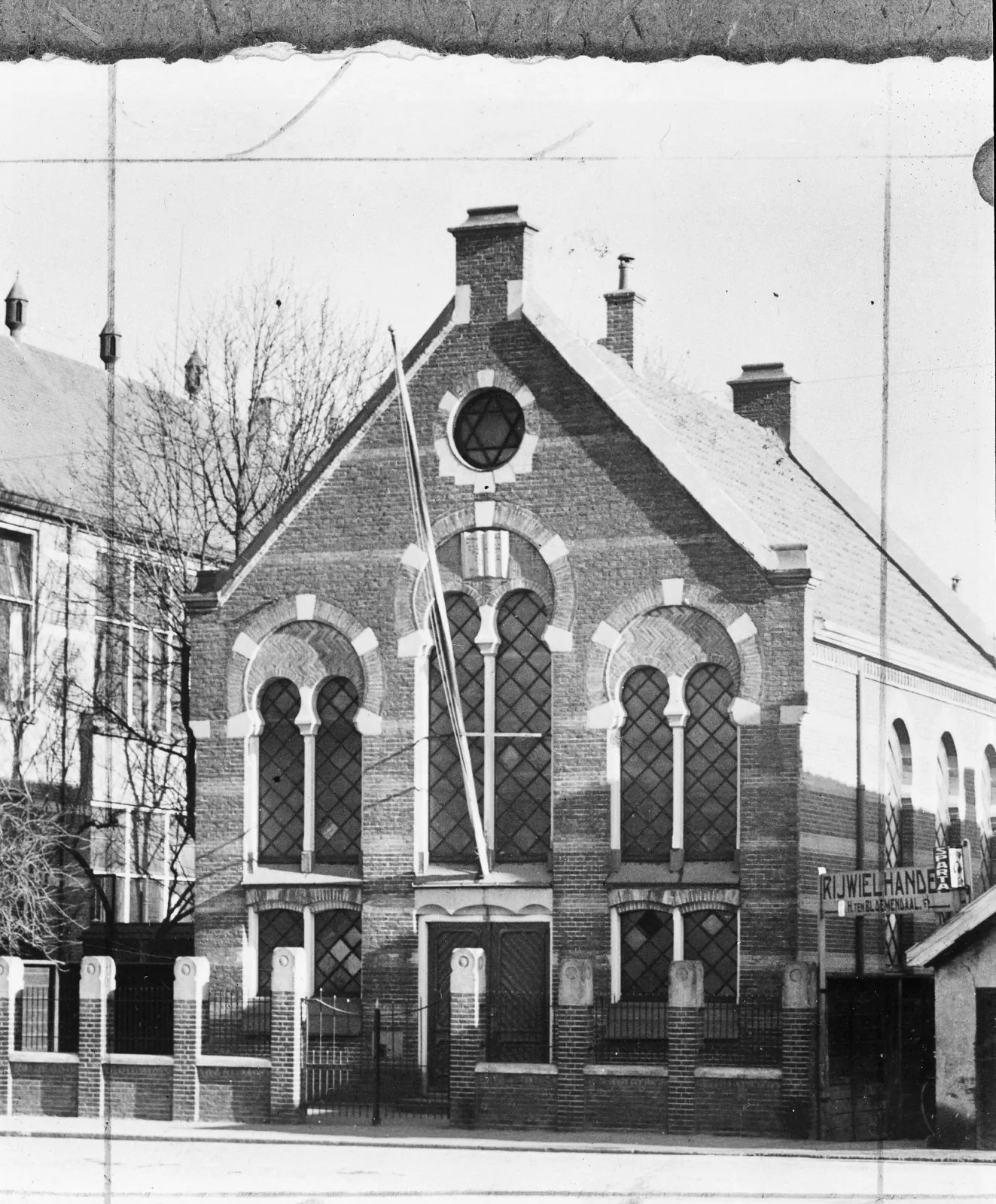
La historia de Hengelo Synagogue (Marktstraat)
Jews lived in Hengelo from the first half of the eighteenth century. They first prayed in a private house, used a cemetery on the Dennebosweg from 1775, and around 1830 became an independent community. In 1837 they dedicated a wooden synagogue; in 1848 it was replaced by a stone building with a school and a ritual bath. The Marktstraat, where the community worshipped, was later renamed Burgemeester Jansenstraat, according to a 2025 study commissioned by the municipality.
As Hengelo grew into an industrial town in the late nineteenth century, so did its Jewish population, from 49 in 1869 to 162 in 1899. In 1883 the community built a new, larger synagogue; the 2025 study places it on the same spot as its predecessors. It served the congregation for almost sixty years before the occupation. In August 1941 Nazi German occupiers and Dutch Nazis (NSB members) wrecked the interior, although the furnishings had been taken to safety beforehand.
After the war only the walls were standing. The small surviving community restored the building and reconsecrated it in 1951. Less than a decade later it was pulled down under a plan to reorganise the town centre, and in 1966 the congregation opened a new synagogue on the Dorpsmatenstraat.
Where it stood for 77 years
Historic: Marktstraat (later Burgemeester Jansenstraat), Hengelo, Overijssel; house number unknown. Today: central Hengelo; pin at the midpoint of the present Marktstraat, 7551 Hengelo (approximate; the present street may not exactly match the historic one).
Abrir mapa ampliado →La comunidad judía
The Jews recorded in Hengelo around 1813 were mostly traders, shopkeepers and pedlars, and were generally not well off. The community numbered 46 in 1809, 37 in 1840 and 49 in 1869. Growth came with the Twente textile industry, in which Jews played a relatively large part: in 1912 S. Ph. de Jong and the Van Dam brothers founded the Eerste Nederlandse Kantfabriek, a lace factory, in Hengelo. By 1899 there were 162 Jews, and by 1930 there were 247, the largest figure recorded before the occupation; in the 1930s refugees from Germany added to their number. The congregation was governed by a seven-member board and supported a women's society, a burial society, a charity society and a poor-relief board. Its social life included a theatre association, a Jewish youth association and a Zionist group. When the cantor Heiman Leefsma took office in 1908 the community counted 48 families; at his 25th anniversary in 1933 it had about 240 members in 73 families.
Arquitectura y diseño
No description of the 1883 building was found in the sources read. Its architect, builder, style, seating capacity and the arrangement of its interior are unknown, and no photograph or drawing securely identified as this building was located during this research. The 2025 municipal study states that the synagogue of 1883 was built on the same plot as the stone synagogue of 1848, which had been combined with a school and a ritual bath, but it does not say whether any of the older structure was reused. The fact that the building could be restored after the war, when only its walls survived, suggests that it was a masonry structure. The building's fiftieth anniversary was celebrated in 1933, together with the jubilee of the cantor Heiman Leefsma. A photograph held by the Rijksdienst voor het Cultureel Erfgoed and the Jewish Cultural Quarter, captioned as the front of the former wooden synagogue in the Jansenstraat around 1930, may in fact relate to this site, but its identity has not been resolved and it is not used here.
La vida dentro de la sinagoga
The religious life of the synagogue in its last decades before the war was led by Heiman Leefsma, who served the congregation as chazzan (cantor) and religious teacher from 1908 to 1942. He led the services in the building and taught the children of the community, which by the early 1930s had grown to about 240 people. In 1933 the congregation marked both his 25 years of service and the synagogue's 50th anniversary. Around the synagogue the community ran a burial society, a women's society, a charity society and a poor-relief board, and its members also maintained a theatre association, a Jewish youth association and a Zionist organisation, reflecting the mix of traditional and modern Jewish life in an industrial Twente town. No rabbi of Hengelo is named in the sources read, and the names of the board members are unknown. The 1848 predecessor had housed a school and a ritual bath on the same site; whether these continued after 1883 is unknown.
Destrucción
On 18 August 1941, during the occupation, a group of Dutch Nazis (NSB members) and Nazi German soldiers broke into the synagogue and wrecked it. The furnishings and ritual objects had been taken to safety beforehand and were kept by a non-Jewish resident of Hengelo. How the building was used for the rest of the occupation is not recorded, but by the end of the war only its walls were left standing. Hengelo suffered air raids during the war; none of the sources read mentions bomb damage to the synagogue, and the shell survived to be restored after liberation. The small postwar congregation repaired it and reconsecrated it in 1951. In 1960 it was demolished because of a plan to reorganise the town centre; the 2025 municipal study dates the demolition only to the 1960s. Who decided on and carried out the demolition, and whether the building was first sold, is not recorded in the sources found.
El destino de la comunidad
In the 1930s many Jewish refugees from Germany settled in Hengelo, and the community reached its largest size at the start of the occupation. The first major raid against Hengelo's Jews came in mid-September 1941, a month after the synagogue was wrecked. From the summer of 1942 they were deported in the general deportations from the Netherlands. The Jewish Council in Enschede urged Jews in the region to go into hiding, and many did so in the surrounding countryside. Even so, more than half of Hengelo's Jews were deported to the camps and only a few returned. The cantor Heiman Leefsma moved to Amsterdam in 1943 with his second wife Johanna Geertruida Zwarenstein; they and their baby son Benjamin Mozes were deported via Westerbork to Sobibor on 20 July 1943 and murdered there on 23 July. Two of his daughters were also killed, one in Auschwitz and one in Sobibor. After the war the community numbered 86 in 1951, 70 in 1971 and 32 in 1998.
El lugar hoy
The synagogue stood on the street known in 1883 as the Marktstraat, which according to the 2025 municipal study was later renamed Burgemeester Jansenstraat. The building was cleared in 1960 during the reorganisation of the town centre, and nothing of it survives. The exact plot has not been matched to a modern address in the sources read; no Burgemeester Jansenstraat is found in current OpenStreetMap data. A monument was placed on the Burgemeester Jansenstraat on the spot where the old building stood. The congregation has worshipped since 1966 in a new synagogue on the Dorpsmatenstraat, which is a separate building and not a successor on the same site.
Nombres destacados
Heiman Leefsma
died 23 July 1943Chazzan (cantor) and religious teacher of Hengelo, 1908-1942Leefsma served Hengelo's congregation as cantor and religious teacher from 1908 to 1942, leading the services in the Marktstraat synagogue for more than three decades. He took office when the community had 48 families; in 1933 his 25th anniversary was celebrated together with the synagogue's 50th, when the congregation numbered about 240 people in 73 families. He was murdered in Sobibor with his wife and baby son in July 1943. A street in Hengelo, the H. Leefsmastraat, bears his name.
Biografía o fuente →¿Tiene algo que aportar?
Fotografías, documentos, historias familiares o recuerdos de esta sinagoga y su comunidad ayudan a mantener viva su historia.
- Hengelo (Overijssel) (Joodse gemeenten)
- Hengelo (Overijssel) (Jewish communities, English version)
- Joodse burgers in Hengelo: onteigening en rechtsherstel (December 2025)
- Over Heiman Leefsma
- Voorgevel van de voormalige houten synagoge in de Jansenstraat te Hengelo (O) ca. 1930, reproductie
- Marktstraat, Hengelo (OpenStreetMap way 6670767)
Share a memory or thought
No comments yet. Be the first to add one.