
הסיפור של Herne Synagogue
Herne's Jews worshipped as part of the Bochum synagogue community until 1889, when they formed an independent congregation and used a prayer room in their school building. As the mining town grew, so did the community, and in 1910 it elected a building commission, bought a plot at Schaeferstraße 32, on the corner of the then Hohenzollernstraße, and laid the cornerstone in mid-1910. The new synagogue, designed by the Bochum architect Heinrich Robert, was dedicated in summer 1911 in a ceremony conducted by the Bochum rabbi Dr. Moritz David and attended by the town's leading officials; the local press described the day as a celebration for the whole city. With seats for about 350 people, an organ and a mixed choir, it served the community's liberal majority for 27 years and was also valued for its acoustics, which later brought secular concerts into the hall. During the November Pogrom of 1938, SA men acting under the direction of the NSDAP district leadership set the building alight. The roof and interior burned out in front of several thousand onlookers and the dome collapsed. The ruins were demolished over the following months and the city sold the cleared plot to the Hibernia mining company. No fabric of the building is known to survive.
Where it stood for 27 years
Historic: Schaeferstraße 32, corner of Hohenzollernstraße (now Hermann-Löns-Straße), 44623 Herne. Present: corner of Schaeferstraße and Hermann-Löns-Straße, Herne, marked by a 1963 memorial stone. Location approximate at street-corner level; exact footprint not surveyed.
פתיחת מפה גדולה ←הקהילה היהודית
Jewish settlement in Herne was small for most of the nineteenth century: a butcher named Salomon is recorded around 1806, and the community still numbered only 45 people in 1871. Industrialisation changed this. With the expansion of coal mining, Herne's population rose rapidly and its Jewish population reached 163 in 1895 and roughly 300 by the years before the First World War. Until 1889 these families belonged to the Bochum synagogue community; that year they established their own Synagogengemeinde, with neighbouring Baukau attached. A school opened in 1889 at Schulstraße 30 and its building contained a prayer room, which served as the place of worship until 1911. Under Moritz Gans, a textile merchant who led the congregation from 1901, the community decided to build a representative synagogue. The Jewish population peaked in the 1920s at around 470–530, including many Eastern European Jewish workers, some of them transient migrants.
אדריכלות ועיצוב
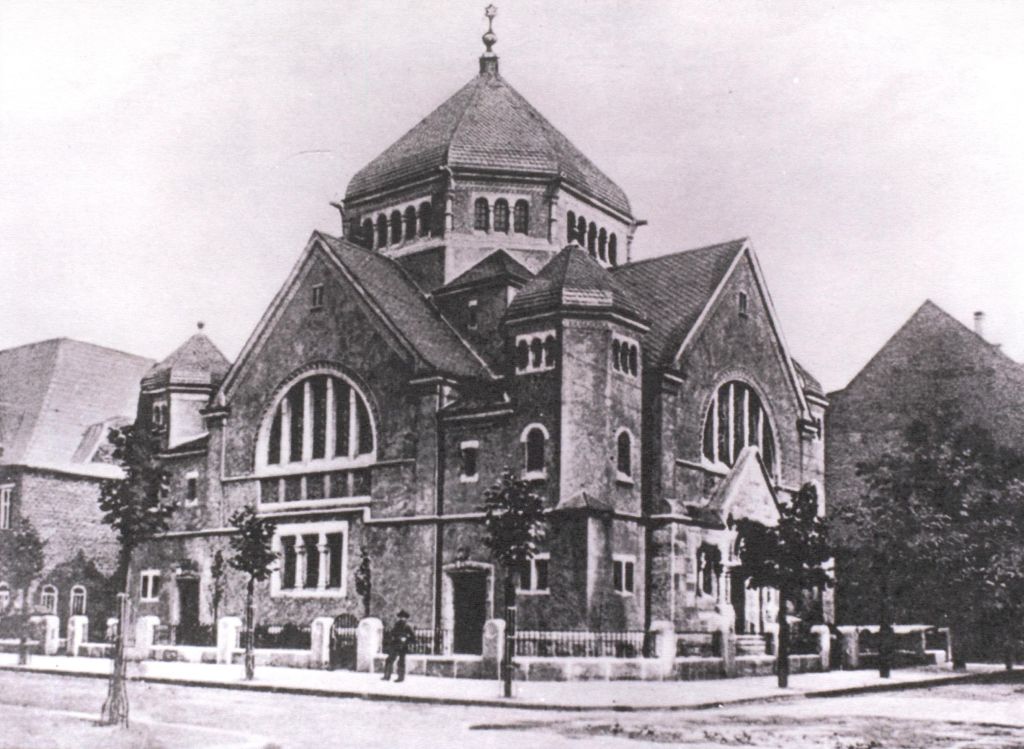
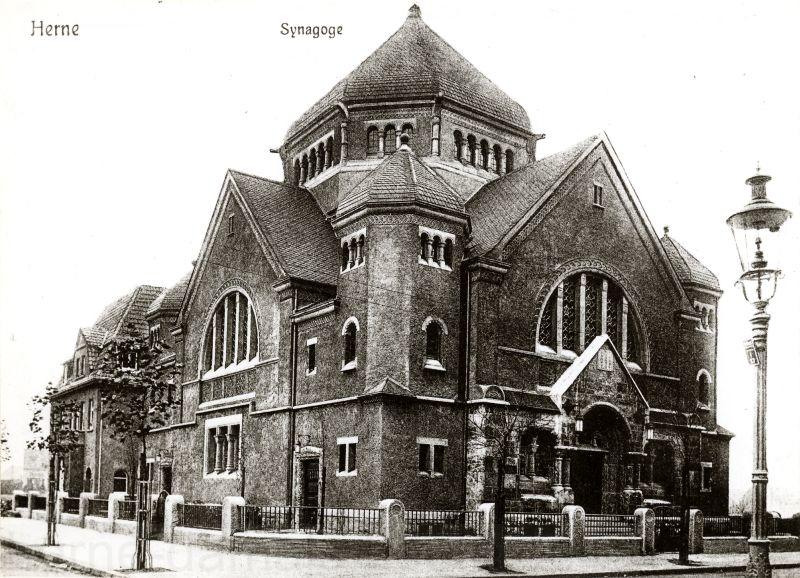
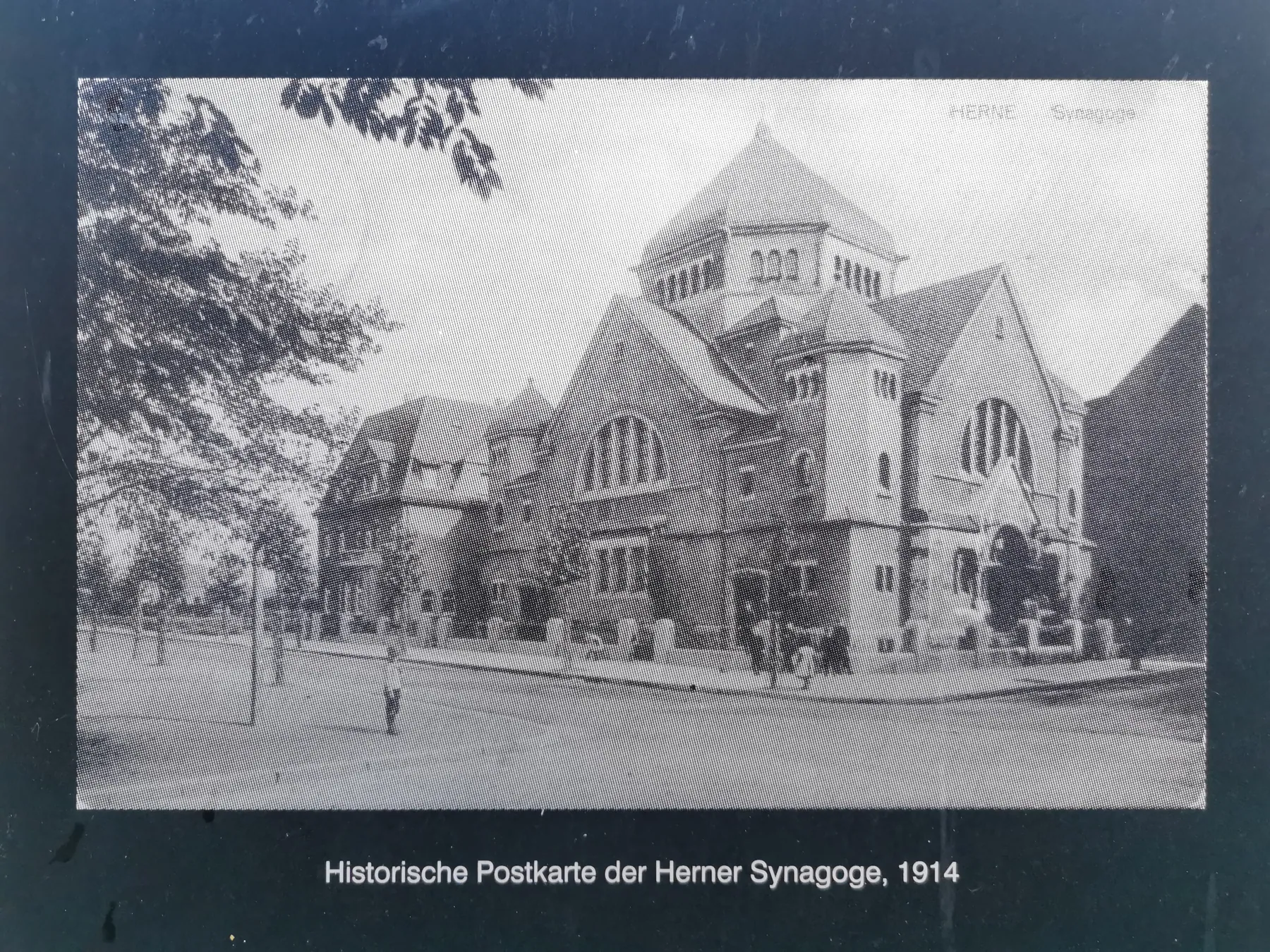
The synagogue stood on a corner plot at Schaeferstraße 32 and Hohenzollernstraße (now Hermann-Löns-Straße). Surviving photographs show a substantial brick building on a centralised plan: gabled wings with large round-arched, multi-light windows surrounded a tall central tower carrying a ribbed, domed roof over an arcaded drum, with a smaller turret at one corner and a projecting arched entrance porch. Contemporary descriptions summarised by Hildebrandt record generous leaded-glass windows, an oak portal with bronze fittings and a vestibule with a marble fountain. The prayer hall held about 350 people, with 196 seats on the ground floor and 138 in the women's gallery. The inclusion of an organ reflects the congregation's liberal orientation. Regional surveys compare the design with other Westphalian synagogues of the period, such as those in Münster and Detmold. Plans, construction cost and a formal stylistic attribution have not been verified from available sources.
החיים בבית הכנסת
The Herne congregation followed a liberal rite. An organ and a mixed choir are documented at the dedication in 1911 and were still mentioned in mid-1936. Religious leadership rested largely on the teacher Jacob Emanuel, who taught at the Jewish school from 1899 and also served as prayer leader and preacher; a cantor named Hartogsohn is recorded in 1936, and ritual slaughterers served the community in succession. Moritz Gans chaired the congregation for more than 25 years and received the honorary title Chower in 1927. His successor Sally Samson died in December 1932 while attending a service. The more orthodox, largely Eastern European members kept the old prayer room in the school building as their meeting place after 1911. The hall's acoustics were considered excellent, and it was later also used for secular concerts. The public Jewish elementary school, with 22 to 48 pupils between 1911 and 1932, was closely tied to congregational life.
הרס
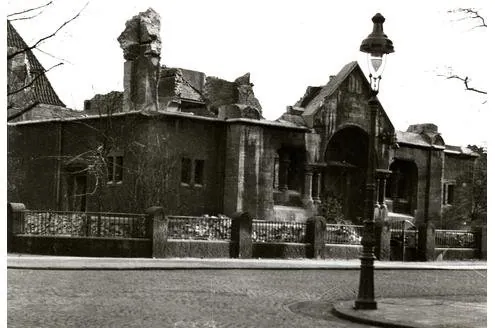
On the night of 9–10 November 1938, during the nationwide November Pogrom, members of the SA acting under the direction of the local NSDAP district leader (Kreisleiter) set fire to the Herne synagogue. The roof structure and the entire interior burned out while several thousand spectators watched, and the dome collapsed. Individual names of the perpetrators have not been verified from the sources consulted. The same night, Jewish shops and apartments in Herne were attacked, windows were smashed and property was looted, and the Jewish school building was also destroyed. At least seventeen Jewish men were taken to Sachsenhausen concentration camp for several weeks. A community member, Moritz Feuerstein, rescued a Torah scroll, which later reached Israel. The authorities ordered the ruin to be cleared immediately; demolition dragged on until February 1939 and the last debris was removed in June 1939. After the site was levelled, the city of Herne sold the plot to the Hibernia AG mining company.
גורל הקהילה
Persecution began with the boycott of April 1933, when SA men photographed customers entering Jewish shops. The community shrank from 467 people in June 1933 to 341 in 1937 as families emigrated. In the Polenaktion of late October 1938, 54 Jews of Polish nationality were expelled to the Polish border, and 21 more were deported in July 1939. After the pogrom, businesses were closed and Jewish families were concentrated in so-called Jew houses, including the home of former chairman Moritz Gans, who died there in April 1942 shortly before his scheduled deportation. Around 40 Jews were deported to the Riga ghetto in January 1942, 31 to Zamość in April 1942 and 22 to Theresienstadt in July 1942. The last chairman, Sally Neugarten, and his wife Frieda were deported to Auschwitz in February 1943. Local sources estimate that about 250–275 Jews from Herne were murdered. A small community re-formed under Edgar Wahl in December 1945 and merged with Bochum and Recklinghausen in 1953.
האתר כיום
No part of the synagogue survives. After the ruins were demolished in 1939, the levelled plot at the corner of Schaeferstraße and Hermann-Löns-Straße was sold by the city to the Hibernia AG mining company. The present use of the plot, and whether any later building stands on the exact footprint, has not been verified from the sources consulted. The site is marked by a granite memorial stone with a bronze inscription, unveiled on 10 November 1963, stating that the synagogue of the Jewish community of Herne stood here. The present Jewish community serving Herne is the Jüdische Gemeinde Bochum–Herne–Hattingen, which worships in Bochum.
שמות בולטים
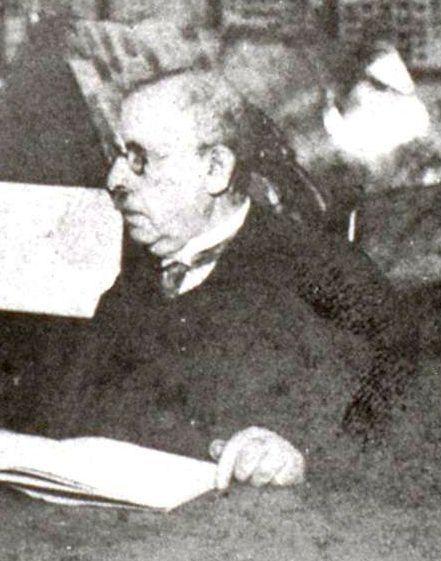
Moritz Gans
2 October 1865 – 23 April 1942Chairman (Vorsteher) of the congregationTextile merchant who led Herne's Jewish congregation from 1901 for more than 25 years; the synagogue was planned, built and dedicated under his leadership, and he received the honorary title Chower in 1927. A liberal city councillor, he was persecuted after 1938, his home became a Judenhaus, and he died there shortly before his scheduled deportation to Theresienstadt.
ביוגרפיה או מקור ←Heinrich Robert
Dates unknownArchitectBochum architect who drew the plans for the Herne synagogue, begun with the cornerstone laying in mid-1910 and dedicated in 1911. The regional handbook of Jewish communities in Westphalia names him as the designer and notes that he also designed the Jewish home for the elderly in Unna, making him one of the architects working for Jewish institutions in the Ruhr region.
ביוגרפיה או מקור ←Dr. Moritz David
Dates unknownRabbi (Bochum), officiant at dedicationRabbi of the Bochum synagogue community, to which Herne's Jews had belonged until 1889. He led the dedication ceremony of the Herne synagogue in 1911, according to the regional handbook, linking the new building to the wider liberal rabbinate of the Ruhr region.
ביוגרפיה או מקור ←Jacob Emanuel
Dates unknownTeacher, prayer leader and preacherTeacher at Herne's Jewish school from 1899 who also served the congregation as prayer leader and preacher. He was one of the principal religious functionaries of the community during the years the synagogue was planned, dedicated and used, and the school building where he taught housed the earlier prayer room.
ביוגרפיה או מקור ←Sally Neugarten
Dates unknownLast chairman of the congregationLast chairman of Herne's Jewish community under Nazi rule, leading the remnant congregation after the synagogue's destruction in 1938. He and his wife Frieda were deported to Auschwitz in February 1943, a deportation that marked the effective end of the historic congregation that had worshipped in the building.
ביוגרפיה או מקור ←Moritz Feuerstein
Dates unknownCongregation memberMember of the Herne congregation who managed to rescue a Torah scroll from the synagogue when it was set on fire during the November Pogrom of 1938. According to the regional handbook, the scroll he saved later reached Israel, one of the few known surviving ritual objects from the building.
ביוגרפיה או מקור ←יש לכם משהו לתרום?
תמונות, מסמכים, סיפורי משפחה וזיכרונות מבית הכנסת ומהקהילה שלו עוזרים לשמור על ההיסטוריה שלו בחיים.
Share a memory or thought
No comments yet. Be the first to add one.