
Die Geschichte von Heves Synagogue
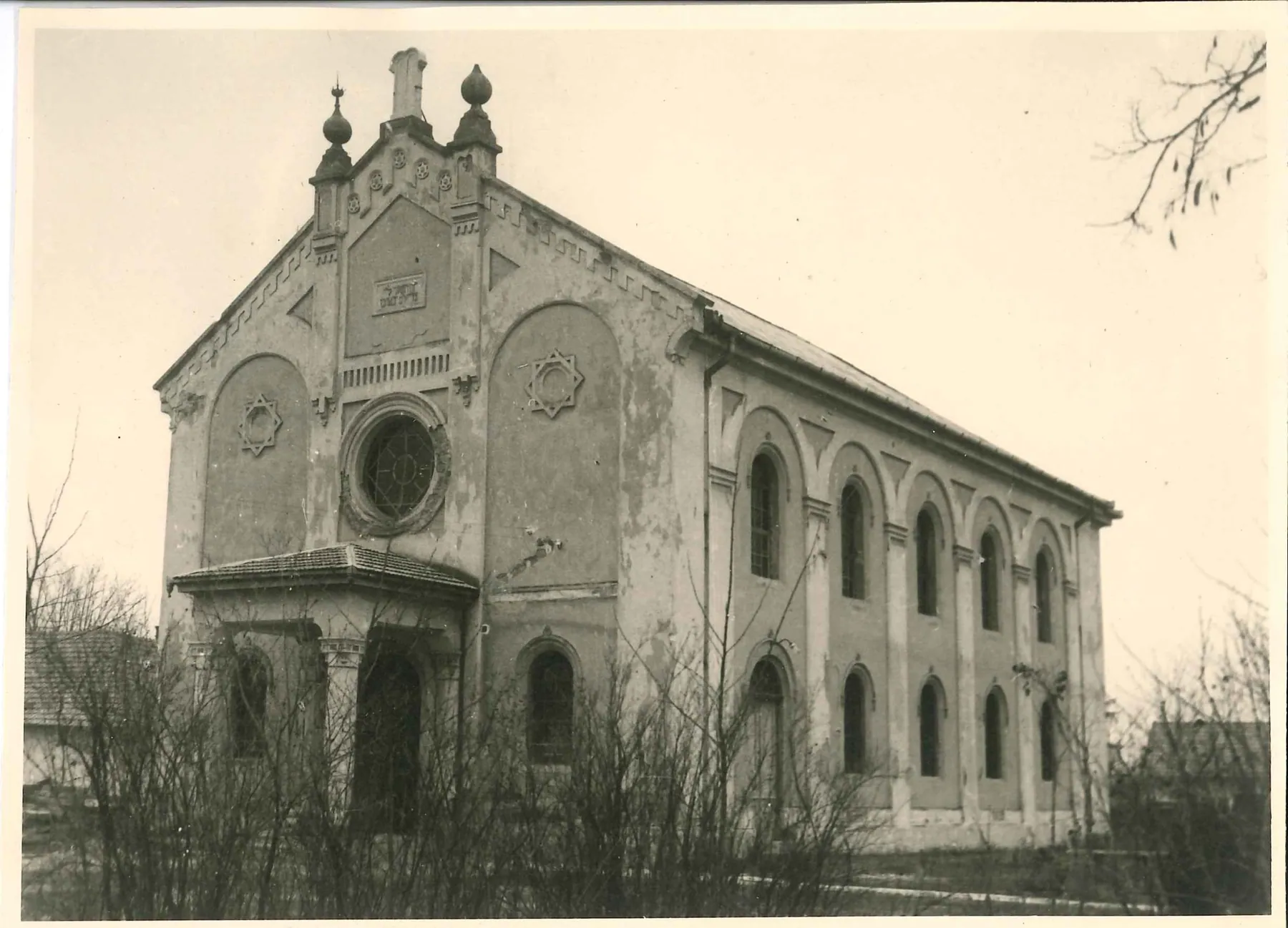
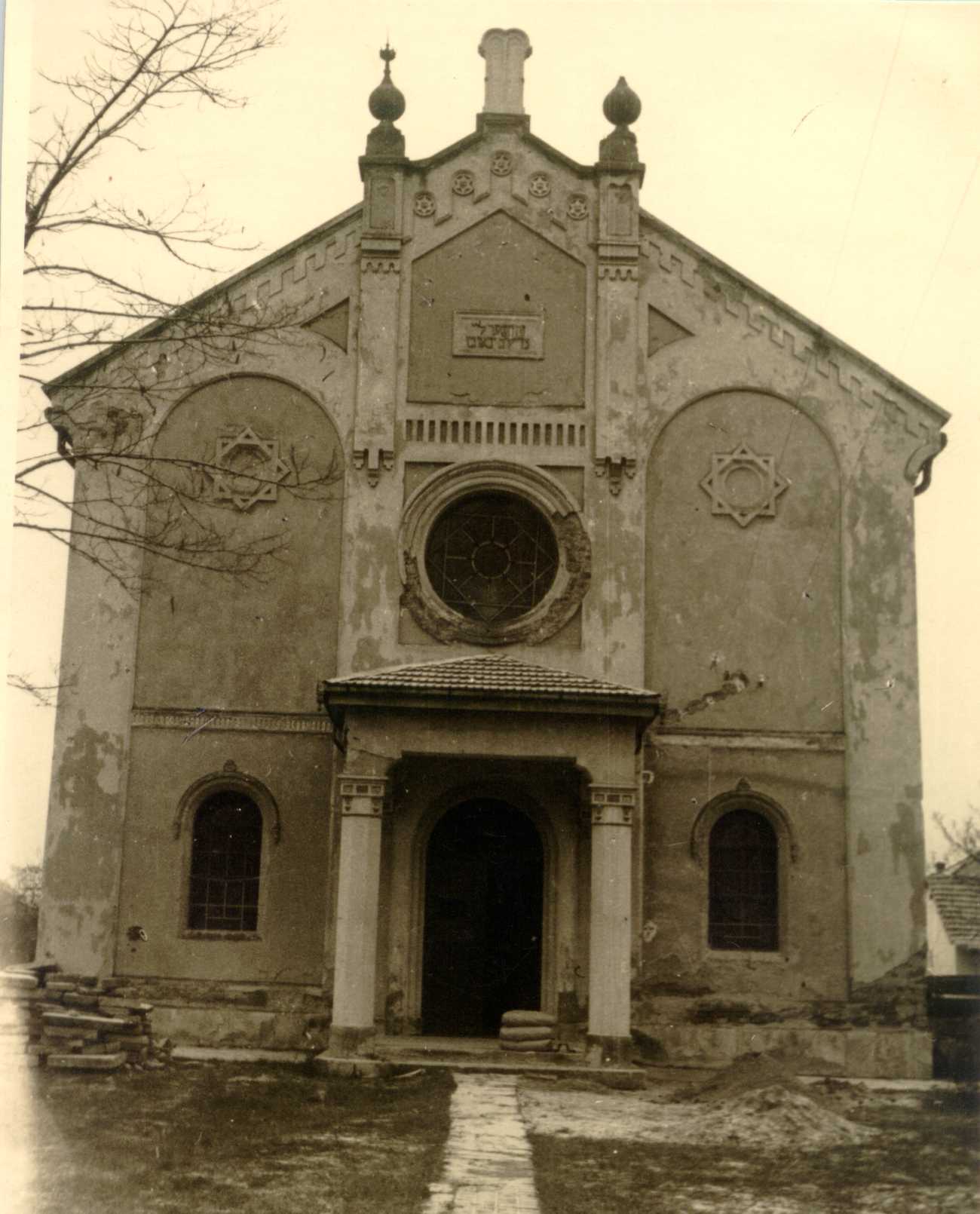
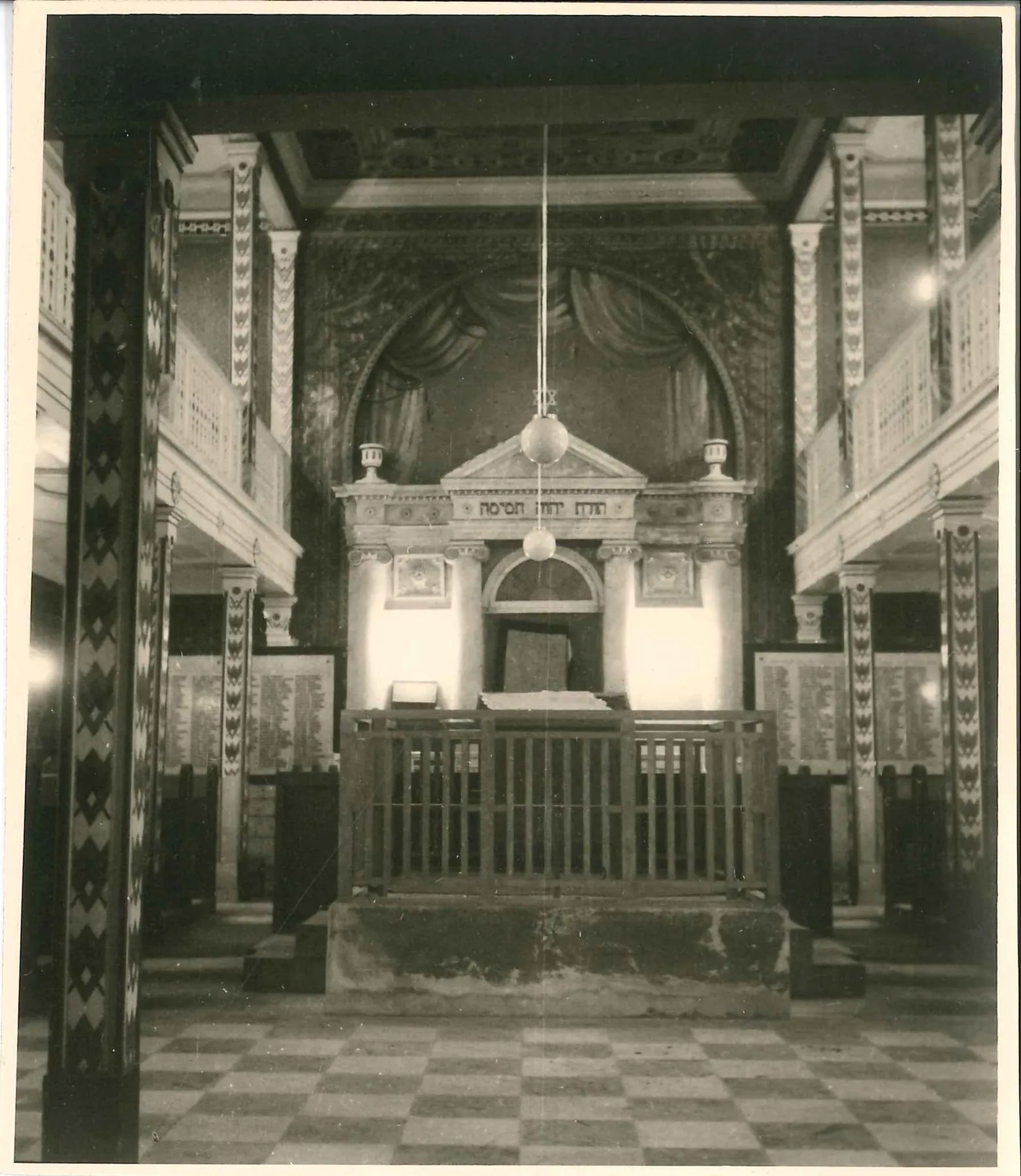
Heves, the small town that gave Heves county its name, had one of the county's oldest Jewish communities. Its synagogue was built in 1867 on Baross utca, a street running north-east from the main square; a Budapest writer who spent childhood summers there remembered it as the first building in the street. A letter from Heves printed in the weekly Eger in April 1867 complained that the Israelites wanted the town's finest plot for their synagogue, which spurred the townspeople to buy that plot for a school instead. The synagogue was restored in 1925. Photographs taken in 1948 show a free-standing, gabled hall with a rose window, Stars of David and onion-capped pinnacles, and a galleried interior with a central reading platform. The Jews of Heves were deported in 1944; the building stood through the war, was looted while the town lay evacuated, and was repaired by the returning survivors in 1947. As the community dwindled it was sold, and in 1981–82 the Budagant glove-makers' co-operative rebuilt it as a glove factory. A survey of Hungary's synagogues made in the 1980s records it as demolished, and by 2000 only its walls were said to stand. Its furnishings are preserved in the Jewish cemetery.
Where it stood for nearly 120 years
Historic: Baross utca 13, Heves. Today: Baross Gábor utca 13–15, 3360 Heves, Hungary (site of the former Budagant glove factory).
Größere Karte öffnen →Die jüdische Gemeinde
The 1929 Hungarian Jewish Lexicon dates the Heves community to 1788 and names its founders as Náthán Frank, Éliás Adler and Gumprecht Schwarc; a recent county study gives 1747, and the Jewish cemetery already appears on the military survey of 1783. Heves mattered to Jewish traders because it lay beside the Jászság district, closed to Jewish settlement until the 1850s, where they went daily to do business. A burial society was founded in 1830. In 1844 there were 204 Jews in 37 families, among them leaseholders, wholesalers, shopkeepers, pedlars and craftsmen, and 27 Jewish soldiers from Heves served in the 1848–49 War of Independence. A Hungarian-language elementary school opened in 1856 and ran until 1944. Numbers peaked at 631 in 1880 and then fell slowly: 513 in 1910, 407 in 1929 and 331 in 1941. In 1929 the congregation counted 34 merchants, 22 farmers, 17 artisans, ten clerks, five lawyers and three doctors, kept women's and girls' societies, and served eleven surrounding villages. The writer Lajos Bíró and the critic Ludwig Hevesi were born in Heves.
Architektur und Gestaltung
No architect or builder is recorded, and no plans are known; the description rests on three photographs in the Hungarian Jewish Museum and Archives. The synagogue was a free-standing, plastered rectangular hall under a pitched roof, its gable end forming the main front. That front was divided into three bays by pilasters which rose above the roofline as pinnacles capped with small onion-shaped finials. The side bays held tall blind arches, each carrying a Star of David in relief, over small round-headed windows. The centre had a columned entrance porch with a tiled roof, a large rose window with star tracery, a Hebrew inscription tablet and a gable set with rosettes and crowned by the Tablets of the Law. The side walls had two tiers of round-arched windows. Inside, women's galleries with latticed parapets ran along the sides on slender columns painted with zigzag patterns. The reading platform stood in the middle of the floor behind a wooden railing. The ark was a classical aedicule with columns and a pediment, inscribed in Hebrew 'The law of the Lord is perfect', set in an arched niche painted with drapery.
Leben in der Synagoge
The first known rabbi, Fülöp Trencsiner, was in office when the synagogue was built and died in 1869. That year the congregation elected Márk Handler, a favourite pupil of the Ketav Sofer of Pressburg and a noted Hungarian-language preacher; he was still rabbi of Heves in 1880 and later moved to Tata. His son Simon Hevesi became chief rabbi of Pest. Jakab Elfer, previously rabbi at Gyula, served from about 1887 until after 1919; on the coronation anniversary in June 1892 the town's officials walked from the Catholic church to the packed synagogue to hear him preach, and a choir closed with the national anthem. Dr József Friedmann is attested as chief rabbi from 1929 to 1944, with Benő Friedmann as cantor and Ernő Szőke as president in 1929. In 1936 the town's national flag was blessed in the Catholic, Reformed and Jewish houses of worship in turn. A survivor, Lili Kertész, recalled that the congregation was sitting in the temple at Passover 1944 when it learned that it must go into a ghetto. After the war tablets naming the dead were set up beside the ark.
Zerstörung
The synagogue was not destroyed in the war. After the deportation of 1944 the Hungarian state sequestrated Jewish property, and in June the local Reformed congregation discussed claiming the empty building for its own use. It was not damaged in the fighting, but it was looted during the three months of 1944–45 when the population of Heves was evacuated under Soviet occupation. The returning survivors renovated it in 1947. It ceased to exist as a synagogue under Communist rule. As the congregation shrank to a handful, the building was sold, and the Budagant glove-makers' co-operative of Budapest, which had run a glove works in Heves since the 1960s, had it rebuilt as a modern plant. The Dél-Heves County Building Co-operative carried out the work at a cost of about ten million forints. The council chairman reported the technical handover in March 1982, and production began in the new building in 1983. A survey of Hungarian synagogues made in the 1980s records the Heves synagogue as demolished.
Das Schicksal der Gemeinde
In 1944 the authorities registered 307 people in Heves as Jews. Although the town had more than 10,000 inhabitants, no ghetto was set up there. On 9 May 1944 Hungarian gendarmes escorted the families, on carts they had to hire themselves, to the abandoned miners' barracks at Bagólyuk near Szúcs, where about 1,500 Jews from Heves, Füzesabony and the surrounding villages were held; the Jewish Council's request to bring the Heves Jews home was refused. Men aged 18 to 56 were taken for forced labour. In June the rest were marched to the Kerecsend brickworks and then to Maklár station, where they were handed over to Nazi German forces and deported through Kassa to Auschwitz. Of some 550 people deported, 31 had returned by May 1945. The survivors reorganised the congregation, which had about 60 members in 1947 and 76 in 1949 under its president Imre Kunovits. Most then moved away or emigrated; by 1965 only a handful of Jews lived in Heves. The memorial tablets list about 400 victims from the town and its district.
Der Ort heute
The synagogue stood at Baross Gábor utca 13, a short walk north-east of the main square, Hősök tere; the glove factory later advertised from numbers 13 and 15. The Budagant works was still operating there in the 1990s, and in 2000 the county newspaper wrote that only the walls of the synagogue remained, within the glovers' premises. The present condition of the building was not established for this entry. The synagogue's furnishings survive in the Martyrs' Hall, a small building put up in the Jewish cemetery on the Jászapáti road in 1981: the reader's platform, a First World War memorial tablet, the Spitzer family's red-marble wash fountain and the stone Tablets of the Law from the gable. The tablets naming the Holocaust victims are also kept there.
Bedeutende Namen
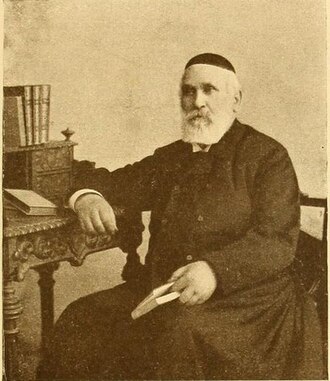
Márk Handler
1837–1911Rabbi of Heves, from 1869Márk Handler, born at Nemesbikk and trained under the Ketav Sofer in Pressburg, was elected rabbi of Heves in 1869, two years after the synagogue was built, having served at Siófok and Aszód. Known for his Hungarian-language sermons and an early Hungarian grammar of Hebrew, he was still rabbi of Heves in 1880 and later moved to Tata, where he died. His son Simon Hevesi became chief rabbi of Pest.
Biografie oder Quelle →Fülöp Trencsiner
died 1869First known rabbi of HevesFülöp Trencsiner is the earliest rabbi of Heves named in the sources: he appears as rabbi in the census of 1844, and the 1929 Hungarian Jewish Lexicon, which calls him the community's first rabbi, records only that he died in 1869. He was therefore in office when the synagogue on Baross utca was built in 1867.
Biografie oder Quelle →Jakab Elfer
UnknownRabbi of Heves, c. 1887–after 1919Jakab Elfer was rabbi at Gyula in the early 1880s and came to Heves by 1887, when the weekly Eger reported his funeral addresses delivered in Hungarian. He is named as rabbi of Heves in a Miskolc school yearbook of 1890 and in the registers of the National Israelite Office down to 1919, so he led the congregation for more than thirty years. In June 1892 he preached in the packed synagogue at the town's coronation-anniversary service.
Biografie oder Quelle →József Friedmann
UnknownChief rabbi of Heves, attested 1929–1944Dr József Friedmann is named as chief rabbi of Heves in the 1929 Hungarian Jewish Lexicon, appears as rabbi of Heves in the files of the National Israelite Office in 1934, and is named as the community's rabbi in the county Holocaust project's account of 1944. He was the synagogue's last rabbi before the deportation; his own fate is not recorded in the sources consulted.
Biografie oder Quelle →Benő Friedmann
UnknownCantorBenő Friedmann was cantor of the Heves synagogue in 1929, when the Hungarian Jewish Lexicon listed the community's officers. A Benő Friedmann born at Petneháza in 1874 appears among the Heves victims murdered at Auschwitz in 1944; he is probably the cantor, but the sources do not say so explicitly.
Biografie oder Quelle →Gyula Gerő
born 1893Community president in 1944Dr Gyula Gerő, a lawyer born in Szolnok in 1893, was president of the Heves congregation in 1944, when its members were registered, removed to the Bagólyuk camp and deported. His name appears on the list of victims from Heves compiled by the county Holocaust project, marked as having died.
Biografie oder Quelle →Imre Kunovits
UnknownCommunity president after 1945Imre Kunovits, a Heves craftsman who survived forced labour while his wife and small daughter were murdered at Auschwitz, led the congregation that the survivors rebuilt after the war; he was its president in 1949, when 76 Jews lived in the town and the synagogue, renovated in 1947, was again in use. He left Hungary in 1956 and settled in Canada.
Biografie oder Quelle →Haben Sie etwas beizutragen?
Fotos, Dokumente, Familiengeschichten oder Erinnerungen an diese Synagoge und ihre Gemeinde halten ihre Geschichte lebendig.
- Heves (entry in Magyar Zsidó Lexikon, 1929, p. 362)
- Heves
- Zsinagógák és zsidó községek Magyarországon: térképek, rajzok, adatok (Heves megye table)
- „Non omnis moriar…” Emlékezés a hevesi zsidóság tragédiájára
- A hevesi temetők (Zsidó temető), Agria 35 (1999), p. 274
- A hevesi református egyházközség története a XIX. század elejétől napjainkig, Agria 33 (1997), p. 304
- A hét öröme-gondja Hevesen (… Új üzemházat avat a BUDAGANT …)
- Az idén már új épületben kezdték meg a munkát a BUDAGANT … hevesi üzemében
- Hajrázik a hevesi BUDAGANT
- Kápolna, templom, imaterem (Heves)
- Mint Marci Hevesen… (Sófár 2014/5), reproduced on hevesholokauszt.hu
- Heves, zsinagóga (16.034.A–B), 1948
- Hevesi zsinagóga épülete romos állapotban (F70.166)
- Heves (Zsinagógák a történelmi Magyarországon)
- Handler Márk (entry in Magyar Zsidó Lexikon, 1929, p. 343)
- Handler Márk
- Hevesi levél (letter from Heves)
- A Brief History of the Jews in Heves County, Hungary
- Állásajánlatok: Budagant Kesztyűs Szövetkezet, Heves, Baross G. u. 13
- Baross Gábor utca, Heves (OpenStreetMap way 277228206)
- Az Országos Izraelita Iroda iktatónaplója 43886–46880 (1919–1922)
- Eger (weekly), 23 August 1887 and 5 June 1888
- Békés (weekly), 2 July 1882
- Békésmegyei Közlöny, 24 October 1880
- Iratok iktatószámok szerint 60200–65000 (no. 61837, 13 March 1934)
- A hevesi katolikusok vallásos társulatai a két világháború között, Agria 44 (2008), p. 266
- Hevesről írják lapunknak (report from Heves)
- Hevesen és másutt (Sófár 2015/1), reproduced on hevesholokauszt.hu
- Emlékezés a hevesi zsidóság tragédiájára – 402 név a táblákon
- Látnivalók (Heves Város Önkormányzata)
Share a memory or thought
No comments yet. Be the first to add one.