
История Hodonín Synagogue
Hodonín, called Göding in German, lies on the Morava river in South Moravia, on the border with Slovakia. Jews lived there from the late sixteenth century, and by 1688 their quarter, set on an island in the river beside the lord's residence, had about thirty houses and a synagogue. The Jewish Museum in Prague holds a contract of 1694 for building a new synagogue, which suggests that the community put up or replaced its house of prayer soon after that first mention. The quarter burned in 1693 and 1754 and was rebuilt on the same spot each time.
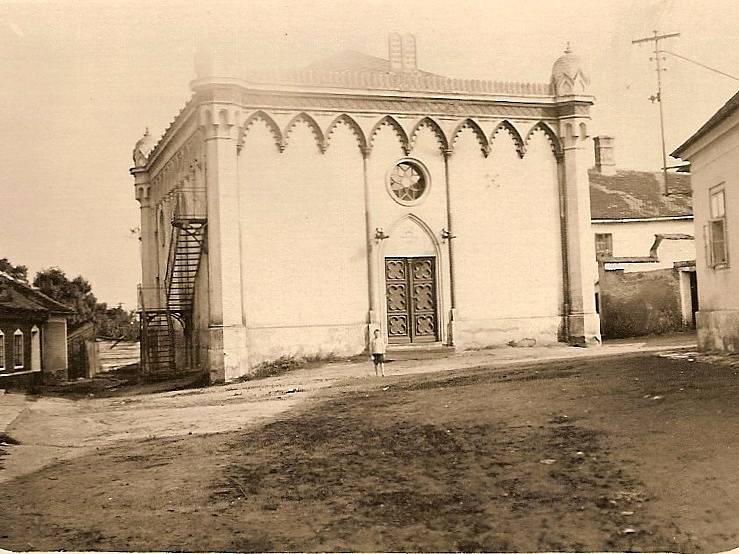
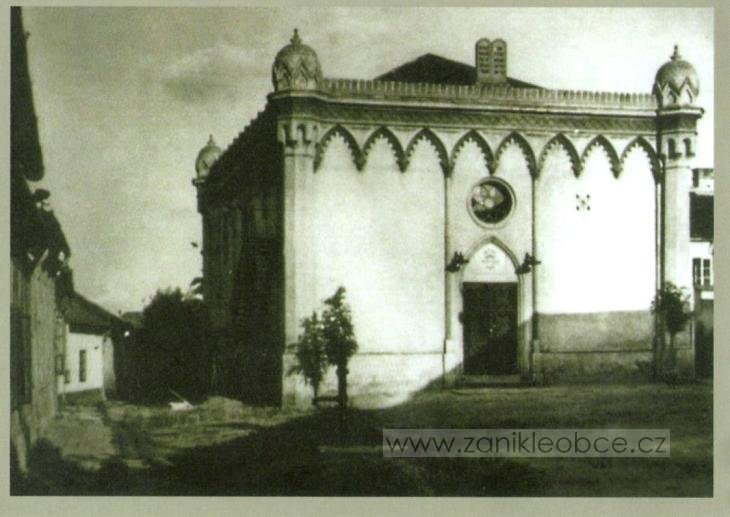
After Maria Theresa acquired the estate in 1774 most Jewish families were expelled, and for decades only thirteen were allowed back. The community grew again after 1848, from about 200 people in the 1850s to nearly a thousand around 1900, and the old synagogue was restored for the larger congregation and solemnly consecrated in 1863. Photographs from about 1910 and 1939 show a rendered hall with Moorish-style ornament. The building was badly damaged during the Nazi occupation, its fittings were taken to Prague, and it was pulled down at an unrecorded date after 1945, together with the rest of the former ghetto.
Where it stood for 82 years
Historic: Göding/Hodonín, former Jewish quarter (ghetto) beside the chateau, south of the main square; street and house number unknown. Today: housing estate in the chateau quarter of Hodonín, near Zámecká street, 695 01 Hodonín (approximate).
Открыть большую карту →Еврейская община
A Jewish community is documented in Hodonín from the first half of the seventeenth century; the Jüdische Gemeinden website dates the first families to about 1580 and counts sixteen families in 1592. The Oppersdorf lords encouraged settlement, and a privilege of 1690 regulated relations between Christians and Jews. A burial society existed early, with statutes of 1682, and the old cemetery was laid out about 1620. Around 1745 some 550 Jews lived in the town. In 1774 Maria Theresa, the new owner of the estate, expelled them; about twenty went on to found the community of Kostelec near Kyjov, and only thirteen families were later readmitted under Joseph II. Numbers recovered after 1848: 433 in 1869, 976 in 1900 and 983 in 1910, after which many moved to larger cities, leaving 670 in 1930, about four and a half per cent of the town. The community regained its own rabbi in 1899 and adopted new statutes in 1921-1922 and 1930. The liberal politician Joseph Redlich was born in Hodonín.
Архитектура и дизайн
No plans, architect or builder have been found. Sources agree that the synagogue stood within the former ghetto, south of the main square next to the chateau, and that the nineteenth-century rebuilding gave it Moorish-style elements. Two photographs, dated about 1910 and 1939, show a free-standing rendered hall on an unpaved open space. Its gable front is framed by slender corner pilasters ending in small onion-shaped domes, and a frieze of pointed and cusped arches runs under a pierced parapet along the top of the walls, repeated along the side elevation. The centre of the front has a round rose window above a pointed-arched doorway with double panelled doors, and a small Star of David is set into the wall beside it. A low pitched roof rises behind the parapet, crowned at the front by the twin Tablets of the Law. An iron outside staircase climbs the left side wall, presumably to the women's gallery. Capacity and the interior arrangement are unknown, and no interior view was found.
Жизнь в синагоге
Little is recorded about worship in the building. The community archive taken to the Jewish Museum in Prague includes records of synagogue seats, minutes of meetings up to 1940 and burial society papers, which show an organised congregation that let or sold seats to its members. The rise in numbers from about 200 in the 1850s to nearly 1,000 by 1900 was the reason for restoring and reconsecrating the old synagogue in 1863. The community had its own rabbi again from 1899, after a long period without one, but none of the sources read names him or any cantor. A man listed in an early residents' register as 'Rabbi Sekl Göding' is mentioned on the JewishGen town page, but his tie to this building is not stated. In 1939, under the Nazi occupation, Hodonín became a district community responsible for Jews in the surrounding area. Under that regime many of the synagogue's ritual objects were ordered to be sent to the Central Jewish Museum in Prague.
Разрушение
Sources read agree that the synagogue was badly damaged during the Nazi occupation of 1939-1945. The JewishGen town page states that it was destroyed during the occupation, and the Jüdische Gemeinden website says it was heavily damaged then and demolished after 1945. Neither source gives a date for the damage or names who caused it, beyond placing it under the Nazi German occupiers. By 1942 the building stood empty: its ritual objects were taken to the Central Jewish Museum in Prague, as happened across the occupied Czech lands. After the war the remains were cleared. The JewishGen page adds that the whole former ghetto was demolished after the Second World War and replaced by a housing estate, which suggests the synagogue went in the same clearance. The year of demolition and who ordered or carried it out are not recorded in any source found.
Судьба общины
After the Nazi German occupation of March 1939 the Jews of Hodonín were subjected to the anti-Jewish laws of the Protectorate of Bohemia and Moravia. In 1942 they were concentrated in Kyjov, the assembly point for the Jews of southern Moravia, and from there deported to the Theresienstadt ghetto; within a few weeks most were sent on to extermination camps. More than 220 Jews of Hodonín were murdered. The community was formally dissolved under the occupation, and its archive was taken to Prague with the property of other liquidated communities. Survivors re-established a small congregation after liberation, which used a prayer room rather than the ruined synagogue; that prayer room no longer exists. The group was later affiliated with the Jewish community of Brno, and by 1970 the few remaining members were attached to Kyjov. Virtually no Jews were left in Hodonín by the end of the twentieth century. The old cemetery was turned into a park in the 1970s, and most of its gravestones were moved to the newer cemetery of about 1920.
Место сегодня
The synagogue stood in the former Jewish quarter south of the main square and next to the chateau, on what was once an island between arms of the Morava. The JewishGen town page says the whole former ghetto was demolished after the Second World War and that a housing estate now stands there. No source read identifies the exact plot, and no surviving fragment of the building has been reported. The map pin is set by the Masaryk Museum on Zámecká street, the chateau quarter, as an approximation for the area and should not be read as the precise site. The old Jewish cemetery survives as a park with a few stones; the newer cemetery of about 1920 is on the road to Lužice.
Вам есть чем поделиться?
Фотографии, документы, семейные истории и воспоминания об этой синагоге и её общине помогают сохранить её историю.
Share a memory or thought
No comments yet. Be the first to add one.