

The story of Horvat Ethri Synagogue
Horvat Ethri (Hurvat Itri; in Arabic Umm Suweid) is a ruined village on a ridge in the Judean Shephelah, about 35 km south-west of Jerusalem and south-east of Beit Shemesh, inside Adullam-France Park. Boaz Zissu and Amir Ganor excavated it for the Israel Antiquities Authority in three seasons, 1999-2001, after years of antiquities looting. They found a village first settled at the end of the Persian period that reached its greatest extent, about 12 dunams, in the first century CE. Ritual baths, stone vessels, lamps and coins show that its people were Jews. The village was partly destroyed and briefly abandoned in the First Jewish Revolt of 66-70 CE and was then resettled on a smaller scale.
The resettled village had a public building: a hall of about 13 by 7 metres whose roof rested on three columns, with two courtyards and a large ritual bath. The excavators consider it most likely a synagogue, built after the destruction of the Second Temple and used until the Bar Kokhba revolt of 132-135 CE. A hiding complex was dug beneath it. The village joined that revolt and was violently destroyed when the Romans reconquered it; the bones of at least twelve of its dead were found in the large ritual bath beside the hall. The identification as a synagogue rests on the plan, the orientation towards Jerusalem and the likeness to other halls of the period; no inscription is mentioned in the sources read.
Where it stood
Horvat Ethri (Hurvat Itri, Umm Suweid), Adullam-France Park, Mateh Yehuda Regional Council, Jerusalem District, Israel; about 35 km south-west of Jerusalem. The pin is the centre of the archaeological site (approximate for the public building).
Open larger map →The Jewish community
The people who used the hall were the Jews of a farming village whose ancient name is not certain. An inscribed potsherd reading 'Ethri' was found in the excavation, and the site has been tentatively identified with Caphethra, a village that Josephus says was destroyed by Cerealis and the Fifth Legion in 69 CE; the Hebrew name Horvat 'Ethri was officially adopted in March 2001. Settlement began in the late Persian period, and coins, stone vessels and ritual baths mark the villagers as Jews. On the eve of the First Revolt the built-up area was about 10 to 12 dunams. The village lived from vines, with many wine presses, from doves raised in a columbarium, and from spinning and weaving. After the First Revolt Jews returned, repaired and adapted the houses, and lived in a village about half the former size, concentrated on the eastern side of the site. It was this smaller community that put up the public building. No name of any villager, elder or teacher is recorded in the sources read.
Architecture and design
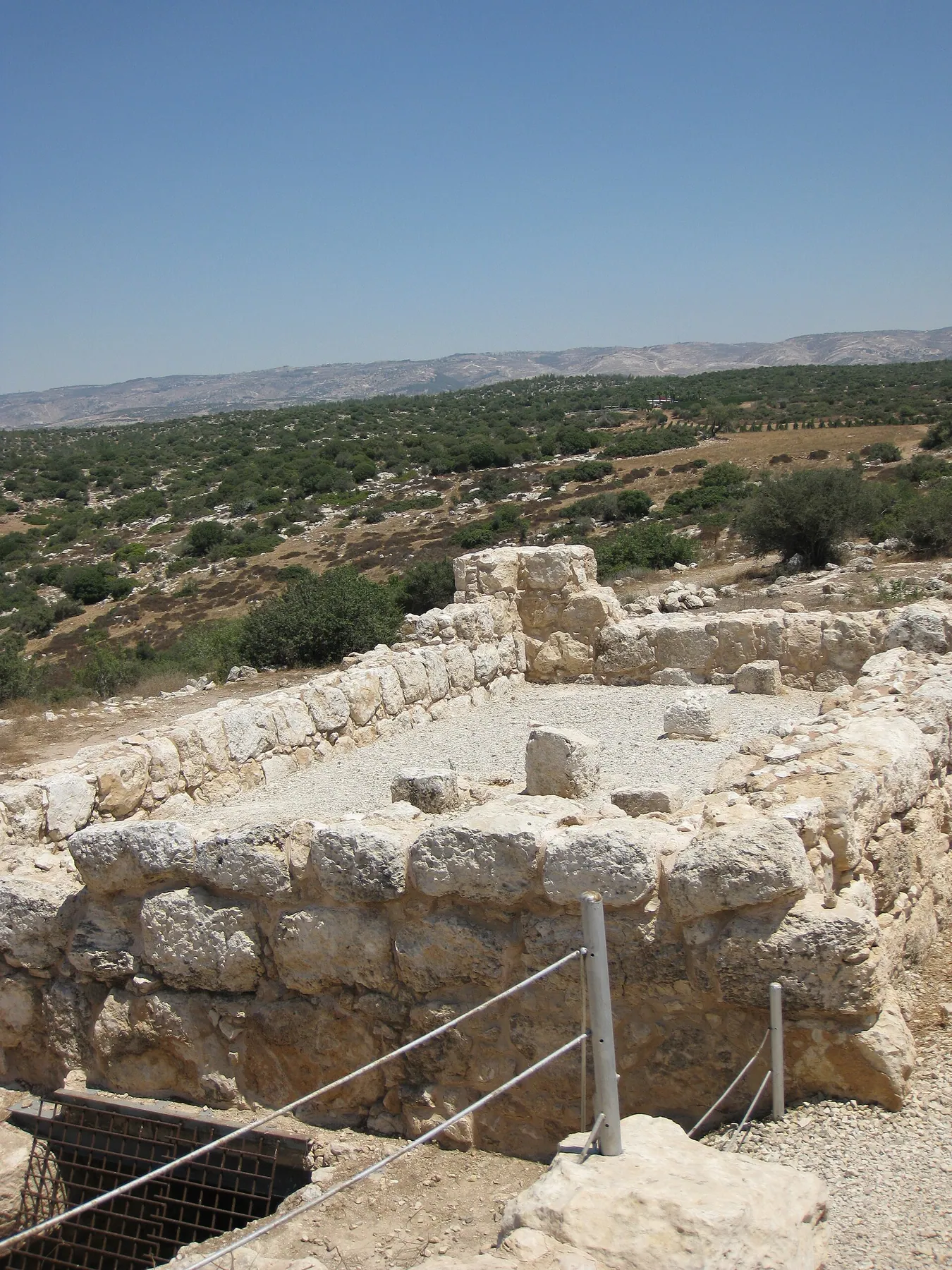
The excavators label the public building Structure M. Its hall (M1) measures about 13 by 7 metres, with walls 0.9 metres thick, and was entered through a single doorway; the wall opposite the entrance faced Jerusalem. The ceiling was probably carried on three round columns built of drums and topped by capitals of Doric type, standing in a row along the middle of the hall. Two column pedestals were found in place and the foundation of a third survived, and a capital and a drum of the local nari limestone were found reused in another room of the village. North-east of the hall lay an open court with a bench cut in the rock, and an inner courtyard had a rock-cut stepped corridor leading down to a large ritual bath. A hiding complex was dug beneath the building. The Safrai commentary on Mishnah Megillah describes the hall as a broad room with a single row of columns, a type between the square halls of the Second Temple period and the three-aisled synagogues of the third century. The walls survive to at most five courses.
Life inside the synagogue
Nothing is recorded directly about what took place in the hall, and no written source mentions the village's worship. The excavators call the building a place for public meetings and assume that it served the resettled village as its synagogue for the sixty or so years between the two revolts. A bench cut in the rock ran along the open court beside the hall, and the large ritual bath reached from the inner courtyard belongs with the other ritual baths of the village, which, together with stone vessels, point to a population that kept the purity laws. Before the Bar Kokhba revolt the villagers dug hiding complexes under their houses and under the public building itself, in which people could shelter and store supplies. One of the village's complexes was found undisturbed, with lamps of the revolt years and three bronze coins overstruck by the Bar Kokhba administration; another had been emptied by looters before the excavation. Whether the hall was used for reading the Torah, for study or for village assemblies cannot be told from the remains described.
Destruction
The village was struck twice. In the First Jewish Revolt of 66-70 CE it was partly destroyed and briefly abandoned, and ash lay on floors in the eastern wing of one large building; if the site is Josephus's Caphethra, the attackers were Roman soldiers of the Fifth Legion under Cerealis in 69 CE. The public building did not yet exist: the excavators date it to the resettled village that followed.
That village joined the Bar Kokhba revolt and, in the excavators' words, was violently destroyed at its end, when the Romans reconquered it. A burnt layer in the central rooms contained a Bar Kokhba silver coin of the revolt's second year. In the large ritual bath beside the hall the excavators found the skulls and bones of at least twelve people, men, women and children, apparently killed in the conquest, mixed with ash, charred wood, heat-warped glass and coins of Vespasian and Trajan. Sword cuts on a neck vertebra show that at least one of them was beheaded. Zissu links the village with the 985 Judean villages that, according to Cassius Dio, the Roman army razed. The public building went out of use with the village.
The community’s fate
The Jewish village ended with the Bar Kokhba revolt. At least twelve of its people, men, women and children, were killed when the Romans retook it, and their bones were gathered into the ritual bath of the public building; who collected them is not stated in the sources read, and the fate of the other villagers is unknown. Cassius Dio wrote that the Romans destroyed 985 Jewish villages in that war. The site then lay deserted for some decades. Soon after 200 CE a new population moved in and restored some of the ruined buildings; the excavators take them to have been of pagan origin, possibly veterans of the Roman army settled on land near the newly founded city of Eleutheropolis (Beit Guvrin). An underground room of the first century was reused as a burial cave. This later settlement changed little and lasted into the late fourth or the fifth century, after which only shepherds and nomads used the ruins. No Jewish community returned to the village.
The site today
Horvat Ethri is an open archaeological site in Adullam-France Park, in the Judean foothills south-east of Beit Shemesh, and can be visited all year. The excavation was undertaken partly to make the looted site accessible to visitors, and the remains have been partially restored. The hall of the public building stands roofless as a rectangle of fieldstone walls a few courses high, roughly waist to chest height, with stone column pedestals still on its floor and a metal grating over the entrance to the hiding complex below one corner. Around it are the excavated houses, ritual baths, cisterns and wine presses of the village.
Do you have something to contribute?
Photographs, documents, family stories or memories of this synagogue and its community help keep its history alive.
- 'Ethri, Horvat (entry in The New Encyclopedia of Archaeological Excavations in the Holy Land, vol. 5)
- Horvat 'Ethri: A Jewish Village from the Second Temple Period and the Bar Kokhba Revolt in the Judean Foothills (Journal of Jewish Studies 60/1, 2009, pp. 90-136), abstract and record
- The public building at Horvat 'Ethri: a synagogue from the Middle Roman period in the Judaean foothills (in Ancient Synagogues Revealed 1981-2022, 2023, pp. 228-235), bibliographic record
- Image details: the public building at Horvat 'Ethri (illustration to Biblical Archaeology Review 33:5, 2007)
- Village Razed, Rebel Beheaded: How Hadrian Suppressed the Second Jewish Revolt at Horvat 'Ethri (Biblical Archaeology Review 33:5, 2007)
- Horvat 'Ethri
- Mishnat Eretz Yisrael on Mishnah Megillah, Appendix 1 (ancient synagogues)
- Hurvat 'Ethri (Itri Ruins)
- File:128975 horbat itri PikiWiki Israel.jpg
- File:Atri IMG 5763.JPG
- Horvat Ethri archaeological site (OpenStreetMap way 374812677)
Share a memory or thought
No comments yet. Be the first to add one.