
La storia di Hostouň Synagogue
Hostouň lies on the flat farmland between Kladno and Prague, about seven kilometres south-east of Kladno. Jews may have lived there as early as the sixteenth century, but they are documented only from the end of the eighteenth, when a rabbi of Hostouň is mentioned in 1792. The congregation drew its members from the village and from about twenty surrounding hamlets, and it kept a community house with a German-language school, a burial society and two cemeteries.
The synagogue stood north of the parish church of St Bartholomew, on building plot no. 54. Jiří Fiedler dates it to the late eighteenth or early nineteenth century; the database of destroyed sacral buildings Zničené kostely says it was built no later than 1801 and altered around the middle of the nineteenth century, and it already appears on the stable cadastre map of 1840. A long prayer hall was joined at the back by a residential wing. The community peaked around 1850 with about sixty families, then shrank steadily as families moved away to larger towns. Services had ceased before 1925, and in 1929 the building passed into private ownership. It served as a shop, a store and later a painter's studio, and the prayer hall was demolished around or after 1950, while the residential wing survives as a modernised house.
Where it stood for nearly 150 years
Historic: Hostouň (Hostau), building plot no. 54 (stavební parcela č. 54), north of the church of St Bartholomew. Today: private garden and house on the same plot, Hostouň, 273 53, Kladno District (pin from the Zničené kostely record, exact to the plot).
Apri la mappa grande →La comunità ebraica
A local tradition, repeated by the German community website Jüdische Gemeinden and by the Geni family project, places the first Jews in Hostouň in the first half of the sixteenth century, but the first record dates only from 1792, when Rabbi Nathaniel (Nasanel) of Hostouň was mentioned by Ezekiel Landau, chief rabbi of Prague. The old cemetery has gravestones from 1786 onwards and a new cemetery was in use by about 1840; the Jews of Unhošť, Velká Dobrá, Kamyk, Hořelice and, until 1889, Kladno also buried their dead in Hostouň. The congregation also served Jewish families scattered through about twenty-one nearby villages. In 1852 there were 64 Jewish families in Hostouň. From the second half of the nineteenth century Jewish families moved away to the larger towns, and the village community dwindled. In 1921 only 21 Jews were left, led by Joseph Kohn, with Max Schwartz named as rabbi; for 1930 the sources give either 17 or 35 Jews.
Architettura e design
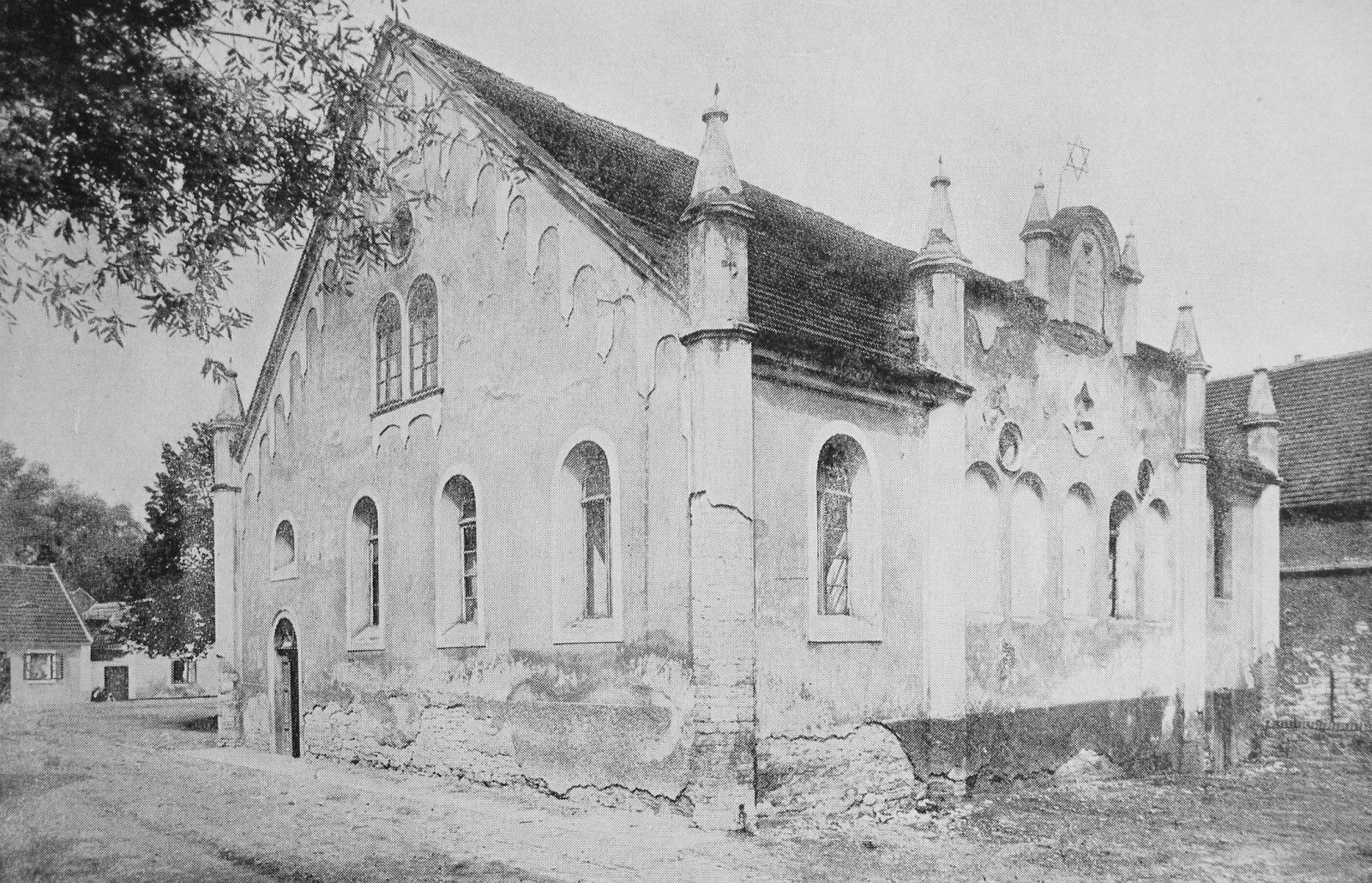
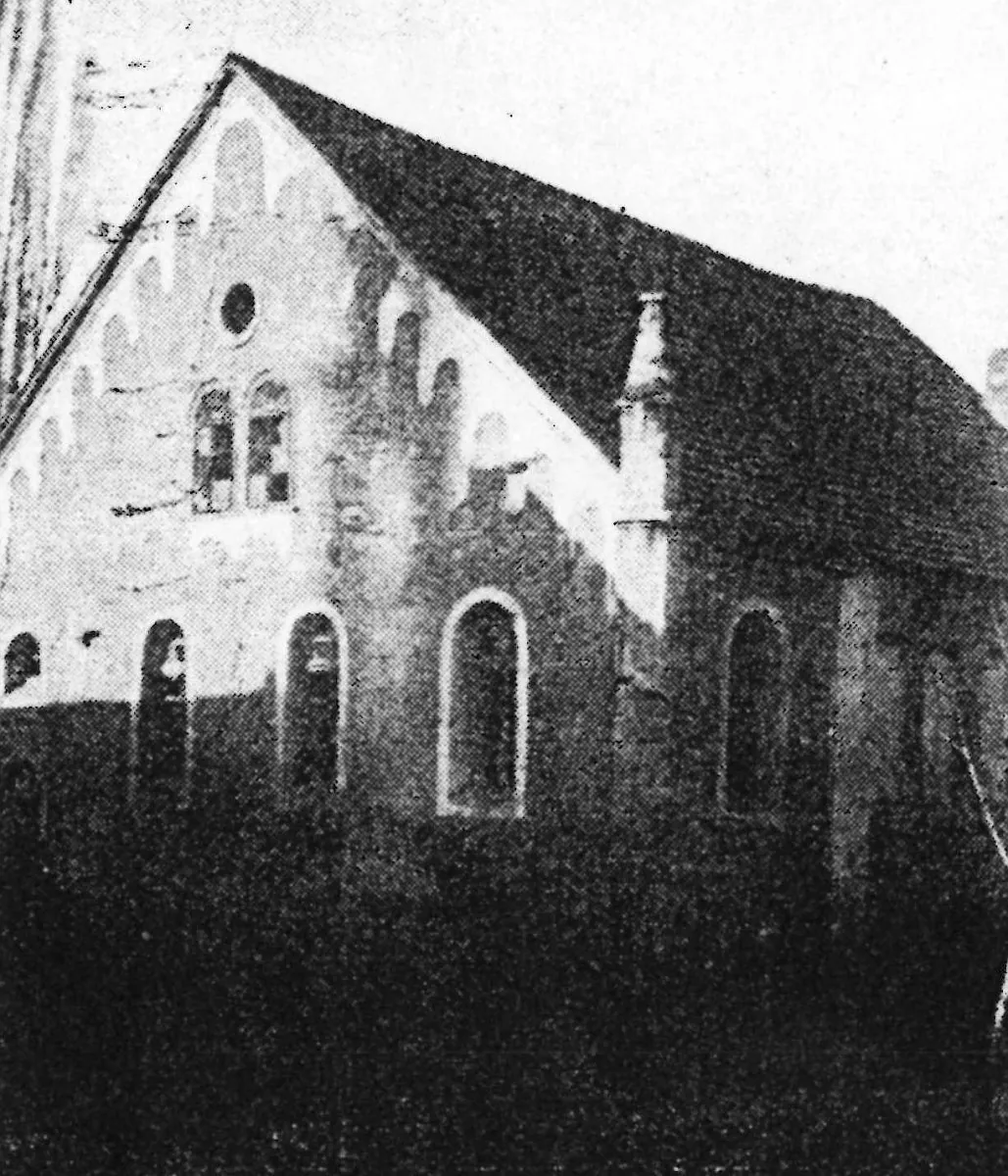
Two photographs taken before 1934 show the building. It was a rendered, free-standing hall with a steep saddle roof. Its long side had tall round-arched windows set between plain pilaster strips, and the corners were marked by stout pilasters that rose above the eaves and ended in small pointed pinnacles. The street gable was decorated with a stepped band of small blind arches following the roof line, a pair of round-arched windows and a small round window near the apex, giving the front a picturesque, castle-like outline typical of mid-nineteenth-century Romantic historicism. A small decorative gable with a finial rose from the roof on the long side. The second photograph shows the gable end from closer, with the arched frieze, the twin windows and the corner pinnacles clearly visible. This dress probably dates from the remodelling around 1850 recorded by Zničené kostely, over an older core of about 1800. A residential wing adjoined the hall at the back. The architect, the builder, the seating capacity and the interior arrangement are unknown, and no interior view has been found.
La vita nella sinagoga
Little is recorded about worship in the building itself. The rabbis of Hostouň appear only as names in rabbinical literature and later lists: Nathaniel, mentioned in 1792 by Ezekiel Landau of Prague; Joseph, mentioned around 1817 by Eleazar Fleckeles; and Dr M. Ascher, who lived in the village around 1850 to 1852, when the congregation was at its largest and the synagogue had probably just been remodelled. The community house next to the synagogue held a school taught in German, and a burial society looked after the two cemeteries. As the congregation shrank, regular services became harder to sustain. In 1921 Max Schwartz is named as rabbi and Joseph Kohn as head of a community of only 21 people, and by 1925 services in the synagogue had ended altogether. A photograph of the synagogue taken around 1930 is held in the photo archive of Beit Hatfutsot, the Museum of the Jewish People.
Distruzione
The synagogue was not destroyed during the Nazi occupation. It had already gone out of religious use before 1925, and in 1929 the dwindling congregation's building passed into private hands. According to Zničené kostely it then served as a shop and a storehouse, and after the Second World War as a painter's studio. Jiří Fiedler, who surveyed the Jewish sites of the area, records that the synagogue was demolished about 1950; Zničené kostely says more precisely that the prayer hall was pulled down after 1950, in the period of Communist rule, and classes the cause of loss as lack of maintenance. Neither source names who ordered or carried out the demolition, and since the building was privately owned, it may have been the owner. Only the rear residential part, since modernised, and one shortened decorative corner pilaster of the synagogue survive.
Il destino della comunità
By the time Czechoslovakia was dismembered after the Munich Agreement of 1938, only a handful of Jews still lived in Hostouň. In March 1939 Bohemia and Moravia were occupied by Nazi Germany and made into the Protectorate, beginning a period of Nazi discrimination and violence against its Jews. According to Jüdische Gemeinden, the Jews who remained in Kladno were deported to the Theresienstadt (Terezín) ghetto in February 1942 together with many Jews from the surrounding region, and from there most were sent to the extermination camps in occupied Poland; Kladno itself had no Jews left by May 1942. The individual fate of the last Jews of Hostouň has not been established in the sources read, and the number who were murdered or survived is unknown. No Jewish community was re-established in the village after the war. The Jewish Community of Prague owns the two cemeteries; the new one was restored together with its mortuary in 1996 and 1997.
Il luogo oggi
The site of the prayer hall, on plot no. 54 north of the church of St Bartholomew, is today a private garden. Behind it stands the former residential wing of the synagogue, which survives as a modernised private house, and one shortened decorative corner pilaster of the synagogue remains beside it. Photographs taken by Jiří Fiedler in 1982 and 2011 and by the Zničené kostely team in 2023 show the garden and the house. The plot is privately owned and is not open to visitors. Hostouň's two Jewish cemeteries, the old one with stones from 1786 and the restored new one with its mortuary, remain the main visible traces of the community.
Nomi importanti
Nathaniel (Nasanel) of Hostouň
UnknownRabbi of Hostouň, late 18th centuryNathaniel is the earliest documented rabbi of Hostouň. He is mentioned in 1792 by Ezekiel Landau, chief rabbi of Prague, and his mention is the first record of an organised Jewish community in the village. He served the congregation in the decades when the synagogue was being built, about 1800, but nothing more is known of his life, his family or how long he held office.
Biografia o fonte →Joseph of Hostouň
UnknownRabbi of Hostouň, around 1817Rabbi Joseph is recorded as rabbi of Hostouň around 1817, when he was mentioned by Eleazar Fleckeles, the Prague rabbinical judge and preacher. He therefore served in the early years of the synagogue, before its mid-nineteenth-century remodelling. His surname, his dates and the length of his tenure are not given in the sources read.
Biografia o fonte →Dr M. Ascher
UnknownRabbi of Hostouň, around 1850-1852Dr M. Ascher (also spelled Asher) lived in Hostouň as its rabbi around 1850 and is named for 1852, when the congregation had 64 families and was at its largest. His time there coincides with the remodelling of the synagogue that gave it its historicist exterior. His full first name and later career were not found.
Biografia o fonte →Max Schwartz
UnknownRabbi of Hostouň, around 1921Max Schwartz is named as rabbi of Hostouň around 1921, when only 21 Jews remained in the village. He was thus the last recorded rabbi of the congregation in the final years of the synagogue's use; services ended before 1925. Nothing more about his life or his fate during the Nazi occupation was found.
Biografia o fonte →Joseph Kohn
UnknownHead of the Hostouň Jewish community, around 1921Joseph Kohn is named as the leader of the Hostouň Jewish community in 1921, when it had only 21 members. As its lay head he presided over the congregation in its last years of worship, shortly before services ended and the synagogue was sold into private hands in 1929. His later life and fate are unknown.
Biografia o fonte →Hai qualcosa da condividere?
Fotografie, documenti, storie di famiglia o ricordi di questa sinagoga e della sua comunità aiutano a mantenerne viva la storia.
- Kladno (with Hostouň among the communities of the surroundings), in Židovské památky v Čechách a na Moravě
- Hostouň (synagoga), record 17046
- Kladno (Böhmen), with section on Hostau
- HOSTOUN (Cemetery Discovery Project)
- Jewish Families from Hostouň, Bohemia, Czech Republic
- File:Synagoga v Hostouni.jpg
- Hostouň, zahrádka na místě modlitebního sálu, za ní obytná část synagogy
- Hostouň (Kladno District)
- Hostouň (OpenStreetMap relation 436169)
Share a memory or thought
No comments yet. Be the first to add one.