
The story of Old Synagogue of Humenné
Humenné, known in Hungarian as Homonna, lies near the Laborec (Labor) river in north-eastern Slovakia, in the former Zemplén county. Jews are recorded there from the first half of the eighteenth century, and by 1830 the community numbered 666. According to a community history by David Friedmann, the first congregation prayed in a small synagogue with a straw roof, built partly with material from a burnt church bought from the landowner, Count Csáky. When it became too small, the community put up 'a beautiful building' in 1792 (5552 in the Jewish calendar). The Encyclopaedia Judaica gives the same year for the first synagogue; the Slovak Wikipedia gives 1795 for the 'so-called old' synagogue. It stood on the square near the parish church, on the plot now occupied by the main post office on Námestie slobody. The town later had a second large synagogue and smaller prayer houses, among them a Hasidic synagogue of 1906 and a small Klaus. The congregation became Orthodox after the Hungarian Jewish Congress of 1868 and grew to about 2,200 people by 1940. The Slovak Wikipedia states that the old synagogue was seriously damaged by bombing during the Second World War; it was later demolished, and the year and the people responsible are not recorded in the sources read.
Where it stood for nearly 170 years
Historic: the square near the parish church, Homonna (Humenné), Zemplén county; house number unknown. Today: site of the Slovak Post office Humenné 1, Námestie slobody 10/19, 066 01 Humenné (approximate: the post office building, not a surveyed footprint).
Open larger map →The Jewish community
Jewish settlement in Humenné is documented by a lease of 20 September 1743, in which the widow Mária Szivi renewed the rent of two shops beside the parish house to Moses Jacob, a Jew; the wording shows that Jews had lived there before. The Encyclopaedia Judaica counts 666 Jews in 1830-35, 1,280 in 1880 and about 1,570 in 1910, 34.8 percent of the town. The census of 1921 recorded 1,254 and that of 1930 2,197. Trade was the main occupation: Humenné lay on the route between Poland and southern Hungary, and wine, oil and spirits passed through it. The first rabbi was Pinchas Luria, who left after a conflict. At Passover 1809 the community, led by its president Moritz Propper and Rabbi Jacob Spira (Shapira), adopted written statutes in German and held a board election. Shapira served until 1828. In 1902 Hasidim from Poland broke away and founded a beit midrash following the Sephardic rite, building their own small synagogue in 1906; a further split produced another beit midrash.
Architecture and design
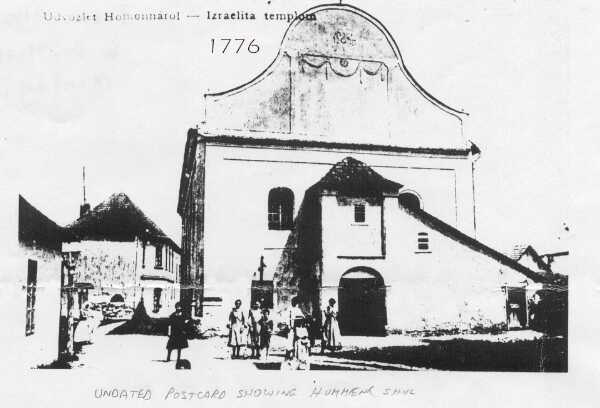
No plan, measured drawing or description of the old synagogue was found. The only image located is an undated Hungarian-era postcard captioned 'Üdvözlet Homonnáról - Izraelita templom' (Greetings from Homonna - Israelite temple), which is identified here as the old building because it shows an eighteenth-century form, while the second large synagogue was a flat-roofed interwar building. The postcard shows a tall, rendered hall whose street front ends in a high curved Baroque gable decorated with a garland and a small inscribed cartouche. Below the gable a single round-headed window lights the hall. In front of it stands a lower annexe with its own pitched roof, a small window and an arched doorway, and a long sloping roof runs down the right-hand side, probably covering an outside stair or side rooms. Low houses crowd close on the left. A handwritten '1776' has been added to the scan by a later owner and is not supported by any text source. The architect, builder, seating capacity and interior arrangement are unknown.
Life inside the synagogue
Very little is recorded about worship inside the old synagogue as distinct from the community's other buildings. It was the congregation's main house of prayer from the 1790s, so the communal decisions of 1809, when the board under Moritz Propper and Rabbi Jacob Spira resolved that all resolutions be kept in a protocol, were taken by the community that used it. Spira, remembered as 'Jakev Chariff', organised the routine of the congregation until 1828. From 1815 the assistant rabbi (dayan) Lezer Liebermann demanded reform of the Jewish religion; after 1868 the community was formally Orthodox. Its last rabbi, Haim Judah Herrmann Ehrenreich, published the scholarly periodical Oẓar ha-Ḥayyim. A memoir recorded by Centropa recalls that before the war the town had Orthodox prayer houses, a Neolog congregation with a modern synagogue, an Orthodox and a Neolog rabbi, a shochet and a cantor. Which rabbis preached in the old building rather than the newer one is not stated in any source read.
Destruction
The building stood without its congregation from the spring of 1944. The Slovak Wikipedia article on Humenné states that the old synagogue was seriously damaged by bombing during the Second World War; it does not say who bombed it or when. Survivors who returned in the spring of 1945 repaired 'the synagogue' and the mikveh, according to the Encyclopaedia Judaica, but it does not say which building was repaired. The Encyclopaedia Judaica and the JewishGen cemetery page both state only that the two large synagogues were demolished, in a passage about the postwar decades. A table of Slovak synagogues gives 1975 for the demolition of both, but the Slovak Wikipedia gives that year only for the newer synagogue. When the war-damaged old building was finally pulled down, and by whom, is not recorded in the sources read.
The community’s fate
About 2,172 Jews lived in Humenné in 1940. After the expulsion of Jews from Bratislava in 1941 some settled there, raising the number to 2,285. Deportations from Slovakia began in March 1942; from Humenné whole families were sent to the ghetto at Chełm (Chola) near Lublin in Nazi-occupied Poland. Some Jews were smuggled across the border into Hungary to save them. In the spring of 1944 the few who remained were ordered to move to western Slovakia. Rabbi Haim Judah Ehrenreich was among those killed in the Holocaust. Survivors returned in 1945 and restored a small community, but on 6 December 1945 Ukrainian nationalists of the Bandera movement attacked a group of survivors gathered in the nearby village of Kolbasy and killed them all, looting their property. Most of the remaining Jews emigrated to Israel and overseas in 1948-49. About 160 Jews lived in the town in the 1960s, served by the Košice community, and 28 in 1990.
The site today
According to the Slovak Wikipedia, the old synagogue stood where the Slovak Post building (Slovenská pošta) now stands on Námestie slobody in the centre of Humenné. The main post office, Humenné 1, is at Námestie slobody 10/19. No part of the synagogue is known to survive and no marker on the post office plot was found. The site of the second, newer synagogue, demolished in 1975, was taken by the building of the Communist Party district committee. The small Klaus was converted into a dwelling. The Jewish cemetery of Humenné survives; 27 of its tombstones were overturned in 1986.
Notable names
Jacob Spira (Shapira), 'Jakev Chariff'
rabbi 1809-1828Rabbi of HumennéSpira succeeded the first rabbi, Pinchas Luria, and served from 1809 to 1828, the first decades of the synagogue built in 1792. The Encyclopaedia Judaica credits him with organising the routine of the congregation. At Passover 1809, with the president Moritz Propper, he led the community's decision to keep all board resolutions in a written protocol and to hold a board election; the German-language statute is said to survive in the town archives.
Biography or source →Moritz Propper
UnknownPresident of the Humenné Jewish community in 1809David Friedmann's community history names Propper as president when, at Passover 1809, the organised community decided that all board resolutions be regulated by a protocol and held an election of its board. He therefore led the congregation in the early years of its 1792 synagogue. Nothing more about his life was found in the sources read.
Biography or source →Haim Judah Herrmann Ehrenreich
1887-1942Last rabbi of HumennéEhrenreich was the last rabbi of the Orthodox congregation of Humenné, which used the old synagogue until the deportations. He published the scholarly periodical Oẓar ha-Ḥayyim. He was killed in the Holocaust in 1942, the year the deportations from Humenné began. The sources read do not say in which of the town's synagogues he usually preached.
Biography or source →Do you have something to contribute?
Photographs, documents, family stories or memories of this synagogue and its community help keep its history alive.
- Humenné (Encyclopaedia Judaica, 2nd ed.)
- Humenne (Encyclopaedia Judaica text)
- Humenné (Cemetery Discovery Project)
- Humenné (Zaujímavosti section)
- List of synagogues in Slovakia
- Humenne, Slovakia (KehilaLinks)
- The Story of the Jews of Humenne, Chapter 2
- Centropa interview (Homonna)
- Humenné 1 post office, Námestie slobody 10/19 (OpenStreetMap way 118205986)
Share a memory or thought
No comments yet. Be the first to add one.