
La storia di Jemnice Synagogue
Jemnice is a small town in the Bohemian-Moravian Highlands of south-western Moravia, close to the Austrian border. Its Jewish community is first mentioned in 1336 and is often counted among the oldest in Moravia. Jews lived in a separate quarter on the south side of the town square, in the area of today's Zámecká and U Templu streets; twenty-three of its houses survive.
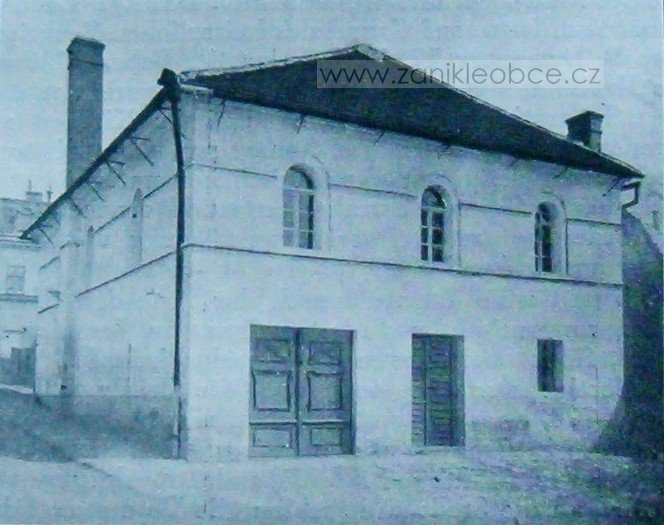
The synagogue stood on the small Jewish square inside this quarter. The Vysočina regional tourism office describes it as a Baroque synagogue of 1649, and the inscription at the site gives the same founding year; Jüdische Gemeinden and the Encyclopaedia Judaica give about 1650 and 1648. The building suffered in the great fires that swept the Jewish street in 1752 and 1832, and the form recorded in a photograph of 1929 was a plain two-storey hall under a hipped roof. How much of the seventeenth-century fabric it still contained is not known.
The congregation shrank sharply after the mid-nineteenth century, lost its own rabbi around the end of the First World War and joined the rabbinate of Znojmo. Its synagogue was still standing in 1929. In 1942 the Nazis pulled it down, and the community's ritual objects were taken to the Central Jewish Museum in Prague.
Where it stood for nearly 300 years
Historic: Jewish square (Judengasse quarter), Jemnice / Jamnitz, Moravia. Today: lawn on U Templu street beside no. 160, 675 31 Jemnice, Třebíč district, Vysočina region; marked by a paving-stone Star of David (approximate to within a few metres).
Apri la mappa grande →La comunità ebraica
Jews are first recorded in Jemnice in 1336, when the community suffered in the Armleder massacres; a gravestone of 1362 survives and Jews are again documented from that year. In the sixteenth century the Protestant lords of the estate granted the Jews privileges, and Jews owned houses in the town by 1530. There were 23 families in 1627 and 24 families living in 11 houses in 1666. Under Charles VI the Jews were confined to a Jewish street, and the Familiants Law of 1754 fixed the number of permitted families at 45. The community numbered 263 people in 1781, nearly a fifth of the town, and reached about 325 around 1830. A great fire in 1832 destroyed all 28 houses of the Jewish quarter. The ghetto was formally abolished in 1849. In 1866 Jews were accused of siding with the Prussians and a crowd attacked Jewish houses until the town's civic guard intervened. Emigration to the cities then reduced the community from 305 in 1857 to 102 in 1910, 84 in 1921 and 52 in 1930.
Architettura e design
No plans or interior views of the synagogue were found, and the architect and builder are unknown. The Vysočina tourism office calls it a Baroque synagogue of 1649. The only image found is a photograph dated 1929, reproduced on Jüdische Gemeinden from the zanikleobce.cz collection. It shows a free-standing, rendered building of two storeys with a hipped roof covered in dark tiles and a tall brick chimney at one corner. A plain string course divides the storeys. The upper storey has tall round-arched windows, three on the front and one or more on the side, while the ground floor has a large double door with fielded panels, a second panelled door and a small rectangular window. The facades are otherwise without ornament. This sober appearance may reflect rebuilding after the fires of 1752 and 1832, which according to Jüdische Gemeinden largely destroyed the Jewish street and the synagogue, but no source read describes the reconstruction. The seating capacity, the position of the women's gallery and the furnishing of the interior are unknown.
La vita nella sinagoga
Little is recorded about worship in the building itself. The community kept its own school from 1812: first a religious school, then a German-language elementary school that operated as a public school until 1918. From about 1890 the Jamnitz community covered the whole court district of Jemnice and also took in the Jews of nearby Dačice. JewishGen's Cemetery Discovery Project names Jakub Juda Löb Aschkenazy as a seventeenth-century rabbi living in Jemnice, but the names and terms of the later rabbis were not found in the sources read. Towards the end of the First World War the shrinking community could no longer support a rabbi and joined the rabbinate of Znojmo. The synagogue's ritual objects survived the war because they were sent to the Central Jewish Museum in Prague. The community's seal is preserved and is reproduced on the Jüdische Gemeinden page.
Distruzione
The synagogue had survived the fires of 1752 and 1832 in some form and was photographed intact in 1929. After the occupation of Bohemia and Moravia, the building lost its congregation in May 1942. All sources found agree that it was destroyed in 1942 and attribute the destruction to the Nazis: the Vysočina regional tourism office states that the Nazis destroyed it in 1942, and JewishGen's Cemetery Discovery Project says that the synagogue was demolished by the Nazis in 1942 and that in the same campaign the Jewish cemetery was damaged and tombstones were used to pave streets. Jüdische Gemeinden says only that the building was destroyed during the Nazi period. The inscription at the site gives 1942 as the year it ceased to stand. No source read records the exact date, which office ordered the demolition, or whether the materials were reused. The building was demolished rather than burned, and nothing of it is known to survive above ground.
Il destino della comunità
In 1930 the community numbered 52 people, about 1.5 per cent of the town. According to the Czech Holocaust memorials database, most of the Jews of Jemnice were deported in transport Aw, which left Třebíč for the Terezín ghetto on 22 May 1942; a regional news report gives 45 Jemnice residents on that transport and at least ten more sent to the camps on other transports. The family of Bedřich Kaufried, who had been appointed liquidator of Jewish property, followed on transport Ck from Prague to Terezín on 22 December. The memorial in Jemnice lists 53 Jewish victims of the Holocaust from the town. The Encyclopaedia Judaica states that the community was deported to the extermination camps in 1942. According to the same news report, only one person, Jana Kohnová, returned after the war; she later moved to Mariánské Lázně and died there in 1955. No Jewish community was re-established in Jemnice.
Il luogo oggi
The synagogue stood on the former Jewish square in the old Jewish quarter, now U Templu street, named after the vanished temple. The site is an open lawn beside a footpath, in front of the building that served as the Jewish school and later as the German school. A Star of David laid in paving stones in the lawn marks where the synagogue stood, and a memorial stele to the Holocaust victims of Jemnice was placed beside it in 2006. Twenty-three houses of the Jewish quarter survive around the site, and the Jewish cemetery, with gravestones from the 1670s, lies outside the town.
Hai qualcosa da condividere?
Fotografie, documenti, storie di famiglia o ricordi di questa sinagoga e della sua comunità aiutano a mantenerne viva la storia.
Share a memory or thought
No comments yet. Be the first to add one.