


История Jerash Synagogue
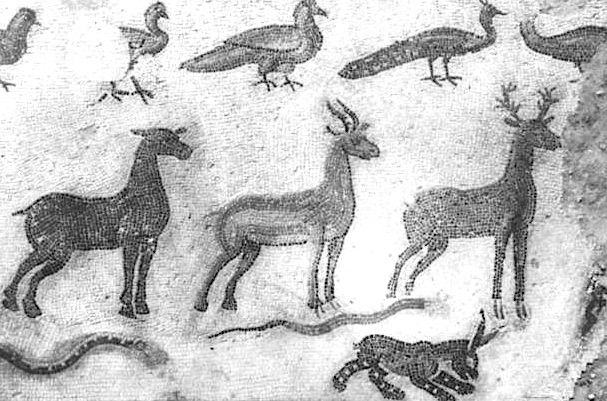
Gerasa, today Jerash in northern Jordan, was one of the cities of the Decapolis. Josephus reports that at the outbreak of the First Jewish Revolt its inhabitants spared their Jewish fellow citizens. In late antiquity a synagogue stood on the southern slope of the city's Northwest Quarter, the highest ground inside the walls, just west of the sanctuary of Artemis. It was a basilica entered from the east through a colonnaded forecourt and a vestibule, with a hall divided by two rows of columns. Its floors carried mosaics: a long panel of the Flood story with rows of birds and beasts and the heads of Noah's sons Shem and Japheth, a menorah set in a Greek blessing on the congregation, and an Aramaic inscription naming three donors.
When the synagogue was built is not known; scholars have proposed dates from the third to the fifth century CE. Its end is fixed only by the church that replaced it, where a mosaic inscription is dated 530-531 CE. The builders of the church demolished the eastern forecourt and vestibule, raised an apse over them, turned the building round so that it was entered from the west, and laid a new floor about 15 centimetres above the old one. A joint American and British expedition uncovered both floors in a three-week campaign in 1929, published that year by J. W. Crowfoot and R. W. Hamilton. The church itself was destroyed by the earthquake of 749 CE.
Where it stood
Ancient Gerasa, Northwest Quarter, on the terrace west of the sanctuary of Artemis. Today: the 'Synagogue Church' ruin inside the Jerash archaeological site, Jerash, Jordan (exact site; no street address).
Открыть большую карту →Еврейская община
Little is known of the Jews of Gerasa beyond a few literary notices and the synagogue itself. The Encyclopaedia Judaica states that a Jewish community lived in the city and kept friendly relations with the other inhabitants, and that during the disturbances leading to the Jewish War of 66 CE the people of Gerasa sent their Jewish population away unharmed. It adds that Rabbi Joshua 'the Garsi', a pupil of Rabbi Akiva, may have been named after the city. Between those notices and the synagogue the record is silent for centuries. The archaeologist Rubina Raja, co-director of the Danish-German excavations in the Northwest Quarter, has said the synagogue shows that a large Jewish community lived in the city and was well integrated. The inscriptions on its floor are in Greek and in Aramaic, and they name three donors: Pinhas son of Baruch, Jose son of Samuel and Yudan son of Hezekiah. Achim Lichtenberger and Raja point to repairs in the mosaics and to several dedicatory inscriptions as signs that the building was in use for a considerable time. The size of the community, its leaders and its other institutions are unknown.
Архитектура и дизайн
The plan is known from the 1929 excavation beneath the church and is hard to recover in detail because of the later alterations. The synagogue lay on an east-west terrace and was oriented at about 292 degrees, which follows the terrace and the Roman street grid rather than the direction of Jerusalem. Worshippers entered from the east through a rectangular colonnaded forecourt and then a vestibule paved with the Flood mosaic. Beyond lay a basilical hall with a nave and two aisles, divided by two rows of seven columns. At the west end a structure projected from the wall; it has been interpreted as the place of the Torah shrine. An Aramaic donor inscription, framed as a vertical tablet with handles, was set in the hall floor between two columns of the northern row. Parts of an older building, perhaps a private house with a columned courtyard of roughly Late Roman date, lie under the synagogue. The dimensions of the hall are not given in the sources read, and nothing is recorded of its walls above floor level, its roof, its furnishings or its seating. The architect and builders are unknown.
Жизнь в синагоге
What can be said of worship here comes from the floor. In the vestibule a long panel showed the Flood story of Genesis. According to the Center for Jewish Art's description, a dove with a branch perches on a tree in one corner above the heads of Noah's sons Shem and Japheth, labelled in Greek, and the animals walk in three rows. Claudine Dauphin describes birds in the upper row and wild and domesticated animals in the middle one; a published drawing shows snakes and small creatures in the lowest. In the border a seven-branched menorah stands with a lulav, an ethrog, a shofar and an incense shovel, inside a Greek inscription read as 'to the most holy place. Amen. Sela. Peace upon the synagogue'. In the hall an Aramaic panel reads 'Peace be upon all Israel, Amen, Amen, Selah', followed by the names of Pinhas son of Baruch, Jose son of Samuel and Yudan son of Hezekiah. Greek and Aramaic were therefore both in use in the congregation, and the biblical scene was laid where everyone entering would cross it. No text describes the services, officers or customs of the congregation.
Разрушение
No account of the synagogue's end survives. The only fixed date is a fragmentary mosaic inscription in the church built over it, which records a donation and is dated 530-531 CE. By then the forecourt and vestibule on the east had been demolished and an apse raised on top of them, the direction of the building had been reversed so that the Torah-shrine end became the entrance, and the floor had been raised by about 15 centimetres, burying the synagogue mosaics under new ones. Who did this, and how the building left Jewish hands, is not recorded. The excavators assumed 'a violent collision' between Christianity and Judaism. Estée Dvorjetski connected the conversion with Justinian's anti-Jewish decrees. Achim Lichtenberger and Rubina Raja set out three possibilities, abandonment, conversion of the congregation, or appropriation by Christians, and lean towards the last, suggesting that the church met the needs of a military unit, the Electi Iustiniani, named in inscriptions of 576 and 591 CE in a hall beside it. They note that no violence is attested at Gerasa and that Justinian's laws against synagogues date after 535 and concern North Africa. Claudine Dauphin sees a church policy of confiscating synagogues.
Судьба общины
What became of the Jews of Gerasa after their synagogue was replaced by a church is unknown. No source read records an expulsion, a massacre or a mass conversion in the city. Claudine Dauphin has observed that the takeover of the synagogue by Christians does not necessarily mean the end of the Jewish community of Gerasa, and the report quoting her adds that it is not known how long the community survived. Lichtenberger and Raja consider the idea that the congregation itself converted to Christianity and judge it unlikely. They also raise the Samaritan revolt of 529-531 CE as a possible indirect reason for the arrival of a military unit in the city, but reject an attack on Samaritans as the direct cause of the conversion. The church that replaced the synagogue stayed in use, with repairs to its mosaics, until the earthquake of 749 CE, which destroyed most of Gerasa. The sources consulted mention no later synagogue and no later Jewish inscription from the city.
Место сегодня
The site lies inside the archaeological park of Jerash, in the Northwest Quarter of the ancient city on the high ground west of the Temple of Artemis, and is generally labelled the Synagogue Church. What can be seen belongs mainly to the sixth-century church: photographs taken in 1922, before the excavation, show a low curved apse wall between two masonry piers and several tall Corinthian columns standing beside it. Of the synagogue, the sources describe only what lay below the church floor: foundations reused by the church and fragments of mosaic recorded in 1929. In 2014-2016 the Danish-German Jerash Northwest Quarter Project excavated a mosaic-paved hall immediately north of the church. The sources read do not say whether the Flood mosaic and the inscriptions are still in place, covered over, or kept in a museum.
Значимые имена
Pinhas son of Baruch
UnknownDonor named in the synagogue's mosaic floorPinhas son of Baruch is the first of three men named in the Aramaic mosaic inscription set in the floor of the hall, after the blessing 'Peace be upon all Israel, Amen, Amen, Selah'. Epigraphers list him as a benefactor of the synagogue. Nothing else is known of him: no title, trade or date is given.
Биография или источник →Jose son of Samuel
UnknownDonor named in the synagogue's mosaic floorJose son of Samuel is the second name in the Aramaic donor inscription, a mosaic panel shaped as a vertical tablet with handles that lay between two columns of the northern row of the hall. He is recorded as a benefactor of the synagogue. The inscription gives only his name and his father's name.
Биография или источник →Yudan son of Hezekiah
UnknownDonor named in the synagogue's mosaic floorYudan son of Hezekiah is the third and last man named in the Aramaic inscription of the synagogue floor, read and translated in the Warsaw and Brown University epigraphic databases after Estée Dvorjetski's 2005 study. Like the other two he is taken to be a donor to the building; no further detail about him survives.
Биография или источник →Вам есть чем поделиться?
Фотографии, документы, семейные истории и воспоминания об этой синагоге и её общине помогают сохранить её историю.
- From Synagogue to Church. The Appropriation of the Synagogue of Gerasa/Jerash under Justinian (Jahrbuch für Antike und Christentum 61, 2018, pp. 85-98)
- Synagogue, Gerasa (building record 103)
- Inscription 122: Greek mosaic inscription with menorah, synagogue of Gerasa
- Inscription 123: Aramaic donor inscription, synagogue of Gerasa
- Inscription JERA0009 (Jerash, synagogue mosaic)
- Noah's Ark mosaic puts ancient Jordan synagogue on tourist map
- Gerasa (Encyclopaedia Judaica, 2nd ed.)
- Synagogue-Church at Gerasa
- Photograph of: Gerasa Synagogue, The Flood mosaic panel (CJA-497-0194022)
- Synagogue church, NINO F Scholten Gerash 2: 17
- Synagogue church, NINO F Scholten Gerash 2: 12
- Gerasa, City of the Decapolis (1938)
- Synagoge - Church, Gerasa (Jerash), vici.org place 24689
Share a memory or thought
No comments yet. Be the first to add one.