
The story of Jobar Synagogue
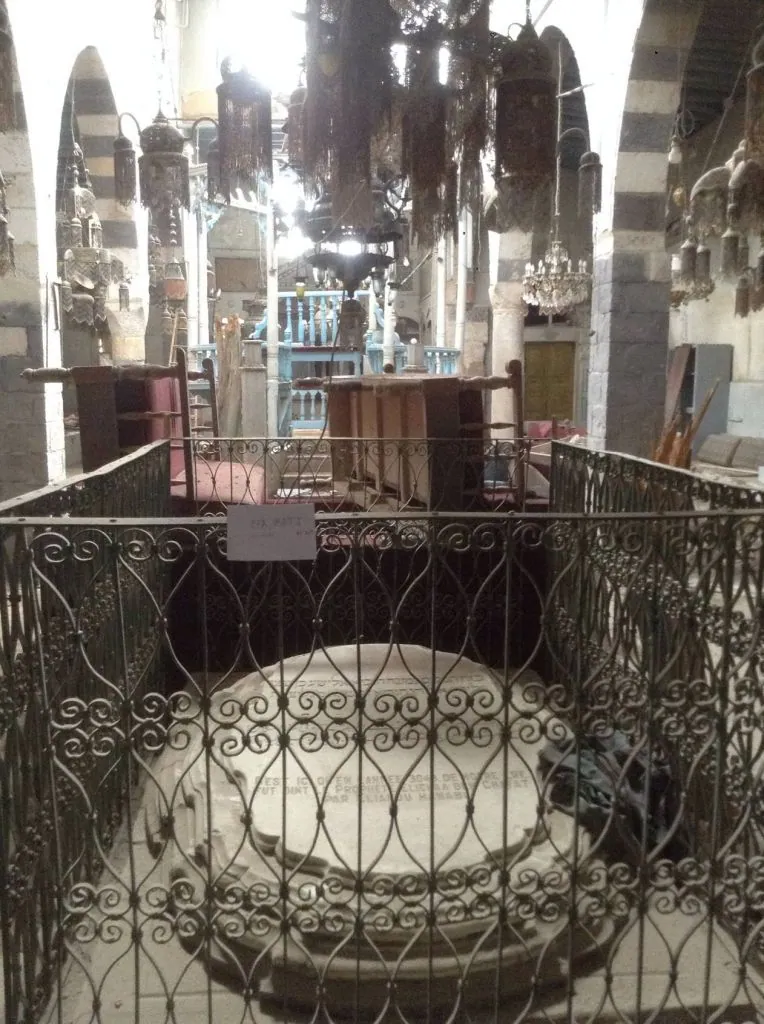
Jobar was a village about two kilometres north-east of the Old City of Damascus and is now a suburb of the capital. Its synagogue, named for the prophet Elijah (Eliyahu Hanavi), stood over a cave in which, by tradition, Elijah hid, and Jewish tradition credited the building itself to his disciple Elisha. A marble sign at the gate claimed it was first built in 720 BCE, and news reports regularly called it 2,000 years old. Neither claim is documented. A Talmudic passage naming a synagogue of 'Abi Gobar' has often been applied to it, but that identification is contested. The earliest dated mention is by the French traveller Samuel ben Samson, who in 1210 described a beautiful synagogue outside the city. The nineteenth-century traveller J. J. Benjamin wrote that an earlier synagogue here was destroyed in the sixteenth century, and heritage monitors in 2014 described the building that then stood as about 400 years old, raised over a far older cave site.
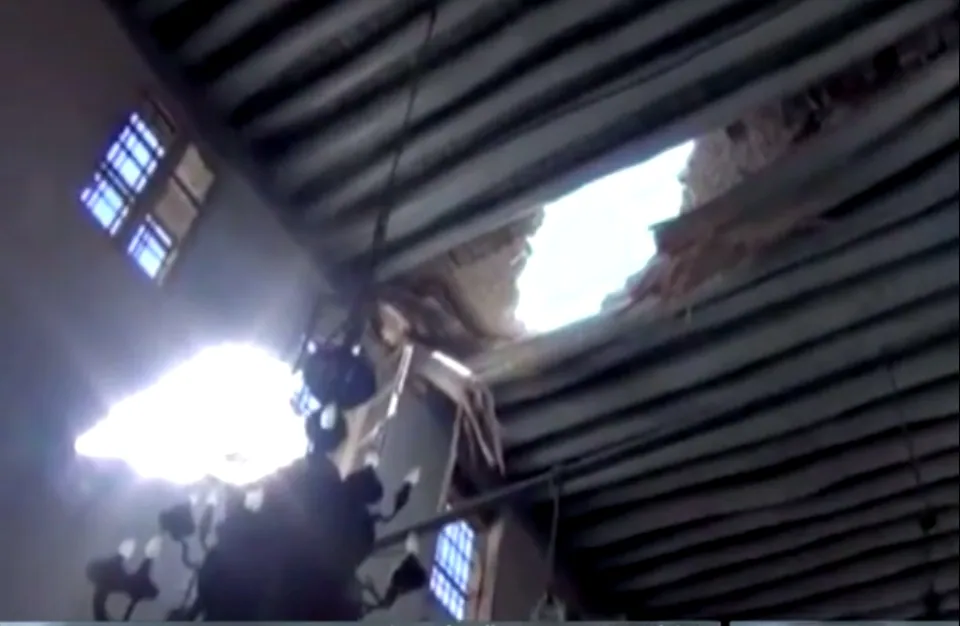
Jews from Damascus still came to pray there on Saturdays until the Syrian civil war began in 2011. Jobar then became an opposition-held front line. From March 2013 the synagogue was reported shelled, looted and burned, with the government and the rebels blaming each other, yet photographs from December 2013 showed the prayer hall still standing. Over a weekend in late May 2014 it was shelled into rubble; the opposition blamed the Syrian army. Visitors in September 2025 found almost nothing left.
Where it stood for 804 years
Historic: the village of Jobar (Djobar), about two kilometres north-east of the Old City of Damascus. Today: rubble in the Jobar district of Damascus, Syria; no street address found. Pin from published coordinates (approximate).
Open larger map →The Jewish community
The Jewish Encyclopedia records that an anonymous traveller who arrived a few years after the Spanish expulsion of 1492 found sixty Jewish families living in Jobar, a mile from Damascus, and that Joseph Sambari's chronicle, finished in 1672, said the Jews of Damascus lived chiefly in Jobar. The Damascene writer Ibn Tulun, who died in the 1540s, is cited as calling Jobar a Jewish village with a Muslim presence. By 1847, according to the Scottish missionary John Wilson, only one Jewish family lived in the village and looked after the synagogue, while many Jews of Damascus came out for the festivals and at other times of the year; a later account says some used rooms in the adjoining court as a spring and summer retreat. In 1901 the Damascus community had eight synagogues 'besides the ancient one of Jobar'. After 1948 Syrian restrictions on Jews tightened, and part of the synagogue's land was turned into a school for displaced Palestinians. Diarna records that it stayed in regular use into the 1990s, when most of the remaining Jews emigrated, and that the Damascus community then kept caretakers there.
Architecture and design
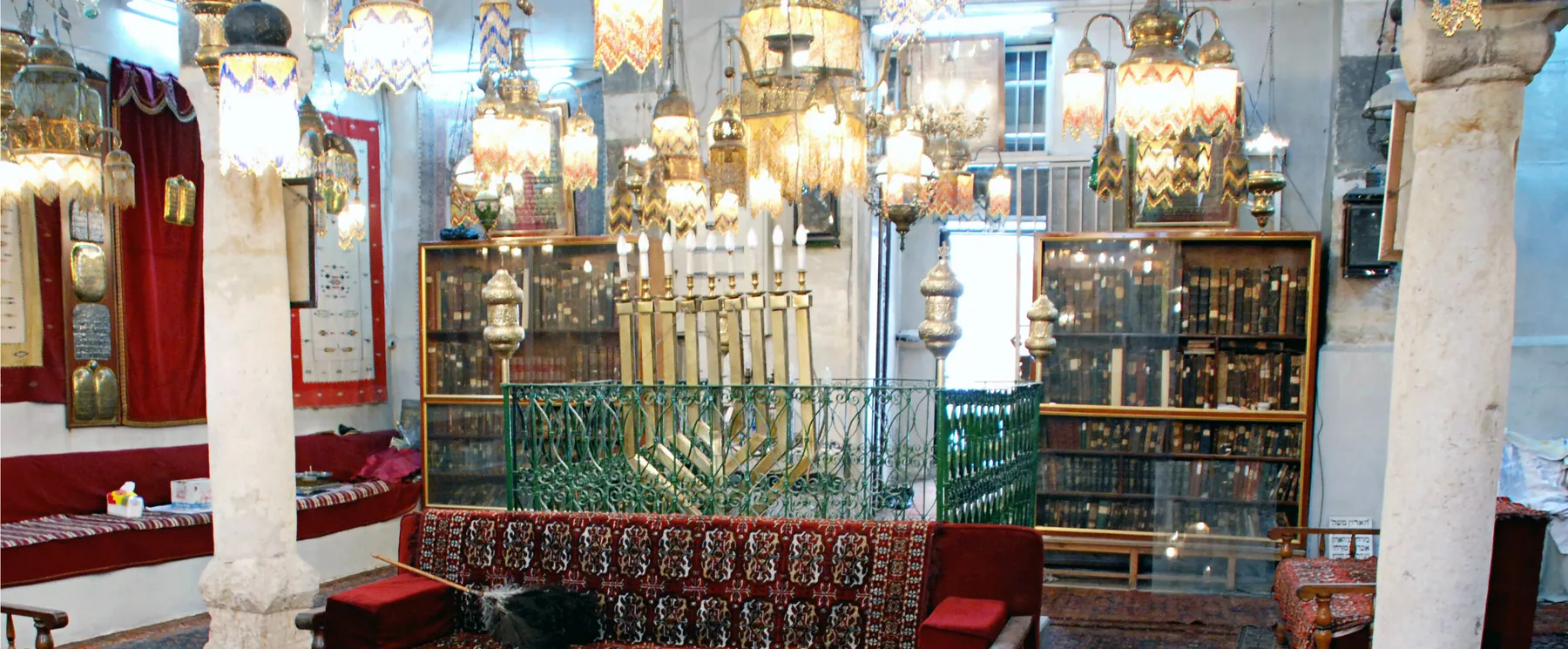
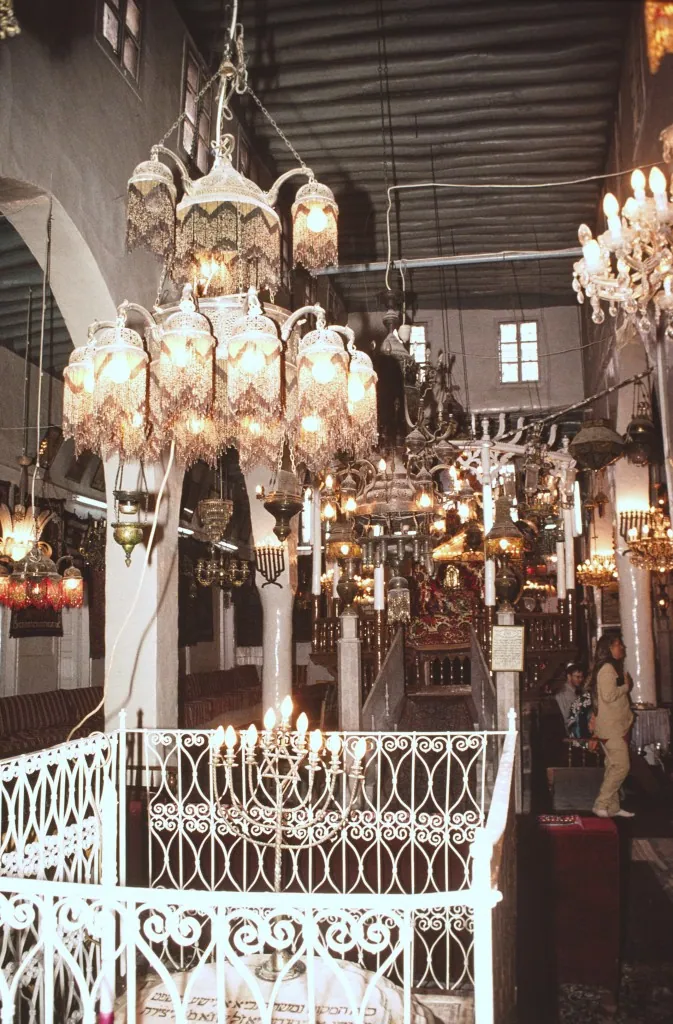
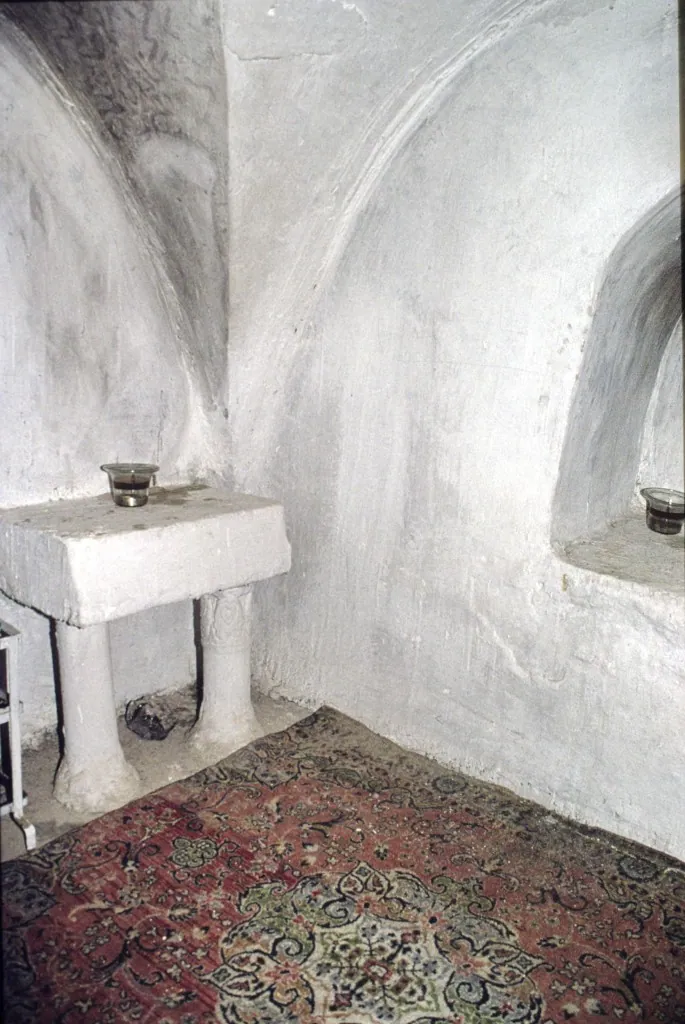
No architect or building date is recorded. The prayer hall was a small rectangle: the Syrian cadastre, cited by the historian Eliyahu Ashtor in 1959, gave long sides of 17.3 and 15.7 metres and a width of 12.13 metres. It was entered through a single portal. The traveller of the 1490s wrote that the building was supported by thirteen columns, and J. J. Benjamin, who visited in the late 1840s, counted thirteen marble pillars, six on the right and seven on the left, in an interior inlaid with marble; he compared the building to a mosque. The columns divided the hall into a central aisle and two wings. A video of 2013 showed a ceiling of poplar beams. Beneath the shrine, about twenty steps led down to the grotto linked with Elijah and Elisha, which one writer describes as a former burial chamber. Near the entrance lay a worn stone step on which, by tradition, King Hazael sat when he was anointed. Rooms for the rabbi and community staff adjoined the hall around a court, with communal rooms on an upper floor. The seating capacity is unknown.
Life inside the synagogue
The synagogue was as much a shrine as a house of prayer. It was dedicated to Elijah, known in Arabic as al-Khidr and venerated by Muslims as well as Jews, and pilgrims came to the cave below the hall in hope of miracles. A nineteenth-century account says the sick were left alone overnight in the cavern in the hope that the spirit of Elisha would heal them. Tradition also placed here the anointing of Hazael as king of Syria. The Jews of Damascus came out to Jobar for the festivals. In 1840, during the Damascus affair, a mob broke in, pillaged the building and destroyed its Torah scrolls. In the years before 2011 members of the small community left in Damascus, among them its later head Bakhour Chamntoub, came on Saturdays to pray. He remembered Torah scrolls written on gazelle leather, chandeliers, tapestries and carpets. A Muslim neighbour, Barakat Hazroumi, recalled worshippers asking him to switch on lights or light candles for them on the Sabbath.
Destruction
Jobar was held by opposition fighters during the Syrian civil war and was bombarded by government forces for years. On 2 March 2013 Al-Arabiya aired an opposition video presenting the synagogue as destroyed by the government. Rebels accused the government of looting and burning it, which the government denied; the outlet Syrian News blamed the Free Syrian Army for the looting, and Al-Manar blamed 'Zionist commandos'. According to Diarna, mortar fire in early 2013 damaged the outer courtyard and rooms, and looting followed. Photographs sent by opposition contacts in December 2013 showed the hall standing but stripped; a source told the Times of Israel that a group linked to the Nusra Front held the Torah scrolls. Over the weekend before 27 May 2014 the building was shelled into rubble. The Daily Beast, citing opposition leaders, reported that the Syrian army had flattened it. Franklin Lamb, writing from Damascus, rejected blaming the government, and Diarna's correspondents judged the damage extensive but not intentional. No government statement on that shelling was found. Adam Blitz wrote that over two-thirds was destroyed, the left wing and central aisle reduced to rubble.
The community’s fate
The Jews who used the Jobar synagogue did not perish with it: almost the whole community had left Syria before the building fell. According to the Associated Press, Syria had about 100,000 Jews at the start of the twentieth century. After the creation of Israel in 1948, restrictions on Syrian Jews tightened and property left behind by those who departed was confiscated. In December 2024, after the fall of the Assad government, the head of the community, Bakhour Chamntoub, then 74, said that nine Jews were left in Syria, almost all of them elderly men and women, and that the community expected none to remain within a few years. A Times of Israel report of September 2025 put the number at six. What survives of the synagogue's contents, including fire-damaged Torah scrolls stripped of their coverings, a Ner Tamid lamp and hangings from the walls, has been kept in a storeroom of the National Museum of Damascus since 2017, according to the museum's chief curator.
The site today
The site lies in the ruined Jobar district, which government forces retook in 2018 and kept under tight security until the Assad government fell in December 2024. On 26 December 2024 Bakhour Chamntoub visited for the first time in fifteen years; the Associated Press reported that walls and roofs had collapsed and part of the building was a pile of debris. Its photograph shows a roofless two-storey range of the complex, with an arcaded ground floor, still standing beside the rubble, and the same shell appears in a photograph of September 2025. The editor of the Times of Israel, who visited on 15 September 2025, wrote that almost nothing hinted that a synagogue had stood there: a last arch of the prayer hall had gone, and treasure hunters had tunnelled into the rubble. No restoration work was reported.
Notable names
Bakhour Chamntoub
born c. 1950Head of the Jewish community of Syria; worshipper at Jobar before 2011Chamntoub, who stayed in Damascus when nearly all other Syrian Jews had left, came with other members of the community to pray at the Jobar synagogue on Saturdays until the civil war began in 2011. As head of the community he returned on 26 December 2024, his first visit in fifteen years, and told the Associated Press that the synagogue 'means a lot to us' and that he had not expected to find part of it reduced to a pile of debris.
Biography or source →Do you have something to contribute?
Photographs, documents, family stories or memories of this synagogue and its community help keep its history alive.
- Damascus (article in the Jewish Encyclopedia, 1901-1906)
- Jobar Synagogue
- In Syria, small Jewish community can again visit synagogue built 720 years before Christ
- Syria's 'destroyed' ancient synagogue is still intact
- Damascus Hide and Seek / The case for Jobar (blog post on the reporting of the synagogue's damage)
- Exclusive Pictures: Syria's Oldest Synagogue Destroyed by Assad
- Assad forces destroy Syria's oldest synagogue
- Jobar synagogue
- Damage to Syria's heritage, 1 June 2014
- Respected and Protected... Syrians Working to Preserve Jewish Cultural Heritage
- ASOR Cultural Heritage Initiatives, Weekly Report 7
- 48 surreal hours in Damascus
- Before Its Destruction: Jobar Synagogue in Syria
- Before Its Destruction: Jobar Synagogue in Syria (Diarna page)
- Syria's dwindling Jewish community can visit one of the world's oldest synagogues again
- Jobar Synagogue (Wikidata item Q6206772)
Share a memory or thought
No comments yet. Be the first to add one.