
The story of Wooden Synagogue of Jurbarkas
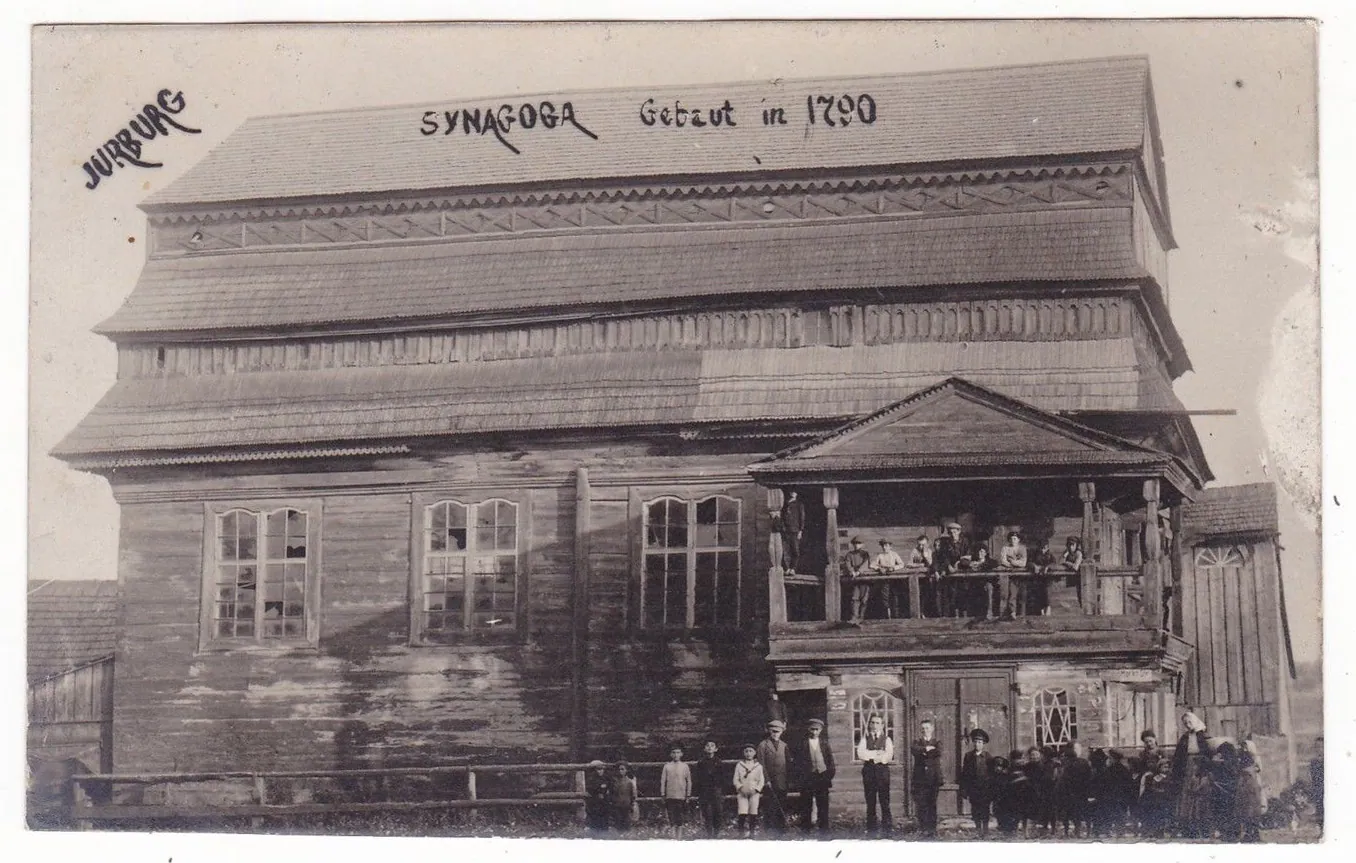
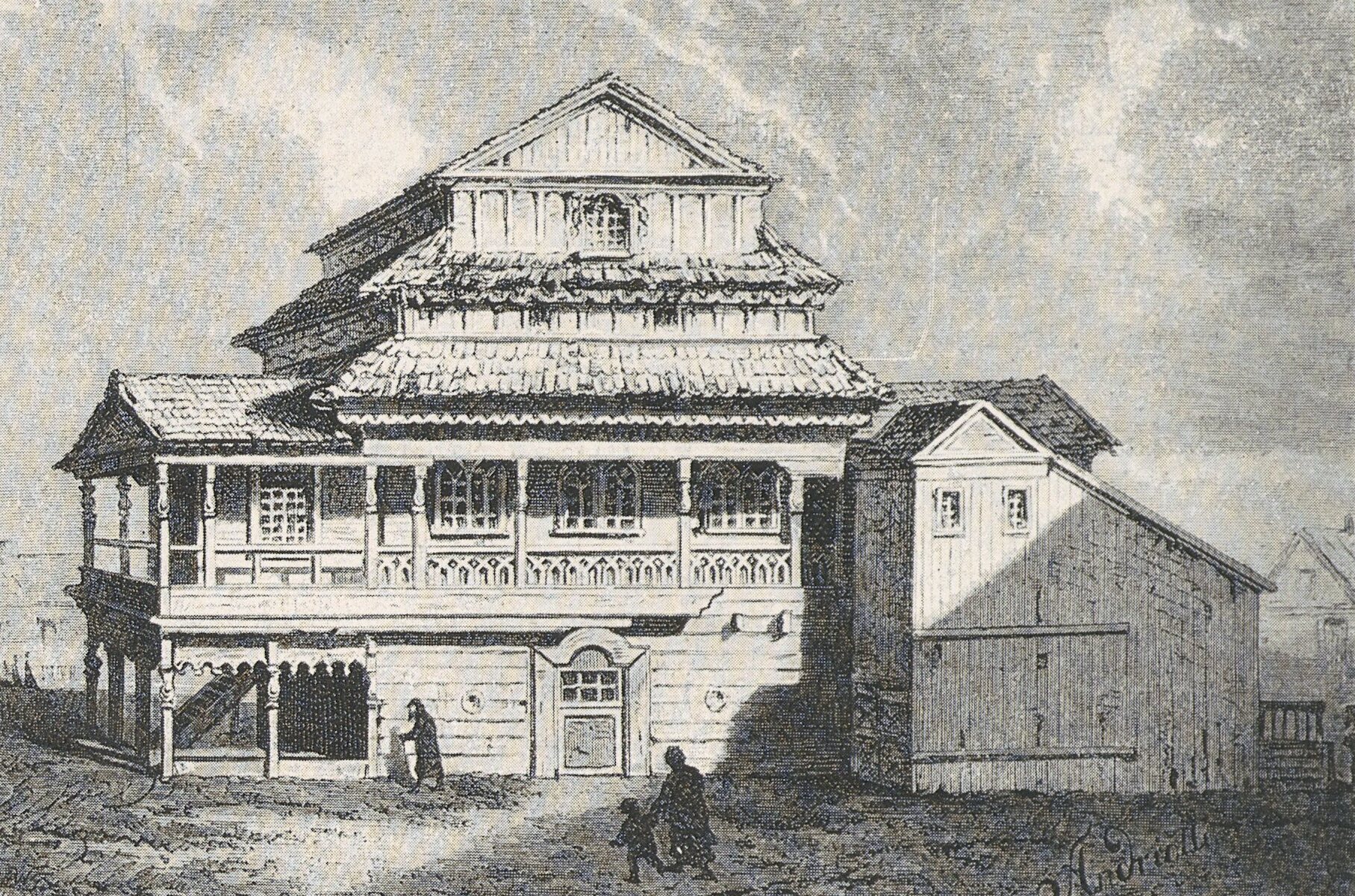
Jurbarkas, known to Jews as Yurburg, is a town on the Neman river in western Lithuania, close to the old border with East Prussia. Its great wooden synagogue was built in 1790, as the date "gebaut im 1790" painted on a wartime photograph records, on what is now Kaunas Street, formerly Jewish Street. The Lithuanian Jewish heritage survey gives 1786. It was a tall timber building with a massive main block under several stepped, overhanging roofs and a two-storey front with open wooden galleries. Jewish artisans built it and carved its interior. The Holy Ark was covered with carvings of wild animals, birds and plants, and the synagogue also had a carved Chair of Elijah and an ornate bimah. The artist Michał Elwiro Andriolli drew it in 1872, and his view was widely reproduced. German soldiers photographed it in the First World War, and postcards of it circulated around the world. In 1886 a masonry synagogue with heating for winter prayer was built beside it. After Nazi Germany invaded in June 1941, the German and Lithuanian authorities ordered the Jews to pull down the old synagogue, and its Torah scrolls and books were burned. A memorial square now marks the site.
Where it stood for 151 years
Historic: Jewish Street (now Kauno g. / Kaunas Street), Jurbarkas. Present day: Synagogues' Square memorial on Kaunas Street, Jurbarkas, Lithuania. Approximate.
Open larger map →The Jewish community
Jurbarkas, a river port on the Neman beside the East Prussian border, had a large and long-established Jewish community. Its two main streets, Jewish Street (now Kaunas Street) and Raseiniai Street, were lined with Jewish shops and craftsmen's workshops. The community built its great wooden synagogue in 1790 and, a century later, a masonry synagogue beside it that also served as a winter prayer house, study house and religious school. The Yurburg memorial book stresses the community's pride in its institutions. Besides the famous synagogue, it kept a Hebrew gymnasium open to rich and poor alike, something larger and wealthier towns lacked. The memorial book, compiled by survivors and emigrants, describes a lively town of religious, educational and cultural institutions in the interwar Republic of Lithuania, which the German occupation of 1941 destroyed within months.
Architecture and design
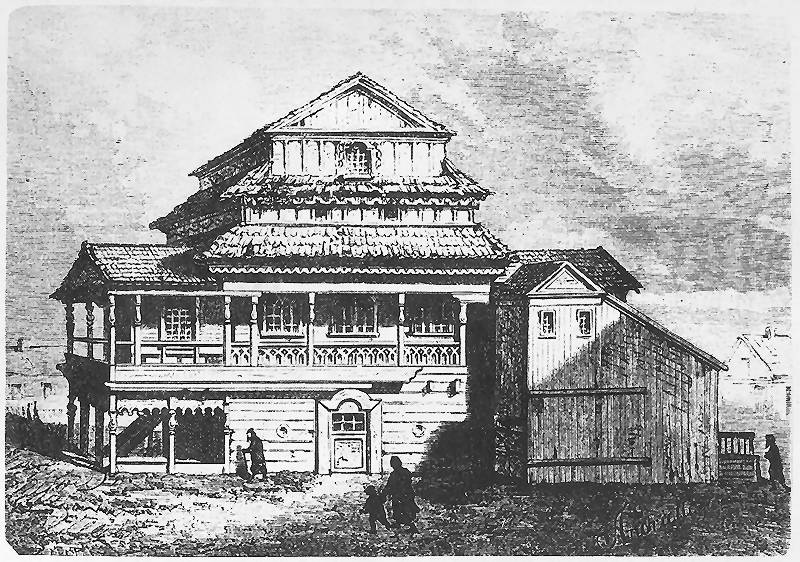
The synagogue was a large log building of several storeys. Its main prayer hall rose to a massive block topped by a series of stepped, overhanging roofs, with carved boards along the eaves. On the front, a lower two-storey annex carried an open wooden gallery on each level, framed by carved posts and balustrades, with the entrance below. Michał Elwiro Andriolli's drawing of 1872 shows the building from the corner, with the tall central mass and its tiers of roofs, the galleried front and a plain side annex. Photographs taken around 1915 show weathered log walls, paired windows and the gabled galleried porch, with a crowd of townspeople in front. Inside, Jewish craftsmen carved the Holy Ark with wild animals, birds and plants. There were also a carved Chair of Elijah for circumcisions and an elaborate bimah. The memorial book calls its style that of the Middle Ages.
Life inside the synagogue
The great synagogue was the pride of Yurburg and a place of pilgrimage for visitors. The memorial book recalls that many people came to see it and that its pictures were distributed all over the world. It served as the town's main house of prayer for over 150 years. The adjoining masonry synagogue of 1886 provided a heated winter prayer hall, a study house and a religious school. The community's rabbis led worship there up to the war. The last of them, Rabbi Haim-Ruven Rubinstein, was forced by the occupiers in June 1941 to hand over his own writings and books to be burned. The synagogue was also a subject for artists. Andriolli's engraving appeared in books about his work, and wartime German photographs made it one of the best-known wooden synagogues of Lithuania.
Destruction
Nazi Germany invaded Lithuania on 22 June 1941, and Jurbarkas, on the border with East Prussia, was occupied immediately. On 28–29 June 1941 the Torah scrolls and books of the Jewish community, including the rabbi's writings, were heaped in a yard and burned. According to the survivors' account on the Yurburg KehilaLinks site, the Jews were then ordered to destroy the synagogue themselves, to tear down its walls and hand over everything removable to the local Lithuanians. The Lithuanian Jewish heritage survey states that the Nazi occupation forces ordered its destruction in the summer of 1941. The memorial book says that in September 1941 the synagogue was set on fire and destroyed. The destruction was ordered by the Nazi German occupiers and carried out with Lithuanian collaborators, who also murdered the community.
The community’s fate
The Jews of Jurbarkas were murdered within three months of the German invasion. On 3 July 1941 the Gestapo chief Böhme, with 30–40 Germans who came from Smalininkai (Schmalleningken) and Lithuanian collaborators, shot 322 Jewish men and a few women and children at the Jewish cemetery. On 21 July about 45 elderly people and coachmen were shot on the Raseiniai road. On 1 August about 200 women and children were murdered by Lithuanian activists in the Švančiai woods. In early September 1941 German and Lithuanian police rounded up and murdered the remaining Jewish population. Almost the entire community was killed. In 2018 memory stones were laid for the Berkover family, and in 2019 a memorial square was opened on the site of the synagogues.
The site today
Nothing of the wooden synagogue survives. It stood on Kaunas Street, formerly Jewish Street, in the historic Jewish quarter of Jurbarkas, together with the later masonry synagogue. In 2019 the Synagogues' Square memorial was opened on the site, with work by the sculptor Dovydas Zundelovičius. Nearby, eleven memory stones laid in 2018 commemorate members of the Berkover family murdered in 1941. The synagogue is known from Andriolli's drawing of 1872, published in 1904, and from photographs taken around 1915 and postcards of the 1920s.
Notable names
Haim-Ruven Rubinstein
fl. 1941Last rabbi of JurbarkasHaim-Ruven Rubinstein was the last rabbi of Yurburg, leading the congregation of the great wooden synagogue and its neighbouring masonry synagogue until the German invasion. On 28 June 1941 the occupiers forced him to deliver his own writings and books, which were burned with the community's Torah scrolls. His own fate is not documented in the account consulted; the community he served was murdered in the massacres of July to September 1941.
Biography or source →Do you have something to contribute?
Photographs, documents, family stories or memories of this synagogue and its community help keep its history alive.
Share a memory or thought
No comments yet. Be the first to add one.