
История Kadaň Synagogue
Kadaň, known in German as Kaaden, lies on the Ohře (Eger) river in north-western Bohemia, about 14 km south-west of Chomutov. Jews lived there in the Middle Ages and again in the seventeenth century, but they were expelled in 1520 and once more in 1650, and for two centuries the town admitted no Jewish residents. Permanent settlement resumed only in the 1870s. The newcomers first prayed in rented rooms as a prayer association under the rabbinate of Saaz (Žatec), and in 1888-90 they built a synagogue in a bastion of the old town fortifications. The congregation, founded in 1874 and approved in 1884, became a legally constituted community in 1893. The community grew quickly with the town's industry, reaching about 400 people in 1910, and in 1900 it also opened a community house with a prayer hall on Hasnerstraße. Surviving photographs show a gabled hall with a large rose window, standing behind a railing among villas. After Nazi Germany annexed the Sudetenland in October 1938 the synagogue was set on fire in the November Pogrom and destroyed down to its foundations. Nothing of it is recorded as surviving today.
Where it stood for 48 years
Historic: Kaaden, in the Bastei (bastion) of the old town fortifications; street and house number unknown. Today: near Školní 647, Kadaň, okres Chomutov, Ústí nad Labem region (approximate).
Открыть большую карту →Еврейская община
Jews are first recorded in Kadaň in 1339 and 1341. Between 1465 and 1517 seven Jews were granted citizenship, and at least seven Jewish families are documented between 1469 and 1494, living in the south-western corner of the town near the Water Gate under the protection of the lords of Lobkowitz and Hassenstein. After the town bought its freedom the Jews were expelled in 1520. A family returned in 1624 with royal permission and others followed, mainly from Údlice, but in 1650 the whole community was expelled after a visiting Jew was executed on a charge of killing a Christian child. Jews then had to pass the town on a field path still called the Judensteig. Ten Jewish families lived in the town in 1724 and nine in 1798, according to the Encyclopaedia Judaica, though the Jüdische Gemeinden summary says the settlement ban lasted into the nineteenth century. The modern community numbered 118 in the district in 1869, 219 in 1881 and 409 in 1910, then declined to 116 in 1930. At times it included Jews of Vilémov, Vintířov, Radonice and Mašťov. It laid out a cemetery in the 1880s and a second one in 1926.
Архитектура и дизайн
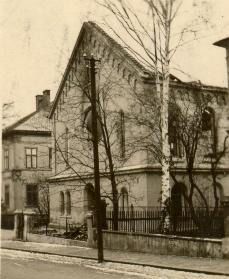
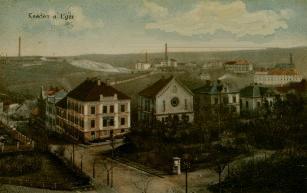
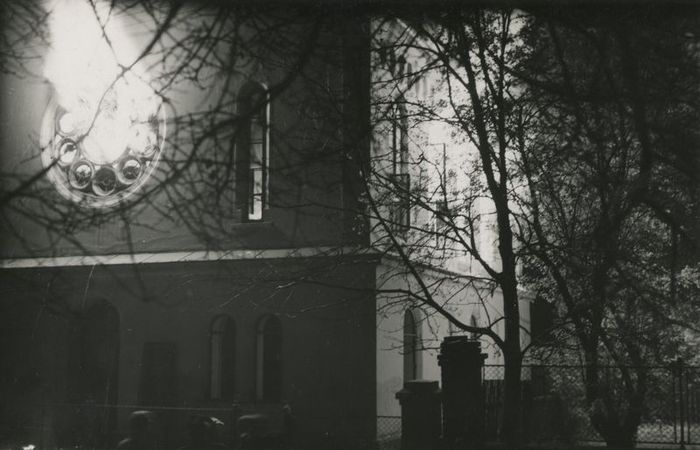
No description of the building, its architect or its seating has been found; this section rests on three photographs. A photograph dated to about 1930 shows a free-standing rendered hall seen from the street corner, with a steep gable crowned by a stepped frieze of small arches along its edges, tall round-headed windows on the long side and smaller paired round-headed windows on the ground floor. A lower wing or porch projects at the front, and the building stands behind a low wall and iron railing beside a two-storey house. A coloured postcard of about 1900 shows the same gabled building in the centre of a view of the town, its gable pierced by a large round rose window. A photograph of the fire in 1938 shows that rose window lit from inside, with a band of round-arched openings below it. The round-arched details point to the round-arched or Romanesque revival manner common in Bohemian synagogues of the time, but no source names the style. Whether the building stood inside the old bastion itself or beside it is not clear from the sources read.
Жизнь в синагоге
Very little is recorded about worship in the building. Before it was built the Jews of Kadaň met as a prayer association in rented rooms and were attached to the rabbinate of Saaz (Žatec), and the community was only formally constituted in the years after the synagogue was dedicated. No rabbi, cantor or community officer is named in any source read in this research, and nothing has been found about the rite followed, the seating, the furnishings or the communal societies. The community kept two cemeteries: the older one, opened in 1884 on the edge of the town and also used by Jews from nearby Saar (Žďár), and a newer one laid out in 1926 near the municipal cemetery. From 1900 the community also had a community house with its own prayer hall on Hasnerstraße, which suggests that the synagogue was used mainly for Sabbaths and festivals while daily or winter services may have been held there, although no source says so directly.
Разрушение
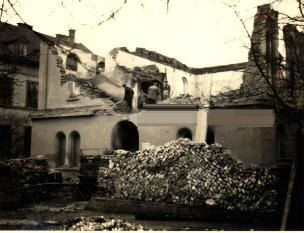
Nazi Germany occupied the Sudetenland, including Kadaň, in October 1938 under the Munich Agreement. During the Nazi November Pogrom (Kristallnacht) the synagogue was set on fire; the Encyclopaedia Judaica gives the date as 10 November 1938. A photograph published on the Czech Holocaust portal holocaust.cz shows the building burning at night, its rose window glowing from the flames inside. A second photograph, dated November 1938, shows the gutted shell: the roof and gable gone, the upper walls broken and a large pile of salvaged bricks stacked in front, which suggests that demolition of the ruin had already begun. The building was destroyed down to its foundations. The sources read do not name the individuals who started the fire, and they do not say who cleared the ruins or when the clearance ended.
Судьба общины
The Kadaň community was dispersed when the Nazis occupied the Sudeten region in October 1938. According to the Jüdische Gemeinden summary, the authorities forced the Jews out of the town and they moved into the interior of Bohemia and Moravia. Some later managed to emigrate. Those who remained in what became the Nazi Protectorate of Bohemia and Moravia were deported from 1942 onwards, most of them through the Theresienstadt (Terezín) ghetto, to death camps in occupied Poland, where they were murdered. Very few survived. The number of Kadaň Jews who were killed is not given in the sources read. No Jewish community was re-established after the war, and the town has no Jewish residents today. The Nazis also used gravestones from the older cemetery as building material.
Место сегодня
No trace of the synagogue is recorded today, and the Jüdische Gemeinden summary states that no visible signs of Jewish life remain in Kadaň. The exact plot has not been identified in a cadastral source. The coordinates given in the German Wikipedia article on the synagogue fall on the south-western side of the town centre near Školní street, close to the line of the old town walls, but this has not been checked against a historic map. The newer Jewish cemetery was built over in 1985 for a municipal funeral hall and parkland, and the last gravestones were removed by the town administration in the 1980s; the older cemetery lies within allotment gardens on Hřbitovní street, with only a few stones left.
Вам есть чем поделиться?
Фотографии, документы, семейные истории и воспоминания об этой синагоге и её общине помогают сохранить её историю.
- Synagoge (Kadaň)
- Liste der zerstörten Synagogen in den vom Deutschen Reich 1938 bis 1945 besetzten Gebieten
- Kaaden/Eger (Böhmen)
- Kadan (Encyclopaedia Judaica entry by Jan Herman)
- Kadan
- Kadaň (Cemetery Discovery Project)
- Nominatim reverse geocoding of 50.379167, 13.272778 (OSM node 2327979355, Školní 647, Kadaň)
Share a memory or thought
No comments yet. Be the first to add one.