
La historia de Kaposvár Synagogue
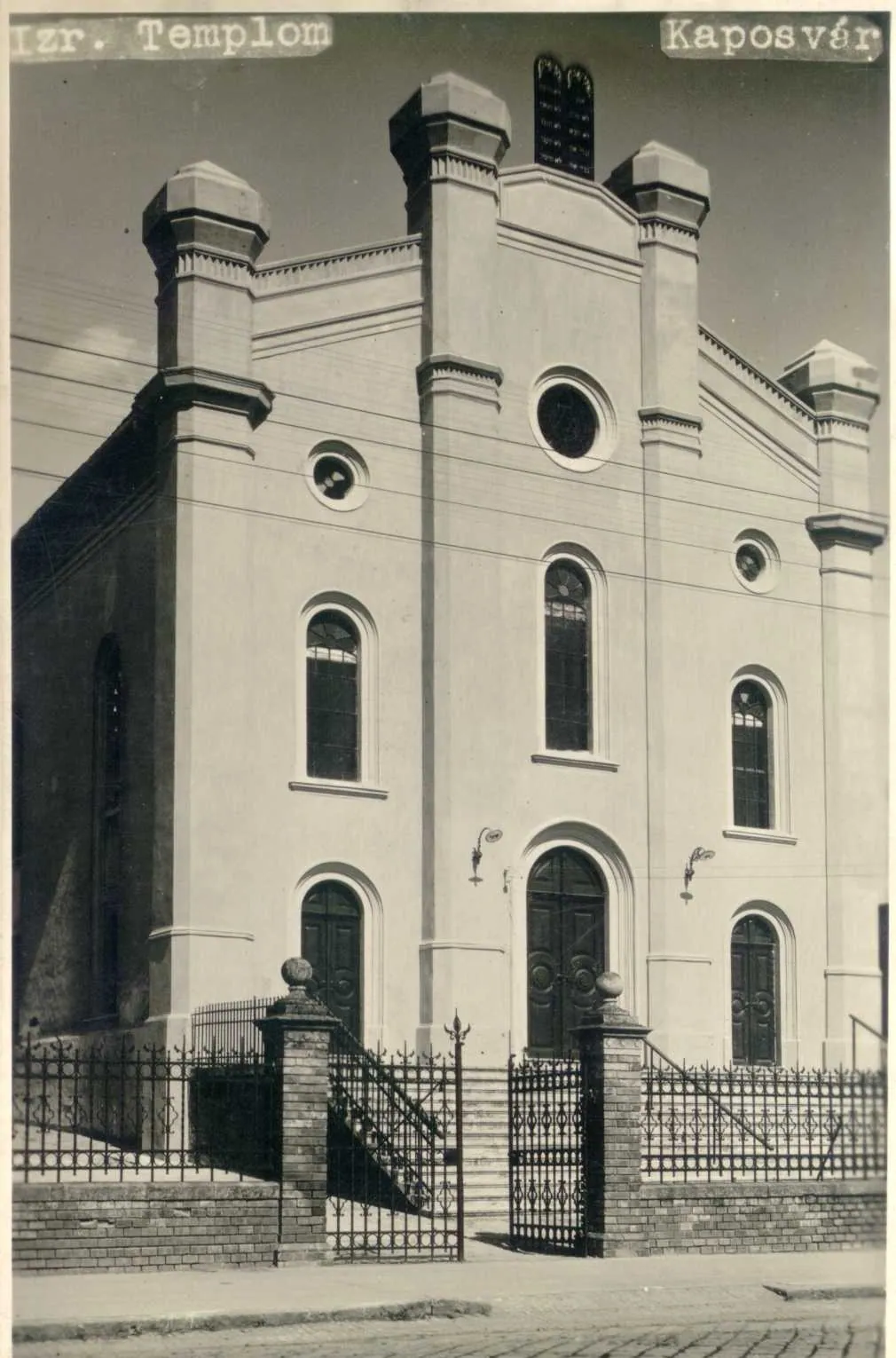
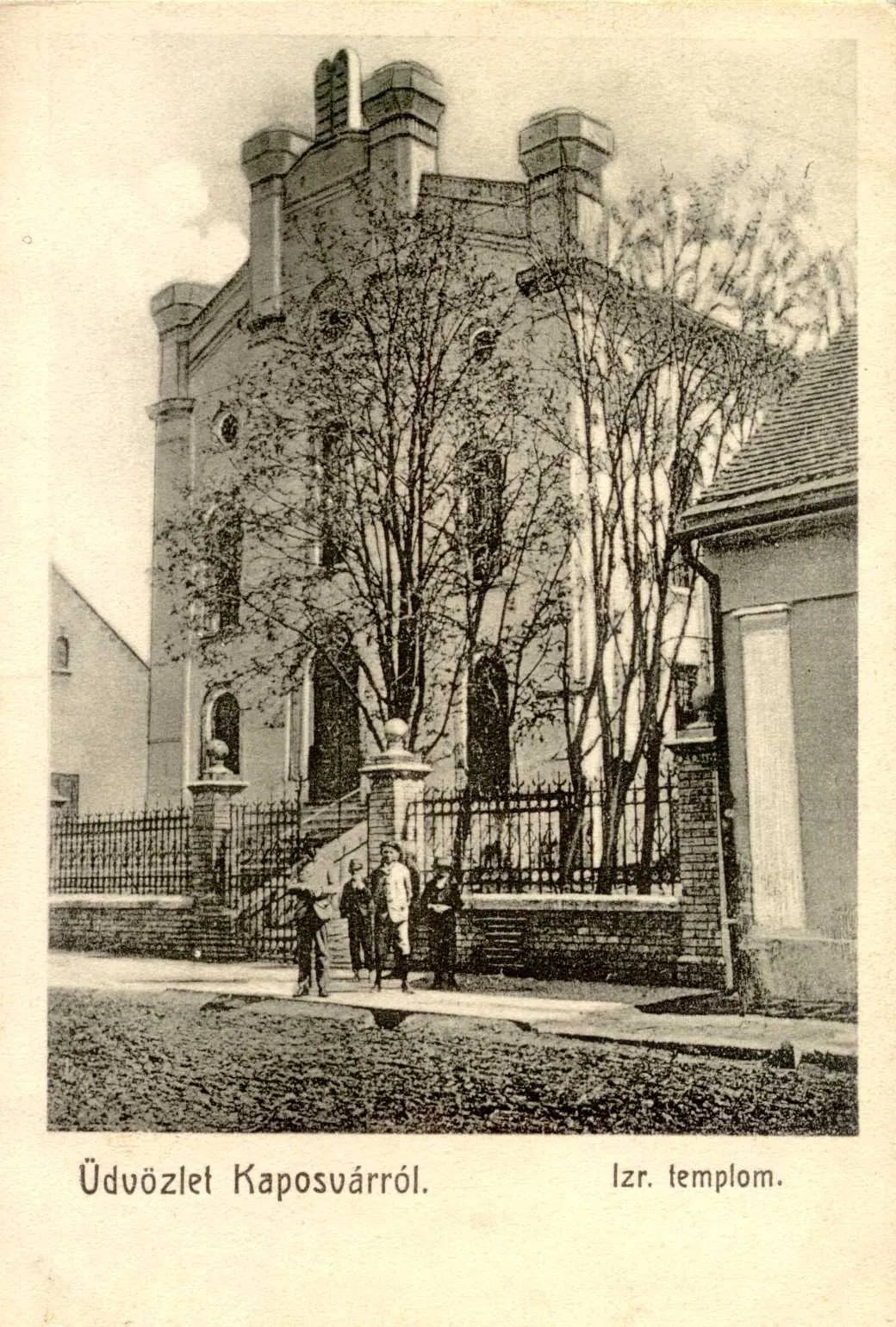
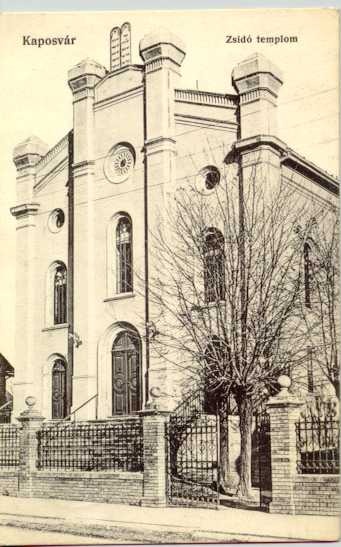
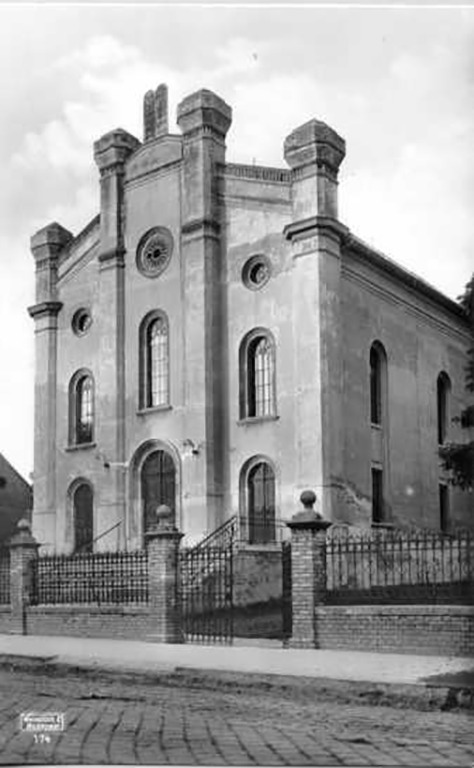
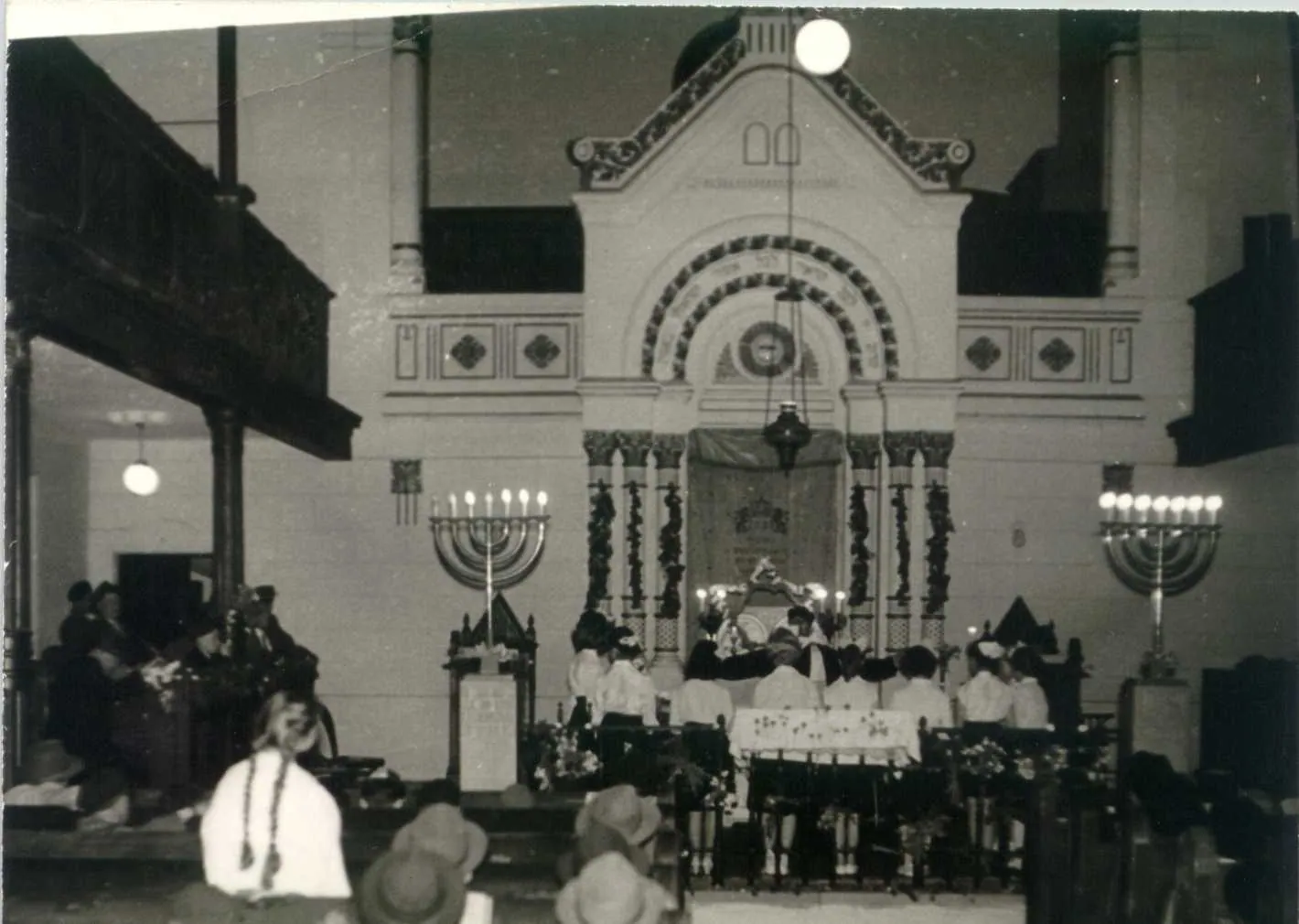
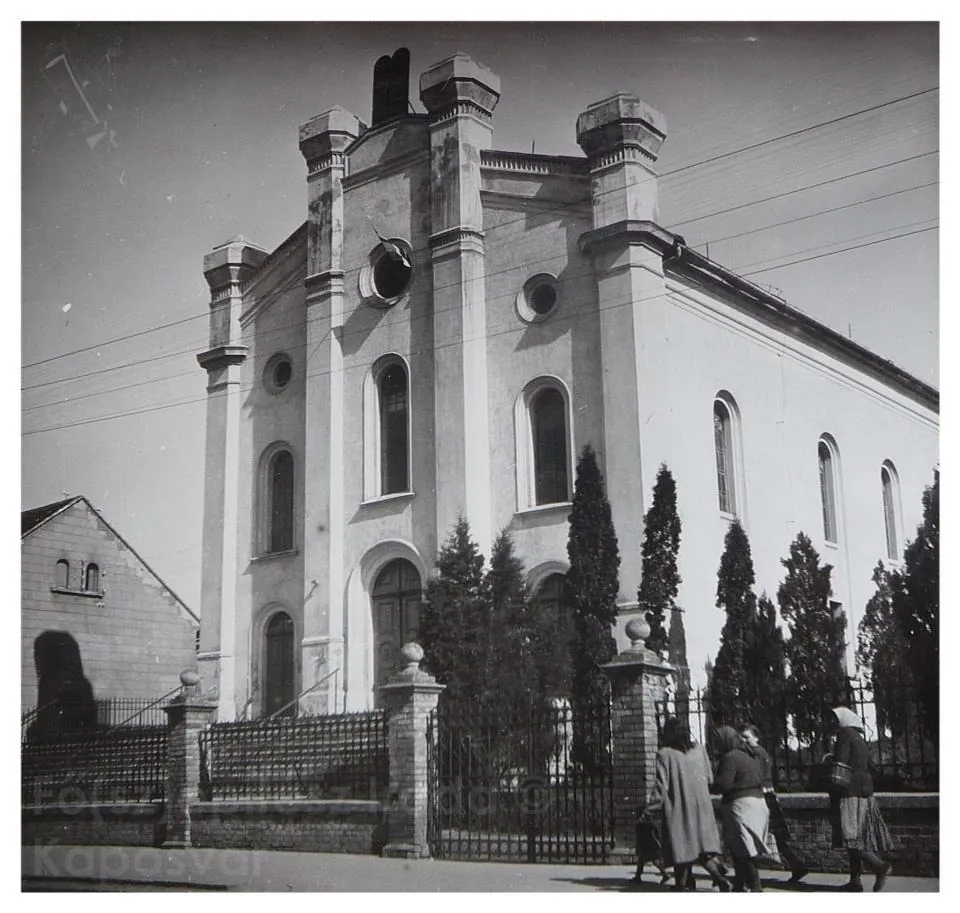
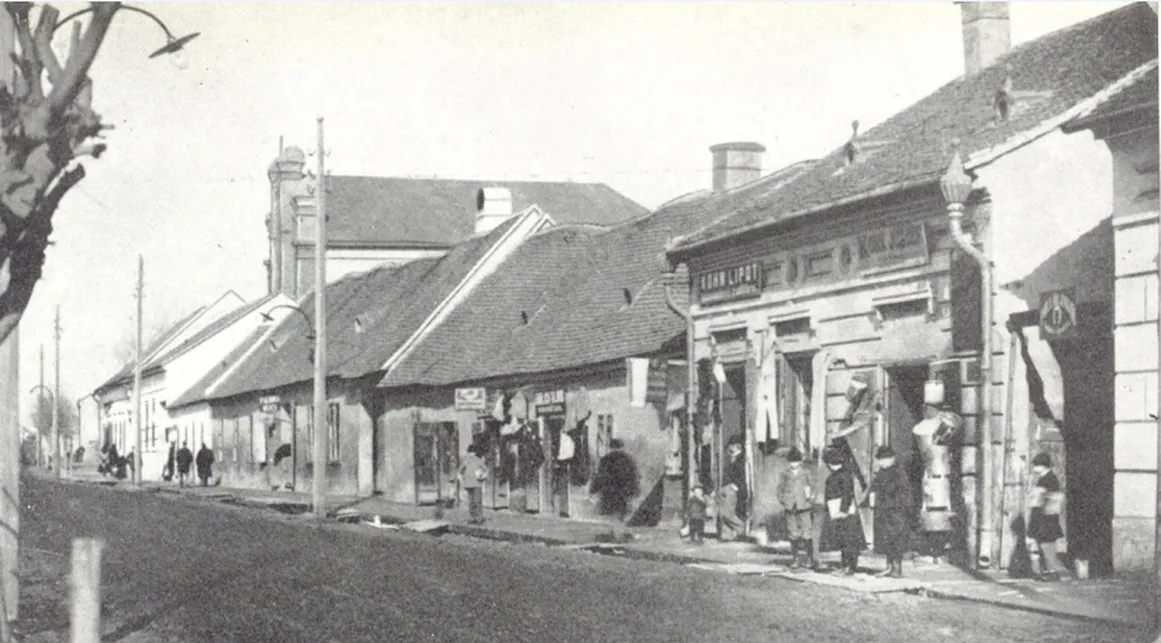
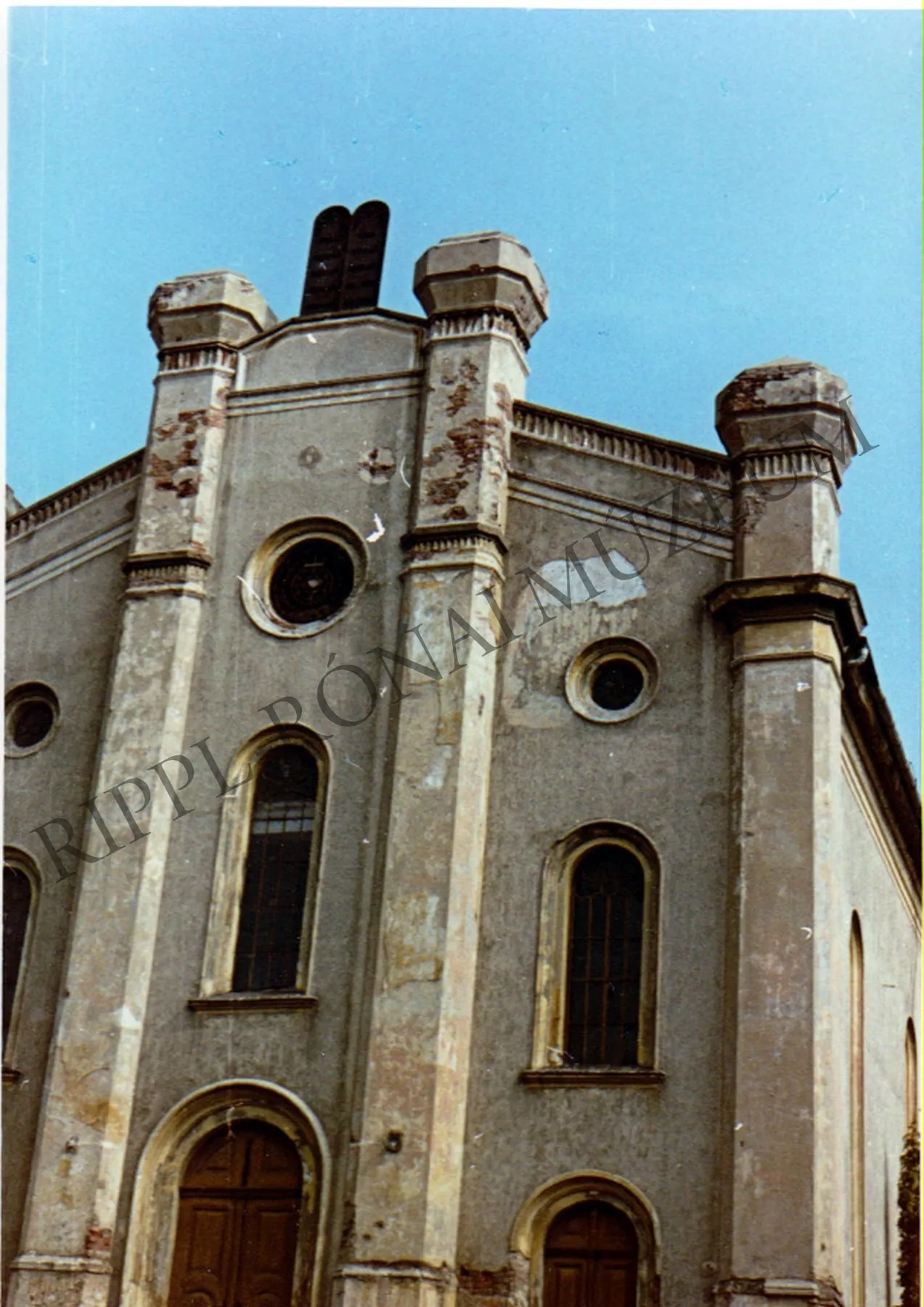
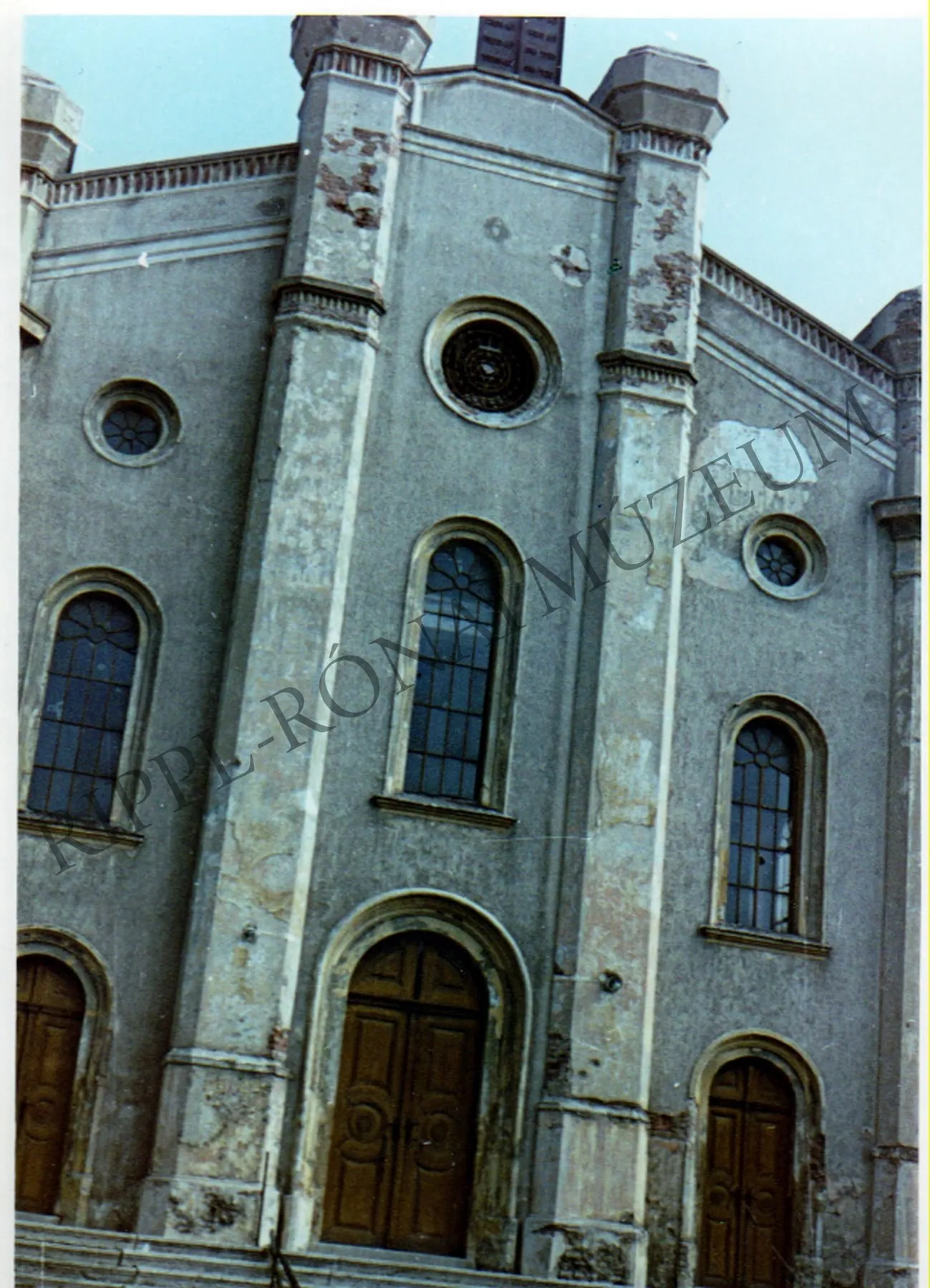
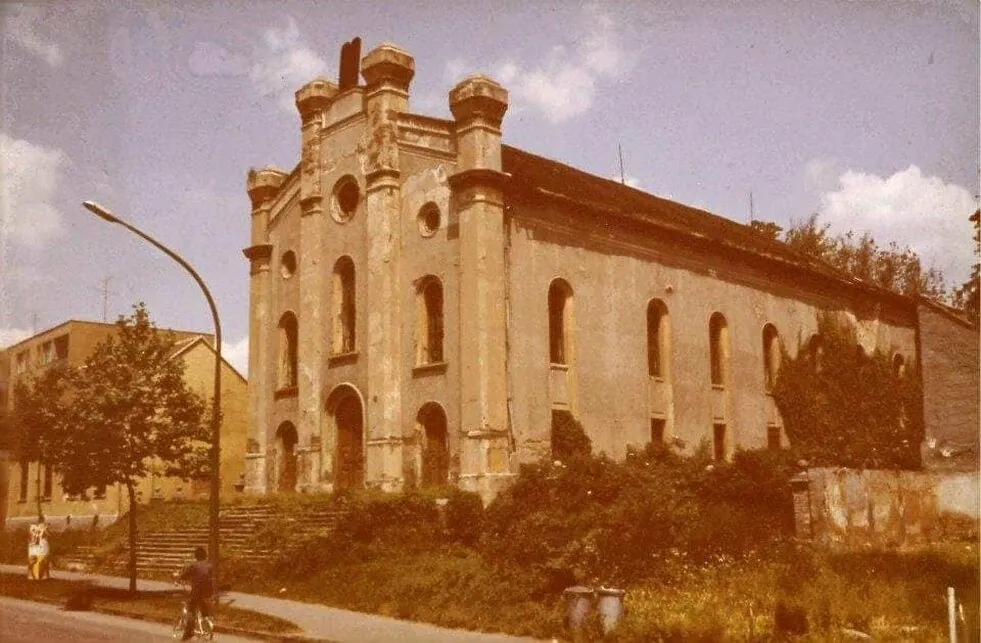
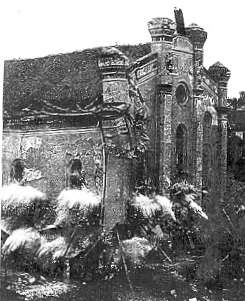
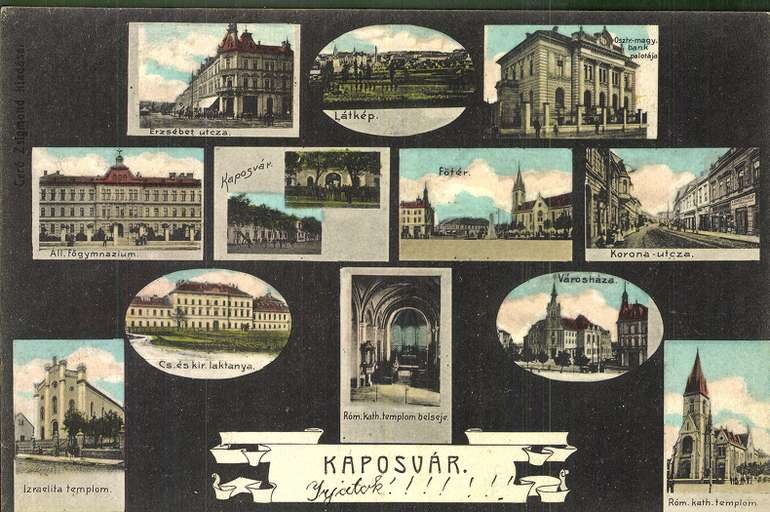
The synagogue stood on Berzsenyi utca, the former Hosszú utca, at what was then the edge of Kaposvár's town centre. The Jewish community had bought a house there for a prayer room, and in 1862 it built the first part of a purpose-built synagogue; some later accounts give 1864. Because there was never money for a larger replacement, the building was enlarged three times, and it received its final form in 1905–06 to plans by the Budapest architect Lipót Baumhorn. Photographs show a tall rendered façade divided by four polygonal turrets with battlemented caps, round-arched doors and windows, small circular windows, and the Tablets of the Law above the central parapet. Behind it lay a long hall whose women's gallery rested on slender cast-iron columns. With 800 to 1,000 seats it was the religious centre of a Neolog community of about 4,000 people in the 1920s. In 1944 the ghetto was laid out in the streets around it. Survivors returned to the synagogue after the war, and a bat mitzvah ceremony was photographed there in 1960, but the shrunken community could not maintain the building, and it was sold to the town council in 1974. On 18 July 1980 it was blown up.
Where it stood for 118 years
Historic: Hosszú utca, later Berzsenyi utca, Kaposvár. Today: Berzsenyi utca, 7400 Kaposvár, by the Jewish community's present prayer house at Berzsenyi utca 14.
Abrir mapa ampliado →La comunidad judía
Fifteen Jews lived in Kaposvár in 1784 and 95 in 1840; until the Compromise of 1867 they could acquire property only through Christian straw men. A burial society (Chevra Kadisha) was founded in 1834 and a Jewish elementary school in 1840, which worked until the Holocaust. Once Jews could settle freely, the community grew with the county seat, to 1,078 in 1869 and 3,505 in 1920. After the Hungarian Jewish Congress of 1868–69 it joined the Congress (Neolog) movement, and in outlook it leaned towards assimilation and Hungarian culture. By the early twentieth century Jews owned many of the town's banks, shops, mills and factories, and one of them served as deputy mayor for twenty years. In 1929 the community counted about 4,000 people in 1,200 families, with a four-teacher school, a Talmud Torah, a sick-relief society, a women's association and a charity that clothed poor children; 65 of its members had fallen in the First World War. The 1941 census recorded 2,346 Jews, seven per cent of the town's population.
Arquitectura y diseño
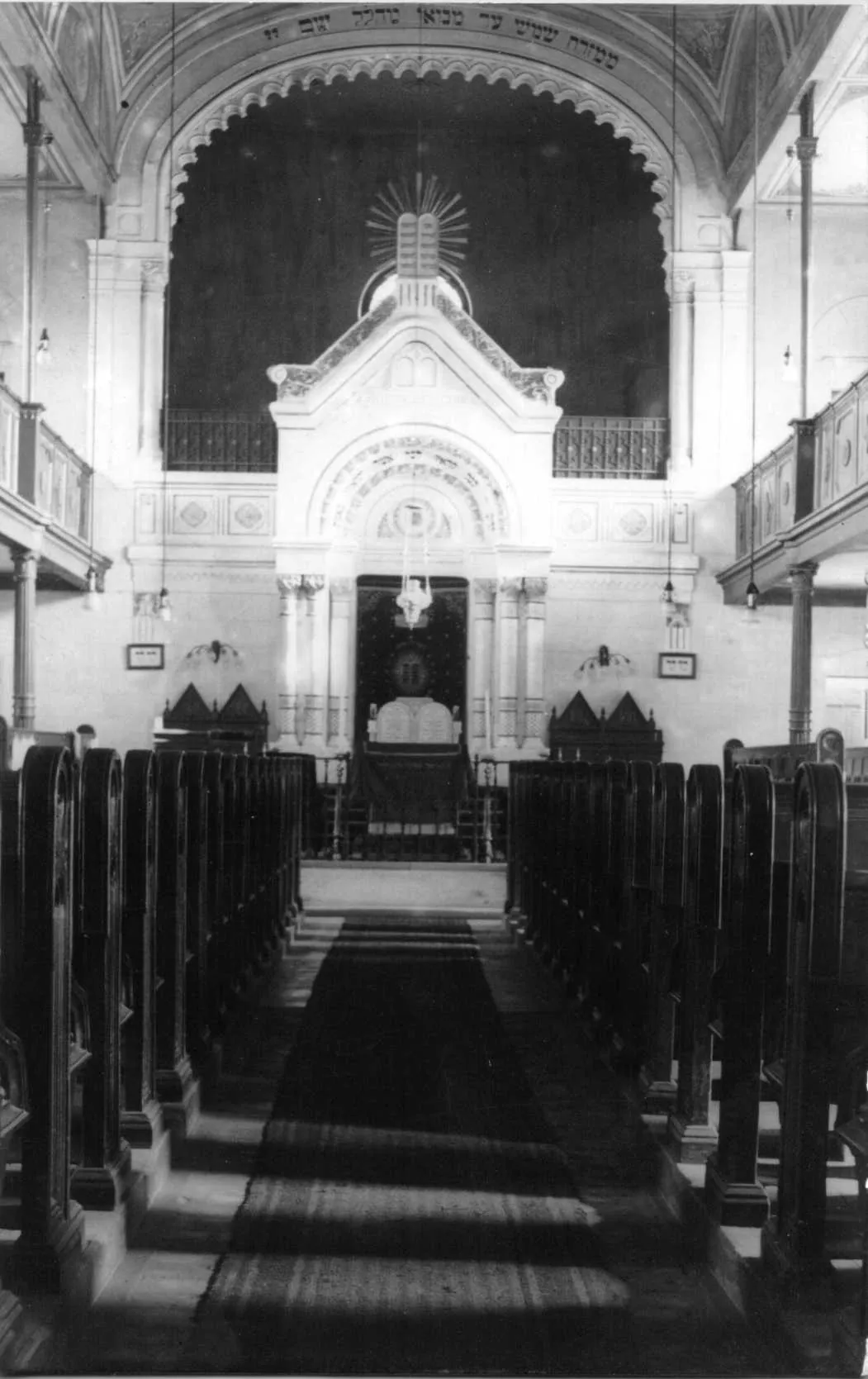
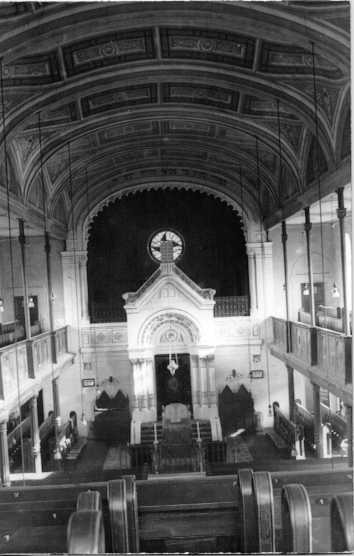
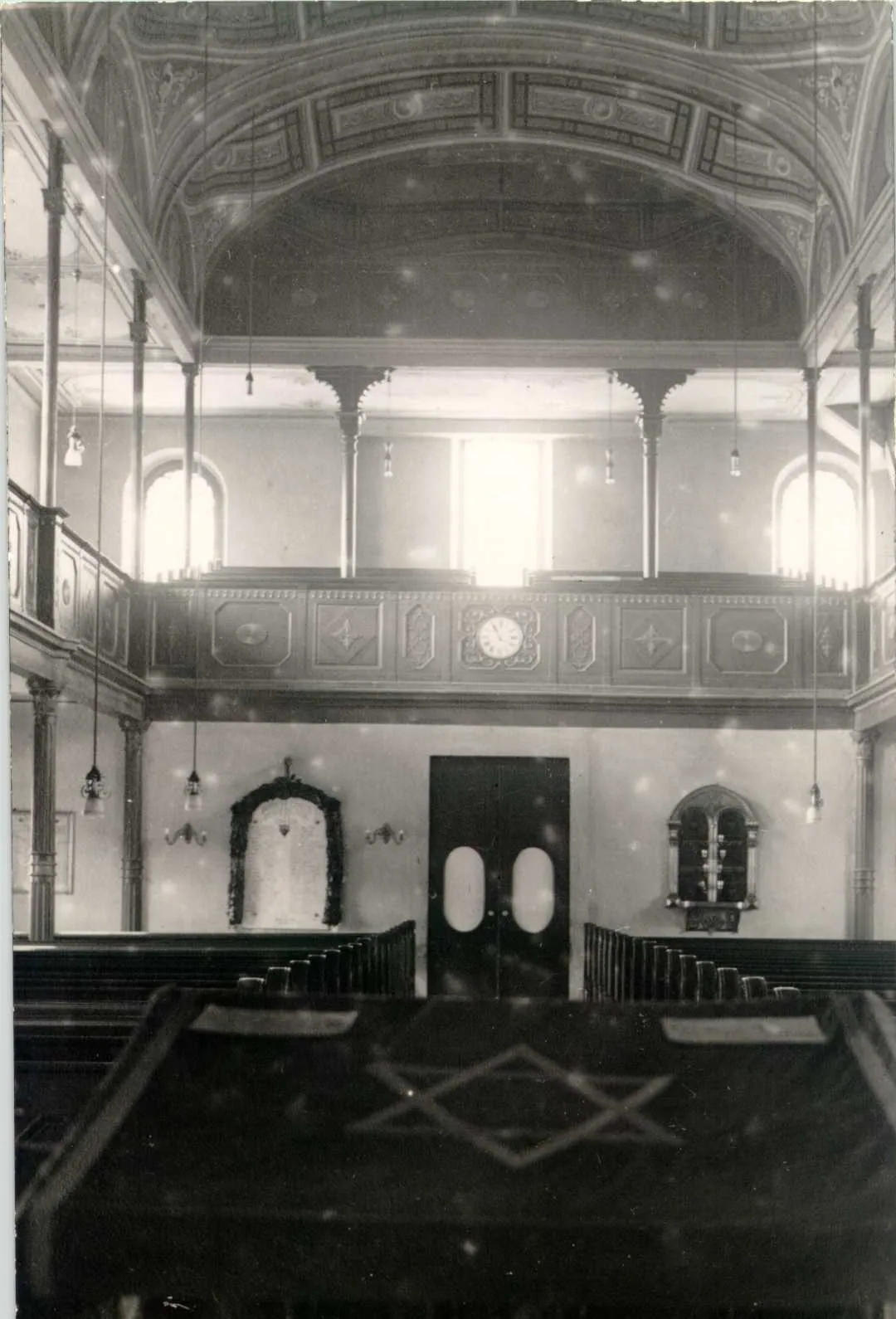
No architect is recorded for the building of 1862. The synagogue known from photographs is the result of three enlargements, the last carried out in 1905–06 by Lipót Baumhorn, Hungary's leading synagogue architect. It was a long rectangular hall with a plain rendered exterior and round-arched windows along its sides. The street façade, set back behind a brick-and-iron fence and a flight of steps, was divided into three bays by four polygonal pier-turrets with battlemented caps. It had three round-arched doorways, tall round-arched windows above them, small circular windows, and a pair of bronze Tablets of the Law on the central parapet. Inside, slender cast-iron columns carried the women's gallery along the sides and the entrance wall, beneath a vaulted ceiling painted with panels. The Ark, a Romantic design with three pairs of columns, stood in a deep arched recess framed by a Hebrew inscription. An organ was inaugurated at the end of 1889. Long rows of wooden pews gave the hall between 800 and 1,000 seats.
La vida dentro de la sinagoga
The synagogue followed the Neolog practice of the Congress communities: it had an organ from 1889, a chief cantor led the music, and sermons were preached in Hungarian. Salamon Kuttna was rabbi when it was built. Sándor Rosenberg, later chief rabbi of Arad, held the pulpit from 1876–77 to 1885 and published Das Judentum und die Nationalitätsidee in Kaposvár. Manó Herzog (1862–1941), a graduate of the Budapest Rabbinical Seminary, served for decades as district chief rabbi; 186 manuscripts of his sermons from 1910–18 survive in the Hungarian Jewish Archives. In 1929 Ármin Liebermann was chief cantor and József Katz assistant rabbi. A smaller, heated winter synagogue was used in the cold months, and on the High Holidays, when even the main hall was too small, worshippers spilled into the courtyard. A Centropa interviewee recalled a young rabbi who prayed in Hebrew and preached in Hungarian, and a mother and daughter with fine voices who sang in the synagogue. A 1960 photograph shows girls in white at a bat mitzvah ceremony before the Ark.
Destrucción
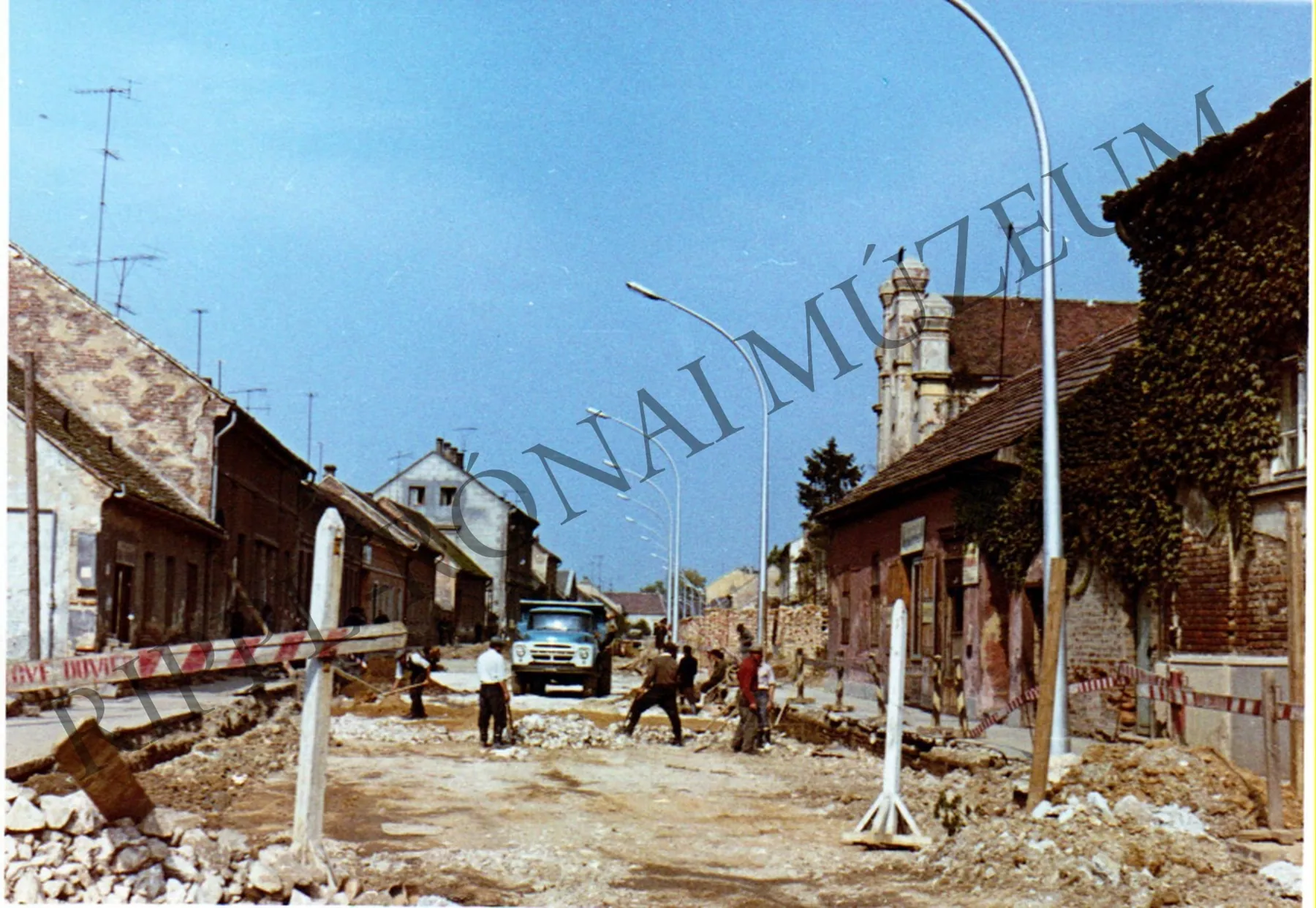
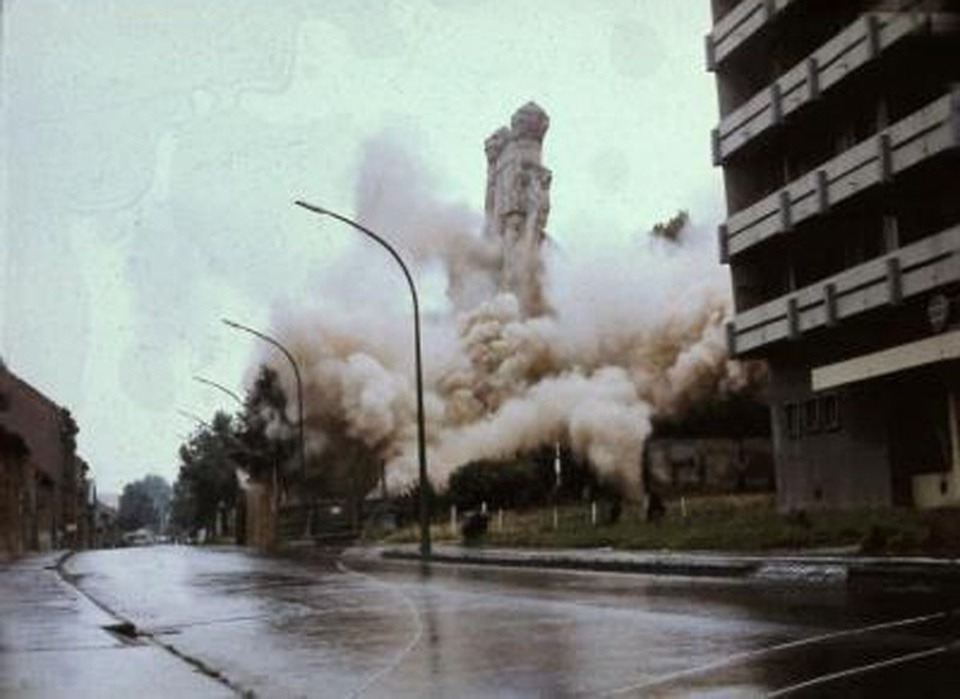
The synagogue came through the Second World War damaged but standing, and the returning survivors used it again. By about 1970 the community was too small and too poor to keep it up. In 1974 the building was sold to the town council through MIOK, the national Jewish representative body of the time, on condition that it not be put to an irreverent use such as a sports hall or granary. Six years later the Communists demolished it: on 18 July 1980 explosives specialists of the local unit of the Hungarian People's Army, commanded by Captain József Tián, blew up the 118-year-old synagogue on Berzsenyi utca. The reason given was town planning — the building was said to stand in the wrong place. László Róna, later president of the community, said it had been condemned as unsafe because of cracks in both long walls, but added that the plot was probably too valuable for anyone to want to save it. From the rubble the congregation recovered only the pair of bronze Tablets of the Law from the top of the façade, one intact and one badly damaged.
El destino de la comunidad
After the German occupation of Hungary in March 1944, Jewish shops and workshops in Kaposvár were sealed in April. On 12 May the mayor, György Kaposváry Vétek, ordered the Jews into a ghetto made up of Berzsenyi utca 1–48, Széchenyi tér, Vár utca and parts of Kontrássy and Korona utca, the streets around the synagogue. About 6,000 people from the town and its surroundings, including refugees, were held there while neighbours applied for their emptied homes and businesses. In early July 1944 — on 4 July according to the Encyclopaedia Judaica, on 6 July according to recent research — they were deported to Auschwitz-Birkenau, where most were murdered. Only about 200 of the deportees survived. With men returning from forced labour, 450 Jews lived in Kaposvár in 1945 and 574 in 1949. Antisemitic leaflets and a blood-libel rumour circulated in the town in the autumn of 1945. Many left after the 1956 revolution, leaving 261 in 1959, and fewer than 100 Jews live in Kaposvár today.
El lugar hoy
Nothing of the synagogue building survives. According to the Hungarian Jewish history exhibition magyarzsido.hu, the two bronze tablets rescued in 1980 now stand on its site as a memorial. Berzsenyi utca itself has been transformed: from the 1990s its western side was cleared for a large car park, hypermarkets and a shopping mall, and the road was widened. The Jewish Community of Kaposvár worships in the former winter synagogue at Berzsenyi utca 14. In 2011 the community, the town, the county and Mazsihisz signed a letter of intent for a new community centre on the site of the present prayer house, with a façade that would be a reduced copy of the lost synagogue; the roughly one billion forints needed had not been raised by then.
Nombres destacados
Lipót Baumhorn
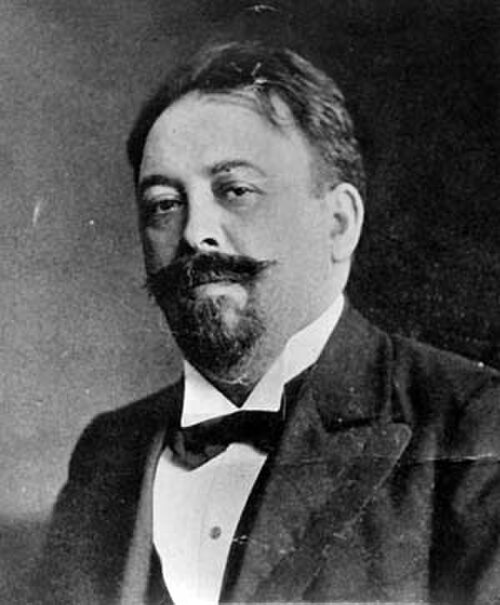
1860–1932Architect of the 1905–06 enlargementLipót Baumhorn, the Budapest architect of the synagogues of Szeged, Novi Sad and Esztergom and the leading synagogue builder of the Kingdom of Hungary, drew the plans for the last enlargement of the Kaposvár synagogue. The work of 1905–06 gave the building of 1862 the form in which it stood until it was blown up in 1980.
Biografía o fuente →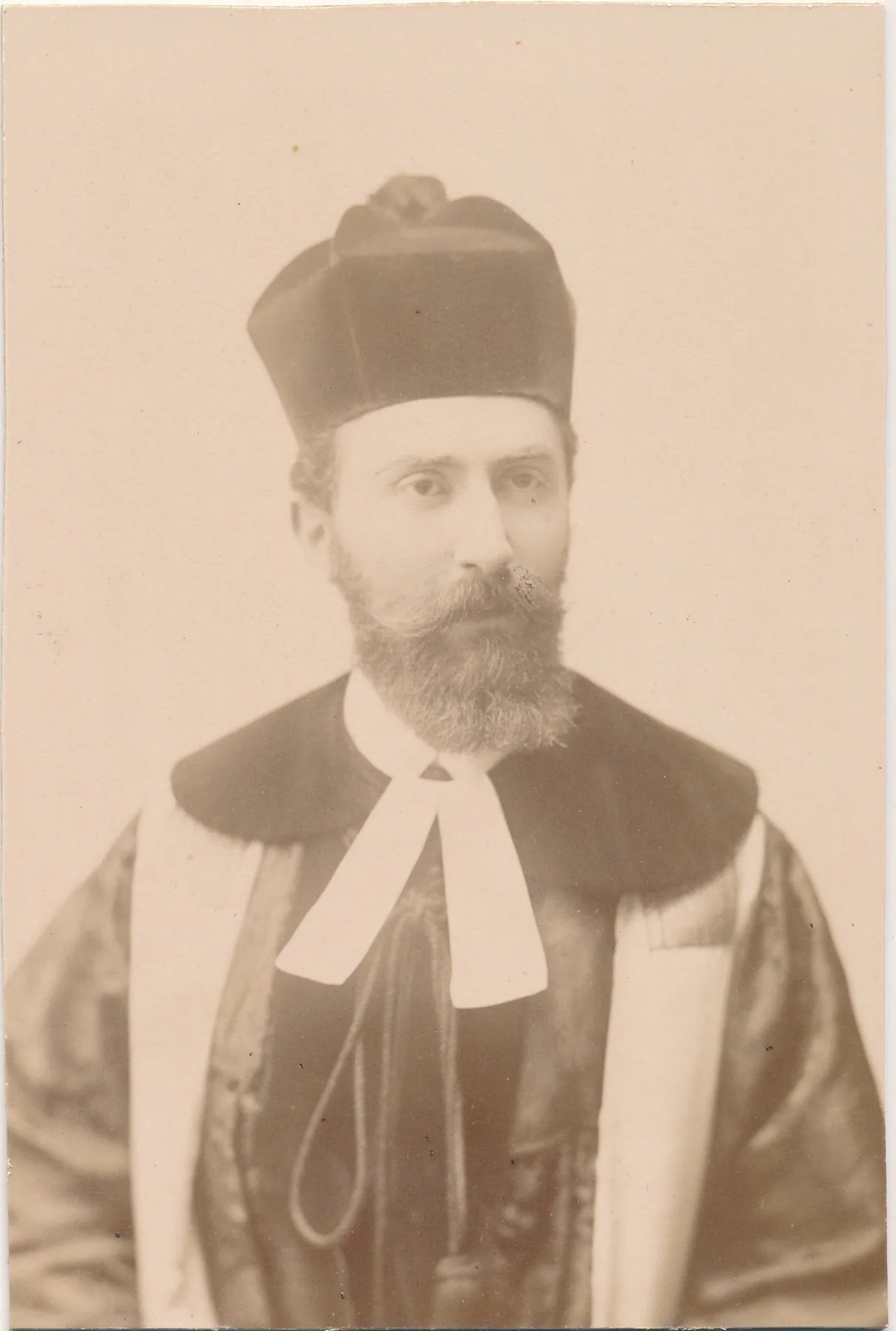
Manó Herzog
1862–1941District chief rabbi of KaposvárManó Herzog (also spelled Herczog or Hercog), a graduate of the National Rabbinical Seminary in Budapest, served for decades as chief rabbi of Kaposvár. The 1929 Hungarian Jewish Lexicon lists him as district chief rabbi and as head of the charity that clothed poor children. The Hungarian Jewish Archives hold 186 manuscripts of sermons he delivered in 1910–18 and a photograph he inscribed in 1917.
Biografía o fuente →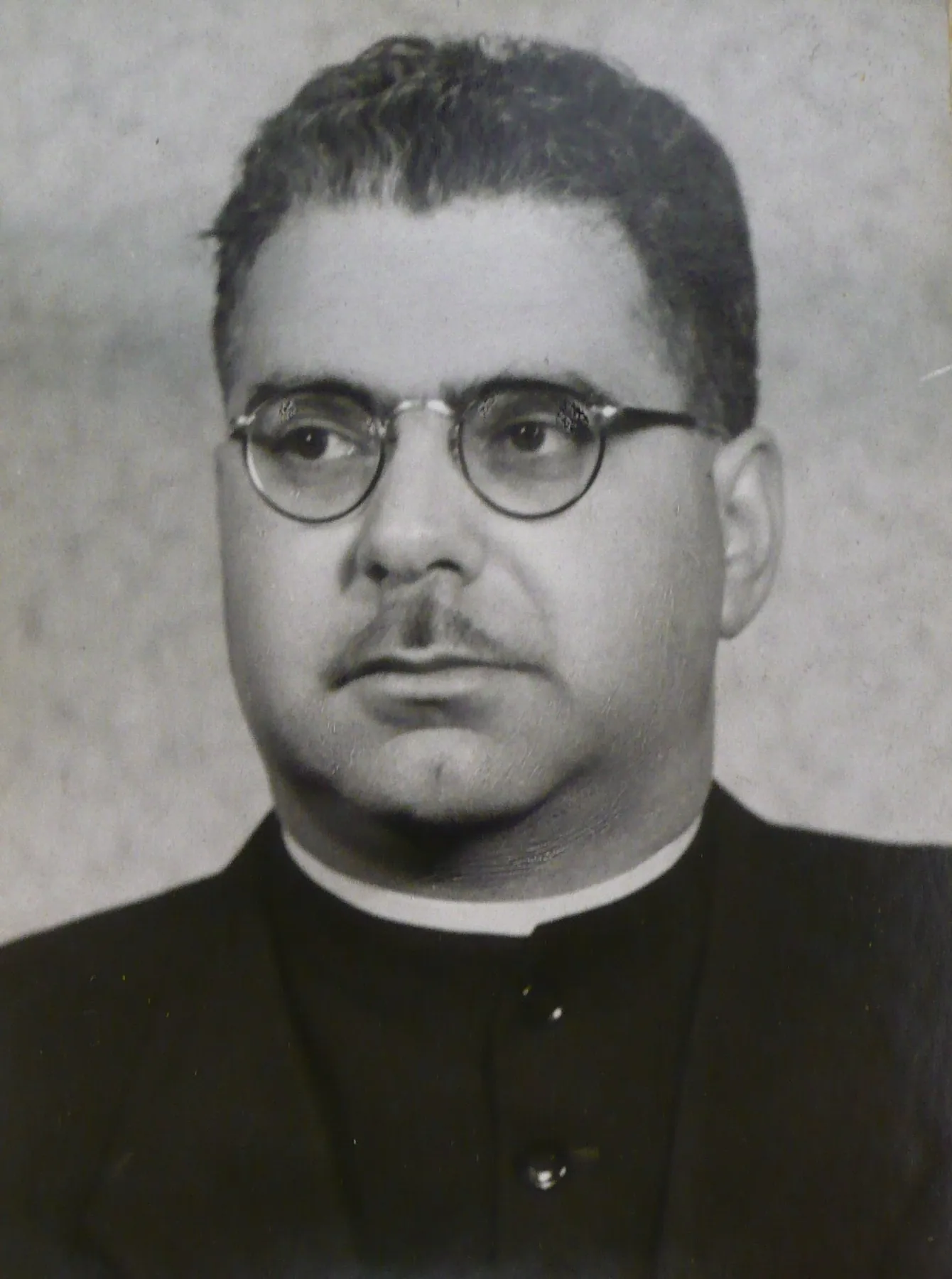
Henrik Krausz
UnknownRabbi of Kaposvár after the Second World WarDr Henrik Krausz is recorded by the Hungarian Jewish Museum and Archives as rabbi of Kaposvár in 1950, when his portrait appeared on the tableau of the national assembly of Hungarian Jewish communities held that February. He served the small congregation of survivors who had returned to the town and its synagogue after the Holocaust.
Biografía o fuente →Sándor Rosenberg
1844–1909Chief rabbi of Kaposvár, 1876/77–1885Born in Makó and trained at the Breslau seminary, Sándor Rosenberg came to Kaposvár from the Neolog congregation of Nagyvárad in 1876 or 1877 and preached in the synagogue until the mid-1880s, publishing Das Judentum und die Nationalitätsidee in the town in 1885. He then became chief rabbi of Arad, where in 1895 he caused a national controversy by blessing a mixed marriage in the synagogue.
Biografía o fuente →Salamon Kuttna
UnknownRabbi of Kaposvár, 1854–1877 (or 1853–1871)Salamon Kuttna was the rabbi of Kaposvár when the community built its synagogue on Hosszú utca, today's Berzsenyi utca, in 1862. The 1929 Hungarian Jewish Lexicon dates his tenure to 1854–77, while the Encyclopaedia Judaica gives 1853–71. He was succeeded by Sándor Rosenberg.
Biografía o fuente →¿Tiene algo que aportar?
Fotografías, documentos, historias familiares o recuerdos de esta sinagoga y su comunidad ayudan a mantener viva su historia.
- Kaposvár (entry in Magyar Zsidó Lexikon, ed. Péter Újvári, 1929)
- Kaposvár
- Kaposvár (unit 4 of the online exhibition on Hungarian Jewish history)
- Volt egyszer egy zsinagóga
- Építkezne a Kaposvári Zsidó Hitközség
- Plázák a várrom felett: a kaposvári Berzsenyi utca átalakulása
- Az izraelita tulajdonban álló ingatlanok tulajdonviszonyainak változása Kaposváron a német megszállást követő hónapokban
- Kaposvár zsidóságának kifosztása 1944 tavaszán
- Kaposvári zsinagóga
- Kaposvári zsinagóga bejárata (F70.197) and related items 26285–26292
- Dr. Herczog Manó (IV/39.5)
- Herzog Manó szónoklatai
- Rosenberger Sándor (entry in Magyar Zsidó Lexikon, 1929)
- Sándor Rosenberg
- Lipót Baumhorn
- Baumhorn Lipót
- 135 éve kapott új orgonát a zsinagóga
- Kaposvár, 1945. november 4.: Gyermekgyilkosságokról szóló rémmesék mérgezik a közéletet
- Tag: synagogue in Kaposvár — interview with Magda Fazekas
- A kaposvári Berzsenyi utca a Zsinagógával (RRM.ÚKT.F.3516) and A kaposvári zsidó templom (F.3518, F.3519)
- Krausz Henrik, Dr. portréja
- Kaposvár; Erzsébet utca; Látkép; … Izraelita templom … (postcard, 27 December 1905)
- Jewish Travel Guide (Hungary)
- ArcGIS World Geocoding Service: Berzsenyi utca 14, 7400 Kaposvár
Share a memory or thought
No comments yet. Be the first to add one.