

Die Geschichte von Kardašova Řečice Synagogue
Kardašova Řečice is a small town about 10 km north-west of Jindřichův Hradec in South Bohemia. Its Jews lived in a small quarter in the eastern half of the town, between today's Hradní Street and the Řečice brook, where a prayer room existed before 1650 and a wooden synagogue was built in 1708. On 18 May 1863 a fire swept through the quarter and burned the wooden synagogue to the ground. The community rebuilt on the same site, and the new synagogue, the subject of this entry, was put up between 1864 and 1866 according to Jüdische Gemeinden and the South Bohemian regional guide; the JewishGen cemetery survey gives 1864-1874. It was a plain rendered hall with a tall gabled entrance front, round-arched windows and small crenellated turrets at the corners. The congregation that built it was already shrinking as families left for larger towns after 1848, and by the First World War the synagogue was hardly used. It stood empty during and after the Second World War, fell into disrepair and was demolished in 1958-1959. The site is now a garden behind house No. 408. The town's Jewish cemetery, south of the town, is the only substantial Jewish monument that remains.
Where it stood for nearly 95 years
Historic: Jewish quarter (Židovská čtvrť), eastern part of Kardašova Řečice, between today's Hradní Street and the Řečice brook. Today: garden behind house No. 408, Kardašova Řečice, 378 21, Jindřichův Hradec district (approximate pin on Hradní Street).
Größere Karte öffnen →Die jüdische Gemeinde
Jews are first mentioned in the region in the late thirteenth century and may have lived in Kardašova Řečice itself from the early fifteenth century. A settled community formed in the seventeenth century: three families are recorded in the middle of that century and about eight around 1680-1690. Most were small traders and peddlers. In 1755 the Jewish quarter consisted of ten single-storey houses, which until 1920 carried Roman numerals rather than the town's ordinary house numbers. Under the Habsburg family laws only a fixed number of families, about 15 to 25, were allowed to live there. The community reached its peak in the mid-nineteenth century, with 136 people in 1840 (6.5 per cent of the population) and 160 in 1857. After 1848, when Jews gained freedom of movement, many moved to larger towns, and numbers fell to 100 in 1880, 52 in 1900 and about 20 in 1921 and 1930. A congregation that also served Jews in surrounding villages survived until the Second World War. Its birth, marriage and death registers survive for 1784-1944, and the community's archive is held by the Jewish Museum in Prague.
Architektur und Gestaltung
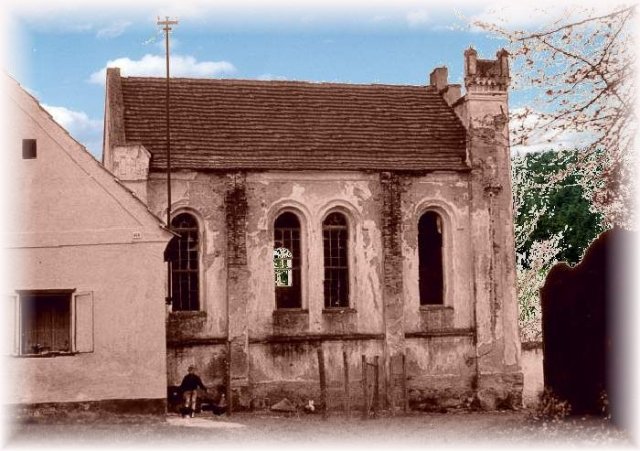
Two historical photographs, reproduced from Jiří Fiedler's study of the community, are the only views found. The entrance front was a tall rendered gable wall framed by broad corner pilasters, each ending above the roofline in a small square turret with a corbelled cornice and crenellated top; a smaller crenellated pier rose at the centre of the stepped parapet. Shallow vertical panels with rounded heads divided the wall. High in the middle was a round window, and below it a single round-arched doorway with a moulded surround and a small triangular pediment, holding a pair of panelled wooden doors. The side photograph shows a long hall under a pitched tiled roof, with four tall round-arched windows set between plain pilasters above a low plinth, and a turret at the rear corner as well. The building stood directly beside an ordinary house, in keeping with its position inside the dense Jewish quarter. Its style may be called Romanesque Revival with castellated detail; the architect, builder, seating capacity and interior arrangement are unknown.
Leben in der Synagoge
Little is recorded about worship in the synagogue. It was built by a community of perhaps 150 people at its largest, and it remained the religious centre for Jewish families in Kardašova Řečice and neighbouring villages for some seventy years. The community kept its own registers from 1784, and its records from the late nineteenth and early twentieth centuries were later gathered into the archive of the Jewish Museum in Prague. A rabbi and teacher, Lazar Beneš, is buried in the town's cemetery, but no source read gives his dates or says when he served. The congregation became increasingly Czech in language and outlook before 1918, which is why a 2013 Charles University thesis chose it as an example of early Czech-Jewish assimilation. As the congregation dwindled the building fell out of regular use: the JewishGen cemetery survey states that by 1916 the synagogue was almost unused and had begun to deteriorate. No rabbi, cantor or community president of the period is named in the sources consulted, and no interior photograph was found.
Zerstörung
The synagogue was not burned or wrecked in 1938-1945 as far as the sources consulted show. Already almost unused by 1916, it was abandoned when the last members of the congregation were deported in 1942 and stood empty during and after the war. No surviving Jewish community remained to maintain it, and the building decayed. Jüdische Gemeinden states that the 'meanwhile dilapidated' synagogue was pulled down at the end of the 1950s, and the South Bohemian regional guide and the JewishGen cemetery survey both date the demolition to 1958-1959, when Czechoslovakia was under Communist rule. A congregation website in Arizona that holds a Torah scroll from the town gives 1950 instead. None of the sources read says who ordered or carried out the demolition, whether the building was first sold, or what happened to its materials and fittings.
Das Schicksal der Gemeinde
After the Nazi German occupation of Bohemia and Moravia in March 1939, the roughly eighteen or nineteen Jews still living in Kardašova Řečice were subject to the anti-Jewish laws of the Nazi-ruled Protectorate. In the spring of 1942 they were deported. The Holocaust victims database of the Terezín Initiative Institute shows, for example, that Adolf Freund, born in 1896 and registered in Kardašova Řečice, was sent on transport Ak from České Budějovice to the Terezín ghetto on 18 April 1942, and from Terezín to Auschwitz on transport El on 29 September 1944, where he was murdered. Jüdische Gemeinden records that from May 1942 no Jews lived in the town and that, as far as is known, none of those deported survived. Only one Jewish woman, protected by a mixed marriage, is known to have lived in the town after the war; her burial in 1965 was the last in the Jewish cemetery. No Jewish community was re-established.
Der Ort heute
The synagogue stood in the middle of the former Jewish quarter in the eastern part of the town, between Hradní Street and the Řečice brook. According to the JewishGen cemetery survey, its site is now a garden behind house No. 408. Nothing of the building is recorded as surviving above ground. Four of the old Jewish houses of the quarter survive in reconstructed form. The photographer Štěpán Bartoš included the empty site in his 'Invisible synagogues' series, featured by Radio Prague International. The Jewish cemetery about a kilometre south of the town, with gravestones from 1647 onward, is the main surviving Jewish monument; its walls and fallen stones have been repaired.
Haben Sie etwas beizutragen?
Fotos, Dokumente, Familiengeschichten oder Erinnerungen an diese Synagoge und ihre Gemeinde halten ihre Geschichte lebendig.
- Kardasch-Retschitz (Böhmen)
- 14. Kardašova Řečice (Židovské památky v jižních Čechách / Jewish monuments in South Bohemia)
- Kardasova Recice (Cemetery Discovery Project / IAJGS cemetery report)
- The Story of Our Torah Scrolls
- Židé na Jindřichohradecku: Proměna židovského osídlení v 19. století na příkladu vybraných obcí
- Adolf Freund (Database of victims)
- Invisible synagogues: Czech photographer captures blank spaces where Jewish houses of worship once stood
- Hradní, Kardašova Řečice (OpenStreetMap way 42782308)
Share a memory or thought
No comments yet. Be the first to add one.