

La historia de Karlovy Vary Synagogue
Karlsbad, today Karlovy Vary, kept Jews from settling permanently for centuries; Jewish traders were admitted only during the spa season, and Jewish spa guests were recorded from the late eighteenth century. After 1848 Jews could settle, and a Jewish hospital with a prayer room for poor Jewish visitors opened in 1847. A congregation formed in 1868 and an independent religious community was approved in 1869, with a rabbinate from 1870.
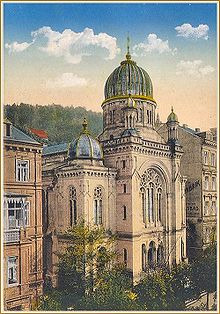
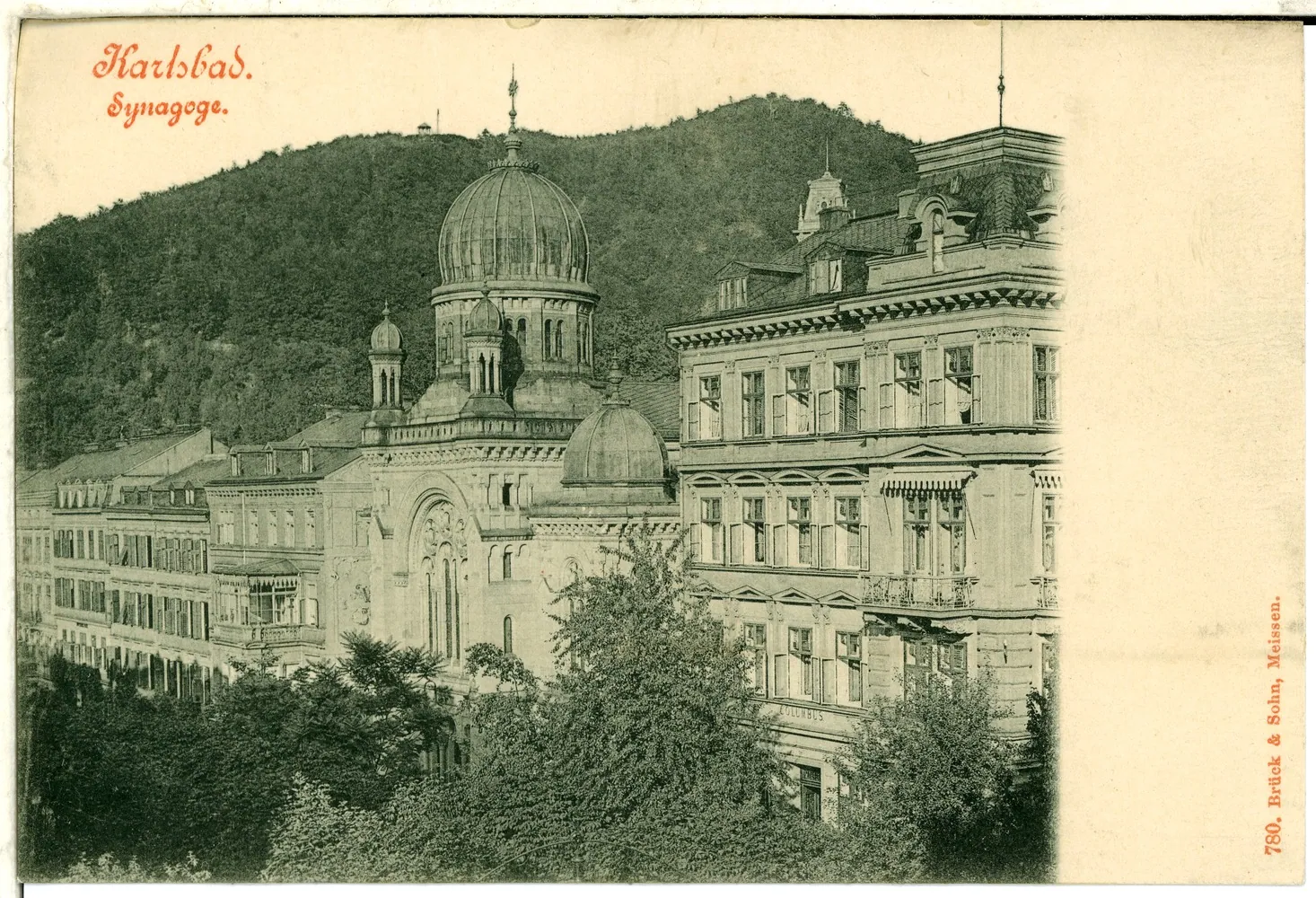
The community grew quickly, and the existing prayer rooms could not hold the many Jewish guests who came to take the waters. A large synagogue was therefore built in 1875-1877 to plans by Adolf Wolff, the Stuttgart city architect who had already designed the synagogues of Stuttgart, Ulm, Nuremberg and Heilbronn. It was consecrated in September 1877; much of the cost of 154,920 guilders came from spa guests. Standing on Sadová třída, the domed building rose high above the surrounding houses of the spa quarter.
For sixty years it served both the resident community, by the 1930s one of the largest in Czechoslovakia, and the international spa clientele. Its rabbi for fifty of those years was Ignaz Ziegler. The synagogue was burned during the November Pogrom of 1938 and its ruins were pulled down.
Where it stood for 61 years
Historic: Sadová třída (Parkstraße), Karlsbad; one source gives Bezručova 8, which does not match the other evidence. Today: site of the Hotel Bristol, Sadová 2026/19, 360 01 Karlovy Vary (approximate).
Abrir mapa ampliado →La comunidad judía
Jüdische Gemeinden, drawing on Wlaschek's figures, counts five Jewish families in Karlsbad in 1849, about 100 Jews in 1869, 651 in 1872, 914 in 1880, 1,069 in 1890 (about 7.5 per cent of the population), 1,405 in 1900 and about 2,120 around 1930; the Encyclopaedia Judaica gives 2,120 in 1930, or 8.9 per cent of the town, with another 292 in neighbouring Fischern (Rybáře). The community was founded on 31 October 1869; according to a Czech study about a hundred families belonged at first, nearly half of them from nearby Lichtenstadt (Hroznětín), and sixty children were taught by a Jewish teacher. A cemetery was opened around 1870. Jewish families were prominent in the spa economy and industry: the banker Alfred Schwab founded the Hotel Imperial, Alois Klein owned the Parkhotel, Dr Isidor Müller opened a sanatorium, and the glassworks Ludwig Moser & Söhne was Jewish-owned. Before the Nazi takeover the town had about 40 Jewish lawyers and 73 Jewish doctors. Karlsbad also hosted Zionist congresses, including that of 1921 chaired by Chaim Weizmann.
Arquitectura y diseño
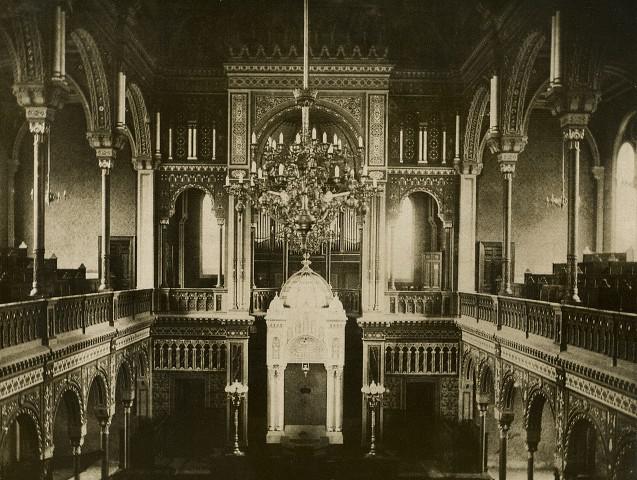
The synagogue was a free-standing, centrally planned building on a raised terrace reached by broad steps. According to the community's own history it was 36 metres long and 22 metres wide. A large central dome on a tall drum, crowned by a lantern, rose over the crossing, with two smaller domes over the corner towers of the entrance front; the domes appear green and gold on a tinted postcard. The facades were of light stone in a mixed Moorish and Romanesque manner, with large round-arched windows filled with tracery, a big rose-like window in the gable of the side front and round-arched portals. Inside, eight slender columns carried arcades and five further columns rising from the women's galleries supported the central nave. The interior was richly painted with colourful Moorish ornament. A historic photograph of the interior shows galleries on three sides with horseshoe arches, a large brass chandelier and, at the east end, a tall domed Torah ark under an arched niche, with a further gallery above it. The Encyclopaedia Judaica says the building could hold 2,000 worshippers. No original plans are known to survive.
La vida dentro de la sinagoga
The synagogue was the seat of the Karlsbad rabbinate, established in 1870. The rabbis named for the community are E. Oppenheimer, Dr Rudolf Plaut and Dr Nathan Porges, who served from 1870, and Dr Ignaz Ziegler, who took office on 15 August 1888 and remained until he was driven out in the autumn of 1938. Ziegler, a scholar of the Midrash and of Jewish history, compiled a collection of documents on the history of the Jews of Karlsbad published in 1913, and through his efforts the community opened the Kaiser Franz Josef Jubilee Hospice for poor Jewish patients in 1903. The congregation was led by its presidents, among them Adolf Rosenfeld from 1869, Salamon Knopfelmacher and Ludvík Moser before 1920, and Dr Karel Moser from 1920 until the occupation. Besides the synagogue the community maintained a school, the Jewish hospital with its own prayer room, a choir, a women's association and a burial society, and from the 1920s a children's holiday home at Schlaggenwald. The great synagogue served the many Jewish spa guests from across Central and Eastern Europe during the summer season as well as the resident families.
Destrucción
German troops entered Karlsbad on 4 October 1938, after the Munich Agreement gave the Sudetenland to Nazi Germany, and Hitler visited the town the same day. Most Jews had already fled into the interior of Czechoslovakia in September. On 10 November 1938, during the November Pogrom, the synagogue was desecrated and set on fire. The history of the present Jewish community of Karlovy Vary says that Sudeten German Gestapo men and local Nazis set the building alight, that the fire was the signal for the open attack on the town's Jews, and that its valuable interior was looted by fanatical Nazis. Jüdische Gemeinden adds that the Hitler Youth opened the pogrom with fanfare signals and that SA men herded Jewish residents together in front of the Schützenhaus. The burned-out building was then demolished. No source read gives the date of the demolition, who carried it out, or whether the walls were blown up or taken down.
El destino de la comunidad
Almost all Jews had left Karlsbad during the Sudeten crisis of September 1938. Those who remained were rounded up during the November Pogrom: a police report quoted in a Czech study records that on 10 November 1938 four Ordner and two Gestapo officials took a Jewish woman, her parents and four sisters to the Schützenhaus, where about 500 Jews of the town and district were gathered; they were driven through jeering crowds, held at Falkenau (Sokolov) and then forced over the border into Czechoslovakia. According to the Czech community's history the Gestapo, SS and SA arrested the heads of 283 wealthier families and sent them to Buchenwald, where they were made to sign their property over; Jüdische Gemeinden names Dachau. Older Jews were held in a makeshift camp at Espenthor (Olšová Vrata). Only 59 Jews were counted in May 1939, and at the outbreak of war the town was declared free of Jews. Many who had fled into Bohemia were later deported; Stolpersteine laid since 2016 name Karlsbad Jews deported in 1941. After 1945 a new community of about 400, mostly from Subcarpathian Ruthenia, was formed; it has about 70 members today.
El lugar hoy
The synagogue stood on Sadová třída in the spa district of Karlovy Vary. According to the history published by the Jewish community of Karlovy Vary, the Hotel Bristol was later built on the site of the destroyed synagogue, and the hotel complex still stands there on Sadová street today. No part of the synagogue building is known to survive above ground. A memorial to the Jewish victims of Nazism stands on Sadová street at the site. The present Jewish community worships in a new prayer hall opened in the 1990s in the restored former Jewish hospice building, and the Jewish cemetery in Drahovice, used since about 1870, is still in use. A virtual three-dimensional reconstruction of the synagogue was made at the Vienna University of Technology in 2019.
Nombres destacados
Adolf Wolff
1832-1885Architect of the synagogueWolff, born at Wäldenbronn in Württemberg and trained at the Stuttgart Polytechnic, was city architect of Stuttgart and later Nuremberg and one of the leading synagogue designers of his generation, with buildings in Stuttgart, Ulm, Nuremberg and Heilbronn. The Karlsbad community commissioned him for its great synagogue, built between about 1875 and 1878 and consecrated in 1877. He later also designed the Great Synagogue of Łódź.
Biografía o fuente →Ignaz Ziegler
1861-1948Rabbi of Karlsbad, 1888-1938Born at Dolný Kubín and educated in Budapest, where he took his doctorate in 1888, Ziegler became rabbi of Karlsbad on 15 August 1888 and served the synagogue for fifty years. A scholar of the Midrash and Jewish history, he published a documentary history of the Karlsbad Jews in 1913 and brought about the Jewish hospice for poor patients opened in 1903. He was driven out in the autumn of 1938 and died in Jerusalem in 1948.
Biografía o fuente →Nathan Porges
UnknownRabbi of Karlsbad from 1870Dr Nathan Porges is named by the Jewish community of Karlovy Vary and by the German Wikipedia article on the synagogue among the rabbis of Karlsbad, serving from 1870, when the rabbinate was established. He was therefore the community's rabbi in the years when the great synagogue was planned, built and consecrated in 1877, before Ignaz Ziegler succeeded to the post in 1888.
Biografía o fuente →Karel (Karl) Moser
UnknownPresident of the Jewish community, 1920-1938The history published by the Jewish community of Karlovy Vary names MUDr. Karel Moser, a physician, as head of the community from 1920 until the Nazi occupation of 1938. He thus led the congregation during its largest period, when it was among the biggest in Czechoslovakia, and was its president when the synagogue was burned in November 1938. Nothing more about his life or fate was found.
Biografía o fuente →¿Tiene algo que aportar?
Fotografías, documentos, historias familiares o recuerdos de esta sinagoga y su comunidad ayudan a mantener viva su historia.
- Synagoge (Karlsbad)
- Karlsbad (Böhmen)
- Židé v Karlových Varech (history of the Jews in Karlovy Vary)
- Carlsbad
- Perzekuce Židů na Karlovarsku v období 2. světové války
- Die virtuelle Rekonstruktion der Synagoge in Karlsbad / Karlovy Vary
- Adolf Wolff (Architekt)
- Ignaz Ziegler
- Hotel Bristol, Sadová, Karlovy Vary (OpenStreetMap node 296533326)
Share a memory or thought
No comments yet. Be the first to add one.