
Historia Kecel Synagogue
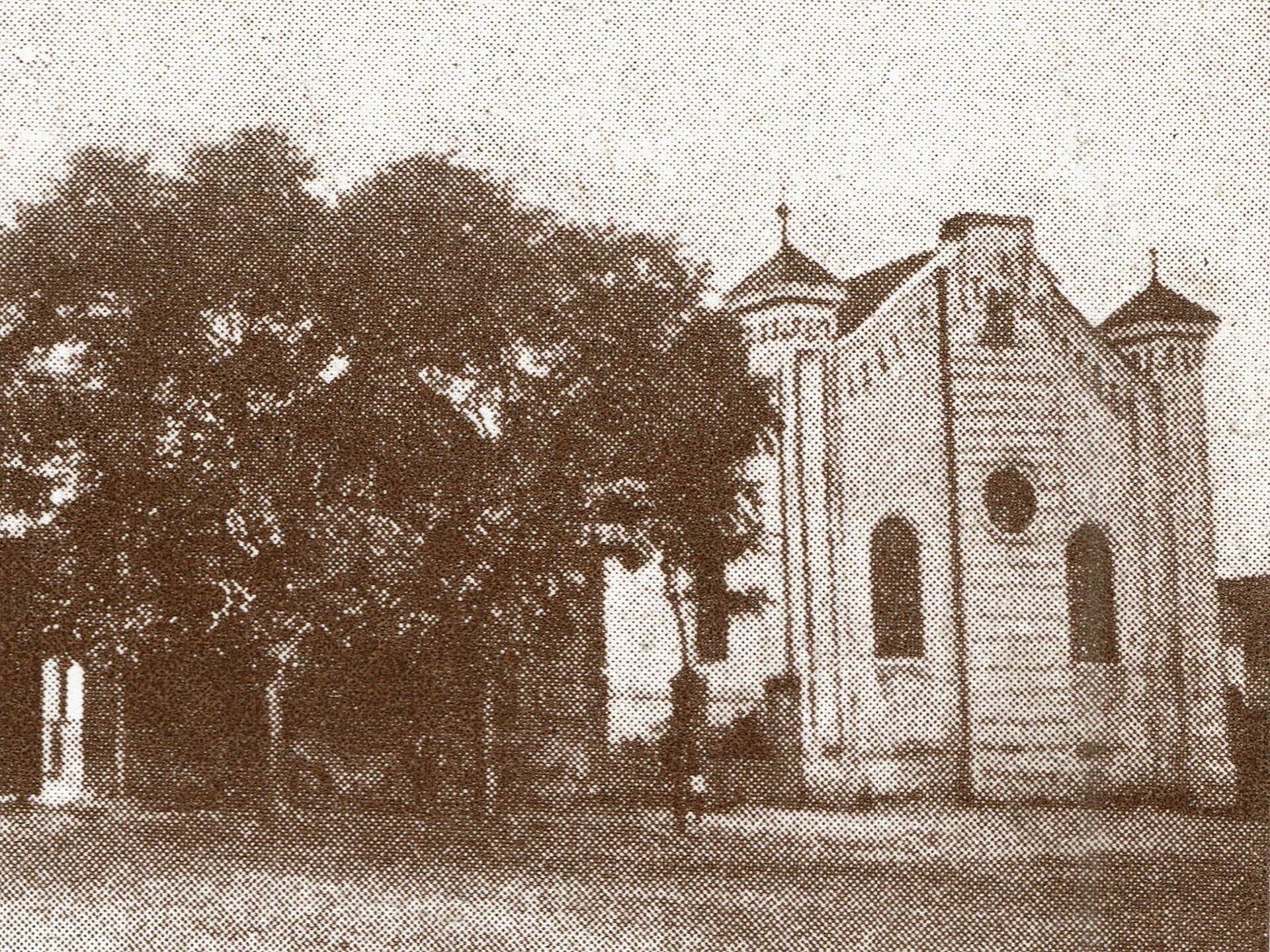
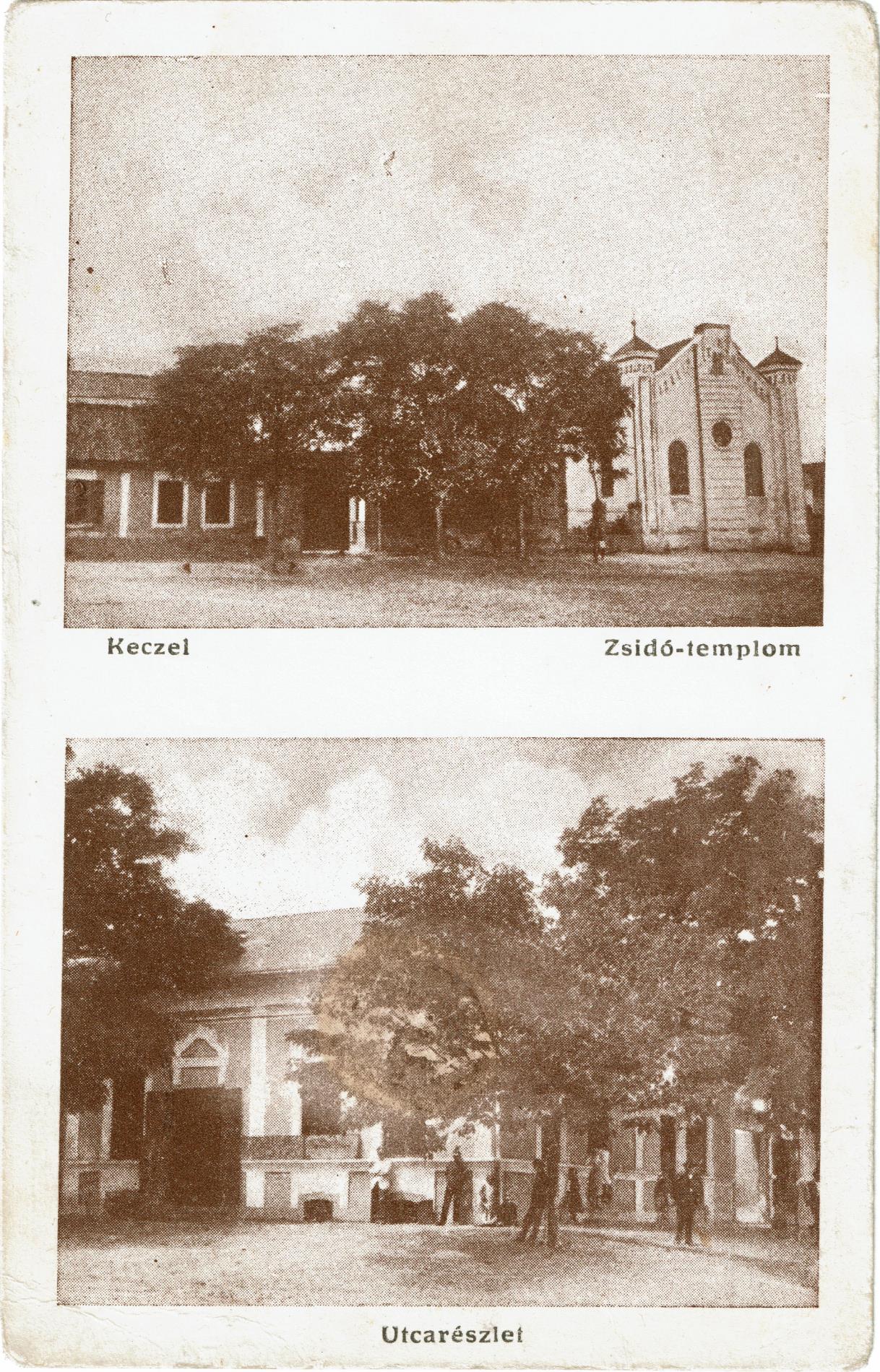
Kecel lies between Kecskemét and Baja in what is now the Kiskőrös district of Bács-Kiskun county; in 1944 it belonged to Pest-Pilis-Solt-Kiskun county. Its Jewish congregation was Orthodox and small: 110 Jews were counted there in 1941. The synagogue is the congregation's only known building. Anikó Gazda's gazetteer dates it to 1874 or about 1880, her sources differing, and classes it as a synagogue rather than a prayer house. One half of a postcard dated 1927 and captioned 'Keczel, Zsidó-templom' is the only view found. It shows a rendered hall with a gabled end wall, round-arched windows and two slender corner turrets, standing at the edge of a wide unpaved space beside a row of trees and a long single-storey house.
In the spring of 1944 the Jews of Kecel and of neighbouring Császártöltés were shut into three houses in II. Rákóczi Ferenc Street. In mid-June Hungarian gendarmes took them by rail to Szeged, from where they were deported to Auschwitz and to Strasshof in Austria. A local account says 36 people came back in 1945. The synagogue did not survive the decades that followed: when Gazda surveyed Hungarian synagogue sites between 1980 and 1987 she recorded it as demolished. No source found gives the year of the demolition, the person or body that carried it out, or the street on which the building stood.
Where it stood for nearly 95 years
Historic: Kecel (Keczel), Pest-Pilis-Solt-Kiskun county; street and house number unknown. Today: Unknown; placeholder pin at the centre of 6237 Kecel, Bács-Kiskun county (approximate).
Otwórz większą mapę →Społeczność żydowska
Little has been found in print about the origins of the Jewish community of Kecel. The Magyar Zsidó Lexikon of 1929 has no entry for the town, and the Kecel entry in Pinkas Hakehillot Hungary (page 474) has not been translated. What is known comes from later sources. The congregation was Orthodox. György Vető, born in Kecel in 1898 into an Orthodox family of iron and general merchants that had changed its name from Weisz in 1902, served as its notary. The Pinkas Hakehillot entry for Kiskőrös names Kecel, with Császártöltés, Nemesnádudvar, Érsekcsanád, Sükösd and Bajaszentistván, as a place under the authority of the Kiskőrös community, which was itself Orthodox from 1912; this may mean that Kecel had no rabbi of its own, but that is not stated. Braham gives a Jewish population of 110 in 1941. The local newspaper Keceli Hírek, reporting a commemoration in 2023, says that 80 Jews were registered in the town in April 1944, while Braham counts 92 local Jews in the ghetto a few weeks later. Two of the four members of the 1944 Jewish Council were named Weisz.
Architektura i projekt
The only image found is one half of a two-view postcard, dated 1927 on Wikimedia Commons and captioned 'Keczel, Zsidó-templom'. It shows the synagogue from a distance across a wide unpaved space, with one gabled end wall turned to the camera and the rest hidden by a row of trees. The wall is rendered, scored with horizontal bands and divided into three bays by flat pilaster strips. The middle bay is carried above the roofline as a short flat-topped block. A round window sits in the centre, and each side bay has one tall round-arched window; a small arched frieze runs under the eaves. At each corner stands a slender turret capped with a bell-shaped roof and a finial. No doorway can be seen on this face, so the entrance was presumably on another side. The round-arched forms would suit a date in the 1870s or 1880s, as Gazda gives, but the style named in this entry is judged from the photograph alone. The architect, the builder, the materials, the plan, the number of seats and the appearance of the interior are unknown; no drawing or interior photograph was found.
Życie w synagodze
Almost nothing has been found about worship in the Kecel synagogue itself. The congregation followed the Orthodox rite. According to Pinkas Hakehillot it came under the authority of the Kiskőrös community, whose twentieth-century rabbis were David Lelovics and Yakov Snyders; no source found names a rabbi, cantor, teacher or ritual slaughterer living in Kecel. The one communal officer known by name is György Vető, an iron and general merchant and veteran of the First World War, who acted as the congregation's notary. In 1965 he wrote a history of the Jews of Kecel. That text was not available for this entry and probably holds the detail missing here: when the community was founded, who paid for the synagogue, whether it had a women's gallery, a schoolroom or a ritual bath, and how many people it seated. The community buried its dead in its own cemetery beside road 54 on the Soltvadkert side of the town, which still exists.
Zniszczenie
No source found describes damage to the synagogue in 1944 or during the fighting at the end of the Second World War. The building lost its congregation in June 1944, when the Jews of Kecel were deported. Thirty-six people are said to have returned in 1945; whether services resumed in the synagogue is unknown. The only firm evidence of its end is Anikó Gazda's survey of Hungarian synagogue sites, carried out between 1980 and 1987, which records the Kecel synagogue as demolished. The demolition therefore took place at some point between 1944 and the 1980s, most of which Hungary spent under Communist rule, but no document, newspaper report or local history consulted gives the year. Nor is it known who pulled the building down: the sources do not say whether it was sold by the surviving community or the national Jewish office, taken over by the local council, or dismantled for its materials. English Wikipedia's list of Hungarian synagogues includes Kecel but leaves its dates and fate blank.
Los społeczności
Braham records 110 Jews in Kecel in 1941. Under the anti-Jewish laws György Vető was interned in the summer of 1941 and his family was expelled from the town until the spring of 1942. After the Nazi German occupation of Hungary in March 1944 the chief clerk of the settlement ordered Vető to list the local Jews and form a Jewish Council. In April the Jews were rounded up and concentrated in three buildings in II. Rákóczi Ferenc Street: 92 from Kecel and 26 brought from Császártöltés. The council consisted of Vető as chairman, József Weisz, Ferenc Weisz and Dávid Klein. Braham dates the transfer to Szeged to 17 June; the local newspaper says they were driven to the railway station on 19 June and taken in cattle wagons to Szeged-Rókus and then to the brickworks. Local Hungarian gendarmerie units carried out the removal. Three transports left Szeged on 25, 27 and 28 June 1944, for Auschwitz and for Strasshof in Austria. Vető and his son survived in Austria; his 74-year-old mother was killed on a death march from Mauthausen to Gunskirchen in April 1945. Thirty-six people returned to Kecel in 1945.
Miejsce dzisiaj
The plot on which the synagogue stood has not been identified in any source consulted, so what occupies it today is unknown. The 1927 postcard shows the building on the edge of a broad unpaved street or square next to a long single-storey house, but names neither. No marker on the site is recorded. The map pin for this entry is a placeholder at the centre of Kecel and should not be read as the synagogue's location. The Jewish cemetery survives on the right-hand side of road 54 leaving Kecel towards Soltvadkert and is open to visitors from spring to autumn, according to the town website. On 11 June 2023 the victims of 1944 were commemorated at the town museum.
Ważne postacie
György Vető (born Avraham Weisz)
1898-1977Notary of the Kecel Orthodox congregation; chairman of the Kecel Jewish Council, 1944Vető was born in Kecel into an Orthodox family of iron and general merchants and served as notary of the local Orthodox congregation that used the synagogue. In 1944 he was ordered to list the town's Jews and chaired the Jewish Council in the ghetto in II. Rákóczi Ferenc Street. He was taken to Szeged and deported to Austria, survived with his son, returned to Kecel, and in 1965 wrote a history of the town's Jews. He died in Kiskunhalas in 1977.
Biografia lub źródło →Czy masz coś do przekazania?
Zdjęcia, dokumenty, historie rodzinne lub wspomnienia o tej synagodze i jej społeczności pomagają zachować jej historię.
- Zsinagógák és zsidó községek Magyarországon (Bács-Kiskun county table)
- A népirtás politikája: a Holocaust Magyarországon, vol. 2 (Zone IV: Kecel; Szeged)
- File:Keczel, Kecel, views, Synagogue.jpg
- File:Keczel (Kecel) Synagogue.jpg
- György Vető
- Kiskoros (Pinkas Hakehillot Hungary, p. 506, English translation)
- Pinkas Hakehillot Hungary: table of contents
- Nem szabad a múltat elfeledni (Keceli Hírek, June 2023, p. 5)
- Keceli zsidó temető
- List of synagogues in Hungary
- Magyar Zsidó Lexikon (1929)
- Kecel (OpenStreetMap relation 1130372)
Share a memory or thought
No comments yet. Be the first to add one.