

La historia de Great Synagogue of Kiskőrös
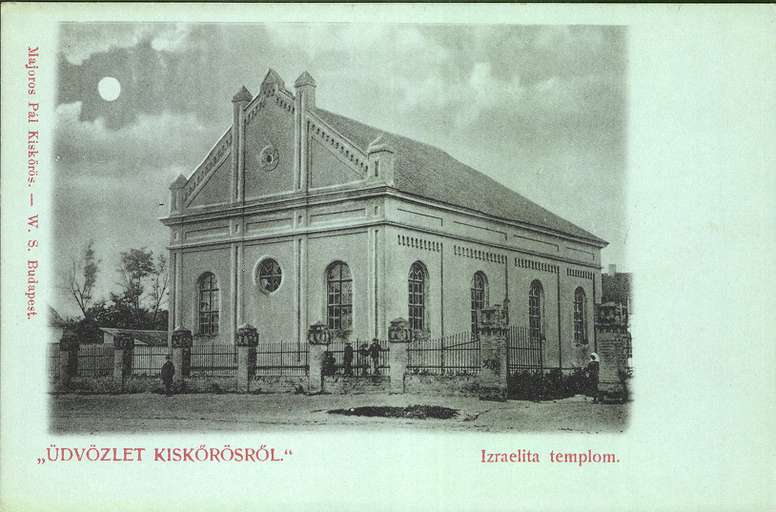
The Great Synagogue, known locally as the Nagytemplom, stood on Petőfi Street in the centre of Kiskőrös, in the small Jewish quarter that local historians place between Okolicsányi, Pozsonyi and Báthory streets. It was built during the long rabbinate of Meshulam Rubinstein (1866–1899); the Hungarian list of synagogues dates it to 1873. Early postcards show a free-standing plastered hall with round-arched windows, a pinnacled gable and an iron fence between brick piers. The community, status quo after the schism of Hungarian Jewry and Orthodox from 1912, renovated and remodelled it between the world wars, and in 1915 added a small house of study nearby, the Kistemplom. In the spring of 1944, after Nazi German forces occupied Hungary, the Jews of Kiskőrös and the surrounding district were shut into a boarded-off ghetto around the synagogue. In June they were taken to the Kecskemét brickworks and from there to Auschwitz-Birkenau; the town commemorates 422 murdered Jews. The synagogue was looted and left damaged. The few survivors prayed in the Kistemplom, and in 1950 they sold the Great Synagogue to the Hungarian People's Army on condition that it be pulled down. The Communists demolished it that year. The Petőfi Sándor Primary School, opened in 1961, now covers the site.
Where it stood for 77 years
Historic: Petőfi utca, Kiskőrös (Jewish quarter between Okolicsányi, Pozsonyi and Báthory streets). Today: Petőfi Sándor Általános Iskola, Petőfi Sándor utca, 6200 Kiskőrös, beside the Kistemplom at Petőfi Sándor út 3.
Abrir mapa ampliado →La comunidad judía
Jews settled in Kiskőrös at the end of the eighteenth century; Pinkas Hakehillot records four in 1784–85, 143 in 1840, 350 in 1869, 482 in 1910 and a peak of 588 in 1930, falling to 509, or 3.9 per cent of the town, in 1941. Most of the founders came from Máramaros and a few from Moravia. They lived chiefly from trading grain, wine and foodstuffs, with some artisans and farm owners. The community was organised in the early nineteenth century, and Joachim Feigelberg became its first rabbi in 1850. After the schism of Hungarian Jewry it took the status quo position, then joined the Orthodox organisation in 1912, though it was regarded as moderate and its rabbis preached in German rather than Yiddish. It maintained a burial society, a women's association, a free-loan fund, a three-room hostel for poor travellers, an elementary school founded about 1880, a Talmud Torah, a small yeshiva and a Talmud study association with a large library. The Jews of Kecel, Császártöltés, Nemesnádudvar, Érsekcsanád, Sükösd and Bajaszentistván belonged to it.
Arquitectura y diseño
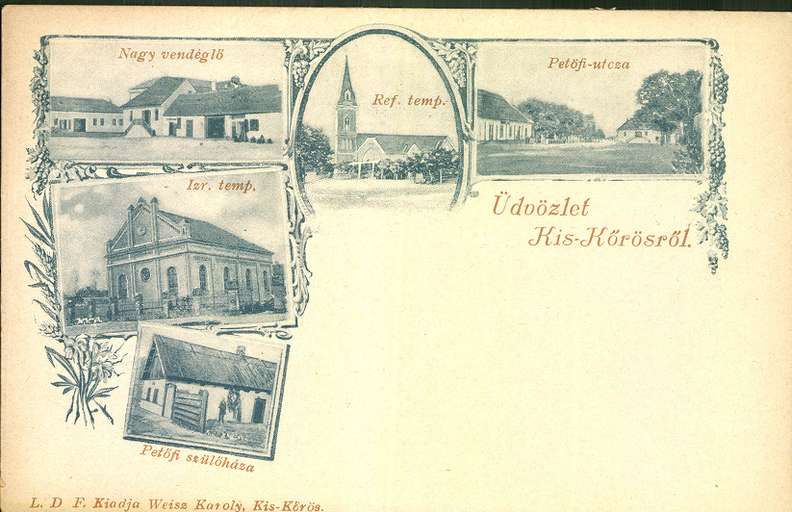
No architect, plan or seating figure has been found for the building, and no interior view is known. Three early postcards show a free-standing rectangular hall under a pitched roof, set back from the street behind an iron fence fixed between brick piers with ornamental caps. The plastered walls were divided by flat pilaster strips and finished with a corbelled frieze beneath the cornice. The short gable front had three bays, with tall round-arched windows on either side of a circular window; above the cornice rose a stepped gable with a central rosette, framed by slender pinnacles with pyramidal caps, and smaller pinnacles marked the corners. The long side had five tall round-arched windows. These round-arched forms are those of the Rundbogenstil. A local historian records that between the world wars the congregation renovated and remodelled its synagogue on Petőfi Street, but what was altered is not stated. A smaller prayer and study house, the Kistemplom of 1915, stood close by and survives.
La vida dentro de la sinagoga
The synagogue was built under Rabbi Meshulam Rubinstein, a pupil of the Ktav Sofer and author of the book Mabit, who served from 1866 to 1899. He was the uncle by marriage of the writer Hugó Ignotus, who spent two childhood years at the Jewish school here. His successor, named Bernát Löblovits in the local press and David Lelovics in Pinkas Hakehillot, founded the town's yeshiva and bore the title of district chief rabbi. Newspaper reports of the early 1920s show the synagogue taking part in the town's public life: a collection for refugees raised 4,900 crowns there in April 1920; in January 1921 Löblovits preached a patriotic sermon; in April 1922 he gave the address at a memorial service for King Charles IV, attended by local officials; and after his appeal from the pulpit the congregation gave 20,300 crowns towards a statue of Sándor Petőfi, who was born in Kiskőrös. The community owned eighteen Torah scrolls. Its last rabbi was Jakab Schnyders.
Destrucción
Antisemitic violence reached the building before the war: the town's official history records armed attacks on the synagogue and on Jewish residents in 1937. After Nazi German forces occupied Hungary in March 1944, the Jews of Kiskőrös and its district were forced into a ghetto of boarded-off streets around the synagogue, under orders issued by the Hungarian district magistrate to the gendarmerie. On the day before their removal many were driven into the synagogue and its courtyard, where women and girls were subjected to body searches. After the deportation the empty building was looted and left damaged; the sources do not say by whom. The handful of survivors could not restore it. In 1950, under Communist rule, they sold the damaged Great Synagogue to the Hungarian People's Army on condition that it be demolished, and the Communists demolished it that year. The town's website gives 1946 for the demolition instead. The emptied Jewish quarter was later expropriated for a school.
El destino de la comunidad
Shortly after the occupation 22 local Jews were taken to the internment camp at Topolya. The ghetto, set up in the second half of April 1944, held 582 people, including Jews brought in from nearby villages, under a Jewish Council of Mór Ruder, Vilmos Lebovits, Sándor Gottlieb, Izsák Spiegel, Mór Kupfer and Mózes Blumenthal. In the second half of June, on 18 or 21 June according to different sources, its inmates were taken by train to the brickworks at Kecskemét and deported from there in two transports that crossed the border at Kassa on 27 and 29 June. Most were murdered at Auschwitz-Birkenau; some, among them Rabbi Schnyders, were sent to Austria. Pinkas Hakehillot counts 580 victims from the Kiskőrös community, and the town commemorates 422 by name. Rabbi Schnyders returned and briefly led the reorganised community, which prayed in the Kistemplom. Numbers dwindled through emigration to Budapest and Israel; a 1960 report speaks of 14 Jews remaining, and about ten families lived there in the 1970s.
El lugar hoy
The site lies in the block beside Petőfi Sándor utca in the town centre. From 1955 the former Jewish quarter was marked out for a new central school; its houses and the old Jewish school were expropriated and cleared, and the Petőfi Sándor Primary School, designed by István Balogh in 1959, was built there in 1960–61. Teaching began on 13 February 1961. Nothing of the Great Synagogue is visible. Its neighbour, the Kistemplom of 1915 at Petőfi Sándor út 3, survived; the town council took it over in 1979 and converted it, and it now serves as a music school and concert hall known as the Zsinagóga. A martyrs' memorial tablet is set in its wall, and a Holocaust memorial was unveiled beside it in July 2023.
Nombres destacados
Meshulam Rubinstein
d. 1898 or 1899Rabbi of Kiskőrös, 1866–1899Meshulam (Mesullam, Mösülöm) Rubinstein was the second rabbi of Kiskőrös, in office from 1866, and the Great Synagogue was built during his rabbinate. A pupil of the Ktav Sofer of Pressburg, he wrote the book Mabit (1895/96). He married Sáli, daughter of the first rabbi, Joachim Feigelberg, and the young Hugó Ignotus lived in his household while attending the Jewish school.
Biografía o fuente →Bernát Löblovits (David Lelovics)
UnknownRabbi of Kiskőrös, 1899–1942; district chief rabbiThe rabbi who served from 1899 to 1942 appears as Bernát Löblovits or Löblovics in the Kiskőrös press and as David Lelovics in Pinkas Hakehillot. He founded the yeshiva and wrote a book printed at Kunszentmiklós in 1934/35. From the synagogue pulpit he preached on national occasions in 1921 and 1922, led the memorial service for King Charles IV, and raised 20,300 crowns from his congregation for the town's Petőfi statue.
Biografía o fuente →Jakab Schnyders
UnknownLast rabbi of KiskőrösJakab Schnyders, whose name is also written Snyders and Smyders, was the last rabbi to serve in the Great Synagogue and in 1939 presided over the board of the community's elementary school. During the Holocaust he was deported to Austria. He returned after the war and briefly led the reorganised community, which could no longer use the ruined synagogue, and later emigrated to Brazil.
Biografía o fuente →¿Tiene algo que aportar?
Fotografías, documentos, historias familiares o recuerdos de esta sinagoga y su comunidad ayudan a mantener viva su historia.
- Turán István: A Petőfi Állami Általános Iskola építése 1960-ban (Fotóközlés), Kiskőrös Múltjából IV/1 (January–February 2022), pp. 14–15
- Turán István: „Történelmének mérföldköves állomásához érkezett” – Ötven éve nyert városi rangot Kiskőrös (Első rész), Kiskőrös Múltjából IV/4 (July–September 2022)
- Turán István: A kiskőrösi gettóról, Kiskőrös Múltjából III/2 (March–April 2021), p. 17
- Zsinagóga – Kistemplom
- Történelem (history of Kiskőrös)
- “Kiskoros” – Encyclopedia of Jewish Communities in Hungary (translation of Pinkas Hakehillot Hungary, ed. Theodore Lavi, Yad Vashem, Jerusalem 1975, pp. 506–507)
- Randolph L. Braham: A népirtás politikája – a holocaust Magyarországon, vol. 2 (zone IV: southern Hungary east of the Danube)
- Kiskőrösi zsinagóga (postcard “Üdvözlet Kis Körösről – Izraelita templom”), inv. F99.17
- Kiskőrös, Üdvözlet Kiskőrösről; Izraelita templom (postcard, publisher Majoros Pál, Kiskőrös; W. S., Budapest)
- Kiskőrös, Üdvözlet Kiskőrösről; Nagy vendéglő; Ref. templom; Petőfi utca; Izr. temp.; Petőfi szülőháza (postcard, L. D. F., published by Weisz Károly, Kiskőrös)
- Magyarországi zsinagógák listája
- Kiskőrös
- Nagy József – Turán István: Ignotus Hugó kiskőrösi családi kapcsolata, Kiskőrös Múltjából II/6 (November–December 2020), p. 21
- Kiskőrös Múltjából III/1 (January–February 2021): Petőfi centenary article and Lapszemle (press review)
- Kiskőrös Múltjából IV/2 (March–April 2022): Petőfi statue article and Lapszemle (press review)
- Kiskőrös Múltjából II/2 (March–April 2020): Lapszemle (press review)
- Csatár István et al. (eds.): Pest-Pilis-Solt-Kiskun vármegye és Kecskemét th. jogú város adattára (Pécs, 1939), part IV, p. 93
- Magyarországi rabbik listája
- Petőfi Sándor Általános Iskola (Kiskőrös)
- Holokauszt emlékmű (Kiskőrös)
- Petőfi Sándor Általános Iskola, Kiskőrös (way 1175021581)
Share a memory or thought
No comments yet. Be the first to add one.