

La historia de Status Quo Ante Synagogue, Košice
Jews were allowed to settle freely in Košice (Kassa, Kaschau) only after 1840, and for the first quarter-century they prayed in a converted house on Zvonárska Street. The Košice region's heritage guide calls the building on Moyzesova Street the first synagogue built in the city, completed in 1866, 26 years after settlement was opened to Jews, and the work of the prominent local architect Michal Répászky. It stood on the plot next to which the Neolog community later raised its large domed synagogue of 1927.
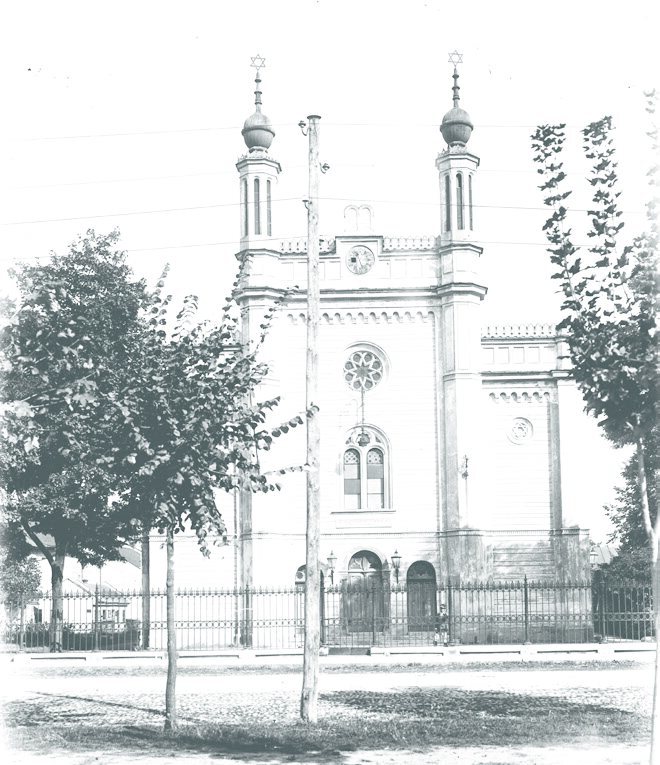
The building was controversial from the start. Its bimah stood at the eastern end of the hall and it had multi-sided towers, features the guide says broke with Orthodox rules and fed a long dispute inside the community. Pinkas Hakehillot describes a synagogue of about 500 seats opened in 1866 by the reforming party, which the Orthodox refused to recognise; the authorities settled the quarrel by leaving the building to the reformers and obliging them to pay for a traditional synagogue for the Orthodox. After the national split of 1868-69 the city's Jews divided into Neolog, Orthodox and status quo ante communities, and the Moyzesova Street building is remembered as the synagogue of the status quo ante congregation. It survived the war, but in 1958, when the neighbouring Neolog synagogue was turned into the House of Arts, it was pulled down.
Where it stood for 92 years
Historic: Moyzesova Street (Moyzes utca), Košice, beside the later Neolog synagogue; house number unknown. Today: next to the House of Arts (Dom umenia), Moyzesova 1018/66, 040 01 Košice-Staré Mesto (approximate).
Abrir mapa ampliado →La comunidad judía
Pinkas Hakehillot records that Košice Jews formed an independent community in 1842, with 30 families in 1843, about 600 Jews in 1848 and about 300 families by 1867. During the 1860s the preacher and journalist Aharon (Siegfried) Bettelheim, community secretary from 1861 to 1866, pressed for changes in worship, and the quarrel over reform came to a head with the new synagogue of 1866. After the Hungarian Jewish Congress of 1868-69 most Košice Jews joined the Neolog stream and the Orthodox left to form their own community. A third group of traditional families, led by Rabbi Avram Abba Katz Zelenfreund, withdrew from the strict Orthodox and formed the congregation Adat Shalom, which soon called itself a status quo community, one of the first in Hungary. It remained small, numbering some dozen families between the wars, and kept its independence even after the Neolog community joined the liberal Yeshurun organisation in 1929. In the interwar years its president was Moritz Klein and its chief rabbi was Mordechai Eckstein. The city as a whole had 8,762 Jews in 1921 and 11,420 in 1938.
Arquitectura y diseño
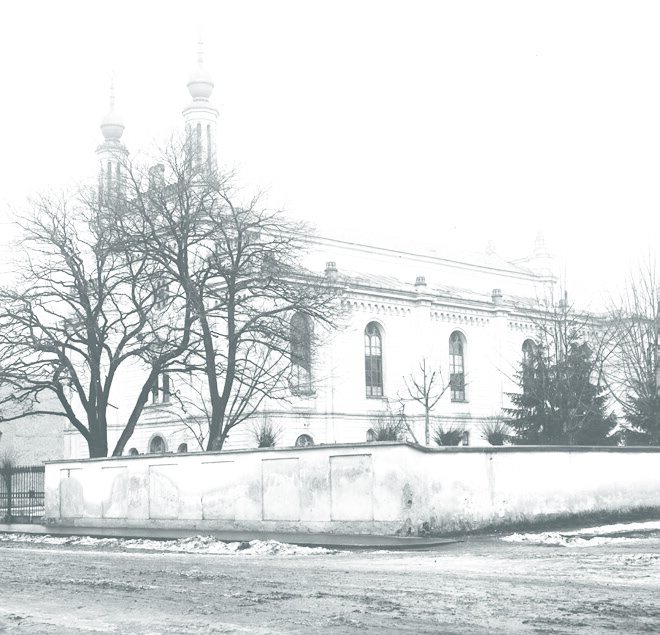
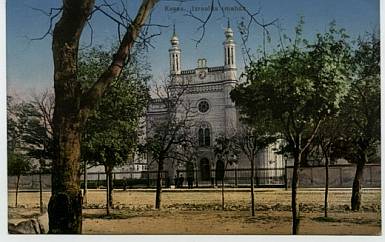
The Košice region guide describes a rectangular building in the Moorish style with a single women's gallery reached by four staircases of four flights each. On the outside the most striking features were the windows: a large neo-Romanesque window and a rose window above the entrance, filled with stained glass made by Móric Horovitz. The bimah for the Torah reading stood in the eastern part of the prayer hall. KehilaLinks notes that the Tempelgasse synagogue in Vienna probably inspired the design. The surviving photographs show a tall rendered entrance front flanked by two slender towers, each topped by an onion dome and a Star of David, with the rose window and a pair of round-arched windows over a triple-arched doorway. The long side walls were divided by pilasters into bays, each with a tall round-headed window above a smaller window at ground level, under a corbelled cornice; small turrets marked the corners of the rear. A railing and later a garden wall separated the building from the street. Pinkas gives about 500 seats for the 1866 synagogue, some of them in the women's section.
La vida dentro de la sinagoga
Little is recorded about services in the building itself. Its arrangement, with the bimah at the east end rather than in the centre and with towers on the facade, marked it from the start as a synagogue of the modernising party, and the guide says these choices caused a long-standing dispute in the community. Pinkas Hakehillot describes the status quo congregation that later worshipped here as keepers of tradition whose way of life was religious, so that even the strictest rabbis did not excommunicate them. Its first rabbi, Avram Abba Katz Zelenfreund, was known as a scholar and author of the books Pras Avot and P'nai Avraham. He was followed by Rabbi Mordechai Eckstein, who served as chief rabbi of the congregation until 1944. Between the wars the community, led by Moritz Klein, numbered only some dozen families. It kept its own framework apart from the Neolog and Orthodox communities, with its own synagogue and a few communal institutions, while the city's Neolog, Orthodox and Hasidic congregations each had their own large buildings nearby.
Destrucción
No source found records damage to the synagogue during the Second World War, and the photographs from the 1950s show it intact. After the war the surviving Jews of Košice united in a single community of Orthodox character, which reopened the new Orthodox synagogue and the house of study on Zvonárska Street; the Moyzesova Street building is not among those recorded as returned to worship. The neighbouring Neolog synagogue was used as a grain store and was then rebuilt as the House of Arts, later the seat of the State Philharmonic. The Košice region guide states that when the Neolog synagogue was converted into the House of Arts in 1958, the decision was made to demolish the Status Quo Ante synagogue, and KehilaLinks also gives 1958 for the demolition. This happened under the Communist regime in Czechoslovakia, as part of a state cultural project on the adjoining plot, but none of the sources read names the body or official that decided on or carried out the demolition, or says whether the building had first been transferred by the Jewish community.
El destino de la comunidad
In 1941 the Hungarian authorities deported Jews without proof of citizenship to the Kamenets-Podolski region, where they were murdered. After the Nazi German occupation of Hungary on 19 March 1944, Jews from the surrounding district were brought into the city, and on 20 April a ghetto was set up in the Jakab brickworks under the Hungarian police officer Tibor So. On 24 April the state secretary László Endre visited with a group of SS officers to coordinate the concentration and deportation; on 27 April the Jews were ordered to the synagogue area on Zvonárska Street and marched to the ghetto, which held 11,839 people the next day. A separate ghetto for privileged Jews was run by the Hungarian gendarmerie officer László Csatáry. Between 15 May and 4 June 1944 five transports took about 15,700 Jews from Košice to Auschwitz. Rabbi Mordechai Eckstein of the status quo congregation was among those deported. In 1947 about 2,542 Jews lived in Košice, and more than a thousand left for Israel in 1949-50.
El lugar hoy
Nothing of the synagogue survives. The Košice region guide says it can now be recalled only from photographs. Its neighbour, the Neolog synagogue of 1927 at Moyzesova 66, still stands as the House of Arts (Dom umenia), home of the State Philharmonic Košice. The exact footprint of the demolished building next to the House of Arts was not identified in the sources read, nor what occupies it today. The map pin marks the House of Arts and should be read as the approximate location of the vanished synagogue beside it.
Nombres destacados
Michal Répászky
UnknownArchitect of the synagogue (1866)Répászky, described by the Košice region guide as a prominent Košice architect, designed the synagogue on Moyzesova Street, completed in 1866 as the first purpose-built synagogue in the city. KehilaLinks also names him as the architect and suggests that the Tempelgasse synagogue in Vienna inspired his design. His Moorish building, with twin domed towers and a rose window, was the model of a modern urban synagogue in Košice until the large synagogues of the 1920s were built.
Biografía o fuente →Móric Horovitz
UnknownMaker of the stained-glass windowsThe Košice region guide names Móric Horovitz as the maker of the stained glass in the synagogue's windows, including the large neo-Romanesque window and the rose window above the entrance, which it calls the most interesting features of the exterior. Nothing further about him was found in the sources read.
Biografía o fuente →Avram Abba Katz Zelenfreund
UnknownFounding rabbi of the status quo congregation Adat ShalomAccording to Pinkas Hakehillot, Zelenfreund led the traditional but moderate families who withdrew from the strict Orthodox community after the split of 1868-69 and founded the congregation Adat Shalom, which soon called itself a status quo community, one of the first in Hungary. He was a distinguished scholar, author of Pras Avot and P'nai Avraham, and served as its rabbi until his death; Pinkas gives the year as 1819, evidently a misprint.
Biografía o fuente →Mordechai Eckstein
died 1944 or laterChief rabbi of the status quo congregation until 1944Pinkas Hakehillot names Rabbi Mordechai Eckstein as successor to Rabbi Zelenfreund at the head of the Košice status quo congregation and says he continued as its chief rabbi through the interwar years, when the community numbered some dozen families, until he was deported to Auschwitz in 1944. His exact dates and fate after deportation are not given in the sources read.
Biografía o fuente →Moritz Klein
UnknownHead of the status quo congregation between the world warsPinkas Hakehillot records Moritz Klein as head of the Košice status quo community in the Czechoslovak period, when the congregation of some dozen families kept its independent framework alongside the much larger Neolog and Orthodox communities and did not join the liberal Yeshurun organisation. As lay leader he was responsible for its synagogue and institutions. Nothing more about his life or fate was found.
Biografía o fuente →¿Tiene algo que aportar?
Fotografías, documentos, historias familiares o recuerdos de esta sinagoga y su comunidad ayudan a mantener viva su historia.
- Jewish Monuments of Eastern Slovakia: Status Quo Ante Synagogue in Košice (pp. 6-7)
- Židovské pamiatky východného Slovenska (Slovak edition)
- Kosice Town Views
- Košice (Pinkas Hakehillot Slovakia, Encyclopedia of Jewish Communities)
- Kosice
- List of synagogues in Slovakia
- Kosice State Philharmonic Orchestra (Dom umenia)
- Dom umenia, Moyzesova 1018/66, Košice (OpenStreetMap way 27167820)
Share a memory or thought
No comments yet. Be the first to add one.