

La storia di Krefeld Synagogue (Petersstraße)
The synagogue at the corner of Petersstraße and Marktstraße was Krefeld's principal Jewish house of worship for 85 years. It replaced an 18th-century prayer house that the growing community had outgrown. Built between 1851 and 1853 to plans by the city architect Heinrich Johann Freyse, it was dedicated in June 1853 with four days of celebrations in which the town's non-Jewish population also took part; non-Jewish residents had donated 2,500 thalers towards the building.
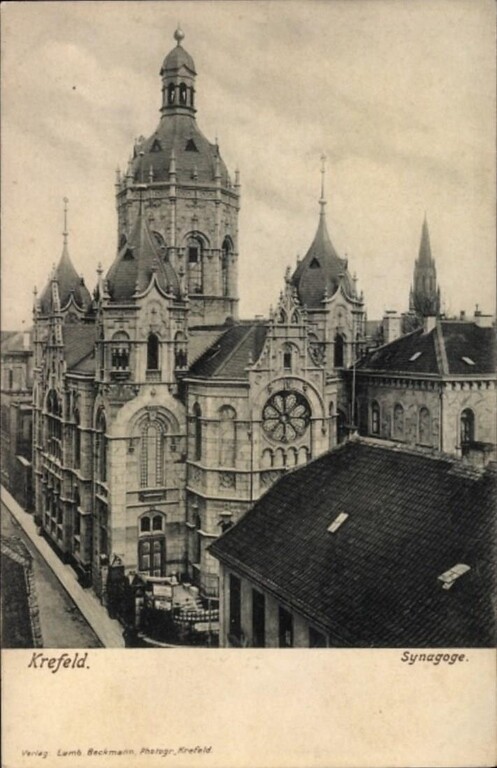
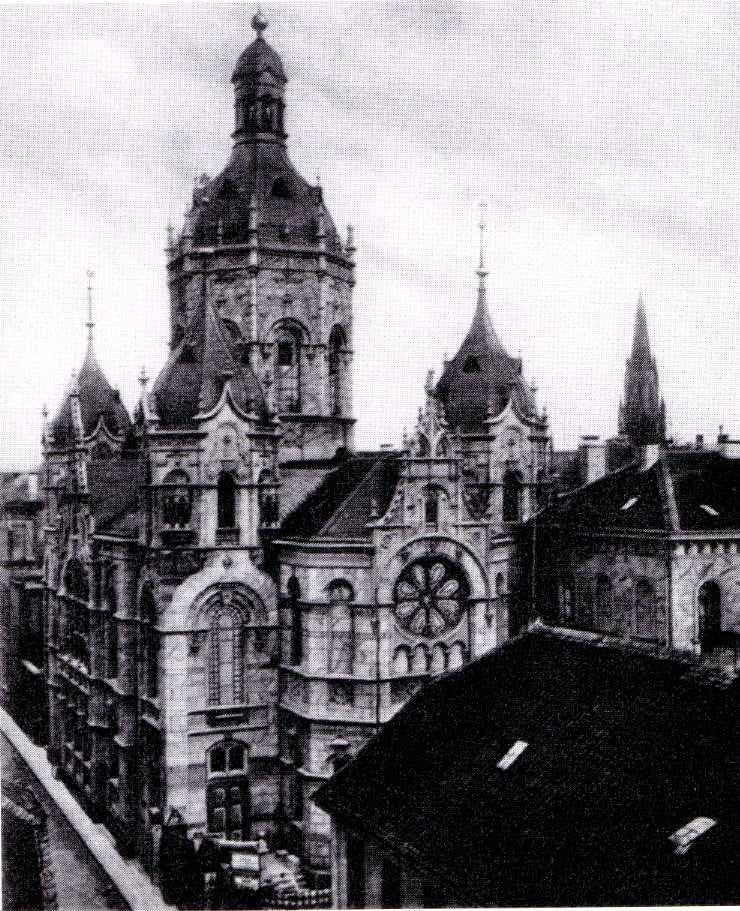
Its high dome, about 40 metres tall, made it one of the most prominent buildings in the city centre, visible across Krefeld alongside the church towers. As seat of the chief rabbi, it served as the religious centre for Jews across the region.
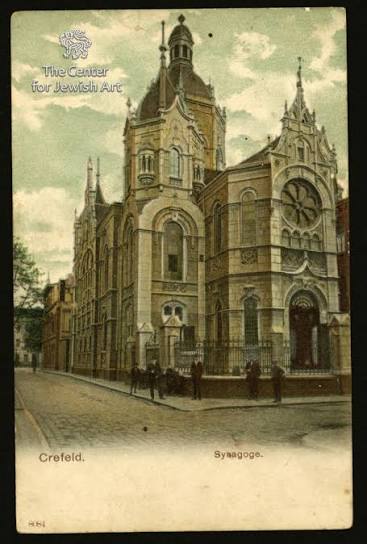
In 1902–03 the Krefeld architect Johann Reck remodelled the building, adding exits and wrapping it in opulent stucco decoration; it was reopened on 8 July 1903. In the later 1920s architect Max Sippel toned down that decoration and the building received twelve windows designed by the Dutch artist Johan Thorn Prikker.
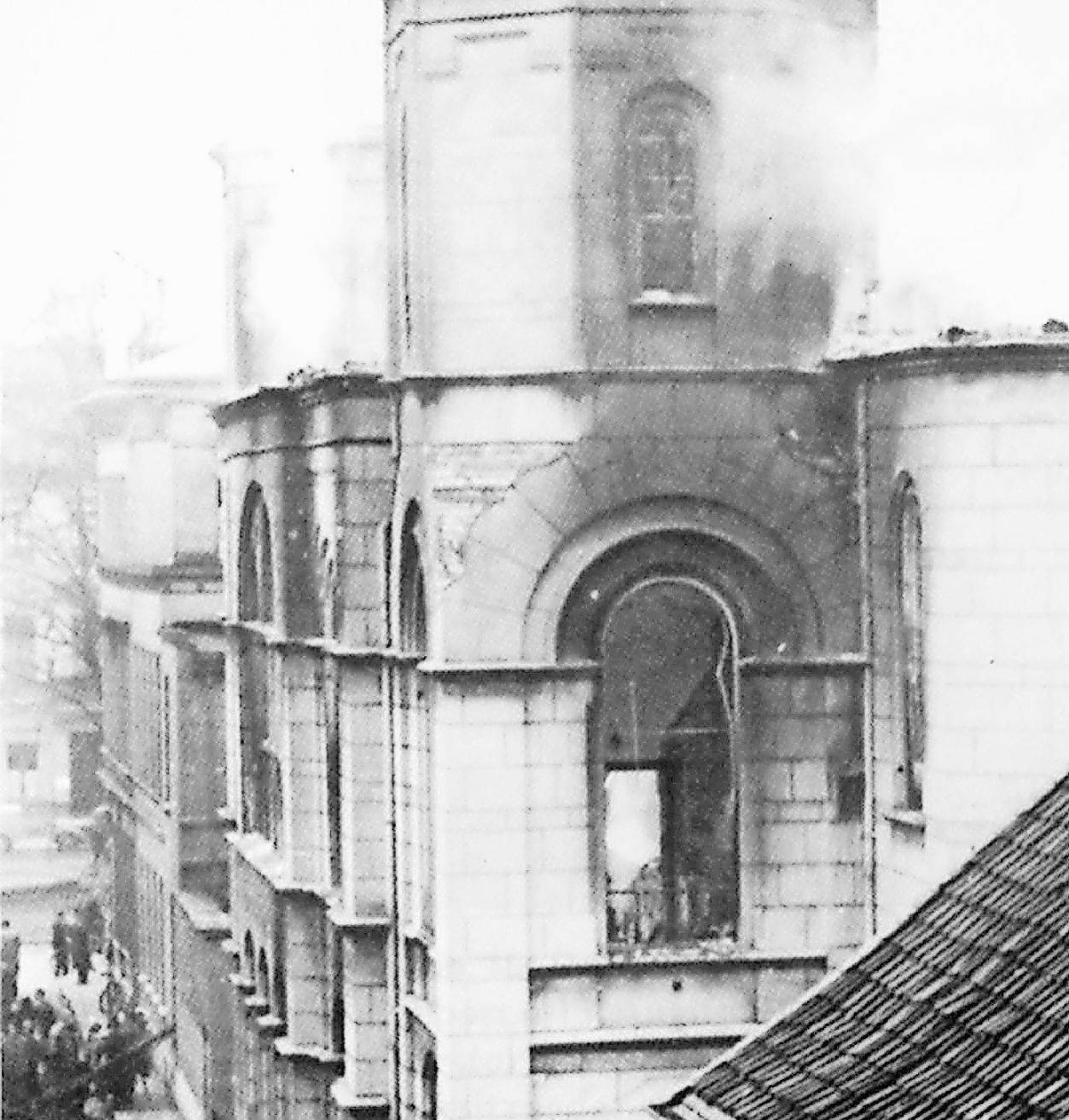
On the night of 9–10 November 1938 a unit of SA men broke in, wrecked the interior and set it on fire while police and fire brigade stood by. Nothing of the building survives.
Where it stood for 85 years
Historic: corner of Petersstraße and Marktstraße, Krefeld. Present-day: An der alten Synagoge, Marktstraße / Petersstraße, 47798 Krefeld (open space; footprint marked in the paving). Location approximate.
Apri la mappa grande →La comunità ebraica
Jews are recorded in Krefeld from the late 17th century: three families in 1685 and about ten by 1760. Under French rule Krefeld became the seat of a consistory, and in 1808–09 Löb Carlburg was appointed its first chief rabbi. The community grew quickly with the city's silk and textile economy, from about 160 people in 1806 to 484 in 1846 and 1,085 in 1871, reaching roughly 1,700 around 1885, about two per cent of the population.
By the mid-19th century the old 18th-century prayer house was far too small. The community resolved to build a large new synagogue in the centre of town, and construction began in 1851 at the corner of Petersstraße and Marktstraße. The project drew support from outside the congregation: non-Jewish Krefelders contributed 2,500 thalers, and the dedication in June 1853 was a civic event led by chief rabbi Löb Bodenheimer.
Architettura e design
Freyse's design was laid out on a square with two equal rectangles attached to it. Over the square rose a tall dome, about 40 metres high, which made the building a landmark of the Krefeld skyline. The original building was in a classical manner.
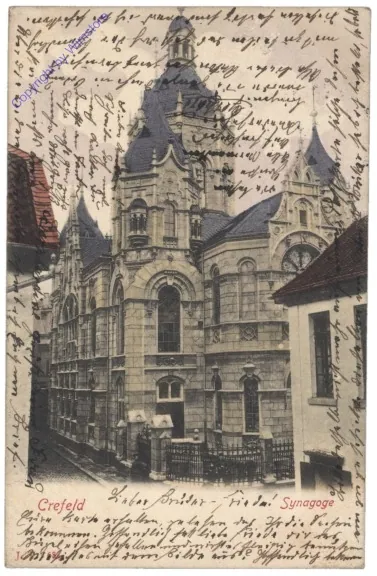
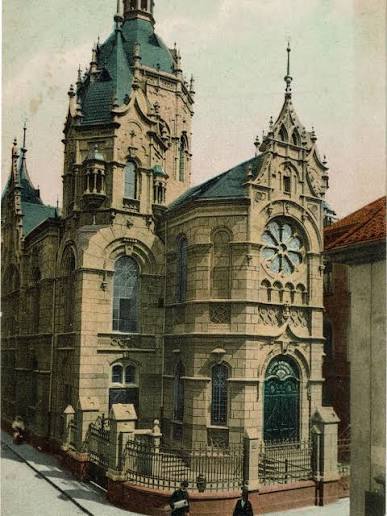
In 1902–03 Johann Reck remodelled the synagogue, adding several exits and encasing the exterior in lavish stucco ornament described as pseudo-oriental. Early 20th-century postcards show this phase: a richly articulated corner building with an octagonal domed tower, pointed corner turrets, round-arched windows and a large rose window over the entrance, behind a low wall with iron railings.
In the later 1920s Max Sippel stripped back much of the stucco. The interior was lined with marble and held about 500 people. Twelve stained-glass windows designed by Johan Thorn Prikker were installed; replicas of his work now hang in the new synagogue on Wiedstraße. Many details of the furnishings are no longer known.
La vita nella sinagoga
As the seat of the chief rabbi of the Krefeld consistory and later district rabbinate, the synagogue was the religious centre for Jews of Krefeld and the surrounding Lower Rhine area. Its dedication in June 1853 opened with a procession through the town, with girls in white carrying the key on a silk cushion, the Torah scrolls, the chief rabbi and consistory, a choir and the congregation; the scrolls were placed in the new ark to festive singing. Rabbi Bodenheimer closed his sermon by blessing all the people of Krefeld regardless of faith.
Rabbis who served the congregation included Löb Bodenheimer (1844–1855), Jakob Horowitz, whose tenure lasted more than thirty years (1868–1904), and Dr Arthur Bluhm, the last chief rabbi (1928–1938). A Hebrew and German inscription over the entrance read, in paraphrase, "Lord, I love the beauty of your house"; it has been reproduced in the new synagogue.
Distruzione
Antisemitic incidents grew from about 1928, including cemetery desecrations and broken synagogue windows. On the night of 9–10 November 1938, after Joseph Goebbels's speech in Munich, orders reached the NSDAP district leadership in Krefeld at about 10.30 pm. Instructions were to seize archival material in the synagogue and community offices. Instead, a group of young men from the SA-Standarte "Feldherrenhalle", stationed at Fichtenhain, forced their way into the synagogue, destroyed everything inside and set the building on fire. Police and fire brigade deliberately did not intervene, reportedly to avoid a clash with the SA men from outside the city.
The synagogue burned out completely. The community house and 18 Jewish businesses were also wrecked, and 63 Jewish men were arrested. The synagogues in Linn, Uerdingen and Hüls were destroyed in the same pogrom. On 11 November the Nazi Rheinische Landeszeitung described the violence as "spontaneous demonstrations".
Il destino della comunità
The Jewish population of Krefeld fell from 1,413 in 1933 to about 850 by December 1938, as families emigrated under growing persecution. Major Jewish businesses were forcibly sold. Rabbi Arthur Bluhm, imprisoned in 1937–38, emigrated to the United States.
The remaining Jews were concentrated in designated "Jew houses", including at Südwall and Neußer Straße. From October 1941 they were deported to Litzmannstadt (Łódź), Riga, Izbica and Theresienstadt; the last major transport left on 17 September 1944. At least 730 Jews from Krefeld and the surrounding area were murdered in the Holocaust. In 1946 only 63 Jews lived in the city.
A small community re-formed after the war, numbering about 60 in the early 1960s and 130 in 1980, and grew to about 1,100 members with immigration from the former Soviet Union. On 14 September 2008 it dedicated a new synagogue on Wiedstraße, which incorporates Thorn Prikker's window design and the old entrance inscription.
Il luogo oggi
Nothing of the synagogue survives. The site at the corner of Marktstraße and Petersstraße in central Krefeld is now an open public space named An der alten Synagoge, and the outline of the building is marked in red stones in the paving. A memorial of basalt columns stands nearby; its inscription says the synagogue stood close to it and was destroyed in the November Pogrom of 1938. No walls or foundations are visible above ground, and no archaeological investigation of the site is recorded in the sources consulted. The congregation's successor, the Jewish Community of Krefeld, now worships in the new synagogue on Wiedstraße.
Nomi importanti
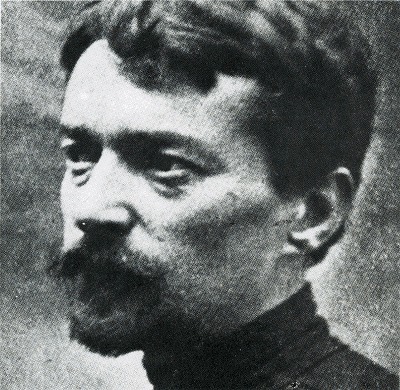
Johan Thorn Prikker
1868–1932Artist (stained-glass windows)Dutch Art Nouveau artist who taught at the Krefeld school of arts and crafts from 1904 to 1910. He designed twelve stained-glass windows installed in the synagogue during its 1920s renovation. The windows were lost in 1938, but his design has been recreated in the new Krefeld synagogue on Wiedstraße, dedicated in 2008.
Biografia o fonte →Heinrich Johann Freyse
1809–1850Architect (original building)Krefeld's city architect, whose plans were used for the synagogue built at the corner of Petersstraße and Marktstraße between 1851 and 1853. His design set a tall dome, about 40 metres high, over a square core with two equal rectangular wings, making the synagogue one of the most visible landmarks of the city centre for 85 years.
Biografia o fonte →Löb Bodenheimer
1807–1868Chief rabbi (1844–1855)Chief rabbi of the Krefeld consistory who led the four-day dedication of the new synagogue in June 1853. As the Torah scrolls were placed in the new ark, he preached, closing his sermon by blessing all the people of Krefeld without distinction of faith, thanking the non-Jewish residents who had helped fund the building. He was also active in Jewish education.
Biografia o fonte →Jakob Horowitz
1837–1907Chief rabbi (1868–1904)Served the Krefeld congregation for more than thirty years, from 1868 to 1904, a period in which the community grew to around 1,700 people and the synagogue on Petersstraße was the religious centre for Jews of the wider district. He was highly respected in the region. Born in Kraków, he had earlier served in Märkisch Friedland, and his Krefeld tenure spanned the synagogue's 1903 remodelling.
Biografia o fonte →Johann Reck
Active c. 1903Architect (1903 remodelling)Krefeld architect who remodelled the synagogue in 1902–03 to cope with the growing congregation. He added several exits and encased the building in lavish stucco ornament described as pseudo-oriental, the appearance recorded on most surviving postcards. The remodelled synagogue was reopened on 8 July 1903.
Biografia o fonte →Max Sippel
1887–1974Architect (1920s renovation)Krefeld architect who renovated the synagogue in the later 1920s, removing much of the 1903 stucco decoration. His work also saw the installation of twelve stained-glass windows designed by Johan Thorn Prikker, giving the interior its final form before the building was destroyed in 1938.
Biografia o fonte →Arthur Bluhm
1899–1962Last chief rabbi (1928–1938)Took office as chief rabbi of Krefeld in February 1928, aged 28, he led the congregation at the Petersstraße synagogue through the rise of Nazism until its destruction in November 1938. He was imprisoned in 1937–38, then emigrated to the United States and settled in Amarillo, Texas, where he died in 1962.
Biografia o fonte →Hai qualcosa da condividere?
Fotografie, documenti, storie di famiglia o ricordi di questa sinagoga e della sua comunità aiutano a mantenerne viva la storia.
- Synagoge Krefeld
- Jüdische Gemeinde – Krefeld (Nordrhein-Westfalen)
- Teil 52: 9./10. November 1938 – Die Synagoge wird zerstört
- Jüdisches Leben am Niederrhein – Krefeld
- Alte Krefelder Synagoge wird als 3D-Animation lebendig
- Ehemalige Synagoge Krefeld (memorial stele)
- Arthur Bluhm (Q19365337)
- Jakob Horowitz
- Löb Bodenheimer
- Arthur Bluhm Collection (AR 25341)
- Heinrich Johann Freyse
Share a memory or thought
No comments yet. Be the first to add one.