
История Kremnica Synagogue
Kremnica is a medieval mining town in central Slovakia, famous for its mint, which was for centuries the most important in the Kingdom of Hungary. The town was enclosed by a double wall with bastions and towers. According to the architectural historian Maroš Borský, Jews were not allowed to live in this mining town for centuries, so a Jewish community formed there only in the second half of the nineteenth century. Its oldest surviving gravestone dates from 1871.
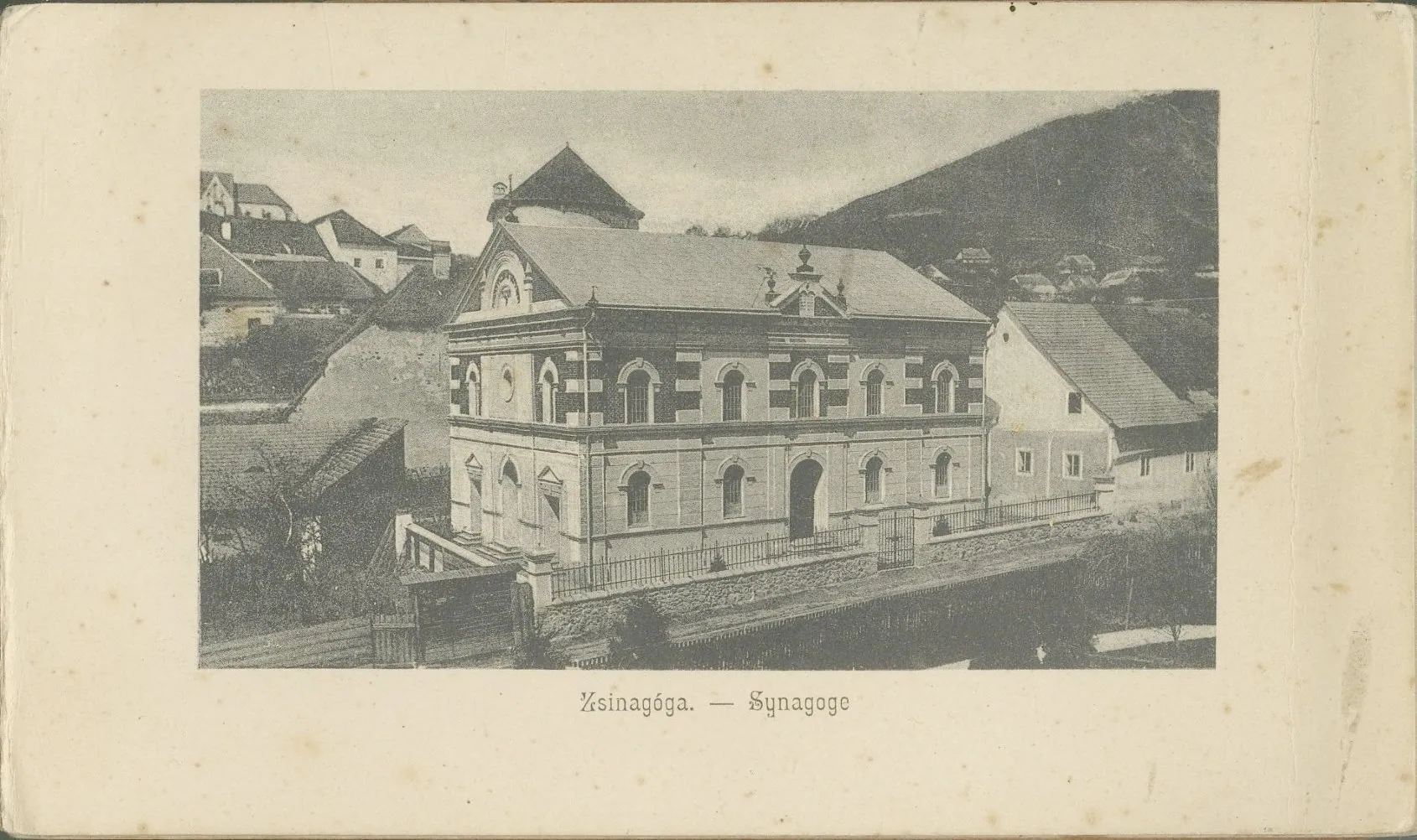
In 1890 the community built a synagogue in the southern suburb of the historic town, below the fortifications. Borský judged it the work of a more sophisticated architect than most provincial synagogues of the region, with a well-proportioned façade that played brick against plaster, and he suggested that a community living in a strongly German town may have looked to Vienna or another German-speaking centre for its design. An early twentieth-century souvenir photo folder of Körmöczbánya includes a view of the building captioned 'Zsinagóga. Synagoge', the only image found.
Borský records that the synagogue was demolished during the Second World War, when Kremnica belonged to the Slovak State; a published list of Slovak synagogues gives the year as 1944. No source read names who demolished it or why. The site has not been identified, and nothing of the building is known to survive.
Where it stood for nearly 55 years
Historic: southern suburb below the town fortifications, Körmöczbánya (Kremnica), Bars county; street unknown. Today: Unknown; pin at the Lower Gate (Dolná brána), Štefánikovo námestie, 967 01 Kremnica (approximate).
Открыть большую карту →Еврейская община
Kremnica was a royal free town and the chief mining town of the Hungarian kingdom, with a population of strongly German character. Borský writes that Jews could not reside there for centuries and that a Jewish community was established only in the second half of the nineteenth century. The burial ground gives the best evidence for its age: the Jewish section of the municipal cemetery on Dolná Street holds 53 gravestones, the oldest dated 1871 and the newest 1929, with inscriptions in Hebrew and German. The German inscriptions fit Borský's view of a congregation that had adopted the language and culture of the town around it. The building of a well-designed synagogue in 1890, about two decades after the first recorded burial, suggests a community that had grown in numbers and means, but its size, its religious affiliation (Orthodox, Neolog or status quo), the names of its rabbis and lay leaders, and its institutions are unknown from the sources read. The Pinkas Hakehillot volume for Slovakia has an entry on Kremnica that is not available online in translation.
Архитектура и дизайн
Borský describes the synagogue as a building with a saddleback roof and a conventional layout, a three-bay western façade, and entrance portals to the vestibule and to the stair towers on the western side. He found its appearance more refined than usual: a pleasant Baroque façade combining well-balanced horizontal mouldings with vertical pilasters and a playful contrast of brick and plaster. The one photograph found confirms this. It shows a free-standing two-storey building under a large pitched roof, standing behind railings on a low stone wall by the street. Both storeys have tall round-arched windows framed in plaster. On the upper storey the walls between the windows are banded in alternating dark brick and light plaster, while the lower storey is rendered and divided by pilasters, with a larger arched doorway in the middle of the long side. A string course separates the two storeys. The gable end carries a round window, and a small pedimented gable with a finial rises above the centre of the long side. The architect, the builder and the seating capacity are unknown.
Жизнь в синагоге
Almost nothing is recorded about religious life in the Kremnica synagogue. No source read names a rabbi, a cantor, a teacher or a community president, and no description of services, of the interior or of the ark survives in the material consulted. The two-storey elevation with stair towers described by Borský points to a hall with a women's gallery reached by separate stairs, the usual arrangement in synagogues of the period, but no plan or interior view has been found to confirm it. The community kept its own section of the municipal cemetery, where burials took place from at least 1871 until 1929, and the German used alongside Hebrew on its gravestones suggests the everyday language of the congregation. The synagogue was evidently regarded as one of the town's sights: the publisher Braun included it among eleven views in a souvenir folder of Körmöczbánya sold in the early twentieth century, beside the town hall, the main square and the medieval town gate.
Разрушение
Borský's catalogue of demolished Slovak synagogues states only that the Kremnica synagogue was demolished during the Second World War. The heritage gazetteer pamiatkynaslovensku.sk, which follows his published book, says the same, and a published list of Slovak synagogues gives 1944 and the words 'destroyed during WW II', without a reference. Between 1939 and 1945 Kremnica belonged to the Slovak State, a client state of Nazi Germany. The town's own history says that its historic core suffered most at the end of the war, when it was set on fire with phosphorus, but it does not mention the synagogue, which stood outside the core. No source read says whether the building was pulled down by the Slovak authorities, by a new owner, or after damage in the fighting, and who demolished it is not recorded.
Судьба общины
The fate of Kremnica's Jews is not described in any source read for this entry, but the deportation records of the Slovak State include them. In 1942 the Slovak authorities organised the deportation of 57,628 Jews from its territory to Auschwitz, Majdanek, Sobibór and ghettos in the Lublin district; the Hlinka Guard, the Freiwillige Schutzstaffel and the gendarmerie rounded them up and loaded the trains. A transport of 1,019 people from Zvolen and Kremnica left on 9 June 1942 for Sobibór and Majdanek, and only a few hundred of all those deported in 1942 returned. In the last months of the war the Nazi Einsatzkommando 14 and Hlinka Guard emergency divisions killed Jews in central Slovakia; at nearby Kremnička 747 people, many of them Jews, were shot between November 1944 and February 1945, and some 13,500 more were deported from Slovakia in 1944-1945. How many Kremnica Jews were killed or survived is unknown, and no community is recorded there after the war.
Место сегодня
The plot where the synagogue stood has not been identified. Borský places it in the southern suburb below the town fortifications, and the photograph shows it on a slope beneath a round bastion with a conical roof, but no street name or house number has been found. The map pin therefore marks the Lower Gate (Dolná brána) at the southern entrance to the walled town and should be read only as an approximation. No part of the building is known to survive. The Jewish section of the municipal cemetery on Dolná Street, at the southern edge of town, still exists, with 53 gravestones, many moved together from a demolished part of the burial ground; it carries no sign.
Вам есть чем поделиться?
Фотографии, документы, семейные истории и воспоминания об этой синагоге и её общине помогают сохранить её историю.
- Synagogue Architecture in Slovakia: Towards Creating a Memorial Landscape of Lost Community (catalogue of demolished synagogues, Kremnica, p. 192; Fig. 433)
- Kremnica - synagóga (zaniknutá pamiatka)
- List of synagogues in Slovakia (Banská Bystrica Region table)
- Emlék Körmöczbányáról / two early photo folders of small towns with a photograph of their synagogue (lot 206)
- Kremnica
- História mesta
- List of Holocaust transports from Slovakia
- Kremnička and Nemecká massacres
- Kremnica Jewish Cemetery
- Kremnica, Žiar nad Hronom (Cemetery Discovery Project)
- Dolná brána, Kremnica (OpenStreetMap way 58511881)
Share a memory or thought
No comments yet. Be the first to add one.