
The story of Krems an der Donau Synagogue
Jews were again allowed to settle in Krems in the mid-nineteenth century; a prayer room was licensed in 1848 and the congregation was constituted in 1862. A bequest of 10,000 gulden from the surgeon Theofil Kornfeld in 1876 gave it the means to build, but the town council, influenced by a self-declared antisemitic faction, refused to sell municipal land in 1890 and 1892. On 19 April 1892 the congregation bought a private plot on Dinstlstraße from Elisabeth Goldberger. The council approved the building line in January 1893 by 15 votes to 8, and the Lower Austrian governor's office approved the building on 15 July 1893.
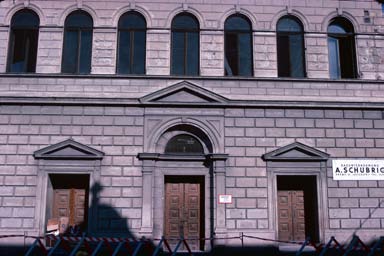
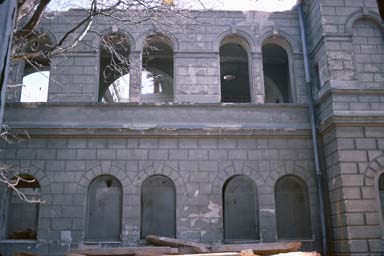
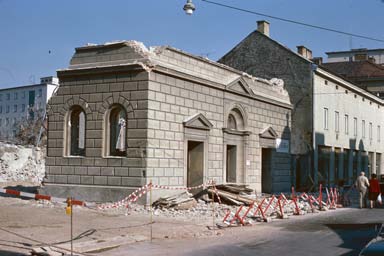
Max Fleischer of Vienna supplied the plans and Josef Utz senior was the builder. Chief Rabbi Moritz Güdemann of Vienna consecrated the synagogue on 25 September 1894 before the district captain, the mayor, judges and army officers; the Catholic clergy declined their invitation. The building cost 58,000 crowns with its furnishings. A local paper complained that it stood 'like a landmark of the town' for every visitor arriving by train. It served the congregation until September 1938, then passed to the Nazi town administration. Returned to the Jewish community of Vienna in 1952 and never used for worship again, it was sold in 1971 and demolished in 1978 for an office and commercial building.
Where it stood for 84 years
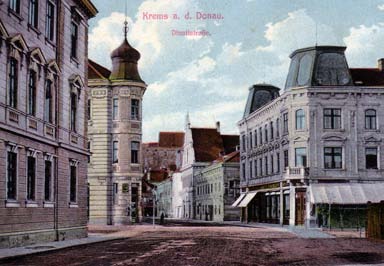
Historic: Dinstlstraße 3 (plot 424/2, EZ 464/465 KG Krems), Krems an der Donau. Today: the 1978 office and commercial building at Dinstlstraße 3, 3500 Krems an der Donau, next to the listed wall tower. Exact (house number).
Open larger map →The Jewish community
Jews had lived in Krems in the Middle Ages, but the modern community dates from the mid-nineteenth century. Its statutes were approved on 19 December 1861, and on 20 January 1862 the members elected three wardens and four councillors. Until 1881 the community's registers were kept by St. Pölten; in that year Rabbi Adolf Hahn was sworn in as registrar. From 1892 the Krems Kultusgemeinde covered the court districts of Gföhl, Krems, Langenlois, Mautern, Pöggstall and Spitz. The Encyclopaedia Judaica gives 179 members in 1869 and 595 in 1880. Rabbi David Weiß served until his death in 1904; the community then shared Rabbi Jakob Diamant with Horn until 1912, and Rabbi Gabriel Meier-Mehrer served from 1912 to 1938. The presidents were Leopold Karpfen, Otto Auspitz, Ignaz Rephan (1919-1924), Otto Auspitz again (1925-1931), Josef Pisker (1932-1936) and Arnold Kerpen (1937-1938). Leopold Weiss became the first Jewish town councillor in 1919. The community shrank after 1918 and could barely pay its rabbi; in 1934 the city had 99 Jews.
Architecture and design
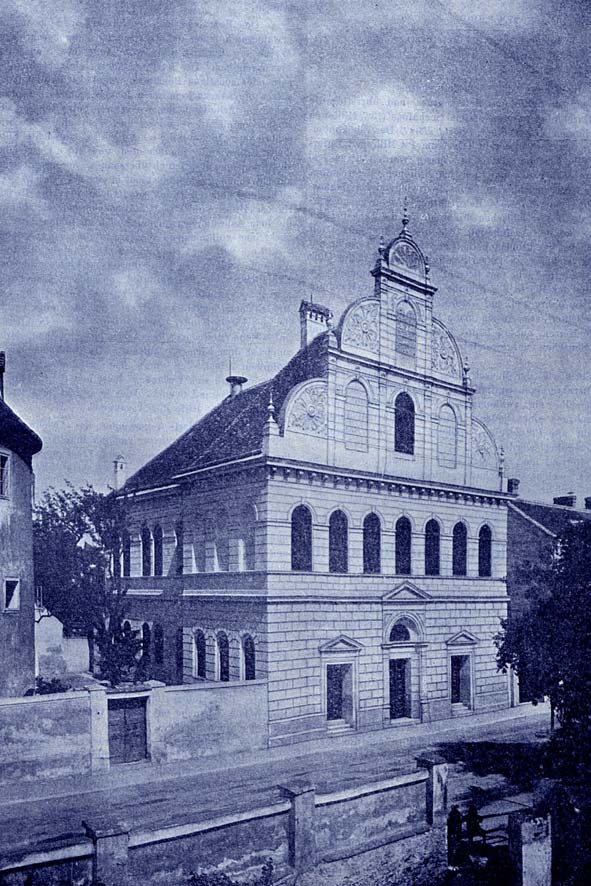
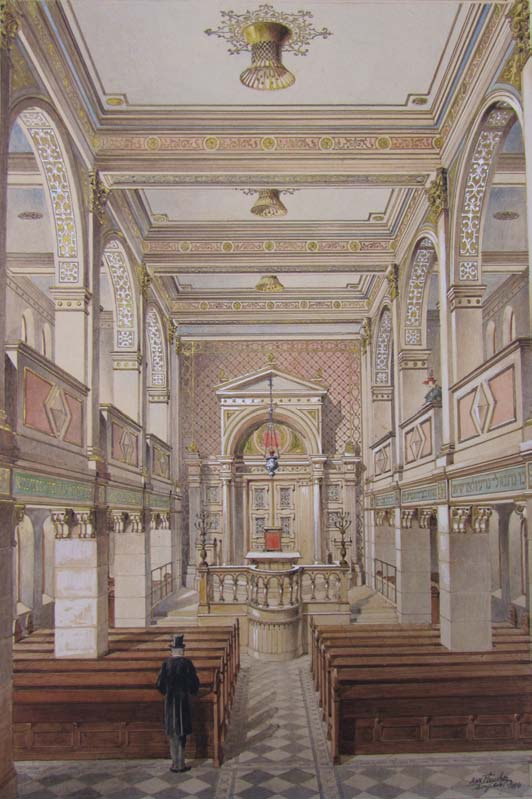
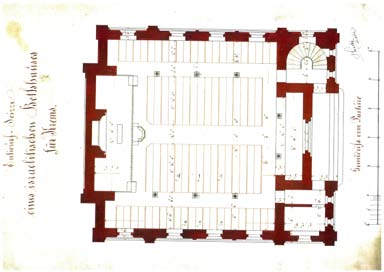
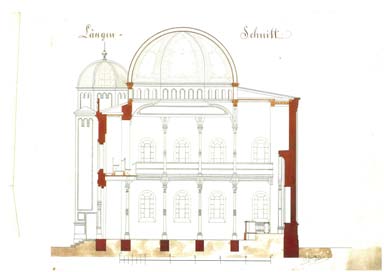
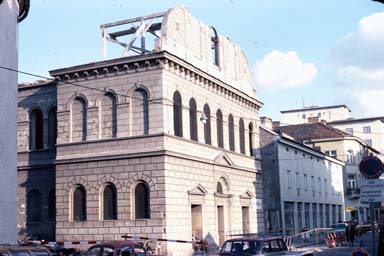
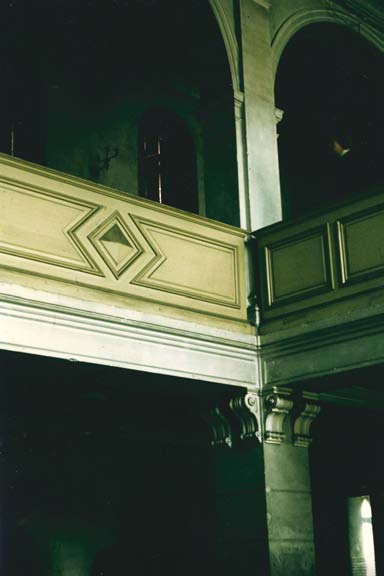
Fleischer, best known for Gothic Revival brick synagogues in Vienna, chose forms of the German Renaissance for Krems. The rendered street front was two storeys high, with three Renaissance portals on the ground floor, rustication imitating ashlar, and seven round-arched windows above. It ended in a three-stepped gable with quarter-circle volutes, stone rosettes, metal urns and, in the middle stage, the two Tablets of the Law in a round-arched niche. This front belonged to a transverse block holding the stairs, an office and a meeting room, set before a rectangular hall. Inside, a gallery on three sides, carried on piers fronted by pilasters with composite capitals, divided the hall into a tall nave and lower aisles in three bays, each lit by a paired window and covered by a stucco-decorated coffered ceiling. The ark and bimah stood together at the east end on a raised platform, following the reformed Vienna rite. The building was of brick on concrete and pile foundations, lit by gas. A newspaper of 1894 counted 220 seats.
Life inside the synagogue
The consecration on 25 September 1894 was a civic occasion. Chief Rabbi Moritz Güdemann recalled the Krems Jews martyred in 1349 and urged the congregation to remain steadfast and united; the president of the Vienna community, Wilhelm von Gutmann, attended. Services followed the moderately reformed Vienna rite. Samuel Neubauer, who came from Veszprém in 1912, was the synagogue's cantor and lived in Schlüsselamtsgasse. Rabbi David Weiß, rabbi in the first decade, was widely respected, and after him the small community shared rabbis with Horn and then employed Rabbi Gabriel Meier-Mehrer. A memoir collected by the historian Robert Streibel says that between the wars the congregation often struggled to gather the ten men needed for a service, yet the synagogue remained the main meeting place of Krems Jews, and children played in a nearby park that locals called the Judenpark. The building also held the community office and meeting room. No photographs of the ark, bimah or pews are known; their appearance is known only from Fleischer's watercolour of the interior.
Destruction
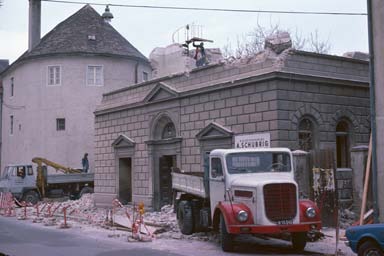
After the Anschluss in March 1938 local Nazis daubed the synagogue with swastikas. Some Nazis wanted it burned, but the SS member Walter Widner, administrator of the Nazi welfare organisation NSV, argued that it should be kept as a store. On 17 and 18 September 1938, under Nazi SA supervision, the Jews of Krems were forced to clear it, hopping on one leg as they carried the furnishings into the street, where a jeering crowd smashed them; the pretext was housing about 70 Sudeten German refugees. On 22 September the community was made to sign the building over to the town. It housed refugees briefly and then served as an NSV store, which is why it escaped the November Pogrom. It was restituted in 1952 but stood unused. In 1971 that community sold it to the KONSUM cooperative of western Lower Austria and the Erste St. Pöltner Dampfbäckerei. The heritage office protected only the medieval tower on the plot. The demolition permit became final at midnight on 10 March 1978, just as the office had begun listing the synagogue; by 11 a.m. the roof had been removed, and demolition continued into April.
The community’s fate
In March 1938 there were 116 Jews in Krems. President Arnold Kerpen was arrested and Paul Rephan took over the community's affairs; its funds were confiscated, Jewish shops were plastered with slogans, and Jews were made to scrub streets and paraded with placards. Nearly all 27 Jewish businesses had been 'Aryanised' by the end of 1938. On 10 November 1938 the Nazi SS-Standarte 52 in Krems was ordered by telephone from Vienna to smash the windows and doors of Jewish homes and businesses; the Encyclopaedia Judaica says 92 remaining Jews then fled to Vienna. By March 1940 only 16 Jews remained, and by the end of 1940 none. Those who could emigrated; the cantor Samuel Neubauer escaped to France, and the Kohn family reached Palestine. Others were forced into crowded flats in Vienna, from where they were deported. According to a summary of Klaus-Dieter Alicke's work, about 130 Krems Jews were murdered. No family returned to live in Krems after the war, and the Jewish community of Vienna took over the property of the dissolved Krems congregation.
The site today
The synagogue stood at Dinstlstraße 3, near the railway station, beside a fifteenth-century tower of the old town wall that is still standing and listed. The office and commercial building erected in 1978 for the new owners occupies the plot; a bank branch was later there, and a gambling or betting business now uses the ground floor. Three original pieces survive in private hands: the Tablets of the Law from the gable, gas lamps and a door sign of the meeting room. A glass plaque of the Jewish community of Vienna, installed in 2016, marks the site. The demolition is still recalled locally as a dark chapter of heritage protection.
Notable names
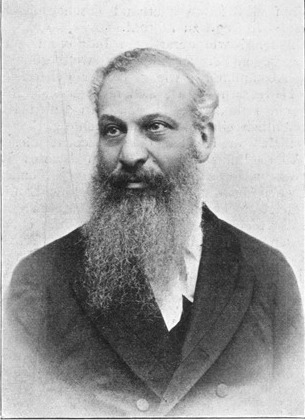
Max Fleischer
1841-1905Architect of the synagogueFleischer, a Viennese architect born in Prossnitz in Moravia, trained under Friedrich von Schmidt and helped build Vienna's City Hall before specialising in synagogues and Jewish tombs. He supplied the plans for the Krems synagogue in 1893, choosing German Renaissance forms rather than the Gothic Revival of his Vienna synagogues, and published the building with a photograph in Der Bautechniker in 1902. His watercolour of the interior, in the Jewish Museum Vienna, is the only view of the furnished hall.
Biography or source →Josef Utz senior
UnknownMaster builder of the synagogueUtz, a Krems master builder, was given charge of construction of the synagogue in 1893-1894, assisted by his son Josef Utz junior. He signed the 1894 revised plans together with Max Fleischer and the community president Leopold Karpfen. These drawings, kept in the Krems building-law archive, are the main documentary record of the building's layout and seating.
Biography or source →Leopold Karpfen
UnknownFirst president (Vorsteher) of the Krems Jewish communityKarpfen was the first president of the Krems Kultusgemeinde and led it while the synagogue was planned and built. As 'Cultusvorsteher' he signed the 1894 building plans with the architect Max Fleischer and the builder Josef Utz senior. His successor Otto Auspitz is recorded from 1913.
Biography or source →David Weiß
died 1904Rabbi of Krems, 1880s/1890s until 1904Dr. David Weiß succeeded Adolf Hahn as rabbi of Krems and served the congregation through the building and first decade of the Dinstlstraße synagogue until his death in 1904. The thesis describes him as universally respected and says his death ended a period of steady development; the community could not afford a rabbi of its own afterwards.
Biography or source →Gabriel Meier-Mehrer
UnknownRabbi of Krems, 1912-1938Dr. Gabriel (Meir Gabriel) Meier-Mehrer, from Vienna, was the last rabbi of the Krems congregation, serving from 1912 until 1938 after Jakob Diamant of Horn. He led worship in the synagogue through its last quarter-century, while the shrinking community struggled to pay his salary.
Biography or source →Samuel Neubauer
UnknownCantor of the synagogue, from 1912Neubauer came to Krems from Veszprém in 1912 and was cantor of the synagogue in Dinstlstraße, living at Schlüsselamtsgasse 4. In September 1938, when the synagogue was cleared, he was to be arrested at home but escaped and fled to France. A memorial tablet for the Neubauer family was later placed in Krems.
Biography or source →Arnold Kerpen
UnknownLast president of the Krems Jewish community, 1937-1938Kerpen was president of the Kultusgemeinde from 1937. He was arrested after the Nazi takeover in March 1938, and Paul Rephan had to take over the community's business, including the forced gift of the synagogue to the town in September 1938. Kerpen is among the people commemorated on the local walking route of Jewish Krems.
Biography or source →Do you have something to contribute?
Photographs, documents, family stories or memories of this synagogue and its community help keep its history alive.
- Die virtuelle Rekonstruktion der Synagoge Krems an der Donau (diploma thesis)
- Der letzte Jude hat den Tempel verlassen (summary)
- Diplomarbeit Alexander (Sam) Ptacek (Jewish memory sites in Krems)
- Kremser Synagoge: ein Denkmal fiel dem 'schnöden Mammon' zum Opfer
- Neues Heft 'Das Waldviertel' mit Beiträgen zur jüdischen Synagoge in Krems
- Krems (Encyclopaedia Judaica)
- Geschichte der Juden in Krems
- Fleischer, Max
- Max Fleischer (Architekt)
- Dinstlstraße 3, Krems an der Donau (OpenStreetMap way 106484782)
Share a memory or thought
No comments yet. Be the first to add one.