
The story of Kroměříž Synagogue
Kroměříž, the Moravian residence town of the bishops of Olomouc, had Jewish residents from the fourteenth century, and for nearly six hundred years its community lived under episcopal protection. In the late seventeenth century it was one of the wealthiest congregations in Moravia and for some years the seat of the Moravian chief rabbi. Its first known synagogue stood on Vodní Street and was demolished in 1656; a second, Baroque synagogue was built inside the walled Jewish quarter in 1689 to 1694 to plans by Giovanni Pietro Tencalla.
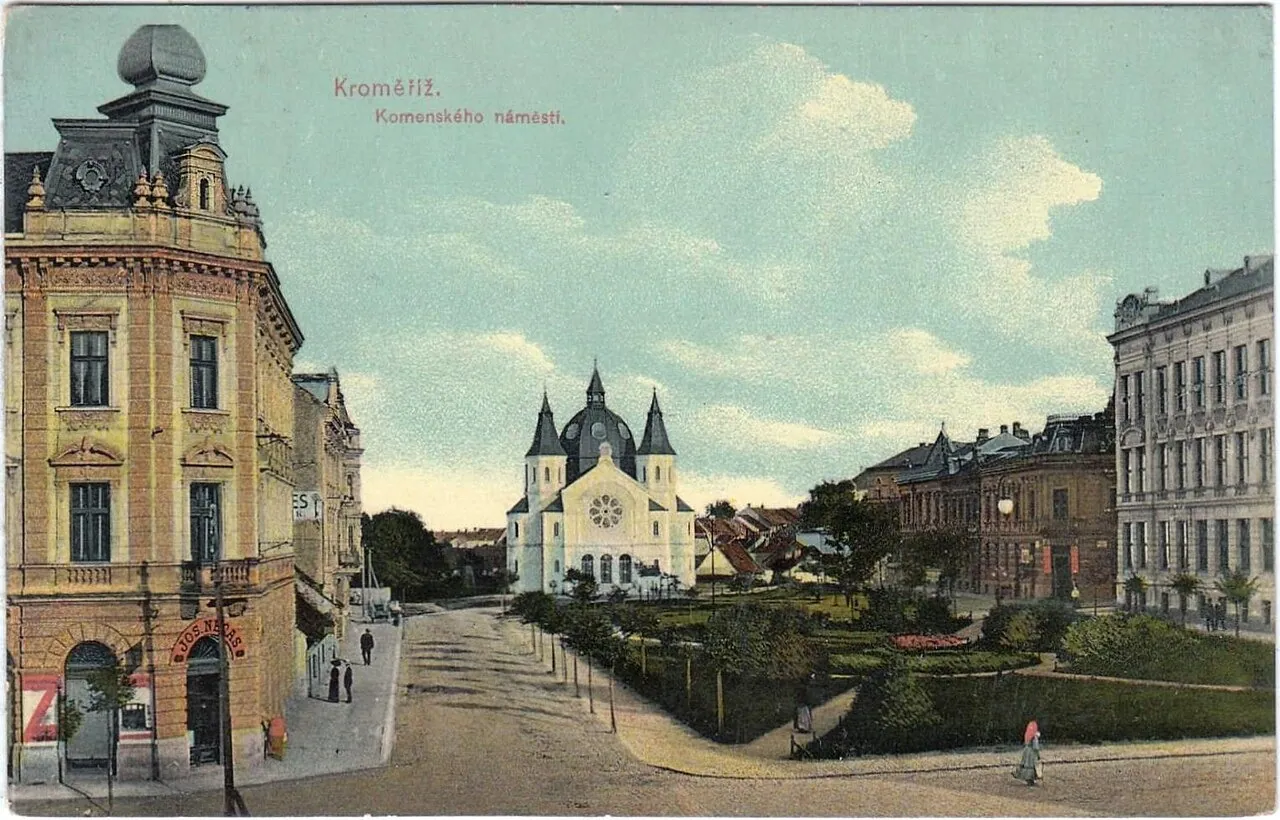
By the end of the nineteenth century the community, though already shrinking, wanted a building that matched its standing. The foundation stone of a new synagogue was laid in December 1908, on the sixtieth anniversary of Emperor Franz Joseph I's accession, on a site outside the old quarter on what is now Komenského náměstí. Felix Skibinský prepared the first design, but the commission went to Jakob Gartner of Vienna, and the builder Ladislav Mesenský put up the building in 1909 and 1910. It was dedicated in 1910 in the presence of representatives of Moravian Jewry. The synagogue served the congregation for little more than thirty years. Nazi German forces looted it and destroyed it with explosives in November 1942, and in 1964 a House of Culture was completed on the site.
Where it stood for 32 years
Historic: Kremsier (Kroměříž), new synagogue on the square then outside the Jewish quarter, today Komenského náměstí; house number unknown. Today: site of the Dům kultury (House of Culture), Komenského náměstí / Tovačovského and Kostnická streets, 767 01 Kroměříž (approximate).
Open larger map →The Jewish community
A royal privilege of 1322 allowed the bishop of Olomouc to keep a Jew in Kroměříž, the first record of Jewish settlement, and a small community with a prayer room probably existed by the early fifteenth century. Jews expelled from Olomouc in 1454 found refuge here. Swedish troops plundered and burned the town and a synagogue in 1642 during the Thirty Years' War, destroying more than thirty Torah scrolls. In 1670 families expelled from Vienna settled under the bishop's protection, and from about 1680 a walled quarter of some 35 houses grew up, with a Jewish town hall built in 1687 and 1688. Rabbis included Menahem Mendel Krochmal (1636 to 1642) and Issachar Berush Eskeles (1710 to 1719). In the eighteenth century the community became poorer and wealthy families left. It numbered 546 people in 1829 and reached its peak of 783 in 1880, about 6.6 per cent of the town. Blood-libel accusations caused unrest in 1889 and 1896. Emigration to the cities then reduced it to 611 in 1900, 392 in 1921 and 382 in 1930, when the synagogue was barely twenty years old.
Architecture and design
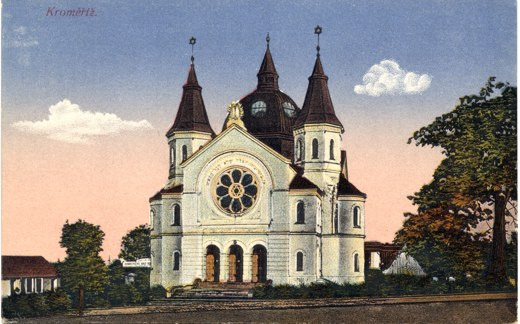
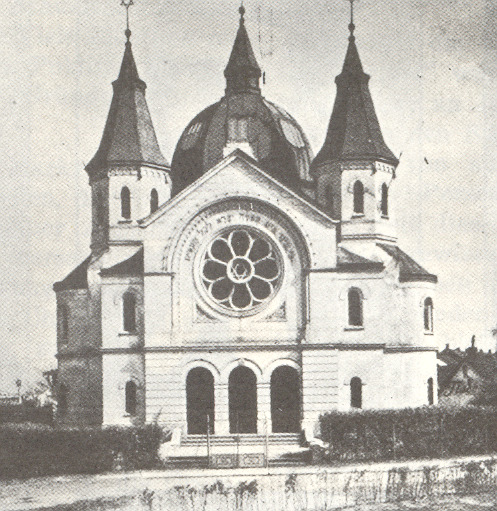
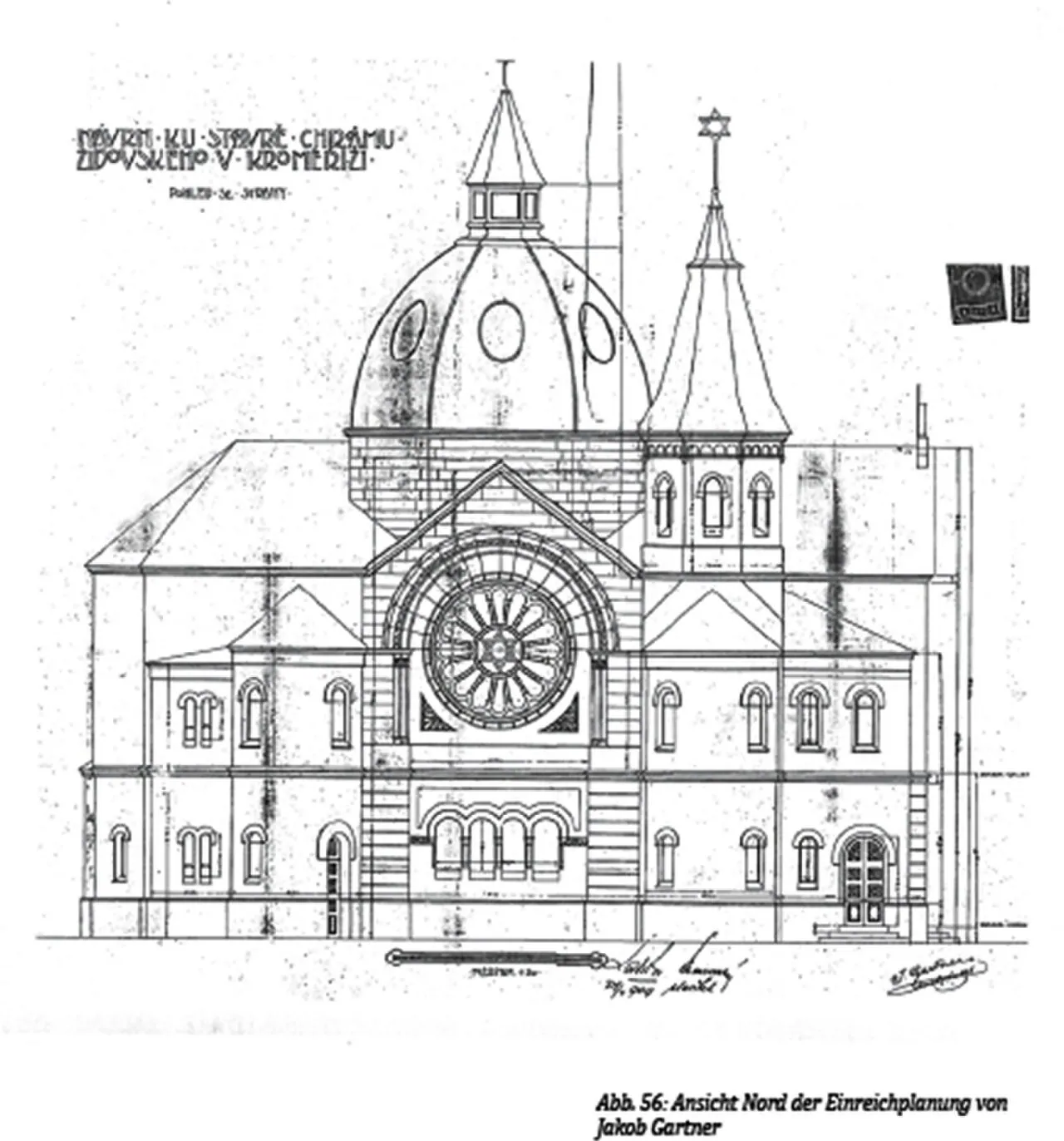
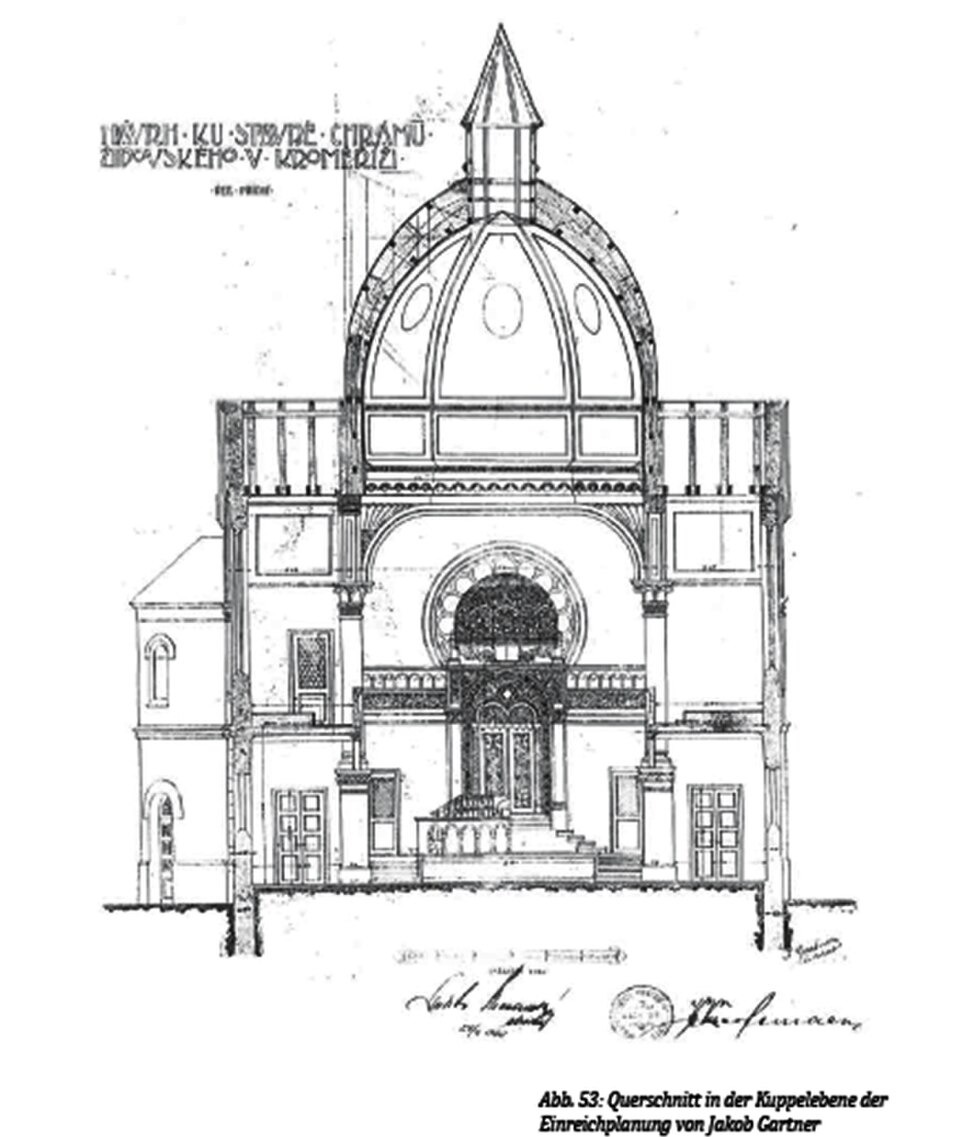
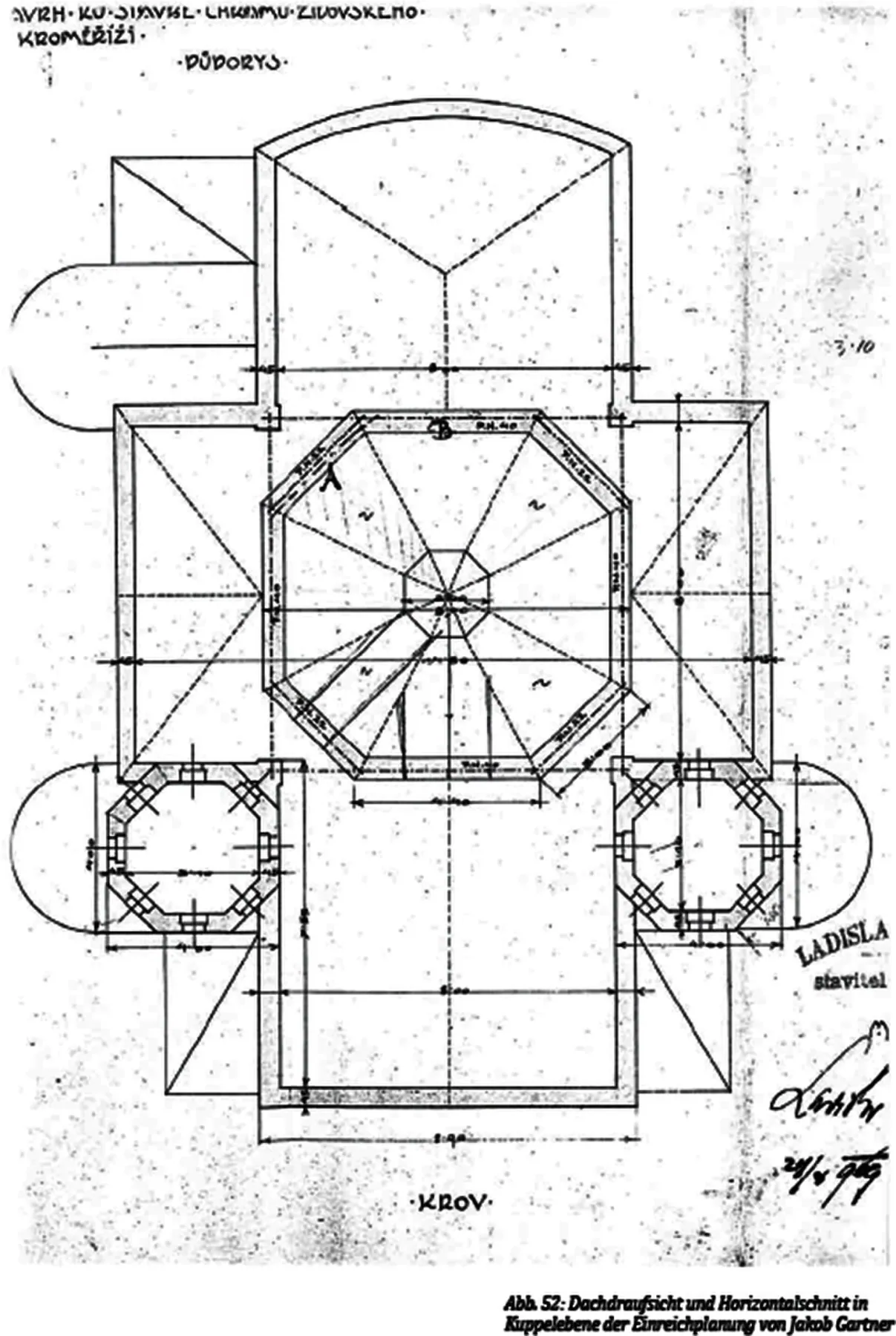
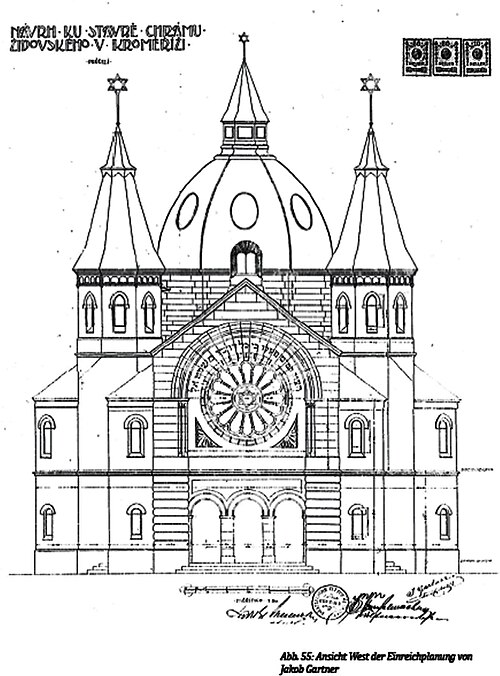
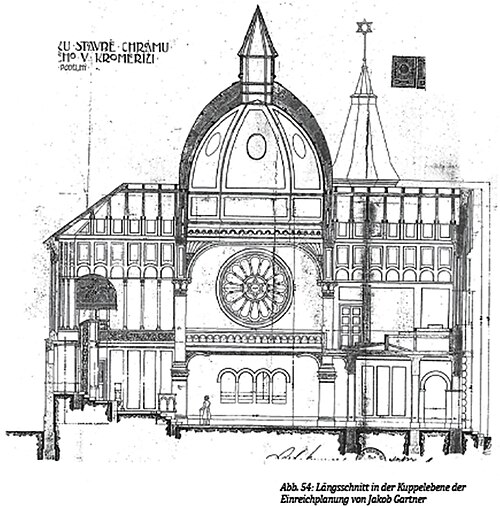
Jakob Gartner, who also designed synagogues in Olomouc, Opava, Holešov, Debrecen and Vienna, gave Kroměříž a free-standing, centrally planned building. Sources describe its style differently: the town's heritage trail calls the façade Neo-Romanesque with an Art Nouveau (Secession) interior, while a local history summary calls it Oriental-Byzantine. Construction was carried out by the builder Ladislav Mesenský under the engineer Friedrich Khünl. Historical views show a rendered entrance front under a broad gable filled by a large rose window with eight petal-shaped lights, framed by a Hebrew inscription. Below it three round-arched doorways open onto a flight of steps. Two slender corner towers with round-arched windows and steep pointed roofs topped by Stars of David flank the gable, and a ribbed dome on a drum, with a small lantern and a third spire, rises over the centre. Lower side wings with round-arched windows extend to each side. Gartner's drawings, including elevations, sections and a ground plan, survive; one cross-section bears revenue stamps and Hebrew inscriptions. The seating capacity and the interior arrangement are unknown.
Life inside the synagogue
Very little has been found about worship in the new building itself. The congregation's best-known modern rabbi, the historian Adolf Frankl-Grün, served from 1877 to 1911, so he led the community through the planning and dedication of the synagogue and into its first year of use. He wrote on the history of the Kroměříž Jews and on theological subjects. Nearly forty rabbis are recorded across the history of the town's synagogues, many of them from abroad. A Talmud Torah school still operated in the early twentieth century, and during the First World War the community helped Jewish refugees from Eastern Europe. The synagogue and the community house had long displayed the coat of arms of the bishop of Olomouc as a sign of the community's protected status. The last rabbi was Joachim Astel, who came from Tachov in 1934 and served until the deportations. After the occupation of 1939 ritual slaughter was banned. The synagogue's furnishings were later taken to the Central Jewish Museum in Prague, which suggests they were removed before the building was destroyed.
Destruction
By 1940 the Kroměříž congregation had practically ceased to function under the anti-Jewish measures of the Nazi German occupation, and the synagogue was earmarked for demolition. After the deportations of June 1942 it stood empty. Its ritual objects and fittings were sent to the Central Jewish Museum in Prague, and the building was then plundered. According to a local history summary, the German occupation authorities ordered it to be blown up with dynamite on 5 November 1942. The director of the State District Archive in Kroměříž has said that the demolition was carried out by a German garrison, which had great difficulty bringing the solid building down and had to repeat the blasting several times. Local residents afterwards carried off building material from the ruins. The Jüdische Gemeinden site states simply that the synagogue was demolished in 1942 on the orders of the German occupying power. The perpetrators were therefore Nazi German forces acting on the orders of the occupation authorities; no Czech body is recorded as taking part.
The community’s fate
After the Nazi German occupation of Bohemia and Moravia in March 1939 the Jews of Kroměříž were subjected to the Protectorate's anti-Jewish laws, although, according to the Encyclopaedia Judaica, the Czech population paid little attention to the measures of 1940. About 350 Jews were living in the town in the mid-1930s. At the end of June 1942 almost all who remained were deported. The sources read do not give the route or first destination of the transport. The last rabbi, Joachim Astel, is recorded as having died in Auschwitz in 1942. Between 259 and 268 Jews from Kroměříž were murdered in the Holocaust, depending on the source, among them entire families; memorial stones (Stolpersteine) for members of the Presser, Loff and Herz families have been laid in the town. After the war a tiny community was re-established and affiliated with Kyjov; it later became a small congregation of believers and ceased to exist after 1980. A memorial of 1962 at the last Jewish cemetery on Velehradská Street honours about 300 Jewish victims from the region.
The site today
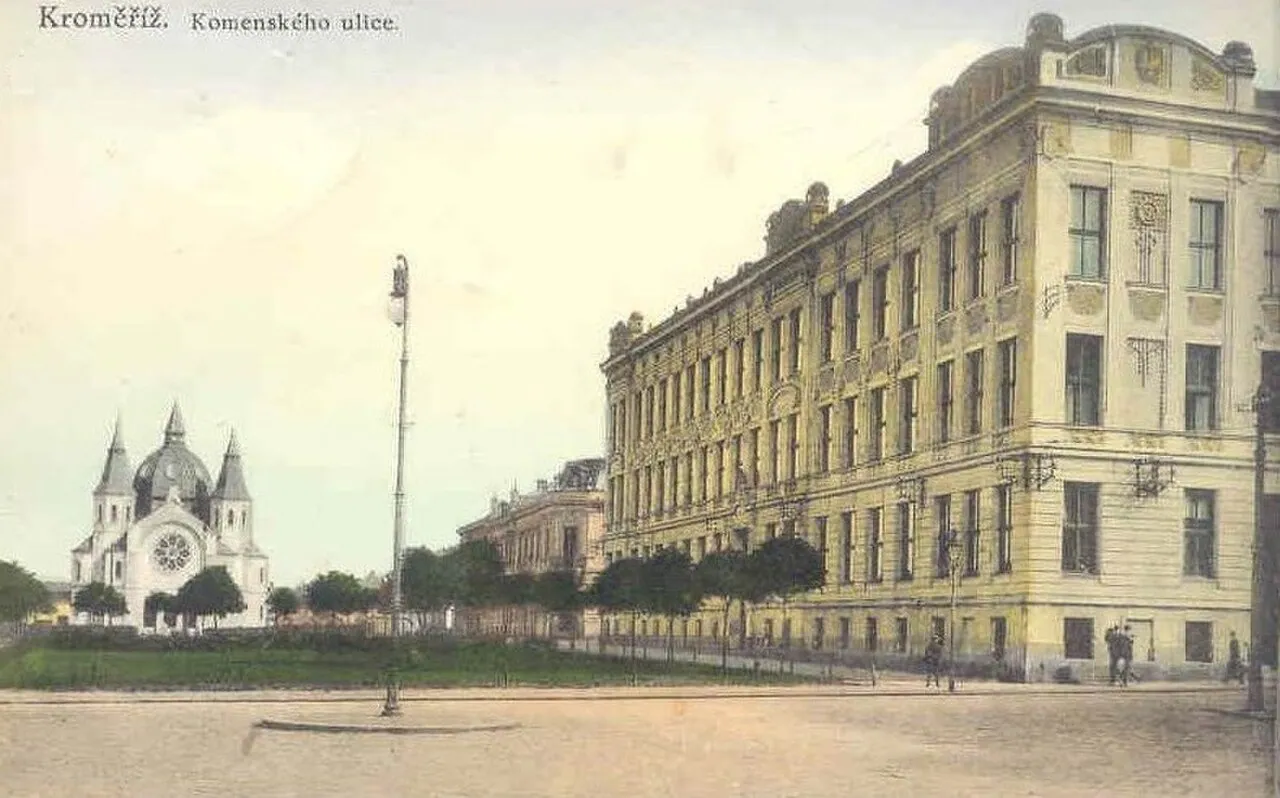
The synagogue stood on today's Komenského náměstí, near Tovačovského Street, outside the former Jewish quarter. The site is occupied by the Kroměříž House of Culture (Dům kultury), completed in 1964 under the Communist-era Action Z (Akce Z) building programme. No part of the synagogue survives above ground. In 2016 a large printed image of the synagogue was hung on the front of the House of Culture during its reconstruction, and in 2022 the town displayed a large model of the building. A memorial sculpture by Olbram Zoubek, a mourning woman facing the spot where the synagogue stood, was unveiled nearby in 1994. Much of the old Jewish quarter around Moravcova Street survives, including the Jewish town hall at No. 259 and part of the ghetto wall.
Notable names
Jakob Gartner
UnknownArchitect of the synagogue (1908-1910)Gartner, a Vienna-based architect who designed synagogues across the Habsburg lands, including Olomouc, Opava, Holešov and Debrecen, received the Kroměříž commission after a first design by Felix Skibinský was set aside. His building, raised in 1909 and 1910 by the builder Ladislav Mesenský, combined a Neo-Romanesque rose-windowed front with towers and a central dome. His elevations, sections and ground plan for the synagogue survive.
Biography or source →Adolf Frankl-Grün
1847-1916Rabbi of Kroměříž, 1877-1911Frankl-Grün served the Kroměříž congregation for 34 years and is described as its most significant modern rabbi. A historian as well as a rabbi, he wrote on the history of the town's Jews and on theological subjects. His tenure covered the decision to build a new synagogue, its construction from 1908 and its dedication in 1910, so he led the congregation during the building's first year of use before leaving office in 1911.
Biography or source →Joachim Astel
died 1942Last rabbi of Kroměříž, 1934-1942Astel came to Kroměříž in 1934 from Tachov in western Bohemia and was the congregation's last rabbi, serving in the Gartner synagogue through the years of the Nazi German occupation, when the community was stripped of its rights and the building was earmarked for demolition. He was deported with the town's Jews in 1942 and, according to the local history summary, died in Auschwitz that year.
Biography or source →Ladislav Mesenský
UnknownBuilder of the synagogue (1909-1910)Mesenský was the building contractor who constructed the synagogue in 1909 and 1910 to Jakob Gartner's design, working under the engineer Friedrich Khünl, according to the State District Archive as reported by Archiweb and a local history summary. Nothing further about his life was found in the sources read, but he was responsible for the building that German forces later found so solid that the blasting had to be repeated several times in 1942.
Biography or source →Do you have something to contribute?
Photographs, documents, family stories or memories of this synagogue and its community help keep its history alive.
- Kremsier (Mähren)
- Synagoge (Kroměříž)
- Lidé si v Kroměříži mohou prohlédnout velký model zničené synagogy
- 9th Stop – Tovačovského Street and Komenského Square
- V Kroměříži je k vidění synagoga, kterou za války zbořili nacisté
- Kroměříž synagogues (geocache GC3VYJ4 history text)
- Kromeriz (from the Encyclopaedia Judaica, 2007)
- Dům kultury, Kroměříž (OpenStreetMap way 30588541)
- Category:Synagogue of Kremsier/Kroměříž
Share a memory or thought
No comments yet. Be the first to add one.