


The story of Künzelsau Synagogue
The Künzelsau synagogue was the only purpose-built house of worship of the town's modern Jewish community, which formed after Jews began settling there again in the 1850s. For decades local Jews attended the older synagogue in nearby Nagelsberg. In 1903 the community leader Gustav Ledermann began the project for a synagogue in Künzelsau itself.
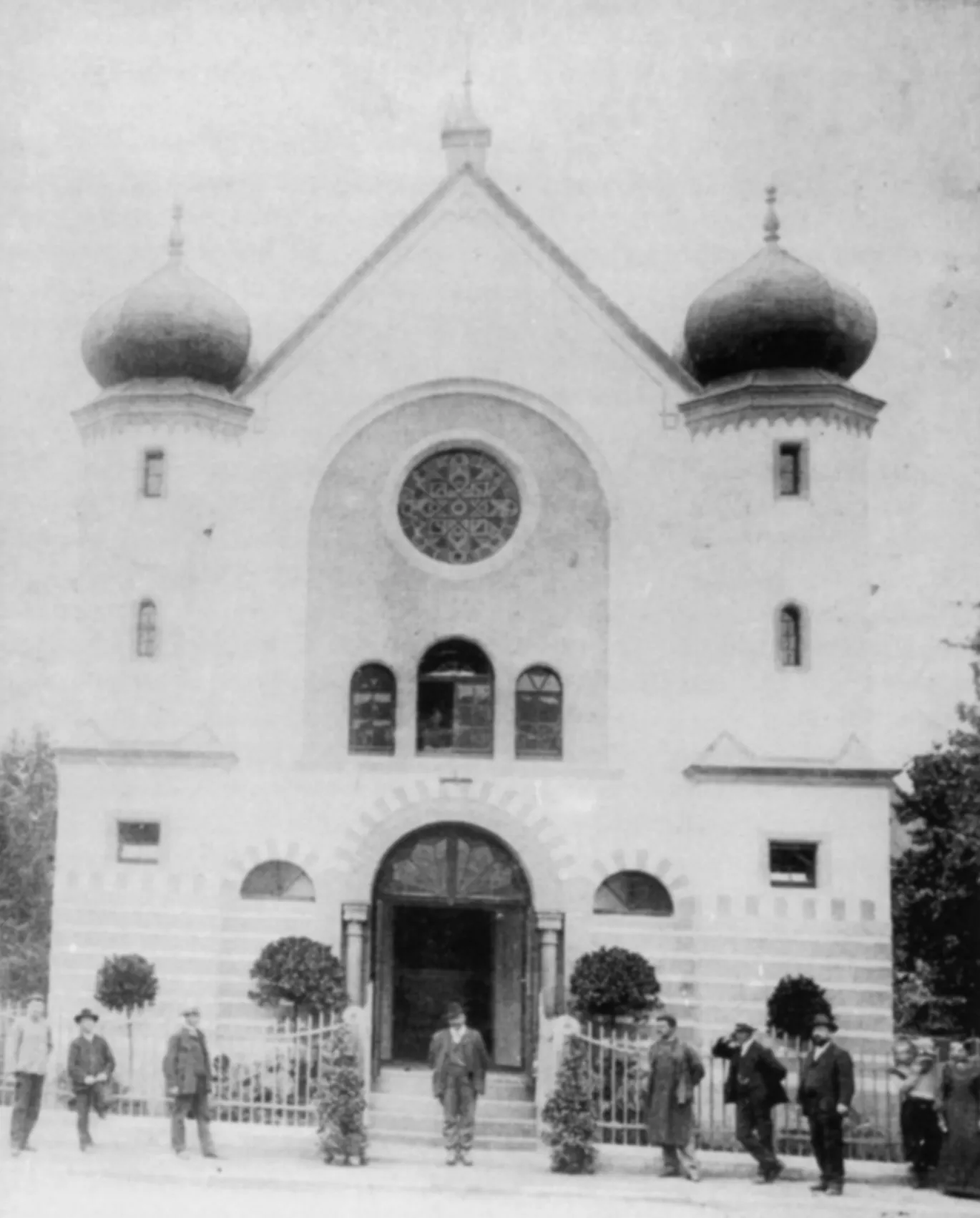
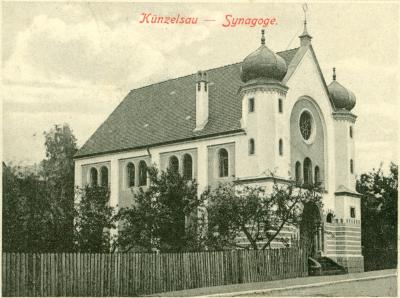
Construction started in June 1906 to designs by the architect August Ganzenmüller and finished in August 1907. The building was dedicated on 30 August 1907 with a formal procession through streets decorated with flags, attended by town officials. With its two domed corner towers, it was a prominent Moorish Revival building in the town's Kanzleistraße, now Konsul-Uebele-Straße.
The synagogue was in use for only thirty-one years. Sources note that it was burned during the November pogrom later than most synagogues, on the late evening of 10 November 1938, by Nazis in civilian clothes who poured petrol inside. The town cleared the ruins, charged the Jewish community for the demolition, and bought the plot in 1939.
A memorial stele has marked the site since 1986.
Where it stood for 31 years
Historic: Kanzleistraße, Künzelsau (the street was later renamed; exact historic house number not verified). Present: Konsul-Uebele-Straße, where the memorial stele stands at no. 20, 74653 Künzelsau. The location is approximate at street level.
Open larger map →The Jewish community
Jews lived in medieval Künzelsau but were killed in the Rintfleisch persecution of 1298. A later settlement from around 1550 was ended by expulsions in the late 16th century.
The modern community grew after 1850, when Jewish families moved into the town from the surrounding rural 'Jewish villages' of Hohenlohe. There were 30 Jews in 1869 and a peak of about 119 in 1880, some 4 percent of the population.
For many years the Künzelsau Jews belonged to the synagogue community of nearby Nagelsberg, whose synagogue dated from 1789. As the town community grew and Nagelsberg's declined, the Künzelsau Jews pressed for a synagogue of their own. Under Gustav Ledermann the project was launched in 1903, and the community later became independent of Nagelsberg.
Architecture and design
August Ganzenmüller designed the synagogue in the Moorish Revival style that was widely used for German synagogues at the time. According to German Wikipedia, the building measured about 15 by 10 metres. Its most distinctive features were the two corner towers facing the street, each topped by an onion dome clad in copper. The right-hand tower held the staircase to the women's gallery, and the left-hand tower held other facilities.
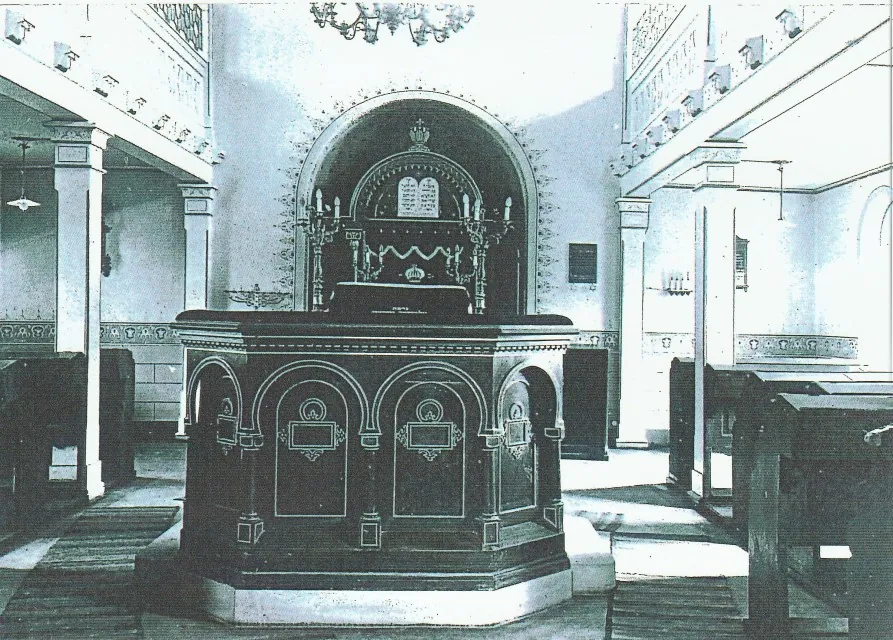
A vestibule led into the prayer hall. The ground floor had seats for 57 men and 14 children, and a women's gallery above had 69 seats. A meeting room was also part of the building. Alemannia Judaica gives the total capacity as about 200 worshippers, which may count standing room as well as seats.
The materials, the interior decoration and the design of the Torah ark have not been verified.
Life inside the synagogue
The synagogue served a small community of roughly 65 to 120 people. Its religious life centred on the community's paid religious teacher, who also acted as prayer leader and ritual slaughterer and taught Hebrew to the children.
Selig Wißmann held this post from 1892 until his death in 1927, so he led services in the new building for its first twenty years. His successor was appointed in 1928. Alemannia Judaica names him Julius Goldstein, while LEO-BW calls him Julius Goldmann in its account of the assaults of March 1933.
The dedication in August 1907 was a public event, with a procession, flag-decked streets and the participation of town officials. This suggests the community was well integrated in the town before 1933. Other information about festivals, societies or the building's rite has not been verified.
Destruction
Persecution in Künzelsau began early. On 20 March 1933, Nazis and police searched Jewish homes for weapons. The religious teacher was badly beaten, the merchant Max Ledermann died of shock, and David Furchheimer took his own life.
During the November pogrom of 1938 the synagogue was attacked later than most in Germany. On the late evening of 10 November 1938, Nazis in civilian clothes from Künzelsau and Heilbronn poured petrol into the building and set it alight. LEO-BW records that they stopped the fire brigade from intervening. Jewish men from the town were arrested and sent to the Dachau concentration camp.
The burnt-out ruin was then demolished. The town charged the Jewish community 1,910.05 Reichsmarks for clearing the rubble and acquired the plot; German Wikipedia dates the purchase to December 1939.
The community’s fate
About 65 Jews lived in Künzelsau in 1933. Under growing boycotts, violence and the 1938 pogrom, most emigrated or moved to larger cities. The Jewish community of Künzelsau was officially dissolved on 12 July 1939.
Those who remained, or who had moved elsewhere in Germany, were caught up in the deportations of 1941 and 1942 to Riga, to Izbica in the Lublin district, and to Theresienstadt. LEO-BW counts nineteen people who were living in Künzelsau before 1933, plus two later arrivals, among those deported. Jüdische Gemeinden gives about forty Künzelsau Jews as victims of Nazi persecution. According to LEO-BW, only one Jewish resident, protected by a mixed marriage, survived in the town itself.
No Jewish community was re-established after the war. Stolpersteine have been laid since 2015, with about seventy in place by 2020.
The site today
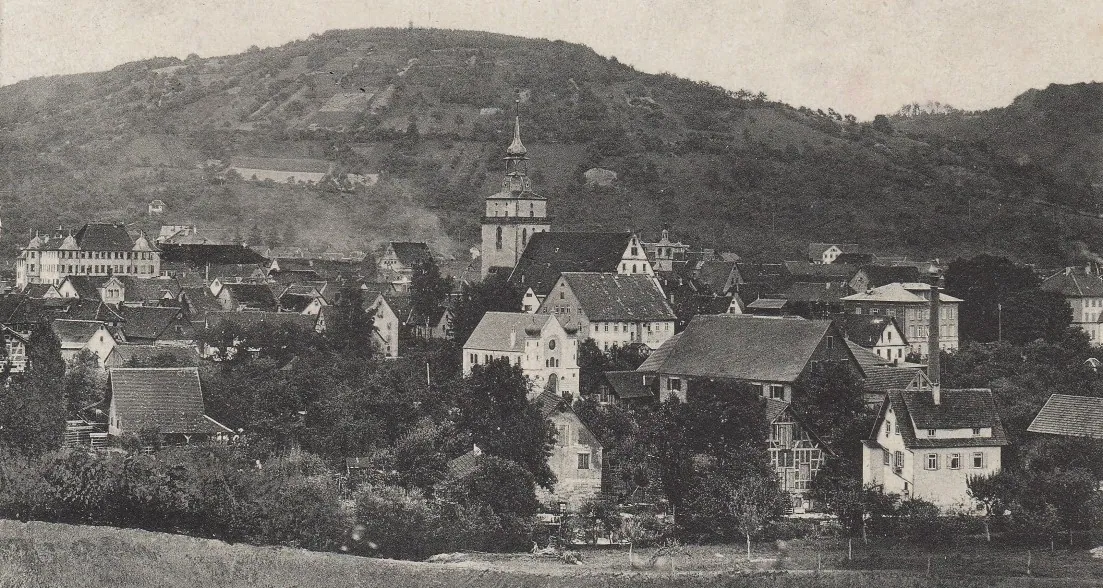
Nothing of the synagogue survives. The town bought the plot in 1939, after the ruins had been cleared. The site lies on Konsul-Uebele-Straße, formerly Kanzleistraße, in the centre of Künzelsau.
A memorial stele for the synagogue and the Jewish community was dedicated on 26 June 1986 at Konsul-Uebele-Straße 20. Since 2015, Stolpersteine for Künzelsau's Jewish residents have been laid across the town.
What currently occupies the exact footprint (a building, open space or a road) has not been verified from the sources checked.
Notable names
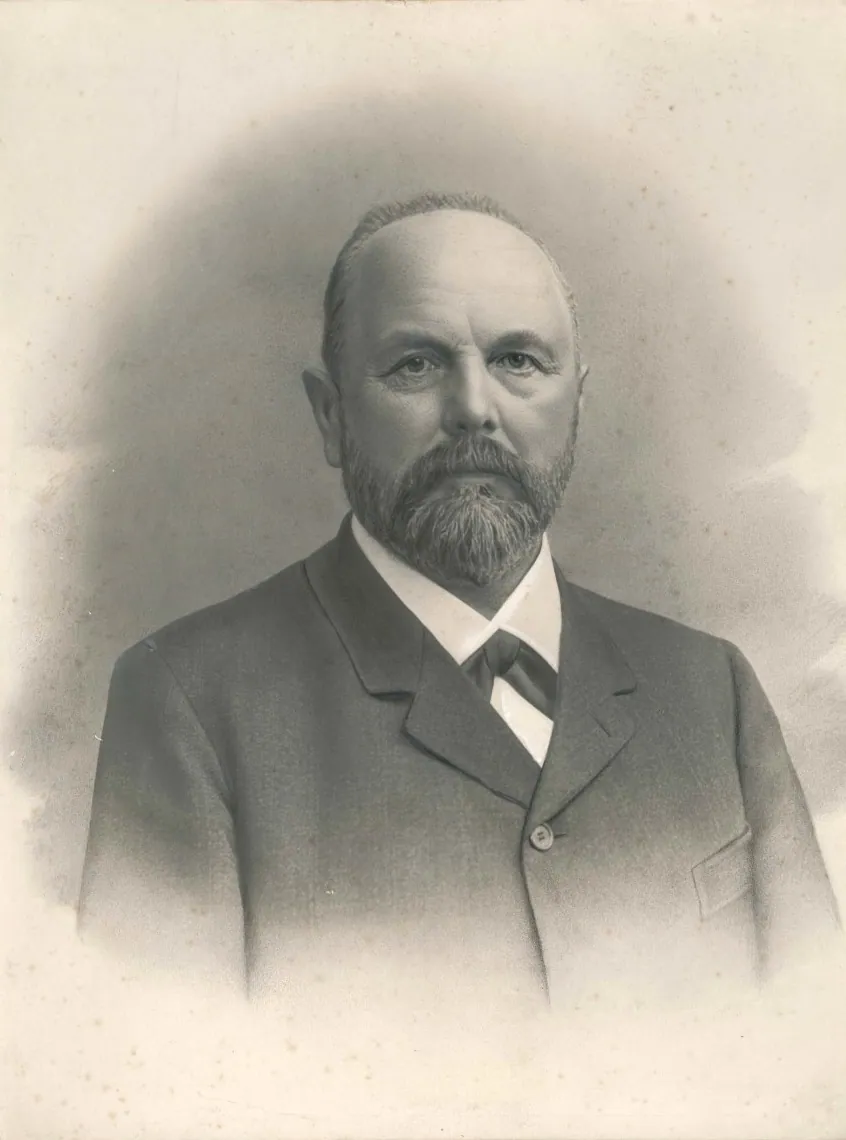
August Ganzenmüller
1847–1933ArchitectAugust Ganzenmüller, Oberamtsbaumeister (district master builder) of Künzelsau from 1877 to 1907, designed the town synagogue, built from June 1906 to August 1907 in the Moorish Revival style with two onion-domed corner towers. His signed plans of March 1906 survive. Born in Weinsberg in 1847, he designed many public, church and private buildings in the district and died in Künzelsau in 1933.
Biography or source →Gustav Ledermann
Dates unknownCommunity leader (Vorsteher) who initiated the synagogueAs leader of the Künzelsau Jewish community, Gustav Ledermann began the effort in 1903 to build a synagogue in the town itself, replacing the community's reliance on the Nagelsberg synagogue. The building was completed in 1907. His life dates and his relationship to Max Ledermann, a victim of the violence of March 1933, have not been verified.
Biography or source →Selig Wißmann
died 1927Religious teacher, prayer leader and ritual slaughterer, 1892–1927Selig Wißmann served the Künzelsau community as religious teacher from 1892 until his death in 1927. He taught Hebrew, led services and acted as ritual slaughterer, and so led worship in the new synagogue for its first twenty years. His birth date has not been verified.
Biography or source →Do you have something to contribute?
Photographs, documents, family stories or memories of this synagogue and its community help keep its history alive.
- Die Synagoge in Künzelsau (Hohenlohekreis)
- Synagoge (Künzelsau)
- Künzelsau – Jüdisches Leben im Südwesten
- Künzelsau/Kocher (Baden-Württemberg)
- August Ganzenmüller, Oberamtsbaumeister (Stadtgeschichte Künzelsau von A–Z)
- Synagoge (Stadtgeschichte Künzelsau von A–Z)
- OpenStreetMap node 5899338213 (Gedenkstein Synagoge Künzelsau)
Share a memory or thought
No comments yet. Be the first to add one.