
История Kynšperk nad Ohří Synagogue
Kynšperk nad Ohří, known in German as Königsberg an der Eger, is a small town on the Ohře (Eger) river between Cheb and Sokolov in the Karlovy Vary region. Jews lived there from the first half of the fourteenth century, and in the spring of 1350 refugees from a pogrom in nearby Cheb (Eger) joined them, so the community counts among the oldest in Bohemia. The town had a Judengasse, today's Bezručova ulice, whose small gate on to Dlouhá ulice still stands, and a Jewish cemetery laid out after the Thirty Years' War in the moat below the old castle rampart.
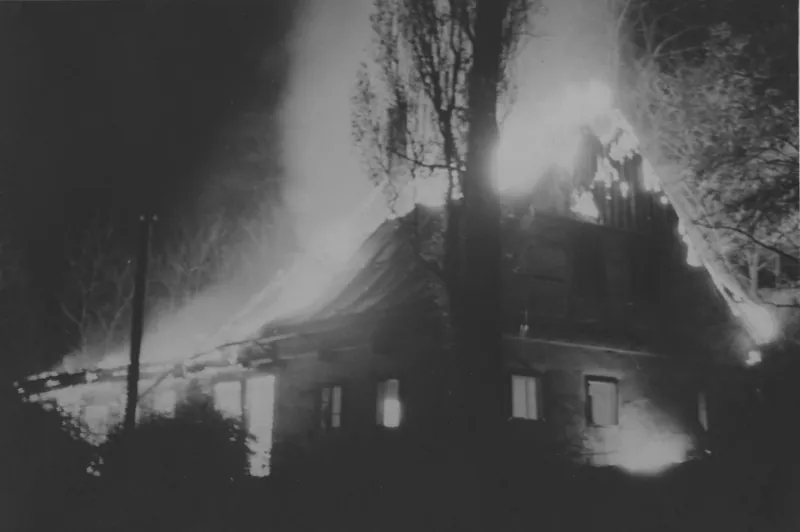
According to the Jüdische Gemeinden website, the community built a wooden synagogue in 1803 and used it until the late 1920s; JewishGen's Cemetery Discovery Project says it was in use until 1930. By then fewer than thirty Jews remained and they had joined the congregation of Eger. The empty building was set alight during the November Pogrom of 1938, a few weeks after the Sudetenland was annexed to Nazi Germany. A photograph of the fire is held by the Jewish Museum in Prague. The building's exact site, its later fate and the present use of the plot are not recorded in the sources read.
Where it stood for 135 years
Historic: Königsberg an der Eger (Kynšperk nad Ohří), Bohemia; street and house number unknown. Today: unknown; placeholder pin at the centre of Kynšperk nad Ohří, Sokolov district, Karlovy Vary region (approximate).
Открыть большую карту →Еврейская община
Jews are recorded in Königsberg from the first half of the fourteenth century, and the community was reinforced in 1350 by refugees fleeing a pogrom in Eger; some historians regard those refugees as its founders. Vojtěch Wagner's 2017 study of the town's history describes the settlement as continuous until the Second World War. The earliest count, from 1570, names six men over the age of ten; six families lived there at the start of the Thirty Years' War and fourteen in 1793. The community reached its peak in the mid-nineteenth century, with about 160 people (162 in 1859 according to JewishGen). After 1860 families left for larger towns with better prospects: around 1880 there were about 120 Jews in 18 families, and by 1930 only 27. The Jews lived around the Judengasse, now Bezručova ulice, and buried their dead in a cemetery in the castle moat whose oldest surviving stone dates from 1605. A history of the Jews of Königsberg compiled by Karl Lederer was published in 1934.
Архитектура и дизайн
Almost nothing is documented about the building. The Jüdische Gemeinden website calls it a wooden synagogue (Holzsynagoge) built in 1803; no architect, builder, capacity or plan is recorded in the sources read. The only image found is the night photograph of the fire in November 1938. It shows a free-standing, two-storey building of domestic appearance with a steep pitched roof, plain rendered walls and small rectangular windows set in regular rows, standing among tall trees. Flames are breaking through the roof and the gable end, and fire glows behind the ground-floor windows; a utility pole stands in front. The rendered walls seen in the photograph may cover a timber frame, which would agree with the description of a wooden synagogue, but this cannot be confirmed from the picture. No exterior view in daylight, no interior view and no description of the ark, bimah or women's gallery was found, so the style and furnishing of the building remain unknown.
Жизнь в синагоге
Very little is recorded about worship in the building. The congregation had its own rabbi for most of the nineteenth century; the last, Jacob Beer, took office in 1888. As families moved away after 1860 the community became too small to support regular services. The synagogue was used until the late 1920s, or until 1930 according to JewishGen, and by the early 1930s the fewer than thirty remaining Jews belonged to the congregation of Eger (Cheb). The cemetery on the castle hill remained in use for the community. No list of officers, cantors or teachers, no record of the community's school and no account of festivals or ritual life in the building was found in the sources read. Karl Lederer's 1934 history of the Jews of Königsberg, cited by Jüdische Gemeinden, probably contains such detail but could not be consulted.
Разрушение
By 1938 the synagogue had stood unused for about a decade. After the Munich Agreement, Nazi Germany occupied the Sudetenland in October 1938, and Kynšperk became part of the Reich. During the Nazi November Pogrom that followed, the empty synagogue was set on fire and its interior destroyed, according to the Jüdische Gemeinden website; the Jewish cemetery was badly damaged at the same time. The Jewish Museum in Prague's guide to the pogrom in the border regions says the burning of synagogues there was carried out by small, mostly organised groups of Nazis while most Sudeten Germans looked on; the individual arsonists at Kynšperk are not named in any source read. A photograph in the Jewish Museum's collection shows the building burning at night, with the roof ablaze. The museum's catalogue dates it 19 November, a date that may be a cataloguing error for 9 or 10 November. Whether the burnt shell was later pulled down, and by whom, is not recorded.
Судьба общины
By the early 1930s fewer than thirty Jews lived in Königsberg, and in 1930 JewishGen counts 27. What happened to them after the Nazi annexation of the Sudetenland in October 1938 is not documented in the sources read: whether they fled to the interior of Czechoslovakia, emigrated or were later deported is unknown, and no list of victims from the town was found. One known life shows the path of many: the painter and graphic artist Fritz Lederer, born in Königsberg in 1878, had lived in Prague since the 1930s. He was deported to the Theresienstadt ghetto in the summer of 1944, survived and made a series of 24 woodcuts about the camp. After the war he kept a studio in the old Jewish gate house in Kynšperk until 1949. He died in Cheb in 1949 and his was the last burial in the town's Jewish cemetery. No Jewish community was re-established afterwards.
Место сегодня
No source read gives the address of the synagogue or says what stands on its plot today, so the site cannot be identified, and the map pin marks only the centre of the town. The Jewish cemetery survives in the former castle moat below the rampart on Zámecký vrch, with about 170 gravestones and fragments; after decades of neglect the town has been restoring stones since 2005. A former Jewish house also still stands, and the small gate at the end of the old Judengasse, now Bezručova ulice, survives as house no. 87. Locating the synagogue will need old cadastral maps or Karl Lederer's 1934 history.
Значимые имена
Jacob Beer
UnknownRabbi of Königsberg an der Eger from 1888, the community's last rabbiJacob Beer took up the rabbinate of Königsberg in 1888 and is named by the Jüdische Gemeinden website as the last rabbi of the community. He served the congregation while it was shrinking fast, as families left for larger towns, and the wooden synagogue of 1803 was his place of worship. Nothing further about his life, the length of his tenure or his fate was found in the sources read.
Биография или источник →Вам есть чем поделиться?
Фотографии, документы, семейные истории и воспоминания об этой синагоге и её общине помогают сохранить её историю.
- Liste der zerstörten Synagogen in den vom Deutschen Reich 1938 bis 1945 besetzten Gebieten
- Königsberg/Eger (Böhmen)
- Hořící synagoga v Kynšperku nad Ohří (Archiv holocaustu, Fotosbírka, I/23/11)
- Kynšperk nad Ohří (Cemetery Discovery Project, kf88)
- Historická naučná stezka v regionu Kynšperk nad Ohří a její didaktické využití
- Křišťálová noc (teaching material)
- Kynšperk nad Ohří (OpenStreetMap relation 439548)
Share a memory or thought
No comments yet. Be the first to add one.