

La historia de Lackenbach Synagogue
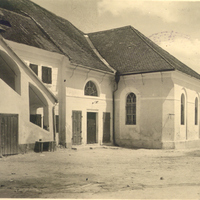
Lackenbach, known in Hungarian as Lakompak, lies in central Burgenland and belonged to the Kingdom of Hungary until 1921. Its Jewish community was one of the Sheva Kehillot, the Seven Communities under the protection of the Esterházy princes, and in the mid-nineteenth century Jews made up about two thirds of the village. The community always had a single synagogue and a single rabbi. An essay on the Austria-Forum estimates that the first synagogue was built about 450 years ago, around 1560 to 1570; the ANU Museum of the Jewish People gives 1582 as the year the community and its synagogue were established. After the expulsion of 1671 and the return of the Jews, the synagogue was rebuilt with the support of the Viennese court Jew Samson Wertheimer. Photographs show a plain rendered hall with a steep tiled roof, standing on one side of a paved yard with a roofed well, reached from Tempelgasse; inside, a vaulted and painted prayer hall held brass chandeliers, a railed bimah and a richly framed Torah ark. Rabbis of standing served here, among them three generations of the Ullmann family between 1809 and 1901. The congregation was driven out in 1938. Sources disagree about when the building was destroyed: one gives Kristallnacht, 10 November 1938, another says the Nazis blew it up on 20 February 1941. A memorial stone marks the site.
Where it stood for nearly 270 years
Historic: synagogue yard off Tempelgasse, Jewish quarter, Lackenbach (Lakompak), Kingdom of Hungary; house number unknown. Today: site marked by a memorial stone in central Lackenbach, 7322 Lackenbach, Bezirk Oberpullendorf, Burgenland (approximate; pin is the village centre).
Abrir mapa ampliado →La comunidad judía
A Jew is first recorded in Lackenbach in documents of 1552, probably after the expulsion of the Jews from Sopron, and the community grew with refugees from Styria, Sopron and, after 1670-71, from Vienna, when Prince Paul Esterházy took in Jews expelled by Leopold I. Lackenbach became one of the Seven Communities of the Esterházy lands. In 1735 there were 103 families with 449 people; by 1857 the community had reached its largest size, 1,155 souls, and in 1851 about 1,200 of the village's 1,800 inhabitants were Jews. The richest merchants came from the Hacker family, and Lackenbach Jews traded with Lower Austria, Styria and Sopron. Emigration from the 1860s reduced the numbers to 395 in 1920 and 346 or 347 in 1934, about a fifth of the population. The community kept a mikveh, a Jewish school, a burial society and the Zedokoh association, which administered the synagogue, appointed its officials and cared for visiting strangers. Its cemetery, used from 1729, has about 1,770 gravestones and is the largest Jewish cemetery in Burgenland.
Arquitectura y diseño
No plans or written description of the building were found, and its architect, builder and capacity are unknown. Three photographs show its appearance before 1938. From the yard, the synagogue was a free-standing rendered hall under a steep hipped roof of plain tiles. The front facing the yard had a round-headed doorway with a semicircular fanlight above it and an arched window; the side wall had tall round-headed windows. A two-storey house adjoined it on the left, with an arcaded external staircase. A photograph of 1931 shows the yard in front, with a well under a pyramidal roof on posts. The interior was a vaulted hall whose ceiling was decorated with painted ornament and round medallions. Several large brass chandeliers with many arms hung from the vault. The Torah ark stood in a recess framed by columns and was hung with a dark curtain, flanked by standing candelabra. In front of it was a bimah enclosed by a metal railing, and the hall was filled with dark wooden pews. The surviving fabric in the photographs probably reflects the rebuilding after 1671, but no source dates the details.
La vida dentro de la sinagoga
The Lackenbach rabbinate was a seat of learning. Shlomo Zalman Lifshitz, who came from Poland and served from about 1789 to 1809, drew students from Hungary and Poland to the Lackenbach yeshiva. Shalom Ullmann, known as Shalom Charif, author of Divrei Rash, followed him from 1809; his son Abraham served from 1825 to 1846, and his grandson David Ullmann led the congregation for 55 years until his death in 1901. Yehuda Hacohen Kraus was rabbi from 1902 until 1935, when he emigrated to Jerusalem, and his son-in-law Meir Chaim Ungar, nominated by 46 members, was the last rabbi, from 1935 to 1938. The Zedokoh association ran the synagogue's affairs, appointed its officials and looked after visitors. Local craftsmen contributed to its decoration: one family history records that the work of a Lackenbach craftsman formed part of the synagogue's ornament, and remembers the paved yard with its well beside the synagogue, reached from Tempelgasse. Yiddish remained the community's inner language until the late nineteenth century.
Destrucción
After the Nazi takeover of Austria in March 1938 the Jews of Lackenbach were driven out within weeks, and the synagogue stood without its congregation. The sources disagree about what happened to the building next. The KehilaLinks site for Lackenbach states that the synagogue was destroyed on 10 November 1938, during the November Pogrom, without naming who did it. The Austria-Forum essay on the community says that the synagogue building existed until 1941 and that on 20 February of that year it was blown up by the Nazis. Both may be true, if the interior was wrecked in 1938 and the shell demolished with explosives in 1941, but no source read says so. After the demolition the rubble was put to use. In 1940 the Nazi authorities had set up a camp for Roma, the Zigeuner-Anhaltelager, on a former Esterházy estate in Lackenbach, and Roma survivors later testified that in 1942 they were made to carry the stones of the destroyed synagogue to other building sites in the village. Who ordered the blasting is not recorded in the sources found.
El destino de la comunidad
In 1934, 346 Jews lived in Lackenbach. Immediately after the Anschluss of March 1938 the Nazi authorities set out to make Burgenland the first region free of Jews by expropriating them and excluding them from business. According to the ANU Museum, the Jews of Lackenbach were loaded onto open trucks in a single night and taken to Vienna with nothing but their clothes. The Austria-Forum essay states that 330 Lackenbach Jews had been driven out by the end of April 1938; by October 1938 none remained, and the cemetery had been used for the last time in March. From Vienna they tried to emigrate. Those who had foreign passports or could obtain visas escaped abroad; the last rabbi, Meir Chaim Ungar, reached Palestine with a certificate in 1938. Most of the others were later deported to death camps and murdered. The KehilaLinks site counts about two hundred Jews born in Lackenbach among the dead. No Jew returned to live in Lackenbach after the war; the survivors settled mainly in Israel, the United States and England.
El lugar hoy
Nothing of the synagogue survives above ground, and none of the houses of the former Jewish quarter around its yard are recorded as standing. The exact plot has not been located on a map in the sources read: the synagogue stood on a paved yard reached from Tempelgasse, near the Schlossgasse, in the old centre of Lackenbach. A memorial stone now stands on the site of the synagogue. The Jewish cemetery, with about 1,770 gravestones from 1730 to 1938, survived the war undamaged and is the main surviving trace of the community; a cemetery for Roma who died in the wartime camp lies in its south-eastern corner. The map pin for this entry is the centre of Lackenbach, not the synagogue plot.
Nombres destacados
Yehuda Hacohen Kraus
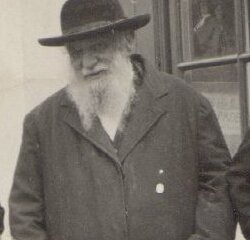
1858-1938Rabbi of Lackenbach, 1902-1935Kraus became rabbi of Lackenbach in 1902 and served until he retired in 1935, when he emigrated to Jerusalem and settled in Meah Shearim, one of few European rabbis to leave for Palestine before the Holocaust. He wrote Divrei Emeth, Divrei Shalom and More Derech, and his son Adonyahu Kraus wrote a history of the community. His son-in-law Meir Chaim Ungar succeeded him. He died in Jerusalem on 23 January 1938.
Biografía o fuente →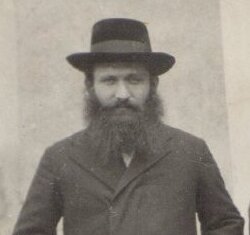
Meir Chaim Ungar
1905-1958Last rabbi of Lackenbach, 1935-1938Ungar, born in 1905, married Sara, daughter of Rabbi Kraus, and was nominated as his successor in 1935 by 46 members of the congregation. He was the last rabbi to serve in the Lackenbach synagogue before the expulsion of 1938. That year he received a certificate for Palestine and survived the Holocaust there, later serving as a rabbi in Jerusalem, where he died in 1958. His book Maor Hachaim was published after his death.
Biografía o fuente →Samson Wertheimer
1658-1724Court Jew in Vienna; patron of the rebuilt synagogueWertheimer was the Viennese court Jew and financier of the Habsburg emperors and held the title of rabbi of Hungary. According to the Austria-Forum essay, after the Jews of Lackenbach returned following the expulsion of 1671, their synagogue was rebuilt with his support. He thus stands at the origin of the building that survived until the Nazi era. The sources read do not say how much he gave or when the rebuilding was finished.
Biografía o fuente →Shalom Ullmann (Shalom Charif)
1755-1825Rabbi of Lackenbach from 1809Born in Fürth in 1755, Ullmann had served as rabbi in Ansbach and other communities before coming to Lackenbach in 1809. He led the congregation for about a quarter of a century and wrote Divrei Rash. He founded a rabbinic dynasty: his son Abraham and his grandson David succeeded him in the Lackenbach rabbinate, so that his family held the post for more than ninety years. He died on his seventieth birthday in 1825.
Biografía o fuente →David Ullmann
1823-1901Rabbi of Lackenbach, 1846-1901Son of Rabbi Abraham Ullmann and grandson of Shalom Ullmann, David Ullmann succeeded his father in 1846 and served the Lackenbach congregation for 55 years, the longest tenure recorded there. His years in office span the community's peak of more than 1,100 members and the start of its decline through emigration. He died on 13 January 1901, and his death was registered at Lakompak the following day. The community history site calls him one of the great rabbis of his time.
Biografía o fuente →¿Tiene algo que aportar?
Fotografías, documentos, historias familiares o recuerdos de esta sinagoga y su comunidad ayudan a mantener viva su historia.
- Jüdische Gemeinde Lackenbach
- Virtuelle Rekonstruktion der Synagoge in Lackenbach (Diplomarbeit)
- Lackenbach KehilaLinks: History
- Lackenbach KehilaLinks: Holocaust Yizkor
- Lackenbach KehilaLinks: Rabbis of Lackenbach
- Lackenbach KehilaLinks: Pictures
- Lackenbach KehilaLinks: Families' life stories
- Lackenbach (Jewish Communities of Austria, modern era)
- Lackenbach (OpenStreetMap relation 109412)
Share a memory or thought
No comments yet. Be the first to add one.