
La storia di Königswart Synagogue (Lázně Kynžvart)
Königswart, a small spa town in western Bohemia below Metternich's castle, had one of the oldest Jewish settlements in the Eger (Cheb) region. Jews are recorded there from the first half of the fifteenth century, and the Jewish cemetery is dated to 1405. After the expulsion of the Jews from Eger in 1430 many families moved to Königswart, and later sources speak, with reservations, of 150 to 180 families. For about two centuries from the late seventeenth century the town was the seat of a district rabbinate.
The synagogue stood in the Jewish enclosure, the Judenhof, the area now called Malé náměstí. Its age is disputed. One gazetteer says a new synagogue was built in the middle of the ghetto around 1765 and that a medieval synagogue preceded it; the Encyclopaedia Judaica says the synagogue was renovated in 1608; the Leo Baeck Institute dates the building to the seventeenth century; and a JewishGen survey calls it a fifteenth-century building. All agree it was very old: it survived two town fires in 1865 and was described as the oldest building in Königswart. The community shrank through the nineteenth century, dissolved in the 1920s and numbered twelve people in 1930. In 1938, after the town became part of Nazi Germany, the synagogue was plundered, burned and pulled down.
Where it stood for nearly 180 years
Historic: Judenhof (Jewish enclosure), Königswart, Bohemia. Today: Malé náměstí, 354 91 Lázně Kynžvart, Cheb district; pin at the centre of the square (approximate; exact plot not identified).
Apri la mappa grande →La comunità ebraica
Jewish traders are said to have settled in Königswart in the fourteenth century, and the community is documented from the first half of the fifteenth. Its cemetery below the castle was founded about 1405 and was later also used by Jews from surrounding places. In 1430 Jews expelled from Eger settled in the town, and the community is said to have grown to 180 families, a figure the sources treat with caution. By 1724 only nine Jewish families lived there, since many had moved away as trade declined. In the first half of the nineteenth century 46 families were permitted to reside in Königswart, and at the start of that century the community was under the protection of Prince Metternich, the lord of the estate. The Königswarter family took its surname from the town: under Joseph II's naming decree the traders Joel Baruch, Löwel Baruch and Samuel Löwel Baruch adopted it, and their descendants became bankers in Frankfurt, Vienna and Paris. After 1848 most Jews left for larger cities or America. In 1902 the community, with nearby villages, numbered 51 people; it dissolved between 1922 and 1929, and only twelve Jews lived in the town in 1930.
Architettura e design
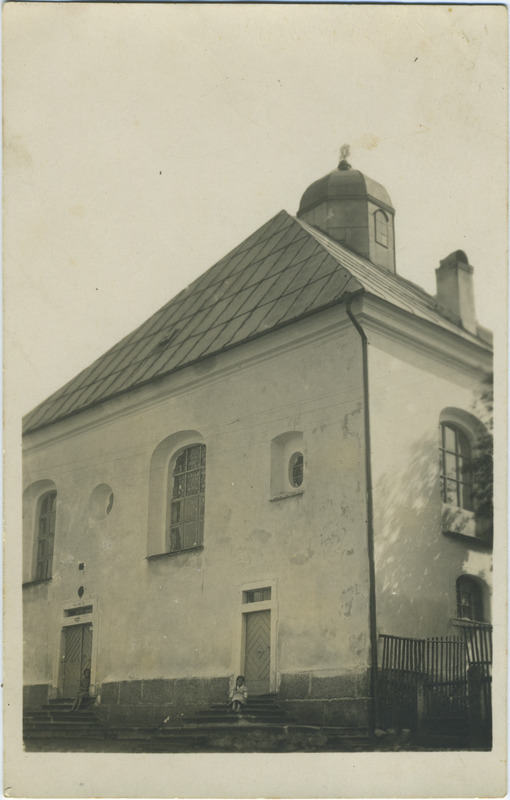
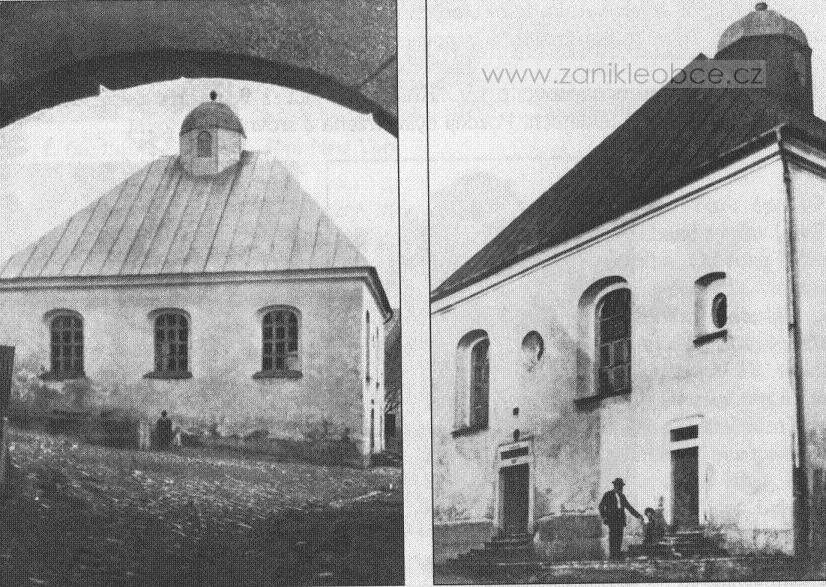
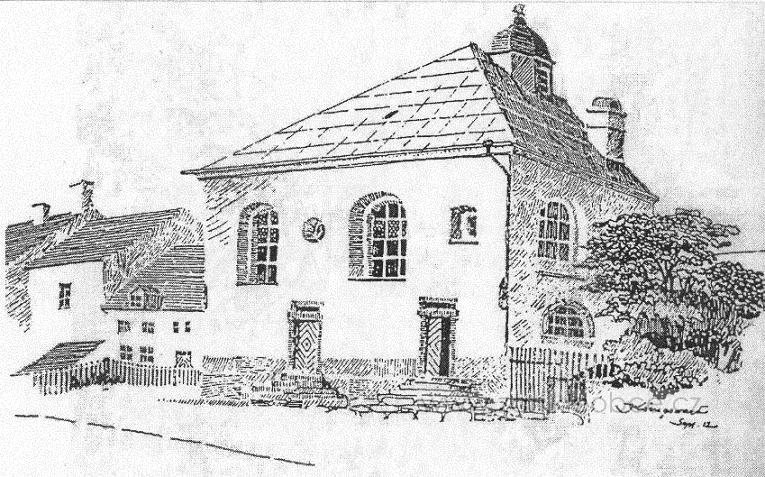
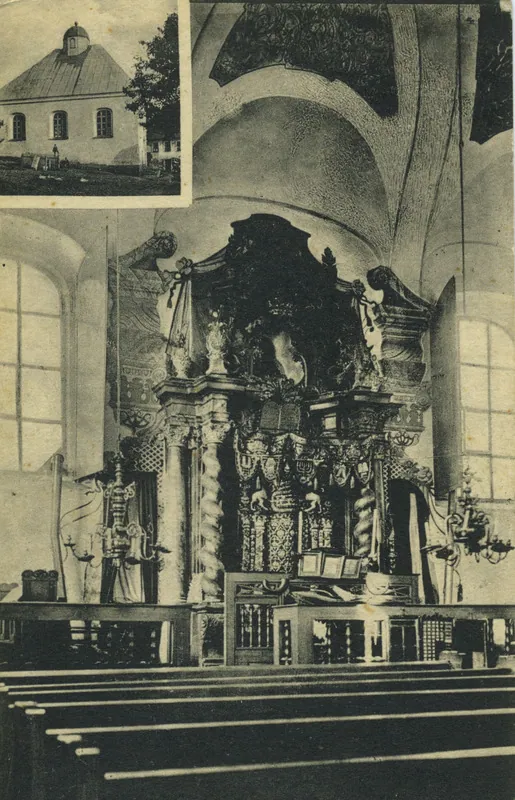
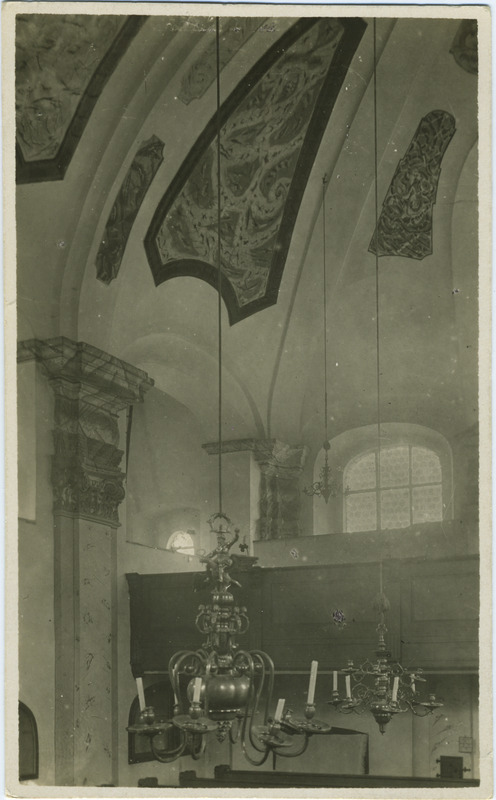
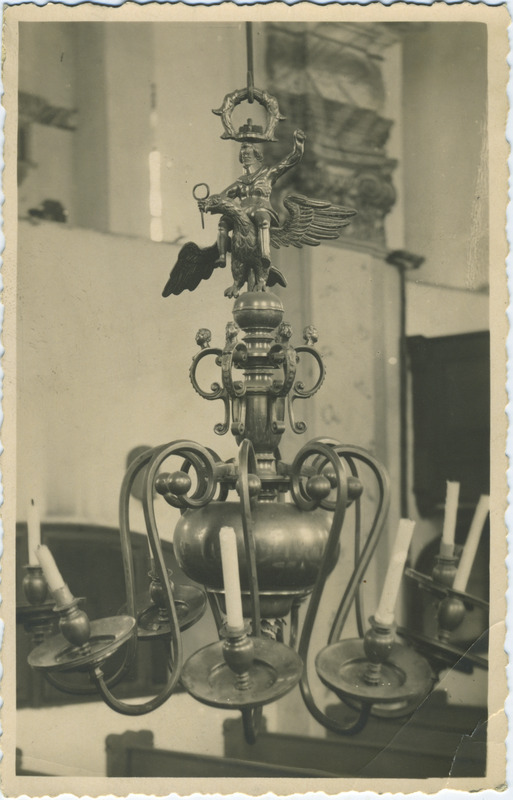
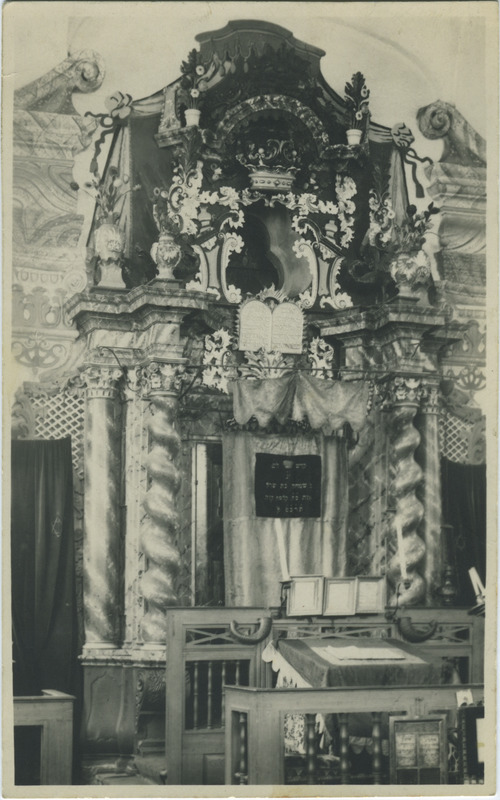
The building is known from several undated postcards in the Hugo Fuchs Collection of the Leo Baeck Institute, from a historical photograph published by zanikleobce.cz and from a pen drawing. Outside it was a plain, free-standing rendered hall of two storeys' height under a steep hipped roof covered with shingles or slate, crowned by a small octagonal lantern with an onion cap. A chimney rose from one end of the roof. The long walls had tall round-arched windows, with small round or oval windows between them, and doors with plain surrounds opened at ground level, reached by a few steps. Inside, the hall was covered by a vault decorated with painted baroque ornament in cartouches. The east wall held a tall, elaborate baroque Torah ark with twisted columns, carved foliage and crowning ornament, with the Ten Commandments above the ark doors; a wooden bimah with a railing stood in front of it. Large brass chandeliers hung from the vault, one crowned by a figure of a double-headed eagle. Long wooden pews filled the hall. The architect, builder and seating capacity are unknown.
La vita nella sinagoga
For roughly two hundred years from the end of the seventeenth century Königswart was the seat of a district rabbinate, so its synagogue served as the religious centre for Jews living in the surrounding villages of the Eger region, who also buried their dead in the town's old cemetery. None of the sources read names the rabbis who served here or describes the rite or the order of services. The rabbi and the chief elder of the community lived in two old houses in the Judenhof next to the synagogue, both of which survived until 1938. A medieval ritual bath lay in the cellar of a nearby house known as New York, built in 1775, which still stands and is considered one of the oldest Jewish buildings in western Bohemia. The richly carved ark, the bimah and the large brass chandeliers, all photographed for postcards, show that the congregation invested heavily in the furnishing of its prayer hall in the baroque period. As the community declined in the nineteenth and early twentieth centuries, the synagogue was used by an ever smaller group, and after the congregation dissolved in the 1920s regular worship there presumably ended; when it stopped is unknown.
Distruzione
Königswart lay in the Sudetenland, which was annexed by Nazi Germany in October 1938; the JewishGen survey records that the last Jews left the town that year. According to the same survey the synagogue, still the oldest standing building in the town, was plundered, set on fire and razed by the Nazis during the Kristallnacht pogrom of 9 to 10 November 1938, together with the old houses of the rabbi and the chief elder in the Judenhof. The Jüdische Gemeinden gazetteer likewise says the synagogue was set on fire in 1938 and pulled down soon afterwards, and the Encyclopaedia Judaica records that it was desecrated in 1938. None of the sources names individual perpetrators or says who carried out the demolition of the burnt shell. In the same period the Nazis destroyed almost the whole Jewish cemetery and laid its gravestones, face up, as paving in the town's streets and square.
Il destino della comunità
By the time of the Nazi annexation of the Sudetenland in October 1938 the organised Jewish community of Königswart no longer existed: it had dissolved between 1922 and 1929, and the census of 1930 counted twelve Jews in the town, while the Encyclopaedia Judaica speaks of only four families in 1933. The JewishGen survey states that the last Jews left Königswart in 1938, as Jews fled the annexed border region for the interior of Czechoslovakia. What happened to these last residents afterwards is unknown; no source read names them or records whether any were later deported from Bohemia and Moravia and murdered. No Jewish community was re-established in the town after the war. After liberation the local national committee had the gravestones taken up from the streets; the Encyclopaedia Judaica says they were piled into a mound, while the Czech tourist portal says they were set against the wall of the old cemetery. Many descendants of Königswart families lived on elsewhere, among them the Königswarter banking family, which had long left the town.
Il luogo oggi
The synagogue stood in the former Judenhof, today the small square called Malé náměstí in the centre of Lázně Kynžvart. No source read describes what now occupies the exact plot, and no part of the building is known to survive. Nearby, the house called New York, built in 1775, still stands and contains a medieval ritual bath in its cellar. The Jewish cemetery, about 400 metres north-north-east of the square below the ruins of Kynžvart castle, survives only as a site: its stones were removed by the Nazis, and the JewishGen survey reports no standing gravestones visible today.
Hai qualcosa da condividere?
Fotografie, documenti, storie di famiglia o ricordi di questa sinagoga e della sua comunità aiutano a mantenerne viva la storia.
- Marienbad (Böhmen), section on Königswart
- Lázně Kynžvart (Cemetery Discovery Project entry)
- Lazne Kynzvart (Encyclopaedia Judaica entry)
- Židovský hřbitov v Lázních Kynžvart
- Synagogue in Bad Königswart bei Marienbad (postcard)
- Synagogue Bad Koenigswart bei Marienbad: interior (postcard)
- Bad Königswart Synagogue: Bimah and the exterior in the corner (postcard)
- Chandelier in the Bad Koenigswart synagogue (postcard)
- Bimah in the Bad Koenigswart Synagogue (postcard)
- Malé náměstí, Lázně Kynžvart (OpenStreetMap way 98603314)
Share a memory or thought
No comments yet. Be the first to add one.