




הסיפור של Great Community Synagogue, Leipzig
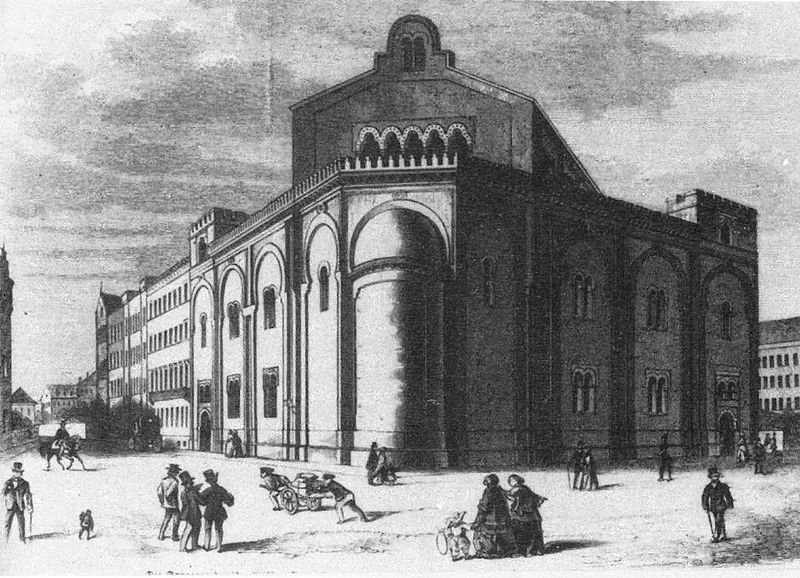
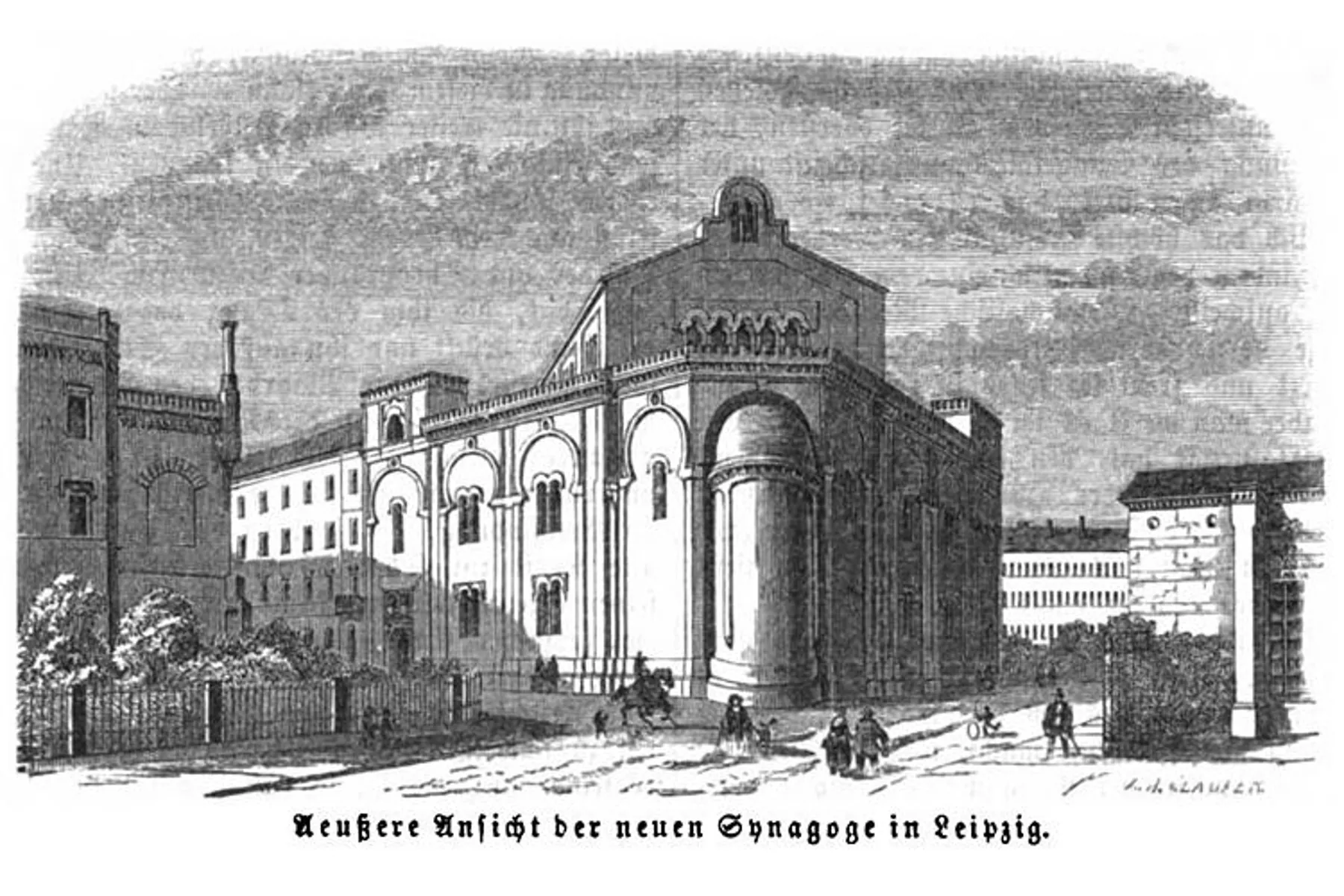
The Große Gemeindesynagoge stood at the corner of Gottschedstraße and Zentralstraße, just west of Leipzig's ring road. It was the principal house of worship of the Israelitische Religionsgemeinde zu Leipzig. The cornerstone was laid on 9 September 1854, and the synagogue was dedicated a year later, on 10 September 1855, by the preacher Adolf Jellinek.
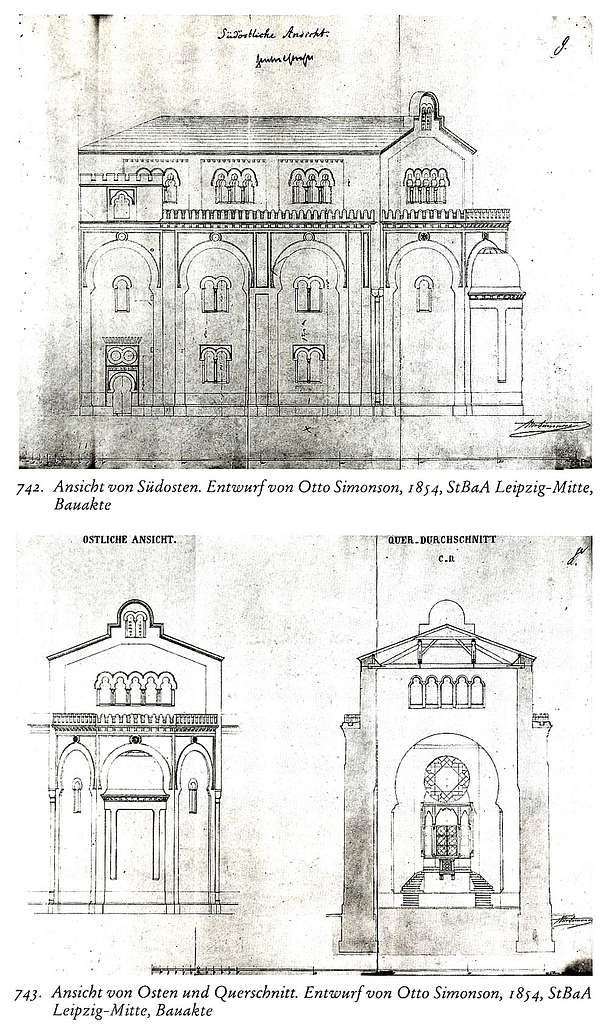
The architect Otto Simonson, a pupil of Gottfried Semper, fitted a Moorish-style gallery basilica onto an awkward kite-shaped plot. Contemporaries praised how well his design handled the irregular site. The building held about 1,600 seats and served both Leipzig's resident community and the Jewish merchants who came to the city's trade fairs from across Europe. It is regarded as an early example of the Moorish Revival synagogue style in Germany.
After 1868 the synagogue had an organ by Friedrich Ladegast, reflecting the community's liberal rite. Leipzig's Jewish population grew to about 13,000 by the 1920s, making it one of the largest in Germany.
During the November pogrom of 1938, the Nazis set the synagogue on fire. The ruins were demolished at the community's expense by February 1939. Since 2001 the site has been marked by a memorial of 140 empty bronze chairs.
Where it stood for 83 years
Historic: Gottschedstraße 3, corner of Zentralstraße, Leipzig (Innere Westvorstadt). Present: Synagogue memorial (Synagogendenkmal), Gottschedstraße 3 / Zentralstraße, 04109 Leipzig. The site is exact: the memorial occupies the synagogue plot.
פתיחת מפה גדולה ←הקהילה היהודית
Jews are recorded in medieval Leipzig from around 1230 until the mid-15th century. In the following centuries, Jewish merchants came to Leipzig mainly as visitors to its trade fairs.
Permanent settlement grew gradually after 1800, and the Leipziger Kunstorte project of the Academy of Visual Arts Leipzig (HGB) dates the formation of the modern religious community to around the 1820s. The growing community needed a synagogue large enough for its resident members and for the many Jewish visitors to the fairs.
Die Gartenlaube, a Leipzig magazine, reported in 1854 that the laying of the cornerstone was celebrated as a step towards religious equality in Saxony. Otto Simonson wrote that the community sought a building large enough for all the faithful of the community. The synagogue opened in 1855. Over the next seventy years the community grew rapidly, and by 1925 it had about 13,000 members, the sixth-largest Jewish community in Germany.
אדריכלות ועיצוב
Simonson designed the synagogue as a gallery basilica (Emporenbasilika) on an irregular, kite-shaped plot. A three-storey nave was flanked by two-storey side aisles with galleries, which held roughly half the seats. In keeping with Jewish tradition, the axis ran west to east, with the Torah ark raised at the eastern end behind a curtain.
The style was deliberately oriental. Horseshoe arches were used throughout, the Aron Kodesh was designed in the manner of a mihrab, the pulpit echoed a minbar, and the coffered ceiling carried stalactite (muqarnas) ornament. German Wikipedia describes these elements as Indo-Islamic.
The organ, by the Weißenfels builder Friedrich Ladegast, had two manuals, 20 stops and 1,089 pipes in a Moorish-style case. German Wikipedia gives its installation date as either 1868 or 1856, as sources conflict. The building is regarded as an early and influential example of Moorish Revival synagogue architecture in Germany.
החיים בבית הכנסת
The Gemeindesynagoge was the religious centre of Leipzig's liberal Jewish community. Its organ, installed by 1868, marked the moderate Reform rite used in its services. Adolf Jellinek, one of the most celebrated synagogue preachers of the 19th century, dedicated the building in 1855 and preached in Leipzig until he moved to Vienna in 1856.
During the trade fairs, the synagogue also served Jewish merchants visiting from Eastern Europe and elsewhere. Other congregations in the city worshipped in separate prayer houses, among them the synagogue on Keilstraße, used by Jews from Brody, which survives today.
Felix Goldmann, born in London in 1882, was community and synagogue rabbi from 1917 until his death in 1934. He tried to bridge the liberal and Orthodox factions, but the community still split during his tenure. Cantors and choir directors have not been verified.
הרס
The synagogue was destroyed during the November pogrom of 1938. According to the account in English Wikipedia's article on Kristallnacht in Leipzig, Nazis in civilian clothes had set the Gemeindesynagoge on fire by 3:51 a.m. on 10 November. They acted under orders passed down through the Nazi party's district leader (Kreisleiter) Ernst Wettengel. Jüdische Gemeinden cites contemporary accounts that local NSDAP groups, members of the NSKK (the Nazi motor corps) and other Nazis attacked Jewish institutions across the city.
The Leipzig fire brigade recorded the cause of the fires as 'unknown' and acted only to stop the flames reaching neighbouring non-Jewish property. More than 550 Jewish men were arrested and sent to concentration camps.
Between 11 November 1938 and 12 February 1939 the burnt-out ruins were demolished, and the Israelitische Religionsgemeinde was forced to pay the cost.
גורל הקהילה
After 1933, Leipzig's Jews faced boycotts, dismissals and emigration pressure. In 1936 the city removed its monument to the composer Felix Mendelssohn Bartholdy.
Deportations began in January 1942 with a transport of 561 people to Riga. Jüdische Gemeinden counts nine deportation transports from Leipzig in all. The last left on 14 February 1945, taking about 169 people to Theresienstadt. When American troops arrived in April 1945, only about 24 Jews remained in the city.
The memorial inscriptions give different totals: the 1966 stone refers to 14,000 Leipzig Jews who perished, while the 2001 memorial honours more than 13,000 murdered and persecuted Jews. A small community re-formed and reopened the surviving synagogue on Keilstraße in October 1945. Many members emigrated to West Germany by 1953, and the community grew again after 1989 through immigration from Eastern Europe, to about 800 members by 2002.
האתר כיום
The synagogue's plot at Gottschedstraße 3, on the corner of Zentralstraße, remained empty after the ruins were cleared. A modest memorial stone by the sculptor Hans-Joachim Förster was unveiled there on 18 November 1966.
After a design competition in 1999, a larger memorial by the Leipzig architects Anna Dilengite and Sebastian Helm was dedicated on 24 June 2001, with the Israeli ambassador Shimon Stein present. Within an area of about 12 by 12 metres that recalls the synagogue's floor plan, 140 empty bronze chairs stand in rows, symbolising the absent congregation. A concrete wall carries inscriptions in German, English and Hebrew, and Braille descriptions are provided for visually impaired visitors.
שמות בולטים

Otto Simonson
1829–1914ArchitectOtto Simonson was born in Dresden and trained under Gottfried Semper. He designed the Leipzig community synagogue and led its construction in 1854–1855. Contemporary critics praised how his Moorish Revival gallery basilica resolved the irregular site. The building became an early, influential model for oriental-style synagogues in Germany. He died in Riga in 1914.
ביוגרפיה או מקור ←
Adolf Jellinek
1821–1893Preacher of the Leipzig community, 1845–1856; dedicated the synagogueAdolf Jellinek was preacher in Leipzig from 1845 to 1856 and dedicated the Große Gemeindesynagoge on 10 September 1855, shortly before he moved to Vienna. There he became one of the most celebrated synagogue orators and Jewish scholars of the 19th century. Sources differ on his exact date of death (28 or 29 December 1893).
ביוגרפיה או מקור ←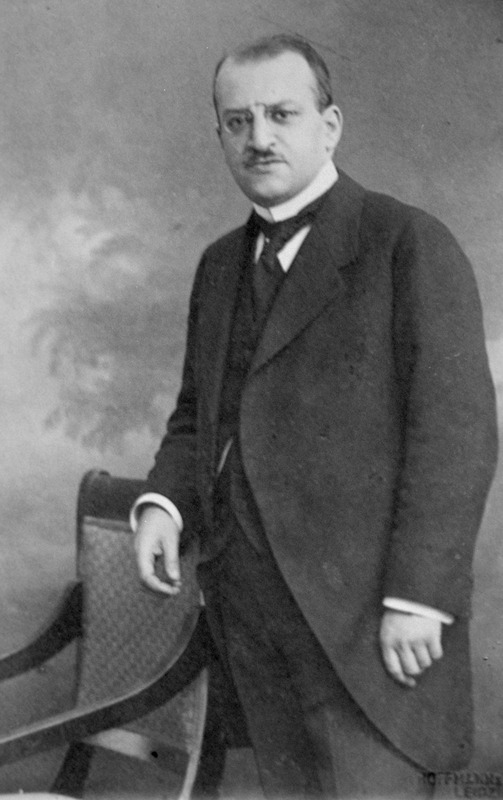
Felix Goldmann
1882–1934Community and synagogue rabbi, 1917–1934Felix Goldmann was born in London and served as rabbi of the Leipzig community and of the Gemeindesynagoge from 1917 until his death in 1934. He tried to bridge the community's liberal and Orthodox factions, but a split occurred during his tenure.
ביוגרפיה או מקור ←יש לכם משהו לתרום?
תמונות, מסמכים, סיפורי משפחה וזיכרונות מבית הכנסת ומהקהילה שלו עוזרים לשמור על ההיסטוריה שלו בחיים.
- Leipzig Synagogue
- Große Gemeindesynagoge
- Synagogendenkmal / Große Gemeindesynagoge
- Große Gemeindesynagoge in Leipzig
- Synagogendenkmal: Die jüdische Gemeinde Leipzig
- Leipzig (Sachsen)
- Kristallnacht in Leipzig
- Otto Simonson (1829–1914)
- Die neue Synagoge in Leipzig (Die Gartenlaube, 1854, no. 40, pp. 476–478)
- Adolf Jellinek
Share a memory or thought
No comments yet. Be the first to add one.