


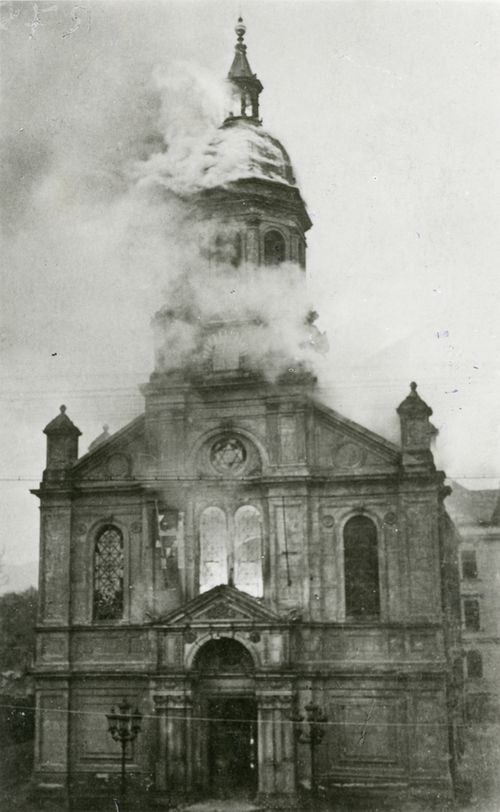
The story of Reichenberg Synagogue (Liberec)
The synagogue of Reichenberg, now Liberec in northern Bohemia, was built for a Jewish community that had only been allowed to settle permanently in the city in the early 1860s. The community grew quickly with the region's textile industry. A first prayer house opened in 1861, and in the 1870s and 1880s the congregation raised money for a monumental new building on a prominent central site.
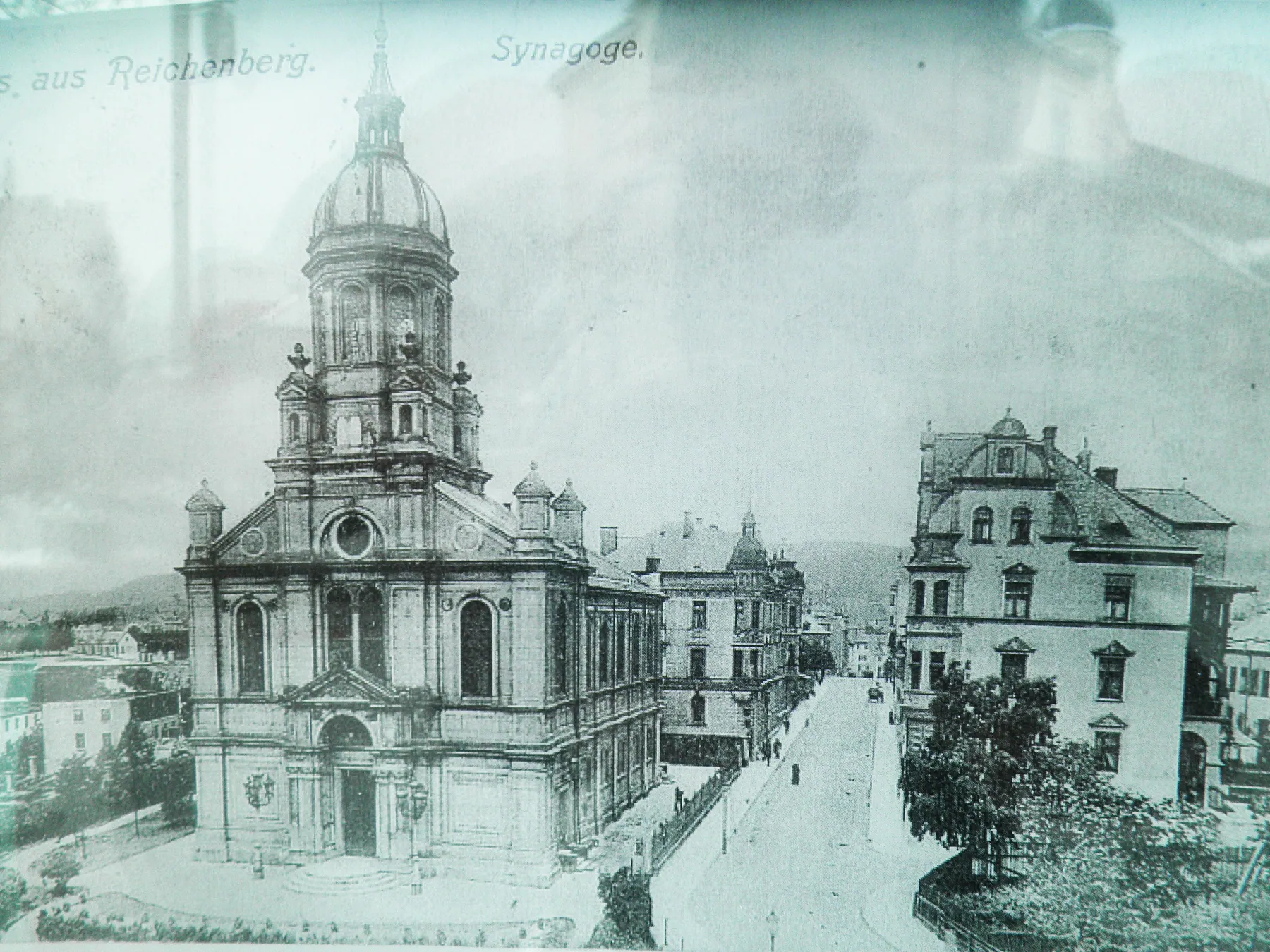
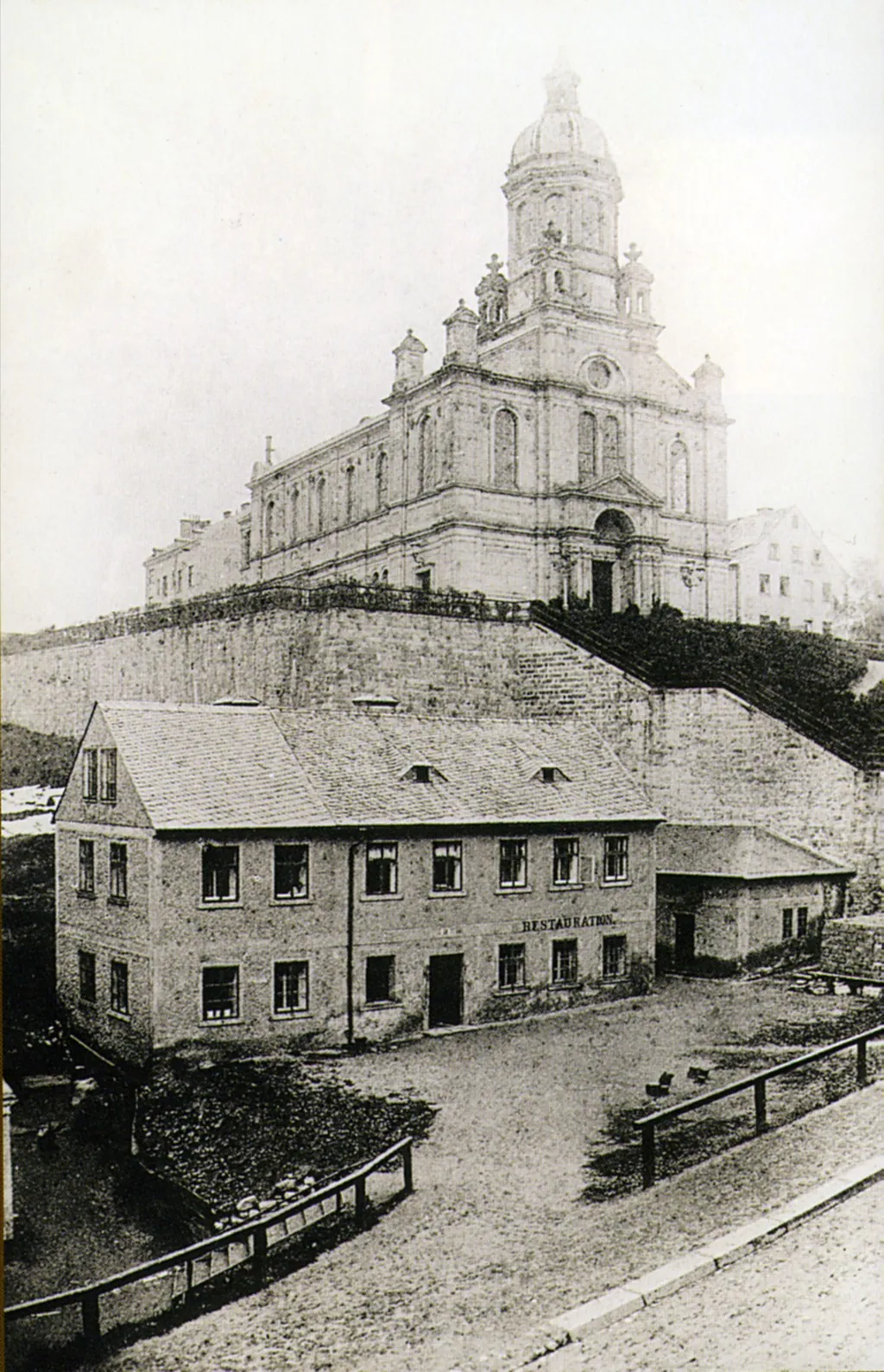
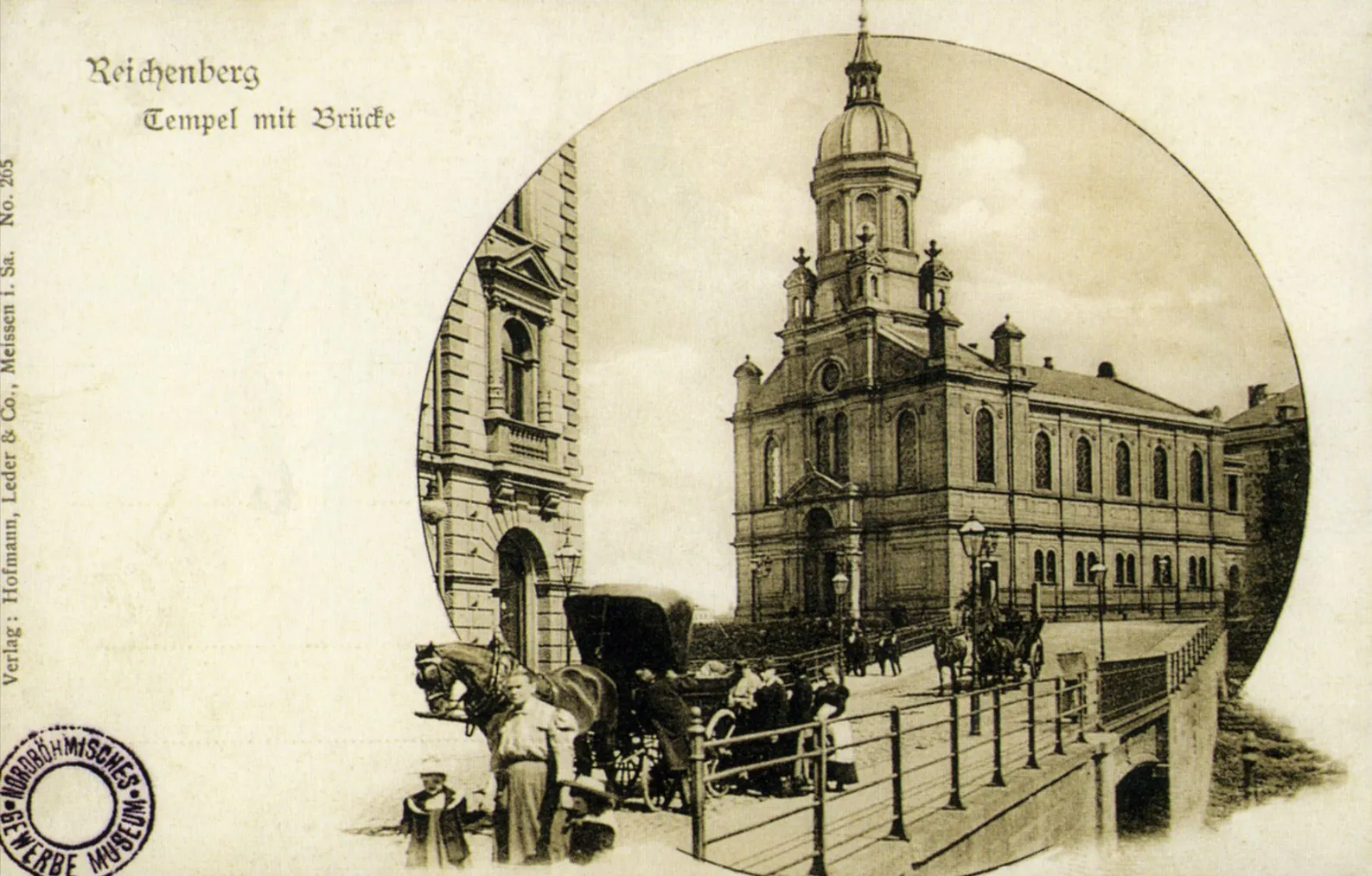
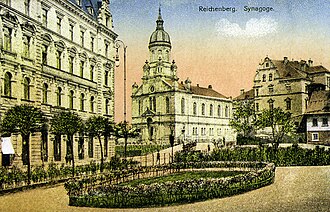
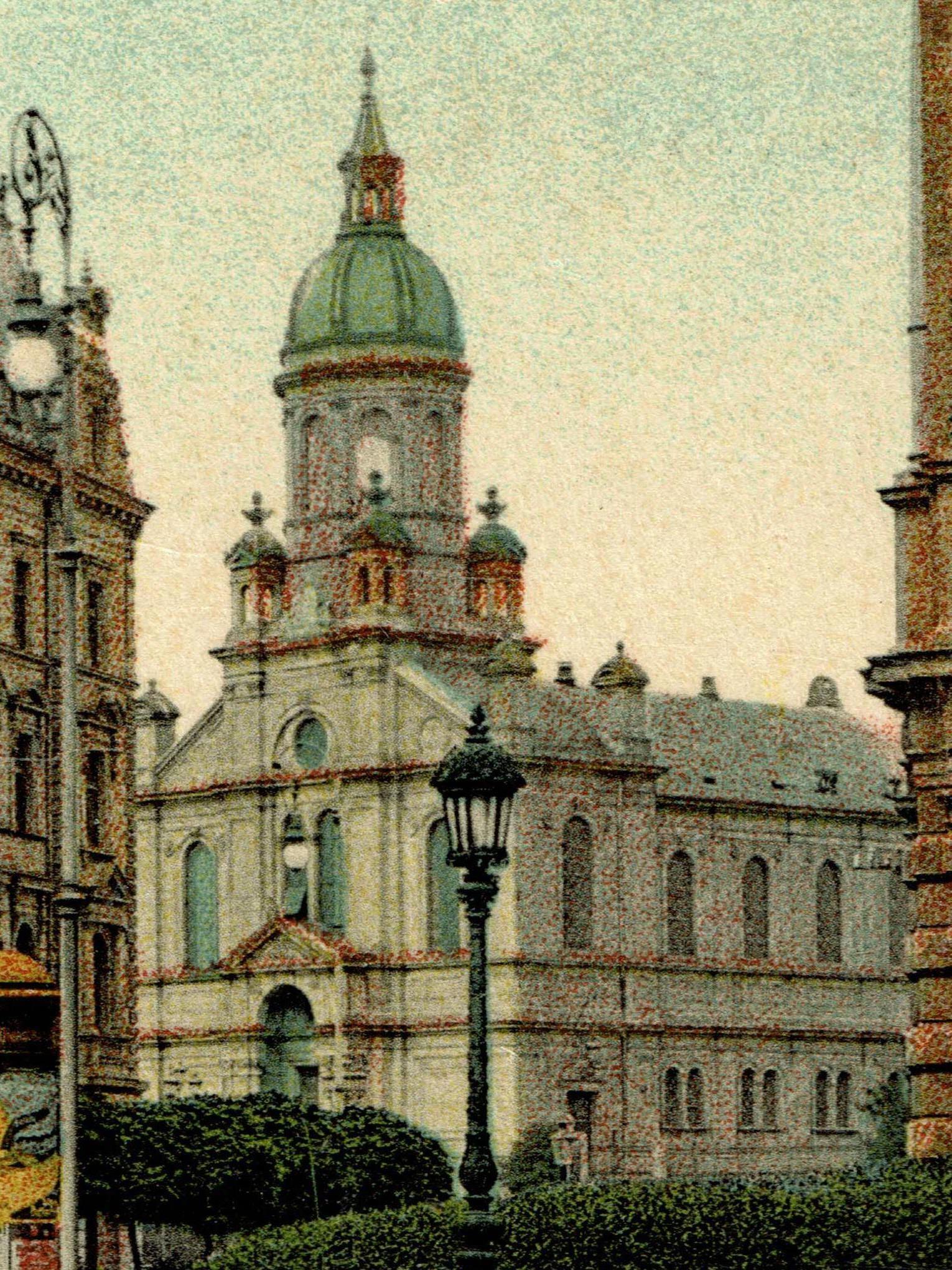
The cornerstone was laid in autumn 1887, and the synagogue was dedicated in September 1889. Sources give either 24 or 27 September. The Viennese architect Carl König designed it in a Neo-Renaissance style, and the local firm Sacher & Gärtner built it. Its octagonal tower, crowned by a dome and lantern, rose about 39 metres and was said to exceed the town hall in height. City officials and clergy of several denominations attended the dedication, and about a third of the building costs came from non-Jewish donors.
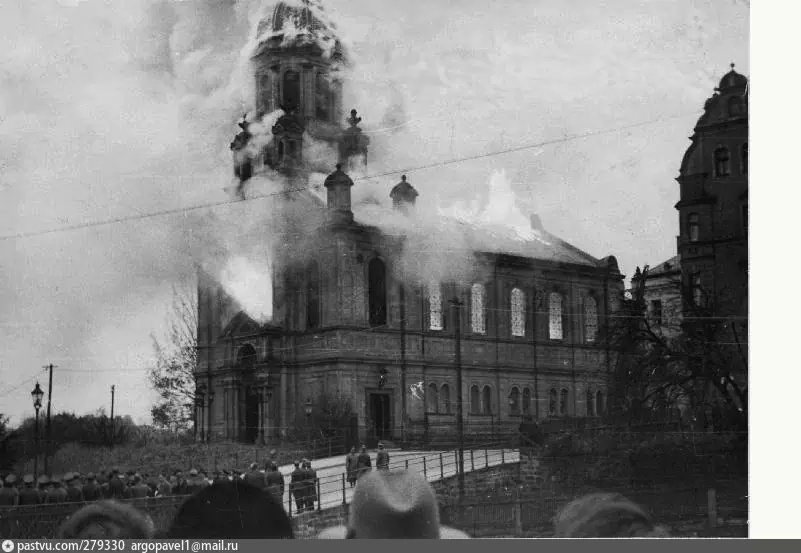
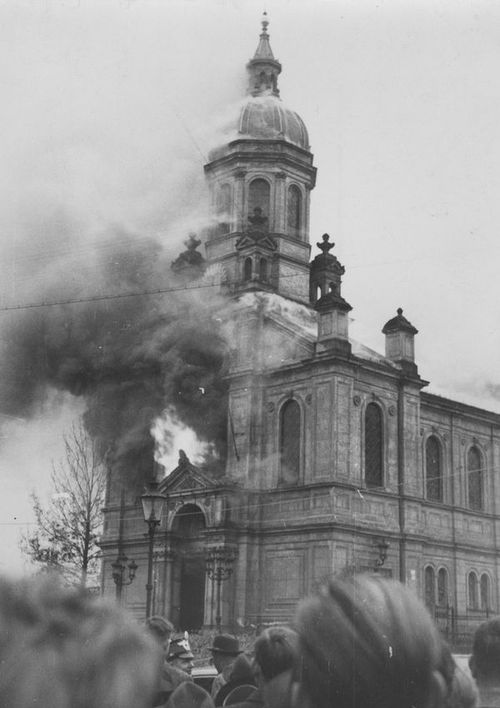
Germany annexed the Sudetenland in October 1938, and on the night of 9–10 November 1938 the Nazis burned the synagogue. Its site later became a car park. In 2000 the Building of Reconciliation (Stavba smíření) was opened there. It houses the regional research library and a new synagogue, the first built in the Czech Republic since the Second World War.
Where it stood for 49 years
Historic: central plot in the Old Town of Reichenberg on the rise between the town hall and the northern districts (historic street address not verified). Present: Building of Reconciliation (Krajská vědecká knihovna / synagoga), Rumjancevova 1362/1, 460 01 Liberec I – Staré Město. The site is exact, since the new building stands on the old synagogue plot. The coordinates are approximate.
Open larger map →The Jewish community
Jews are recorded in Reichenberg from the 15th century, and about fifty families from Prague took temporary refuge there during a plague in 1582. For centuries, however, they were barred from living in the city permanently. In 1776 the city council ruled that Jews could not stay year-round.
Only after the Austrian restrictions were lifted around 1860 could Jews settle freely. About thirty families arrived, most of them involved in the booming textile trade. A prayer house opened on 4 September 1861, the community was formally recognised on 12 December 1862, and a cemetery followed in 1864.
The congregation had grown to ninety families by 1869 and needed larger premises. After years of fundraising it bought a central plot and built the monumental synagogue of 1887–1889. The community numbered 1,240 in 1910 and about 1,400 by 1938. Its rabbi, Emil Hoffmann, described its story as less the history of a congregation than that of a Jewish trading colony.
Architecture and design
Carl König, a professor in Vienna, won the commission; David reports that his design was chosen over one by Max Fleischer. He designed a Neo-Renaissance building whose main feature was an octagonal tower topped by a dome and lantern, about 39 metres high. Set on rising ground between the town hall and the northern districts, it was one of the dominant landmarks of Reichenberg.
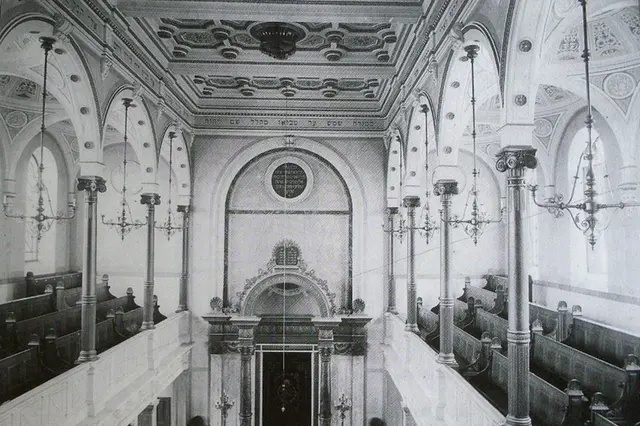
The main hall measured about 29.75 metres long, 15.9 metres wide and 14 metres high. The women's gallery was on the upper level. According to David, the interior was painted in several colours with gilding, and the building had central heating and an organ.
Capacity figures differ, as noted above. The local building firm Sacher & Gärtner carried out the construction. The plan and materials have not been documented in detail in the sources checked.
Life inside the synagogue
The Reichenberg synagogue followed a moderate Reform rite, as the Jewish Encyclopedia records, and its organ reflected that orientation. Many members of the congregation owed their place in the city to the textile trade that had drawn Jewish families to Reichenberg after 1860.
The dedication in September 1889 was a civic occasion attended by city officials and by clergy of several denominations, a sign of the community's standing in the city. The Jewish Encyclopedia lists successive rabbis as Julius Reach (until 1888), Adolf Posnanski (until 1891) and Emil Hoffmann. Other sources give Hoffmann's tenure as 1892 to 1938, so he led the congregation for almost the whole life of the building.
The community also maintained a burial society (founded 1864) and a cemetery. Details of choirs, cantors, schools and cultural associations connected with the synagogue have not been verified.
Destruction
After the Munich Agreement, German troops occupied Reichenberg in October 1938 and the city became the capital of the Reichsgau Sudetenland. Most of the Jewish population had already fled to the Czech interior.
On the night of 9–10 November 1938, during the November pogrom, Nazis set the synagogue on fire. It was one of 44 synagogues in the Sudetenland destroyed or damaged in the pogrom. Hrady.cz gives 11 November as the date of destruction, which may refer to the end of the fire or the start of demolition. The specific units and individuals responsible have not been identified in the sources checked. Holocaust.cz holds a police report on the pogrom in Liberec dated 12 November 1938, which should be consulted.
The burnt ruin was pulled down, and the site was later left as a car park. The catalogue dates the demolition to 1939, which is plausible but not confirmed in the sources checked.
The community’s fate
The annexation broke up the community. According to David, around 12,000 of the region's 28,000 Jews fled in October 1938, and only about 30 Jews stayed in Reichenberg, where they were arrested. Most Reichenberg Jews moved to the Protectorate of Bohemia and Moravia or emigrated.
Those who could not escape further were deported from 1941 to 1944, mainly to Theresienstadt, Łódź and Auschwitz. Jüdische Gemeinden estimates 700 to 800 deportees. Fewer than 40 of the pre-war community survived; Czech Radio gives 37 who returned from the camps. A memorial opened in 2008 in the former ceremonial hall (tahara house) of the Jewish cemetery lists about 800 victims.
After the war, survivors, Jewish soldiers and Jews who moved there from other areas formed a new community, which David numbers at 1,105 in 1948. Most later left. The present community has about 60 to 70 members.
The site today
The synagogue was not rebuilt, and for decades its site was used as a car park. Between 1995 and 2000 the Building of Reconciliation (Stavba smíření) was built there to designs by the architect Radim Kousal. It houses the Liberec Regional Research Library and a new synagogue with a Jewish cultural centre. The prayer hall was opened on 9 November 2000, the 62nd anniversary of the burning, and the building won a Czech 'Building of the Year' award in 2001. It is the only new synagogue built in the Czech Republic since the Second World War.
The prayer hall's triangular plan evokes half of a Star of David. Stones from the old synagogue form a symbolic 'wailing wall', and Torah fragments are kept there. The address is Rumjancevova 1362/1, Liberec 1.
Notable names
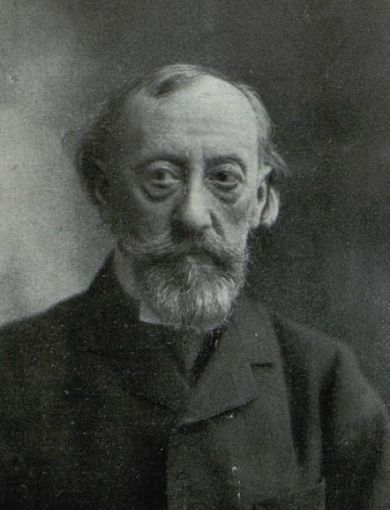
Carl (Karl) König
1841–1915ArchitectCarl König, a Viennese architect and professor, designed the Reichenberg synagogue, built from 1887 to 1889. David reports that his design was chosen over a proposal by Max Fleischer. His Neo-Renaissance building with its octagonal domed tower became one of the city's landmarks. He lived from 1841 to 1915 and also designed the Turnergasse synagogue in Vienna.
Biography or source →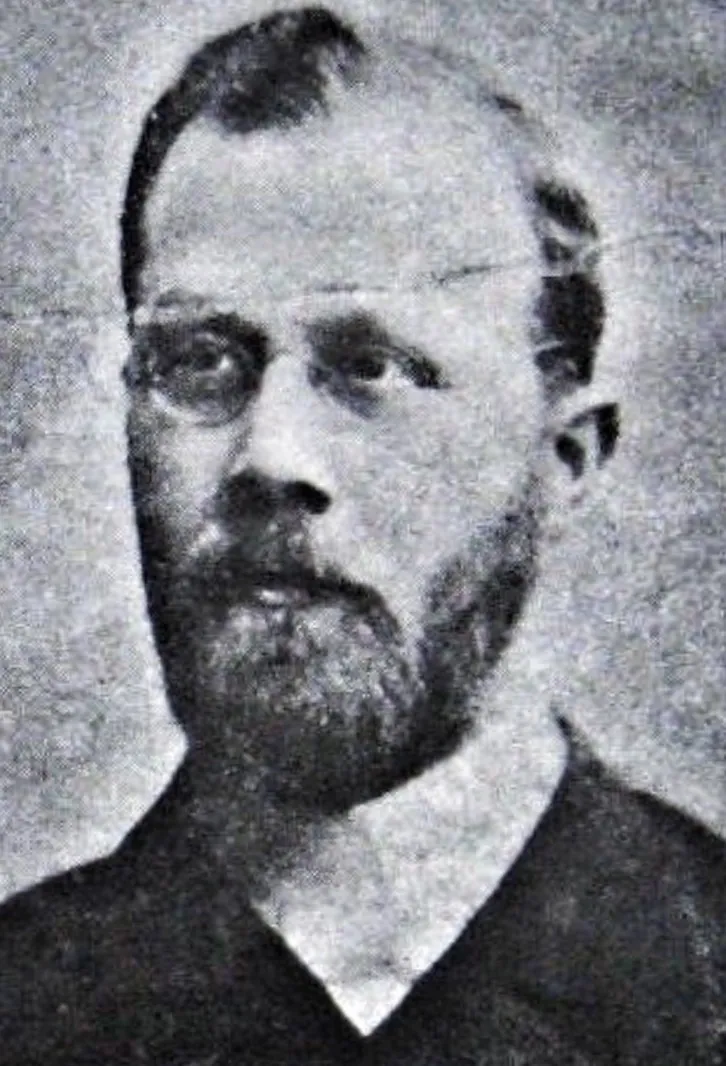
Adolf Posnanski
1854–1920Rabbi of Reichenberg, 1888–1891Adolf Posnanski was rabbi of Reichenberg while the synagogue was being built, and served until 1891, according to the Jewish Encyclopedia. He therefore led the congregation at the dedication in September 1889. Born in 1854, he moved on to Pilsen in 1891 and became known for his study of messianic interpretation, Shiloh (1904).
Biography or source →Emil Hoffmann (Hofmann)
born 1867Rabbi of Reichenberg, about 1891/1892–1938Emil Hoffmann led the Reichenberg congregation in the synagogue for almost its whole existence, from the early 1890s until the community broke up in 1938. He also wrote its history, describing it as less the history of a congregation than of a Jewish trading colony. His later life and death date have not been verified.
Biography or source →Do you have something to contribute?
Photographs, documents, family stories or memories of this synagogue and its community help keep its history alive.
- Synagoga, Liberec I – Staré Město
- Státní vědecká knihovna a synagoga
- Reichenberg (Böhmen)
- Reichenberg
- Reichenberg: Wien des Nordens, böhmisches Manchester
- Připomínka 85 let od vypálení liberecké synagogy
- Před 20 lety byla v Liberci otevřena jediná novostavba synagogy v Česku
- The History of Liberec
- Křišťálová noc v Liberci
- Nová synagoga, Rumjancevova, Liberec (node/building record)
- Karl König
- Posnanski, Adolf
Share a memory or thought
No comments yet. Be the first to add one.