
La storia di Great Synagogue of Lipcani
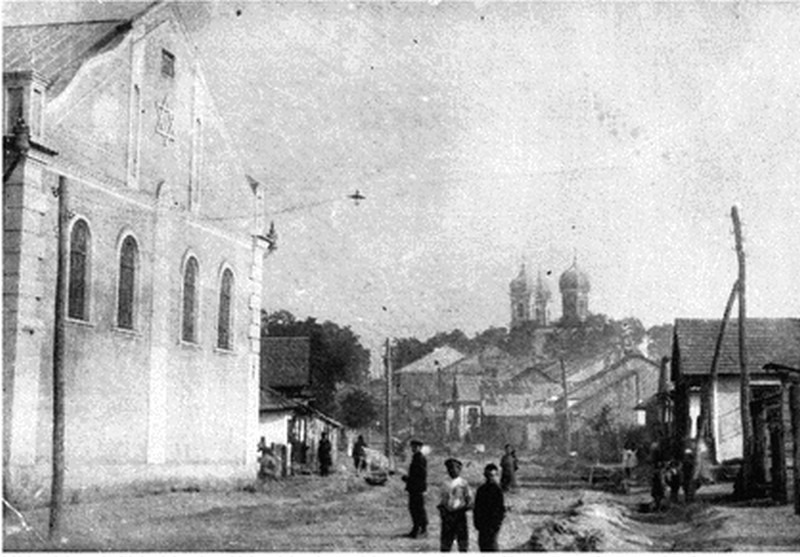
Lipcani lies on the Prut in the far north of today's Moldova, where the borders of Moldova, Romania and Ukraine almost meet. Jews were invited to settle by the local landowners, the Lapchinsky family, in the second half of the seventeenth century, and by 1930 they numbered 4,693, almost 80 per cent of the town. The town was a centre of Hasidism and Hebrew and Yiddish letters; the poet Hayim Nahman Bialik is said to have called it a 'Bessarabian Olympus'. Among roughly twenty synagogues, Hasidic prayer houses and craftsmen's synagogues stood the Great Synagogue, the town's principal congregation. The Yad Vashem community encyclopaedia records that it caught fire many times and had to be repeatedly renovated. Its date of construction and its architect are unknown. The only known photograph shows a tall gabled masonry hall with round-arched windows and a Star of David in the gable. The Soviet authorities who annexed Bessarabia in 1940 closed synagogues and turned some into workshops. In June 1941 the town was bombed by the Nazi German air force, and in July Romanian gendarmes drove its Jews on death marches towards Transnistria, where about four-fifths of them died. The synagogue was destroyed during the occupation, as the town burned. A school was later built on its site.
Where it stood
Site of the former Great Synagogue, town centre, Lipcani, Briceni District, Moldova (now a school; exact plot unidentified). Pin: central Strada Libertății.
Apri la mappa grande →La comunità ebraica
According to the Pinkas Hakehillot encyclopaedia published by Yad Vashem, the village took shape when the Lapchinsky family invited Jews to settle in the later seventeenth century, and the Jews paid their taxes to the estate. Lipcani had 313 Jewish families in 1874, 4,410 Jews in 1897 and 4,693 in 1930. They lived mainly from trade with the surrounding peasants and from crafts, and exported the produce of northern Bessarabia to Austria and Germany; furs and leather went to the United States. The community was formally organised only in 1917. It then paid the rabbis and ritual slaughterers and supported a Talmud Torah, the synagogue, a Jewish hospital, an old-age home, a bathhouse and the Yehuda Steinberg library. The town produced the writers Yehuda Steinberg and Eliezer Steinbarg, and between the wars it had a Tarbut Hebrew school and active Zionist youth movements.
Architettura e design
Almost nothing is documented about the building itself. No source gives its date of construction, architect, size or seating capacity. Pinkas Hakehillot notes only that the Great Synagogue caught fire many times and had to be renovated often, so the building standing in 1941 may have been a rebuilt or much-repaired structure. The one known photograph, published in 2020 by the Moldovan news site Bloknot Moldova with the caption 'Great Synagogue of Lipcani', shows a tall rectangular masonry hall set directly on an unpaved street. Its plastered gable end carries a Star of David high in the pediment, with pilaster strips and a small window below. The long side has a row of four tall round-arched windows. A domed church is visible further along the street, which suggests the synagogue stood in the town centre.
La vita nella sinagoga
The Great Synagogue was one of about twenty Jewish houses of prayer in Lipcani. There were prayer houses for the followers of the Hasidic courts of Stefanesti, Sadigura, Boyan and Strelisk, and each craftsmen's guild had its own synagogue. Later accounts describe the craftsmen's synagogues as standing in the outer neighbourhoods, while the wealthier Jews prayed in the large synagogues of the town centre. After 1917 the organised community took responsibility for maintaining the synagogue alongside its school, hospital and charities. The memorial book of 1963 names Mendel Mastlinshti as sexton (shammes) of the Great Synagogue. After the Soviet annexation of 1940 the authorities closed synagogues, and in Lipcani the carpenters' and tailors' cooperatives were housed in synagogue buildings. Which synagogues were affected is not recorded.
Distruzione
The synagogue was destroyed during the Nazi German and Romanian occupation of 1941–1944, but no source gives the exact date or circumstances. On 22 June 1941, the first day of the invasion of the Soviet Union, Nazi German aircraft bombed Lipcani, killing and wounding Jews, and the Soviet authorities evacuated the town. Romanian and Nazi German forces occupied it in early July. In 1941 Jewish forced labourers brought back to Lipcani were set to clear destroyed houses, so much of the town was already in ruins that summer. The English Wikipedia article states that during the war the town, including almost all its synagogues, was burnt down by the Nazi German forces. A Moldovan local history article says the town was burned and wiped from the face of the earth. Survivors who returned in March 1944 found their houses destroyed. The Jewish heritage survey of Moldova records only that the synagogue was destroyed during the Second World War.
Il destino della comunità
After the bombing of 22 June 1941 the Jews of Lipcani fled to Briceni, where on 11 July local peasants rioted and killed about 80 of them. The same day the military police executed twelve Jewish hostages in Lipcani.On 18 July (20 July in some accounts) the Jews were assembled and driven by Romanian gendarmes on a death march through Edinet, Otaci and Mogilev and back into Bessarabia; the old and weak were shot on the way. Dozens of families who tried to retreat with the Red Army were shot by Nazi German forces near Yampol. In the autumn of 1941 the survivors were deported to Transnistria, to Kopaigorod, Martinovka, Tulchin, Pechora and other camps, where many died of cold, hunger and typhus. About 80 per cent of the Jews of Lipcani perished. The survivors who returned in 1944 found their homes destroyed, and many later emigrated to Israel.
Il luogo oggi
The Jewish heritage survey of Moldova prepared for the United States Commission for the Preservation of America's Heritage Abroad lists the site of the former synagogue as a school in good condition; its text calls it an elementary school and its table a high school. The exact plot is not identified in the sources consulted. The Center for Jewish Art at the Hebrew University documented the site in 2010. The Jewish cemetery, about 10,000 square metres with gravestones from the eighteenth century, survives in poor condition. No other Jewish community buildings are known to survive, and Lipcani has no organised Jewish community today.
Nomi importanti
Mendel Mastlinshti
UnknownSexton (shammes) of the Great SynagogueThe Lipcani memorial book of 1963 names Mendel Mastlinshti as the sexton of the Great Synagogue, responsible for the daily running of the building and its services. In July 1941, during the death march of the town's Jews towards Edinet, his wife was among those who fell by the roadside and were left behind. His own fate is not recorded.
Biografia o fonte →Hai qualcosa da condividere?
Fotografie, documenti, storie di famiglia o ricordi di questa sinagoga e della sua comunità aiutano a mantenerne viva la storia.
- Jewish Heritage Sites and Monuments in Moldova (p. 11 table; p. 53 'Lipcani: Site of Former Synagogue')
- Lipkany (Pinkas Hakehillot: Encyclopedia of Jewish Communities, Romania, vol. II, pp. 362–365)
- Kehilat Lipkany: Sefer Zikaron (The Community of Lipkany: Memorial Book), section 'Transnistria'
- The Jews of Bessarabia: The Holocaust Period
- Lipcani | Briceni
- Lipcani
- Lipcani
- «Бессарабский Олимп» - так назвал Липканы знаменитый еврейский поэт ('Bessarabian Olympus': what a famous Jewish poet called Lipcani)
- Photograph of: Supposedly a synagogue in Lipcani (CJA-13853-A311114)
- Strada Libertății, Lipcani (OSM way 222617782) and schools on Strada Libertății 71 and 81
Share a memory or thought
No comments yet. Be the first to add one.