
La storia di Liptovský Hrádok Synagogue
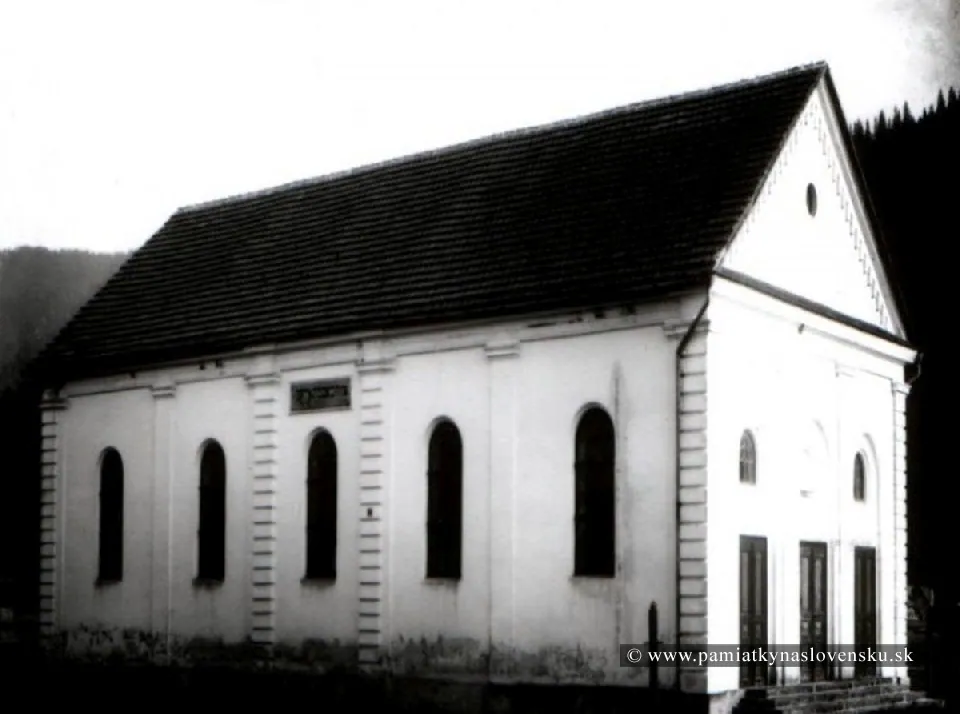
Liptovský Hrádok lies in the Liptov basin, a short distance east of Liptovský Mikuláš, the old centre of Jewish life in the region. According to the historian Peter Vítek, Jews began to settle in Hrádok and its surroundings at the end of the eighteenth century, and before the end of feudalism most of them lived in Prekážka, a settlement that is now part of the town. A land-register map of 1859 already shows an older synagogue in Liptovský Hrádok. Around 1900 a new synagogue was built on approximately the same site, with the community's president, Dr. Viliam Kux, as its driving force. The congregation was too small to keep its own rabbi and belonged to the rabbinate of Liptovský Mikuláš. A single surviving photograph shows the new building as a rendered, steep-roofed hall with a pedimented entrance front and five tall arched windows along each side. Maroš Borský's survey of Slovak synagogue architecture, as summarised by the heritage portal Pamiatky na Slovensku, dates it to the second half of the nineteenth century and records that it was demolished after the Second World War. No source consulted gives the year of demolition or names who carried it out, and the plot it stood on is known only approximately.
Where it stood for nearly 45 years
Historic: Liptovský Hrádok (Hungarian Liptóújvár), Liptó county, probably in or near Prekážka; street and house number unknown. Today: Belanská štvrť area, 033 01 Liptovský Hrádok, Liptovský Mikuláš district (approximate).
Apri la mappa grande →La comunità ebraica
Vítek's study of the Jews of Liptov describes the Hrádok community as a cluster of merchant and innkeeping families that grew up from the late eighteenth century around Prekážka. Samuel Stark, who came from Dolný Kubín, built a house there around 1840; other early residents named by Vítek include Martin Rotschild from Trenčín, the merchant Jakub Stern, the widow Anna Sternová from Liptovský Mikuláš, Emanuel Braun from Huncovce in Spiš, Joachim Schwartz, and Anton Luchs, who lived there with a family of seven. The Donner family owned an inn at Maša near Hrádok; the architect Vojtech Donner (1901-1945) came from it. From the 1870s the community supported a one-class private Jewish school in Prekážka. In 1900 Dr. Viliam Kux was president of the Jewish religious community of Liptovský Hrádok, which belonged to the rabbinate of Liptovský Mikuláš. Between the wars Jewish enterprise in the town included the biscuit firm founded in 1935 by Fridrich Haas with his brothers; it was Aryanized in 1941 and became the basis of the Tatranka factory. No population figures for the Jewish community of Hrádok were found in the sources consulted.
Architettura e design
Vítek describes the synagogue of about 1900 as a building in the form of a rectangular block. Its entrance, on the west side, consisted of three doorways, and the south and north walls each had five tall round-arched windows without stained glass. Inside, the entrance hall probably also served as a study room or schoolroom; above it was a gallery reached by staircases on both sides. The ground floor was filled with pews, and at the east end stood the Torah ark and the reader's desk; the gallery also had pews. The only known photograph agrees with this description. It shows a whitewashed hall under a steep tiled saddle roof, with pilaster strips dividing the long side into bays and a plain cornice. The entrance front is a gable treated as a pediment, with a small round window in the tympanum, two small arched windows and three tall doors reached by steps. A rectangular inscription tablet is set high on the side wall. The architect, builder, cost, dimensions and seating capacity are unknown.
La vita nella sinagoga
The congregation of Liptovský Hrádok did not have a rabbi of its own in the sources found: it belonged to the rabbinate of Liptovský Mikuláš, whose rabbis, according to Pinkas Hakehillot, included Zeev Wolf Singer from the 1880s until his death in 1930. Whether the Hrádok community followed the Mikuláš community into the liberal Yeshurun association in 1928 is not recorded. Religious instruction appears to have been closely tied to the synagogue: Vítek thinks the entrance hall of the building of about 1900 doubled as a study room or school. Earlier, from the 1870s, a one-class private Jewish school worked in Prekážka. It drew pupils from Liptovský Hrádok, Prekážka, Liptovský Mikuláš, Liptovská Porúbka and Dovalovo, and in 1882 also from Bytča, Spiš and Šariš. Móric Eichner taught there from 1877 to 1884; it had 15 pupils in 1877 and 18 in 1882, and it closed at the end of the 1880s. The names of cantors, wardens and later presidents after Viliam Kux were not found.
Distruzione
No source consulted records damage to the synagogue during the Second World War, although the Liptov region was held by partisans during the Slovak National Uprising of 1944 before Nazi forces took it. The building lost its congregation through the persecution and deportations of 1942-1944 and is not mentioned again until after the war. The heritage portal Pamiatky na Slovensku, citing Maroš Borský's Synagogue Architecture in Slovakia (2007, p. 135), states only that it was demolished after the Second World War, and lists it among lost monuments. The en.wikipedia list of synagogues in Slovakia gives 1950, but that figure has no supporting reference and no second source confirms it. The local histories of the town on its own website and on e-obce.sk do not mention the synagogue at all, and Vítek's study ends before the war. Who demolished the building, and whether it was first sold by a surviving Jewish body, is not recorded in the sources found.
Il destino della comunità
Under the Slovak State the Jews of the Liptov district were stripped of their businesses: Fridrich Haas's biscuit firm in Liptovský Hrádok was Aryanized in 1941. Pinkas Hakehillot records that at the beginning of 1942 there were 1,605 Jews in Liptovský Mikuláš and its surroundings, the area to which Hrádok belonged. At the end of March 1942 the authorities rounded up 120 young men and women; the women were sent through Poprad to Auschwitz and the men through Žilina to Majdanek. From 2 April 1942 a further 596 Jews of the town and surroundings were deported to the Lublin district, where the Nazis sent able-bodied men to Majdanek and women, children and the elderly to Sobibor. About half the Jews of the district were deported in 1942; 623 remained with exemption permits. When Nazi forces occupied the region after the Slovak National Uprising of 1944, many of the remaining Jews survived by fleeing to the forests and remote villages. How many Jews of Liptovský Hrádok itself were murdered or survived is unknown, and no postwar community is recorded there.
Il luogo oggi
The exact plot of the synagogue has not been identified in any source consulted. Vítek places both the older synagogue of 1859 and its successor of about 1900 on roughly the same site but gives no street. The heritage portal Pamiatky na Slovensku gives coordinates for the lost building that fall in the Belanská štvrť district of Liptovský Hrádok; the map pin for this entry uses them, but their basis is not stated. No remains of the building and no marker on the site are recorded. The small Jewish cemetery, with tombstones dated from 1883 to 1913, survives unmarked on a hillside outside the town.
Nomi importanti
Viliam Kux
UnknownPresident of the Jewish religious community of Liptovský Hrádok, in office in 1900Dr. Viliam Kux was president of the Jewish religious community of Liptovský Hrádok in 1900, according to the historian Peter Vítek, who credits him as the driving force behind the new synagogue built that year on approximately the site of the older one shown on the 1859 land-register map. The community he led was small and belonged to the rabbinate of Liptovský Mikuláš. Nothing further about his life, profession or fate was found.
Biografia o fonte →Móric Eichner
UnknownTeacher of the community's Jewish school in Prekážka, 1877-1884Eichner taught at the one-class private Jewish school that the community kept in Prekážka, now part of Liptovský Hrádok, from 1877 to 1884, according to Peter Vítek. The school drew pupils from Hrádok, Prekážka, Liptovský Mikuláš, Liptovská Porúbka and Dovalovo, and in 1882 from as far as Bytča, Spiš and Šariš; it had 15 pupils in 1877 and 18 in 1882 and closed at the end of the 1880s.
Biografia o fonte →Hai qualcosa da condividere?
Fotografie, documenti, storie di famiglia o ricordi di questa sinagoga e della sua comunità aiutano a mantenerne viva la storia.
- Liptovský Hrádok - Synagóga
- Židia v Liptove do 2. svetovej vojny
- Liptovský Hrádok - synagóga (photograph page)
- List of synagogues in Slovakia (Žilina Region table)
- Liptovsky Svaty Mikulas (Encyclopedia of Jewish Communities, Slovakia)
- Liptovsky Hradok Jewish Cemetery (survey)
- Liptovský Hrádok (Cemetery Discovery Project)
- Liptovský Hrádok - História
- Nominatim reverse geocode of 49.039387, 19.730219 (Belanská štvrť, Liptovský Hrádok)
Share a memory or thought
No comments yet. Be the first to add one.