

The story of Lovosice Synagogue
Lovosice, called Lobositz in German, is a small industrial town on the left bank of the Elbe in the Litoměřice district of northern Bohemia. Its Jews lived in a compact quarter, the Judenstadt, laid out on land given by the lord of the manor in the early eighteenth century; it lay around today's Studniční Square, north of what is now Václavské Square. The synagogue was the centre of this quarter. According to the Jüdische Gemeinden website it burned down around 1760 and was rebuilt soon afterwards; a caption on the PastVu photo archive instead speaks of an eighteenth-century synagogue rebuilt after a fire in 1900. The congregation also had a one-storey community house with a winter prayer room and the rabbi's flat. The synagogue was renovated in the 1920s, when the community still numbered around three hundred people, including Jews from the surrounding villages. After the Munich Agreement Lovosice was annexed to Nazi Germany in October 1938. The synagogue's interior was destroyed, the town's spokesperson and the PastVu caption say probably during the November pogrom of 1938, and the Czech Academy of Sciences memorial database records that the building was demolished in 1939, together with the tannery that had been closely tied to the Jewish community. The rest of the Jewish quarter disappeared after 1945.
Where it stood for nearly 180 years
Historic: Jewish quarter (Judenstadt) at Oberfuhrstrasse / Studniční Square, Lobositz. Today: north-eastern edge of Václavské náměstí, 410 01 Lovosice, at the 2026 Holocaust memorial (approximate).
Open larger map →The Jewish community
Local tradition dates Jewish settlement in Lovosice to about 1540, when Jews are said to have come from nearby Litoměřice, but the community is first documented in the early eighteenth century; the Czech Academy of Sciences memorial database gives 1688 as its founding year. In 1704 the landlord provided building land for about twenty houses, which became the Jewish quarter. There were 17 Jewish families in 1724 and about 25 around 1800. Until 1848 Jews lived almost only inside the quarter; after that they moved into the rest of the town and played a large part in its trade and industry, owning breweries and factories making sugar, sweets and coffee substitute. The census counted 85 Jews in 1849, 184 in 1880 (about four percent of the population), about 280 in 1900 and about 270 in 1921. Around 1930 about 200 lived in the town itself, and in 1933 the community had some 320 members, about 250 of them resident in Lovosice. An old cemetery is said to have existed in the seventeenth century, a second was laid out around 1715, and a new cemetery was opened around 1870-1875.
Architecture and design
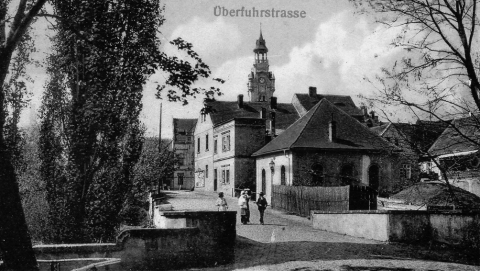
No plan, architect or building date beyond the rebuilding after the fire of about 1760 is recorded in the sources read. Two photographs show the building from the street then called Oberfuhrstrasse, looking towards the town hall tower. The synagogue was a free-standing, rendered hall of one tall storey under a steep hipped roof covered with tiles, set back behind a wooden fence and a low wall. Its long side facing the street had a row of tall round-headed windows, and a lamp on a bracket was fixed to the corner nearest the road. A small chimney rose from the roof. Larger two- and three-storey houses of the Jewish quarter stood close around it. The modest, almost domestic form, without towers or an ornate facade, is typical of rural Bohemian synagogues of the eighteenth century. The renovation of the 1920s is mentioned but not described. The seating capacity, the arrangement of the women's gallery and the interior furnishings are unknown.
Life inside the synagogue
Very little is recorded about worship in the Lovosice synagogue. The Jüdische Gemeinden website notes that the community kept a separate one-storey community house next to it, which held a winter prayer room, used when the large hall was too cold to heat, and the residence of the rabbi. The only rabbi named in the sources read is Samuel Freund, a Talmudist trained in Prague, who served Lobositz in the 1820s before becoming a judge of the Prague rabbinical court in 1832. The congregation also maintained a ritual purification house at its cemetery, which still stands and now serves as the mortuary hall of the municipal cemetery. The synagogue served not only the Jews of Lovosice but also those of nearby villages, so that the community of about 320 members in 1933 was larger than the Jewish population of the town alone. The renovation of the building in the 1920s suggests the congregation was still active and able to invest in its house of prayer in the years between the wars, when its members were prominent in local business.
Destruction
After the Munich Agreement Lovosice was occupied by Nazi Germany in October 1938 and annexed to the Reichsgau Sudetenland. Most Jewish residents had left the town by then. The Jüdische Gemeinden website states that the synagogue's interior was destroyed during the Nazi period. The town's spokesperson, quoted in 2026, said the synagogue was probably destroyed during the Kristallnacht pogrom of November 1938, and the PastVu photo caption says the Nazis probably demolished it in 1938. The Czech Academy of Sciences memorial database is more specific: in 1939 the tannery and, above all, the synagogue, which had allegedly been burned during Kristallnacht, were demolished. None of these sources names the officials or men who set the fire or ordered the demolition, and no contemporary document of either was found, so the burning rests on the word 'allegedly'. The rest of the Jewish quarter and the old Jewish cemetery were cleared after 1945.
The community’s fate
By the time Nazi German forces occupied Lovosice in October 1938, most of its Jews had fled into the interior of Czechoslovakia, as did most Jews of the Sudeten borderlands. Exact information on their fate is lacking. According to the Czech Academy of Sciences memorial database, the Nazis deported members of the community first to the nearby village of Dlažkovice and then to the Terezín ghetto, a few kilometres away across the Elbe, and on to other camps, and the vast majority of them perished. The Jüdische Gemeinden website also concludes that most members were probably victims of Nazi persecution. In the last years of the war a subcamp of the Flossenbürg concentration camp operated in the town; whether Jewish prisoners worked there is unknown. No Jewish community was re-established after 1945. Names of individual victims from Lovosice are recorded in the database of the Terezín Initiative Institute at holocaust.cz, which was not consulted for this entry.
The site today
The site of the synagogue lies on the north-eastern edge of Václavské Square, in the area of the former Jewish quarter around Studniční Square. The remaining houses of the quarter were demolished in the decades after 1945 and the area became open land; a restaurant now stands nearby. Nothing of the synagogue survives above ground. A memorial to the Holocaust victims of Lovosice was unveiled at the site on 27 January 2026. The only surviving Jewish building in the town is the former purification house at the new Jewish cemetery, now the mortuary hall of the municipal cemetery.
Notable names
Samuel ben Issachar Bär Freund
1794-1881Rabbi of Lobositz (Lovosice), probably in the 1820s, before 1832Born in Tuschkau (Tuškov) in 1794, Freund studied under Eleazar of Triesch, Baruch Fränkel of Leipnik and at the Prague yeshiva under Bezalel Ronsperg. A few years after his studies he became rabbi of Lobositz, where he served the congregation of this synagogue. In 1832 he was called to Prague as assistant dayyan to Samuel Landau and, after Landau's death in 1834, led the Prague rabbinical court until he resigned in 1879. He died in Prague on 18 June 1881.
Biography or source →Do you have something to contribute?
Photographs, documents, family stories or memories of this synagogue and its community help keep its history alive.
Share a memory or thought
No comments yet. Be the first to add one.