
La storia di Luduș Synagogue
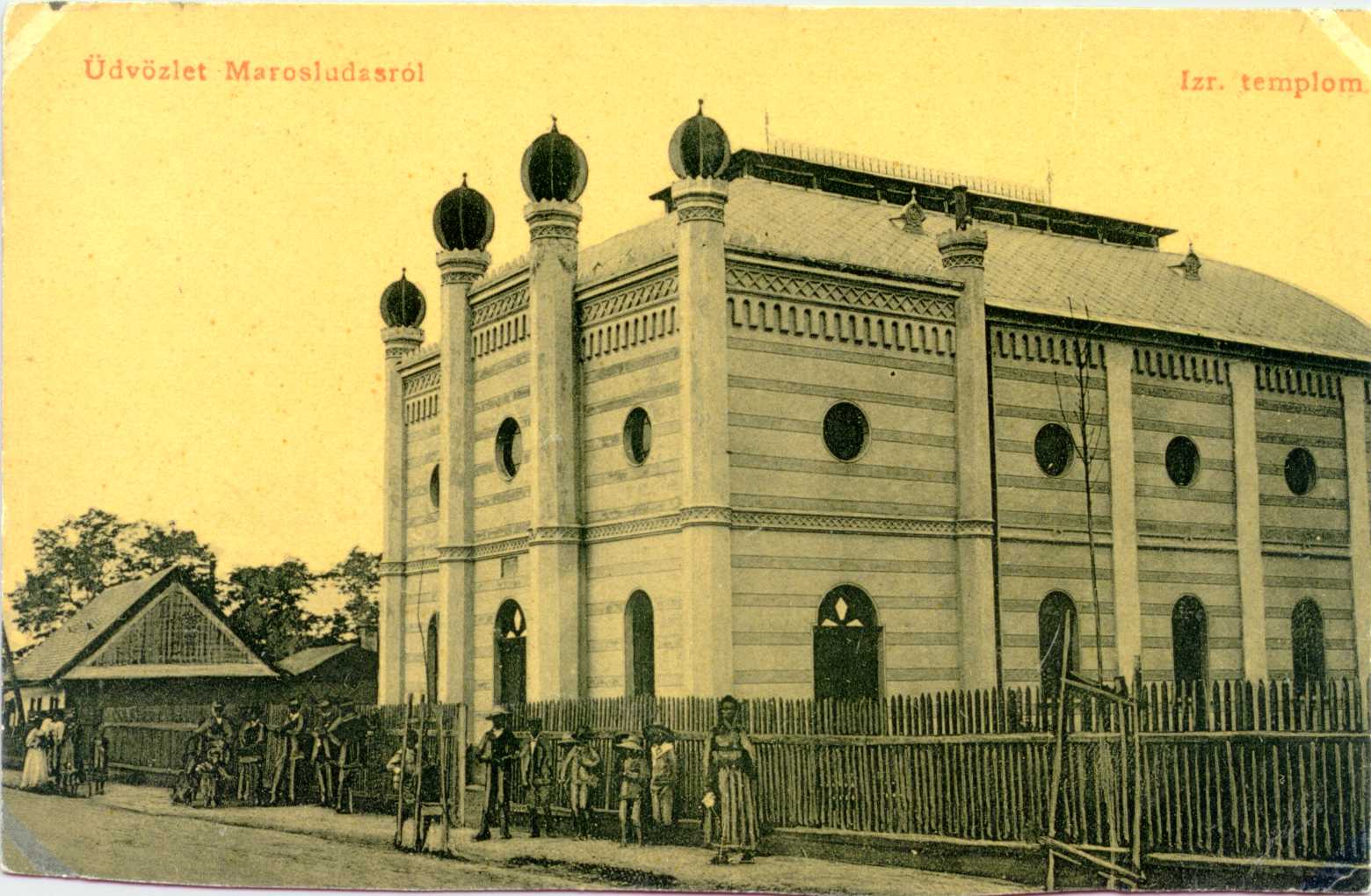
Luduș, known in Hungarian as Marosludas, is a small town on the Mureș river in today's Mureș county, about 25 km south-southeast of Turda. Its Jewish community was small in the nineteenth century. A printed Hungarian-Hebrew fundraising appeal of 1886, now in the YIVO Archives, says the congregation then counted 53 families, could not afford a synagogue of its own and was praying in rented rooms; the appeal was sent to other communities, among them Szeged, to raise money for a building. The community later had a substantial synagogue. A postcard captioned 'Üdvözlet Marosludasról' and 'Izr. templom', preserved in the Hungarian Jewish Museum and Archives, shows a large Moorish Revival hall with four onion-domed corner turrets standing behind a picket fence on an unpaved street. The English Wikipedia list of synagogues in Romania dates the building to the nineteenth century and records it as burned down in 1944, without citing a source. In September 1944 Royal Hungarian Army and gendarmerie units occupied Luduș and shot 13 local Jews between 5 and 13 September. No source found connects the burning of the synagogue to these events, and who set the fire, and in what month, is unknown.
Where it stood for 58 years
Historic: Marosludas (Maros Ludas), about 25 km south-southeast of Torda; street and house number unknown. Today: unknown; placeholder pin at the centre of Luduș, Mureș county, Romania (approximate).
Apri la mappa grande →La comunità ebraica
The earliest firm evidence found for organised Jewish life in Luduș is the 1886 fundraising appeal held by the YIVO Archives in New York. It describes Maros Ludas as a small community of 53 Jewish families that met for prayer in rented quarters because it lacked the means to build a synagogue. To prevent fraud, only collectors who personally held a signed copy of the form were authorised to raise money, and each donation had to be certified by the community's officials; the back of the form had space for donors' names and sums. The copy that survives was sent to the Jewish community of Szeged in southern Hungary. The names of the officers who signed it are not given in the YIVO description. By 1944 the Jewish population of Luduș had grown to 575, according to a 2005 article by Nicolae Balint in Ziarul de Mureș, which notes that the town was then a district centre near the border. No details were found about the community's rabbis, religious orientation, schools or institutions.
Architettura e design
The only image found is a photographic postcard in the Hungarian Jewish Museum and Archives, captioned 'Üdvözlet Marosludasról' (Greetings from Marosludas) and 'Izr. templom' (Israelite temple). It shows a large free-standing hall in a Moorish Revival manner, seen from a corner. Each corner of the entrance front and of the building carries a slender round turret topped by a dark onion dome with a small finial. The rendered walls are banded with horizontal stripes and crowned by a cornice of small blind arches and a zigzag frieze. Round windows run along the upper storey and tall round-headed windows along the ground floor; the entrance has round-headed doors. A broad hipped roof covers the hall, with a railing along its ridge. The architect, the builder, the exact construction date and the seating capacity are unknown, as is the interior arrangement. The building must date from after 1886, when the community still had no synagogue.
La vita nella sinagoga
Almost nothing is recorded about religious life in the Luduș synagogue. The 1886 appeal shows that before it was built the congregation prayed in rented rooms and organised its fundraising through officials who certified each donation, which suggests a formally constituted community with its own board. The postcard shows a building of a size and ambition unusual for a provincial town of a few hundred Jews, indicating that the fundraising succeeded and that the congregation invested heavily in its house of prayer. The postcard was written to a man named Manó Herzog, but nothing further is known about him or about the sender. Whether the congregation followed the Orthodox, Neolog or Status Quo Ante rite, who its rabbis and cantors were, and what schools or societies met in or beside the synagogue are unknown from the sources consulted. Further detail is likely in Hungarian Jewish yearbooks and in the Pinkas Hakehillot volume on Transylvania, which were not read.
Distruzione
The English Wikipedia list of synagogues in Romania states that the Luduș synagogue was burned down in 1944, but gives no reference, no month and no perpetrator. No other source read in this research describes the fire. In September 1944 units of the Royal Hungarian Army and the Hungarian gendarmerie occupied Luduș from the evening of 5 September. Between 5 and 13 September they shot 13 Jews of the town, among them Mihai and Vilma Polac and their daughters, and the Haller sisters with Maria Kopstein and Adelca Izrael, who were raped and shot in the cellar of the Haller house. Two local residents were later convicted by the People's Tribunal in Cluj for their part. None of the accounts of the massacre mentions the synagogue, so it cannot be said whether the Hungarian troops, local people, the fighting that drove the Hungarians out, or another cause destroyed it. Who burned it is unknown.
Il destino della comunità
According to Ziarul de Mureș, 575 Jews lived in Luduș in September 1944. Hungarian army and gendarmerie units that occupied the town from 5 September shot 13 of them by 13 September, including whole families; the bodies were identified after the town was retaken. A 1945-46 investigation followed, and the People's Tribunal in Cluj convicted two local residents, Béla Szabó and Elisabeta Bartha; Bartha, whose denunciation led to two of the deaths, received five years in prison. The Hungarian soldiers involved were never identified. Documents on the killings at Luduș and nearby Sărmașu were passed to Iuliu Hațieganu to publicise them. The sources give conflicting pictures of the rest of the community: the English Wikipedia article on Luduș says the Jewish population was murdered in the massacre, while the figures in the Romanian press accounts imply that most of the 575 survived. What became of the survivors, and whether an organised community re-formed after the war, is unknown.
Il luogo oggi
The location of the synagogue within Luduș has not been identified in any source consulted, so it is not possible to say what stands on the plot today. The postcard shows it on an unpaved street lined with low wooden-gabled houses and picket fences, but neither the street nor any landmark is named. No surviving fragment of the building is recorded. The map pin for this entry is a placeholder at the centre of Luduș and should not be read as the synagogue's position. Fixing the address will need old cadastral maps of Marosludas, Romanian property records or local inquiry in the town.
Hai qualcosa da condividere?
Fotografie, documenti, storie di famiglia o ricordi di questa sinagoga e della sua comunità aiutano a mantenerne viva la storia.
Share a memory or thought
No comments yet. Be the first to add one.