
Historia Lúky Synagogue
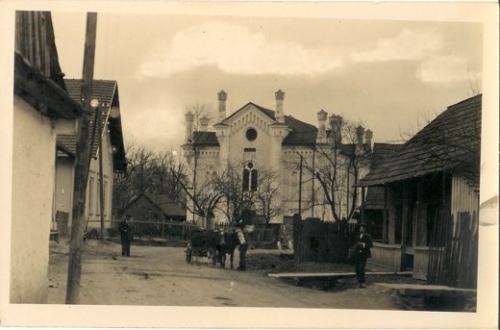
Lúky, historically also called Lúky pod Makytou, lies in the hills of the Púchov district in the Trenčín region, close to the Moravian border. A Jewish community grew up there in the nineteenth century, and in 1872 it built itself a synagogue. The Slovak Wikipedia article on the village describes the building as being in the oriental style, and the one surviving photograph agrees: it shows a tall rendered hall with a gabled front, small turrets with pointed caps along the roofline, a round window in the gable and a pair of round-arched windows below it, standing at the end of an unpaved village street lined with low wooden houses.
By the Second World War, according to the historian Pavol Makyna, Lúky had the second-largest Jewish community in the Púchov district after the town of Púchov itself, and Jewish merchants and landowners there were among those stripped of their property under the Slovak State's aryanisation laws. The synagogue stood empty after the deportations of 1942. Both the official village history published on the Slovak state's public administration portal and Makyna's study state that German troops burned it down in 1945, as they withdrew from the area ahead of the Red Army and Romanian forces. Nothing of the building survives.
Where it stood for 73 years
Historic: Lúky (Lúky pod Makytou), Trenčín county; street and house number unknown. Today: unknown; placeholder pin at the centre of the municipality of Lúky, 020 53, Púchov district, Trenčín region (approximate).
Otwórz większą mapę →Społeczność żydowska
Little has been published about the Jews of Lúky as a community. Makyna's 2016 study of the anti-Jewish measures in the Púchov district names Lúky, together with Pruské and Bolešov, as one of the three Jewish communities that existed in the district alongside Púchov, and calls it the second largest. The Slovak Wikipedia article on the village gives 61 inhabitants of Jewish origin in 1942. Jews in Lúky were traders, shopkeepers and landowners: Makyna records that six Jewish-owned businesses in Lúky pod Makytou were liquidated during aryanisation, that Arnold Weiner held 51.11 hectares of pasture in the cadastral areas of Lúky and Vydrná, that Móric Dávid of Lúky was among those whose property was taken, and that the shop of the trader Alexander Birmann was inspected by the authorities in April 1941. The district office in Púchov refused a medical licence to Dr Aladár Haas of Lúky pod Makytou. The community kept its own cemetery, which survives near the railway station on the road to the Dubková part of the village. The date the community was founded and its religious affiliation are unknown.
Architektura i projekt
The only image found of the building is an undated sepia photographic postcard taken from the village street. It shows the synagogue standing back from the road behind a wooden fence and bare trees, larger and taller than the single-storey wooden and rendered houses around it. The main front faces the street under a steep gable decorated with a row of small arched corbels along its edges. The gable is flanked by two slender turrets ending in pointed caps, and further capped turrets or pinnacles rise at the corners and along the side walls, giving the roofline a spiky outline. In the centre of the gable is a round window, and beneath it a pair of tall round-arched windows set under a further small round opening. The walls appear to be rendered and painted in a light colour, with string courses dividing the storeys. These features fit the oriental or Moorish Revival manner that the Slovak Wikipedia article attributes to it. The architect, builder, dimensions, seating capacity and interior arrangement are unknown, and no interior photograph or plan has been found.
Życie w synagodze
No account of religious life inside the Lúky synagogue has been found. The names of its rabbis, cantors and lay leaders are unknown, and it is not known whether the congregation was Orthodox, Neolog or Status Quo, or whether it had its own rabbi or was served from Púchov or another neighbouring town. The size of the building in the photograph suggests that it was intended to serve not only the Jews of Lúky but probably also those of the surrounding hill villages, but no source confirms this. The community's own cemetery near the railway station shows that it maintained the basic institutions of an independent congregation. The synagogue would have been the centre of its religious life from 1872 until the deportations of 1942, after which no congregation remained to use it.
Zniszczenie
After the deportations of 1942 the synagogue stood empty. Nazi German forces occupied Púchov on 27 January 1945, and Hungarian troops were also stationed in the town. As the front approached in April 1945, Makyna writes, the Germans evacuated Púchov and its surroundings before the Red Army arrived, blowing up the bridges over the Váh; Púchov was liberated on 30 April, and the official village history says Lúky was liberated by Romanian soldiers on 2 May 1945. Two independent sources state who destroyed the synagogue. The village history on the Slovak public administration portal says that in the spring of 1945 it was burned and destroyed by the Germans. Makyna's study, which cites the 1996 village monograph published by the Lúky municipal office, says the synagogue founded in 1872 was burned to the ground by departing German troops in 1945. The Slovak Wikipedia article repeats that retreating German soldiers set it on fire at the end of the war. The exact date of the fire is unknown, and no source records whether any ruins stood after 1945 or when they were cleared.
Los społeczności
In February 1942 a registration counted 464 Jews in the district. Deportations began in late March 1942 and were organised by the fourteenth department of the Slovak Ministry of the Interior; members of the Hlinka Guard and the Freiwillige Schutzstaffel helped compile the lists, and the Hlinka Guard guarded the transports. Some Jews from the district's villages, Lúky pod Makytou among them, were first sent to the labour camp at Horné Kočkovce. Women were taken to the Patrónka camp in Bratislava on 30 March 1942, and further transports went to the camp at Žilina on 7 June, 23 July and 27 August; on 23 July nine Jews from Lúky, Bolešov and Lednické Rovne were taken. From Žilina the deportees were sent on to the Nazi death camps in German-occupied Poland. The Slovak Wikipedia article states that the 61 Jews of Lúky counted in 1942 were murdered in the Holocaust. Makyna notes that only a few Jews of the district returned after the war; how many of them came from Lúky is unknown, and no Jewish community was re-established in the village.
Miejsce dzisiaj
The exact plot on which the synagogue stood has not been identified in any source consulted. The postcard shows it set back from an unpaved street of low houses, but it does not name the street, and no surviving fragment of the building is recorded. The map pin for this entry is a placeholder at the centre of Lúky and should not be read as the synagogue's location. The Jewish cemetery of Lúky survives and has been tidied; it lies near the railway station on the road to the Dubková part of the village. Identifying the site will need the 1996 village monograph, old cadastral maps or local inquiry.
Czy masz coś do przekazania?
Zdjęcia, dokumenty, historie rodzinne lub wspomnienia o tej synagodze i jej społeczności pomagają zachować jej historię.
Share a memory or thought
No comments yet. Be the first to add one.