

La storia di First Synagogue of Luxembourg City
After the French conquest of 1794-95 Jews were again allowed to live in Luxembourg, and a small community grew up in the capital. Around 1821 it acquired a building on the rue du Séminaire, also called rue du Petit-Séminaire and today rue de la Congrégation, in the upper town. The building stood against the Hôtel de Bourgogne, the later seat of the Prime Minister. The synagogue was inaugurated in 1823 and was led in its early years by Pinhas Godchaux, the community's leading figure. It had about a hundred seats.
For seventy years this was the only synagogue in the capital and the seat of the chief rabbinate created in 1843, whose first holder was Samuel Hirsch, one of the thinkers of German Reform Judaism. After the Franco-Prussian War of 1870 Jewish immigration grew and the room became too small. Planning for a new synagogue began in 1876, its foundation stone in the rue Notre-Dame was laid in 1893, and it opened in 1894. The old building was sold, in 1891 according to Wikipedia and in 1895 according to the plaque near the site, reportedly for 20,000 Luxembourg francs, to the Congrégation de Notre-Dame. The only image of it is Guido Oppenheim's painting of the interior from the early 1890s.
Where it stood for 72 years
Historic: rue du Séminaire (rue du Petit-Séminaire), adjoining the Hôtel de Bourgogne, Luxembourg. Today: rue de la Congrégation near no. 4 (Hôtel de Bourgogne), L-1352 Luxembourg, Ville-Haute (approximate).
Apri la mappa grande →La comunità ebraica
Jews had been expelled from Luxembourg in the Middle Ages and returned only after the French annexation at the end of the eighteenth century. An early nineteenth-century census counted 75 Jews in Luxembourg, and by 1810 there were about 20 Jewish families. Pinhas Godchaux settled in the city in 1798 and gradually became the leader of the community; it was he who ran the new synagogue. Alicke's figures for the whole Grand Duchy give about 400 Jews in 1841, 565 in 1867 and about 370 around 1880, and English Wikipedia counts 150 Jewish families in 1880, most of them in the Gutland. The capital's congregation was the centre of this population. In 1843 King William II of the Netherlands, as Grand Duke, appointed Samuel Hirsch the first state-salaried chief rabbi. After the war of 1870, families from Alsace and Lorraine arrived, and by 1895 the Grand Duchy counted 1,054 Jews, which made the 1823 synagogue inadequate and led to the building of its successor.
Architettura e design
Whether the community adapted an existing house or put up a new building is disputed: the tourist office and German Wikipedia say a house bought in 1821 was fitted out as a synagogue, while Alicke writes that the community had the synagogue erected in 1823. The plaque on the site says only that the building adjoined the Hôtel de Bourgogne and was reached from the old rue du Séminaire. No plan, exterior view or photograph is known. Guido Oppenheim's painting shows a tall plastered hall with round-arched windows whose upper panes are filled with coloured glass, a round coloured window above the Torah ark, and the tablets of the Ten Commandments over the ark, which is hung with a dark curtain. A raised bimah in the centre is enclosed by an openwork iron railing with pointed arches and has tall lamp columns at its corners. A women's gallery with a panelled front runs along one side under a vaulted ceiling, a crystal chandelier hangs in the room, and a painted Hebrew inscription reads 'Know before whom you stand'. The architect is unknown.
La vita nella sinagoga
The synagogue was the community's only house of worship in the capital from 1823 to 1894. In its first decades it was directed by Pinhas Godchaux. From 1843 it was the synagogue of Samuel Hirsch, the first chief rabbi of the Grand Duchy, who held the post until 1866. While in Luxembourg Hirsch published Die Humanität als Religion and Reform im Judenthum and took part in the rabbinical conferences of Brunswick, Frankfurt and Breslau in 1844-46, but according to JGuide Europe his reformist views did not win over the traditional congregation he served. Oppenheim's painting suggests a conventional arrangement, with a central bimah, an ark on the end wall and a separate gallery for women. With about a hundred seats, the room was adequate for a community of a few dozen families, but not for the larger community that formed after 1870. Services moved to the new synagogue in the rue Notre-Dame when it was inaugurated on 28 September 1894 by Rabbi Isaac Blumenstein.
Distruzione
The building was not destroyed by violence. Once the new synagogue opened in 1894, the community sold its old premises; the plaque on the site dates the sale to 1895, while English Wikipedia, citing Laurent Moyse, says the congregation left the site in 1891, that the Congrégation de Notre-Dame took its place, and that the price was 20,000 Luxembourg francs. According to the Luxembourg City Tourist Office, the old synagogue then disappeared in the course of the expansion of the neighbouring Sainte-Sophie boarding school for girls. No source consulted gives the year of the demolition, names who ordered or carried it out, or says whether any walls were kept inside the later school buildings. The AEPJ plaque on the site states plainly that the synagogue building no longer exists. Its loss followed a voluntary sale and is unconnected with the Nazi destruction of its successor in the rue Notre-Dame in 1941.
Il destino della comunità
The congregation that worshipped here moved in 1894 to the large new synagogue in the rue Notre-Dame and kept growing, to about 1,200 Jews in the Grand Duchy around 1900 and about 4,000 in May 1940, some 3,000 of them refugees from Germany and Austria. After Nazi Germany invaded Luxembourg in May 1940, the Nazi occupiers drove Jews to emigrate; convoys left for Portugal until October 1941. On 16 November 1941 the first Nazi transport took 323 Jews from Luxembourg to the Łódź ghetto, and later deportations followed; Emile Godchaux died in Theresienstadt in 1942. The painter Guido Oppenheim, who had recorded this synagogue's interior, was also among the victims of the Shoah. JGuide Europe gives the number of Luxembourg Jews who survived as 1,500. After liberation the community met in a rented room in the Stock Exchange building until a new synagogue opened on avenue Monterey on 28 June 1953.
Il luogo oggi
The plot lay in the block between the rue de la Congrégation and the rue Notre-Dame in Luxembourg's upper town, against the Hôtel de Bourgogne at 4 rue de la Congrégation, the former office of the Prime Minister. The former rue du Séminaire that led to the synagogue is now part of an open space between buildings. In 1970 the State bought the whole block, which was restructured and renovated and now houses ministries and government departments. Nothing of the synagogue survives above ground. A plaque erected by the European Association for the Preservation and Promotion of Jewish Culture and Heritage marks the site, and the Kaddish Shoah memorial of 2018 stands a few steps away.
Nomi importanti
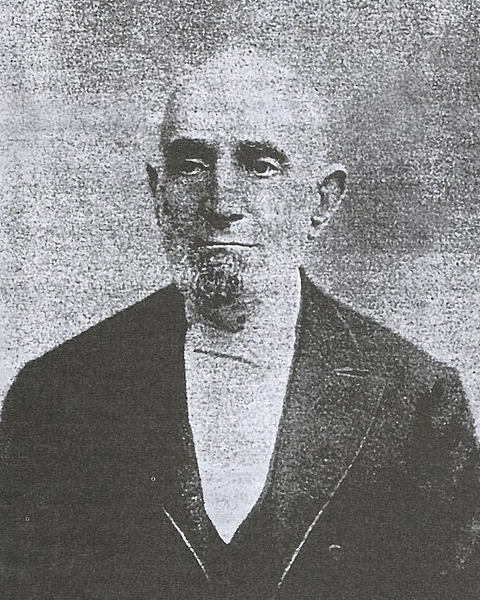
Samuel Hirsch
1815-1889First chief rabbi of the Grand Duchy of Luxembourg, 1843-1866Born in Thalfang, Hirsch was appointed chief rabbi of Luxembourg in 1843 by King William II of the Netherlands, the first rabbi paid by the state, and served the congregation of this synagogue until 1866. During those years he published Die Humanität als Religion and Reform im Judenthum and attended the Reform rabbinical conferences of 1844-46, though his views did not win over his traditional congregation. In 1866 he moved to the United States; he died in Chicago in 1889.
Biografia o fonte →Pinhas Godchaux
UnknownLeader of the Luxembourg Jewish community; ran the synagogue from 1823Godchaux settled in Luxembourg City in 1798, a few years after Jews were readmitted under French rule, and gradually became the leader of the small Jewish community there. According to the Luxembourg City Tourist Office, the synagogue that the community opened in 1823 in its house on the rue du Séminaire was run by him. His dates of birth and death and later career were not found in the sources read.
Biografia o fonte →Hai qualcosa da condividere?
Fotografie, documenti, storie di famiglia o ricordi di questa sinagoga e della sua comunità aiutano a mantenerne viva la storia.
- 8. Location of Luxembourg's Synagogue from 1823
- 7. Location of Luxembourg's Synagogue from 1823
- 5. Old Synagogue
- First synagogue of the Jewish community of Luxembourg (marker)
- Luxembourg Synagogue
- History of the Jews in Luxembourg
- Luxemburg (Luxemburg)
- Luxembourg (JGuide Europe)
- Samuel Hirsch
- File:Guido Oppenheim Synagog.JPG
- Hôtel de Bourgogne (OpenStreetMap way 50792516)
- Luxembourg (JGuide Europe region page)
- File:Samuel Hirsch 1815-1889.jpg
Share a memory or thought
No comments yet. Be the first to add one.