
The story of Maassluis Synagogue
Maassluis, a fishing and harbour town on the Nieuwe Waterweg west of Rotterdam, had Jewish residents from at least 1688, when Levij Jacobs bought a house on the Hoogstraat. The community used two earlier synagogues on the Boonestraat: one approved by the town in 1769, and a converted coach house on the Lange Boonestraat inaugurated on 2 December 1831. When that building decayed beyond repair, the congregation found a new building on the north side of the Zuidvliet, on a quay then called the Looierspad and renamed Groen van Prinstererkade in 1912. The funds raised for it included 400 guilders from the King.
The new synagogue was festively opened on 30 April 1858 and stayed in use for as long as the community existed; its fiftieth anniversary was celebrated in 1908. It formed part of a complex of more than 380 square metres with a house and yard, a ritual bathhouse and a warehouse, while a Jewish school and the house of the religious teacher, who also served as cantor, stood on the adjoining plot. Membership, around ninety for most of the nineteenth century, collapsed after the railway to Rotterdam opened in 1891 and families moved to the city. After 1945 the building stood empty and decaying until it was pulled down in 1960. Fragments of it, including the frieze and the foundation stone, went to the Maassluis museum.
Where it stood for 102 years
Historic: Looierspad (from 1912 Groen van Prinstererkade), north side of the Zuidvliet, two houses past the Lijndraaierssteeg, Maassluis. Today: parking space and pavement on the Groen van Prinstererkade at the junction with the P.C. Hooftlaan, 3142 Maassluis (approximate).
Open larger map →The Jewish community
Jews were living in Maassluis by the 1720s, and the earliest known resident, Levij Jacobs, is recorded in 1688. In the 1760s the group grew large enough to ask the town council for a synagogue, and the council approved the community's statutes in 1770. After 1814 Maassluis was a small subordinate congregation under the main synagogue of The Hague, at first also serving Delft and Schiedam. It was run by three leaders, a chairman, a treasurer and an elder, and employed one man as teacher, reader and sexton, at times also as ritual slaughterer. A burial society, Gemilous Gasodiem, was active from the 1830s, and there was a women's association that looked after the synagogue's interior and a collector for the Holy Land. Quarrels inside the community and with the central consistory in The Hague at one point led to the dismissal of the wardens. The community counted 95 Jews in 1809, 94 in 1840 and 97 in 1869, but only 57 in 1899 and 18 in 1930. A merger with Rotterdam was discussed from 1920, and by 1940 the congregation had effectively ceased to exist.
Architecture and design
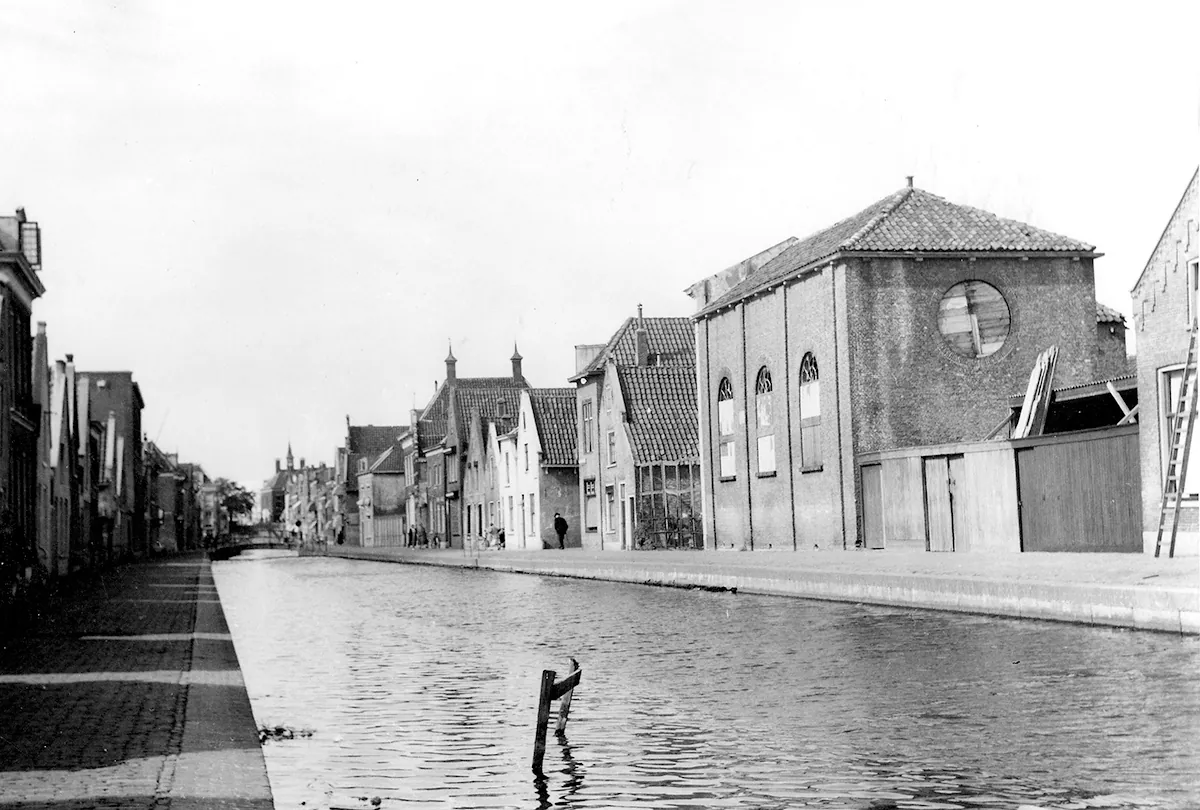
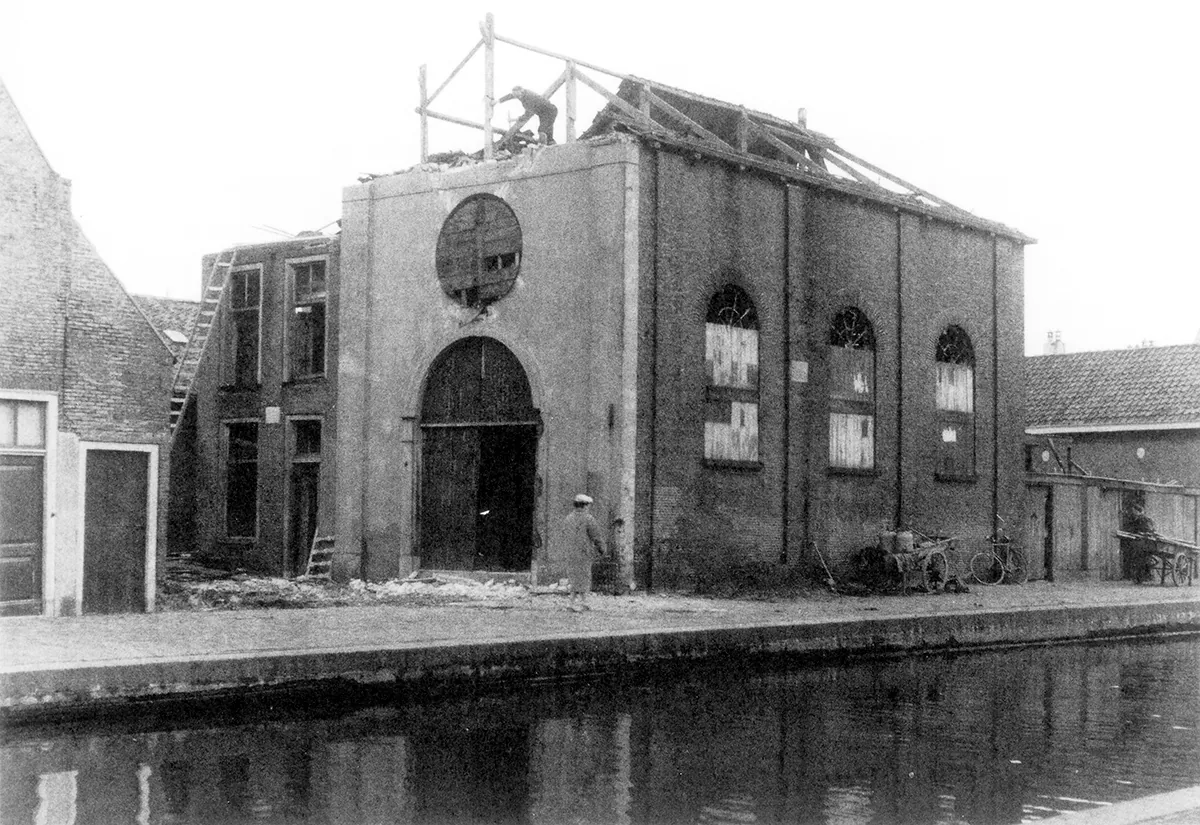
The surviving photographs show a tall, free-standing brick hall under a steep hipped roof of pantiles, set directly on the canal quay among lower gabled houses. The street front had a large round window high in the gable wall and, in the demolition photograph, a broad round-arched doorway below it. Along the long side facing the canal were three tall round-headed windows with small panes. Plain pilaster strips divided the walls, and a low wooden fence and sheds closed off the yard beside it. Inside, according to the recollections of L.A. Colthof, cantor in the early twentieth century, the ark stood against the north wall rather than the east. Three steps ran across the width of the room with the cantor's lectern in front of them, and a central reading platform with steps on two sides carried the desk for the Torah reading, with a bench at its back. Lighting was by gas, later electric. Inside the entrance a staircase on the left led to a women's gallery that Colthof thought held about thirty people. The architect and the total number of seats are unknown.
Life inside the synagogue
For most of the nineteenth century the synagogue served a congregation of about ninety people, enough for regular services with a minyan. Religious life depended on a single paid official who acted as teacher, cantor and often sexton; from 1811 he was called the gazan and earned 100 guilders a year, and his house and the Jewish school stood next to the synagogue. In 1878 the school had eleven paying and eight non-paying pupils. A ritual bath belonged to the same complex. Women of the congregation maintained the furnishings of the prayer hall through their own association. The community marked the synagogue's fiftieth anniversary in 1908; around 1910 about thirty Jews still lived in the town, still enough for a minyan. The Colthof family, of which L.A. Colthof was cantor in the early twentieth century, lived on the synagogue site, and his description of the interior is the main record of how the hall was arranged. By 1920 only sixteen Jews remained and regular worship became increasingly difficult as families left for Rotterdam.
Destruction
No source records damage to the synagogue during the occupation of 1940 to 1945, and no source says that the occupiers looted it, although the congregation had already effectively ceased to exist by 1940. After the war Jewish worship in Maassluis was not resumed, and the building fell into serious disrepair. In 1949 the municipality of Maassluis bought the whole complex from the Jewish community of Rotterdam, which acted as heir to the dissolved Maassluis congregation. A photograph of 1955 shows the synagogue closed, with its windows boarded up. In 1960 the synagogue and its outbuildings, by then in a state of decay, were demolished; a photograph of that year shows workmen stripping the roof. The sources do not say in so many words who carried out the work, but the municipality owned the complex at the time. A transformer building was put up and a car park laid out on the site. Some fragments, including the frieze and the foundation stone, were taken to the Maassluis museum.
The community’s fate
By the start of the Second World War only two Jewish families, Colthof and Van Gelderen, still lived in Maassluis, and the congregation no longer functioned. After the Nazi German occupation of the Netherlands in May 1940, the anti-Jewish measures that applied throughout the country isolated them further. In October 1942 the Jews still living in Maassluis were arrested and deported; the Historische Vereniging Maassluis puts their number at five. None of them came back. The individual names, dates of death and places of murder were not found in the sources read for this entry. Jewish life was not restored after the war. In 1947 Maassluis was formally added to the area of the Jewish community of Rotterdam, which in 1948 bought the Jewish cemetery in the Kapelpolder, last used for a burial in 1937. In 1950 the cemetery was cleared, and the remains and 23 gravestones were moved to a separate section of the general cemetery on the Prinses Julianalaan.
The site today
The synagogue stood on the north side of the Zuidvliet on the Groen van Prinstererkade, two houses beyond the Lijndraaierssteeg, near where the P.C. Hooftbrug now crosses the canal. According to the Historische Vereniging Maassluis, the site of the synagogue is now a parking space for disabled drivers and the adjoining pavement, the teacher's house lay where the roadway and pedestrian crossing of the P.C. Hooftlaan now run, and a small electricity transformer building stands where the ritual bath was. Nothing of the building survives on the spot. An information sign with a historic photograph and a QR code was placed on the site by the historical society and Ervaar Maassluis.
Notable names
L.A. Colthof
UnknownCantor (voorzanger) of the Maassluis congregation in the early twentieth centuryColthof served as cantor of the Maassluis synagogue in the early 1900s, and his family lived in the synagogue complex on the Looierspad. His recollections are the main description of the prayer hall: the ark on the north wall, the steps and cantor's lectern, the central reading platform, gas and later electric lighting, and a women's gallery for about thirty. The Colthof family was one of the two Jewish families still living in Maassluis when the war began.
Biography or source →Do you have something to contribute?
Photographs, documents, family stories or memories of this synagogue and its community help keep its history alive.
Share a memory or thought
No comments yet. Be the first to add one.