
Historia Magdala Synagogue
Magdala, called Migdal in Hebrew and often identified with the Taricheae of the historian Josephus, was a fishing and fish-processing town on the western shore of the Sea of Galilee. In 2009 a salvage excavation ahead of hotel construction on Migdal beach, directed by Dina Avshalom-Gorni and Arfan Najar of the Israel Antiquities Authority, uncovered a synagogue of the Second Temple period. The Authority's announcement dated it between 50 BCE and 100 CE. Avshalom-Gorni later said that Magdala's synagogues existed from about 50 BCE until the Jewish rebellion in 67 CE, and Mordechai Aviam places the building at the beginning of the first century CE.
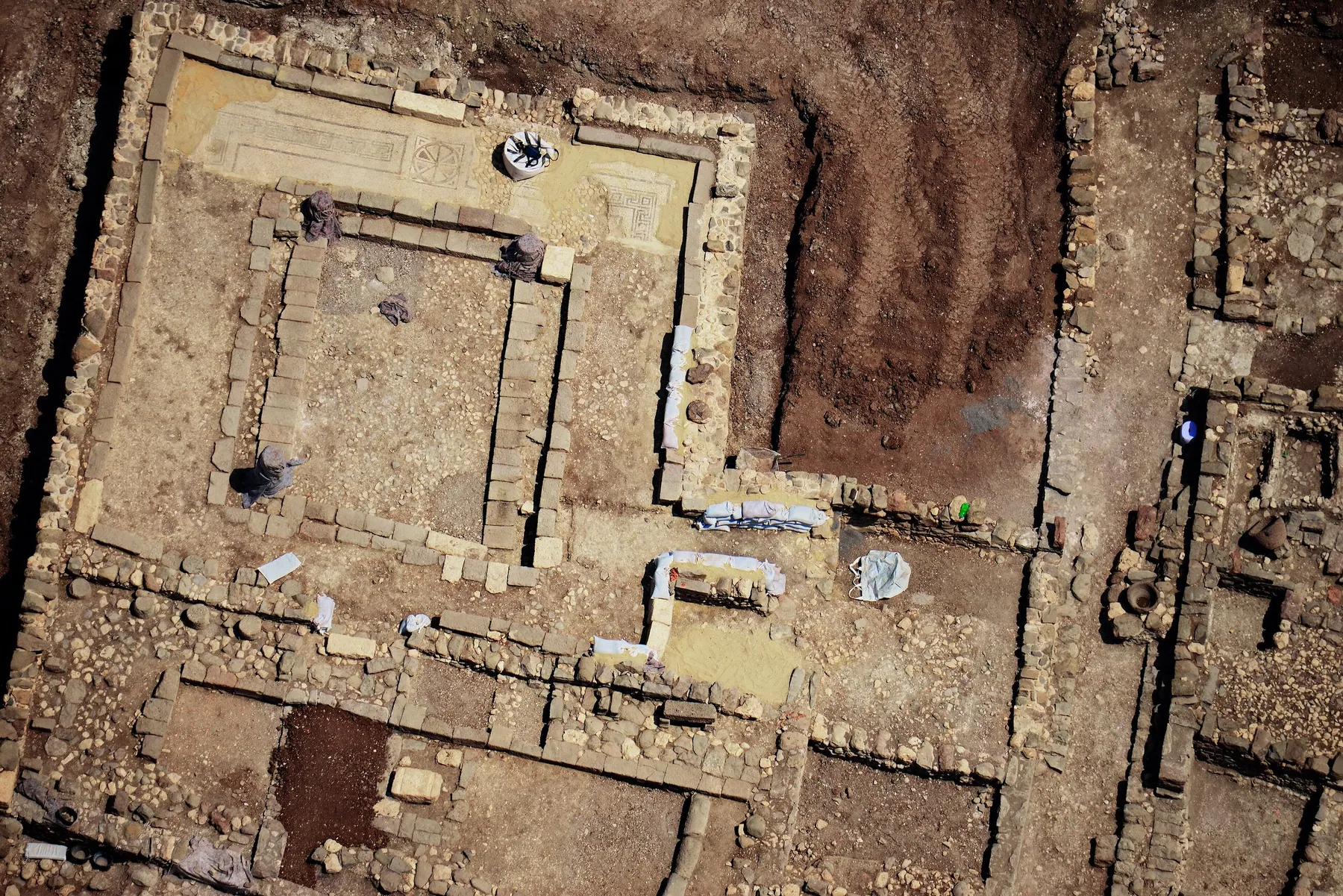
The main hall, about 120 square metres, had stone benches along its walls, plastered walls and columns painted in colours, and a surrounding walkway partly paved in mosaic with a rosette. On its floor lay a limestone block carved in relief, with a seven-branched menorah on the front, now known as the Magdala Stone.
The building did not outlast the First Jewish-Roman War. The panel at the site, which summarises the excavation, says three phases were identified, that the structure served as a synagogue in the second and third, and that it was deserted during preparations for the Great Revolt. Roman forces under Vespasian and Titus took the town in 67 CE. The low walls, benches and mosaics are now shown in the Magdala archaeological park. A second, plainer synagogue was found about 200 metres away in 2021.
Where it stood for roughly 35 to 120 years
No ancient address. Today: Magdala archaeological park (Magdala Center), Migdal beach, off Route 90, Migdal, Northern District, Israel, on the western shore of the Sea of Galilee. Approximate position of the excavated building.
Otwórz większą mapę →Społeczność żydowska
Nothing is known of the congregation by name: no inscription is reported from the building, and no ancient text read for this entry mentions a synagogue at Magdala. What is known comes from the town. Marcela Zapata-Meza and Rosaura Sanz-Rincón, who excavated in the town, call it the largest and most important city on the Sea of Galilee at the turn of the era and say Josephus implies about 30,000 inhabitants. Its Greek name, Taricheae, refers to the preparing of fish, the town's main trade. The panel at the site says the synagogue was established by a community of Jewish farmers and fishermen. Aviam writes that when the synagogue was built the place was already a large, well-established Jewish town. Around the building excavators found streets, a marketplace, industrial installations and ritual baths; the baths, uncovered in 2010 and 2011, were fed by groundwater and are described as the first of that kind known beside the lake. David Gurevich reads the painted walls as a sign of a wealthy community. The discovery in 2021 of a second synagogue in a residential quarter shows that the town had at least two such buildings at the same time.
Architektura i projekt
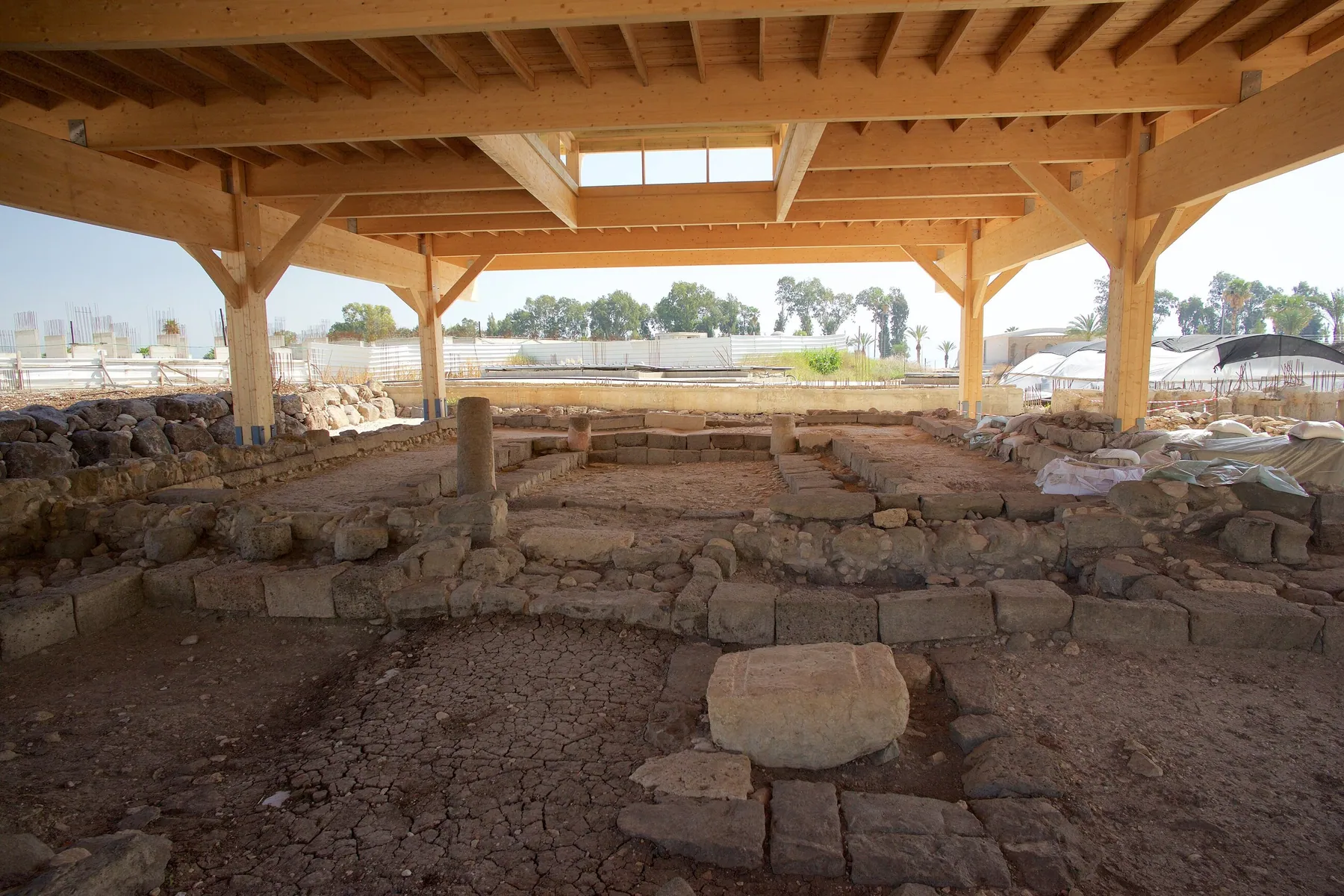
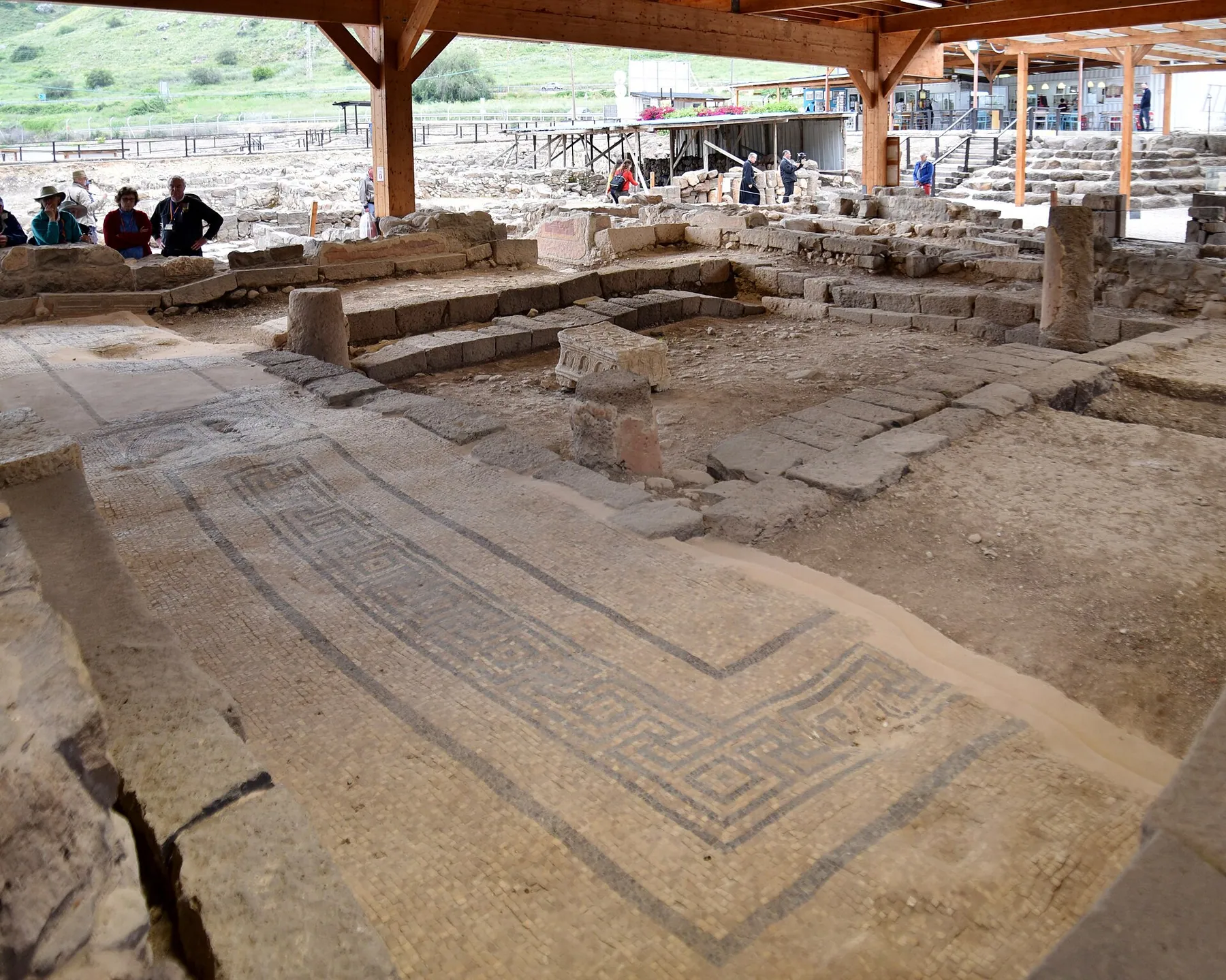
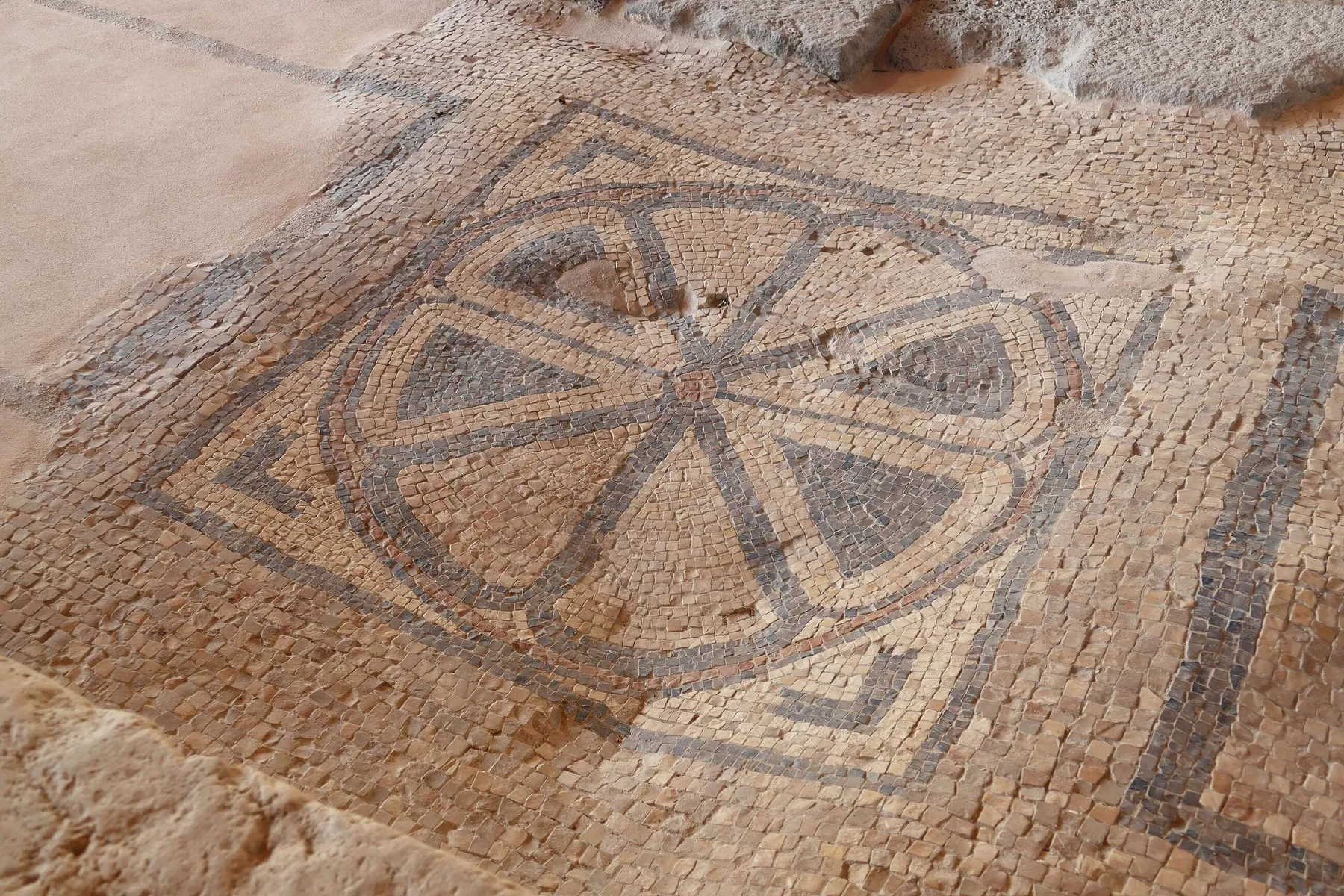
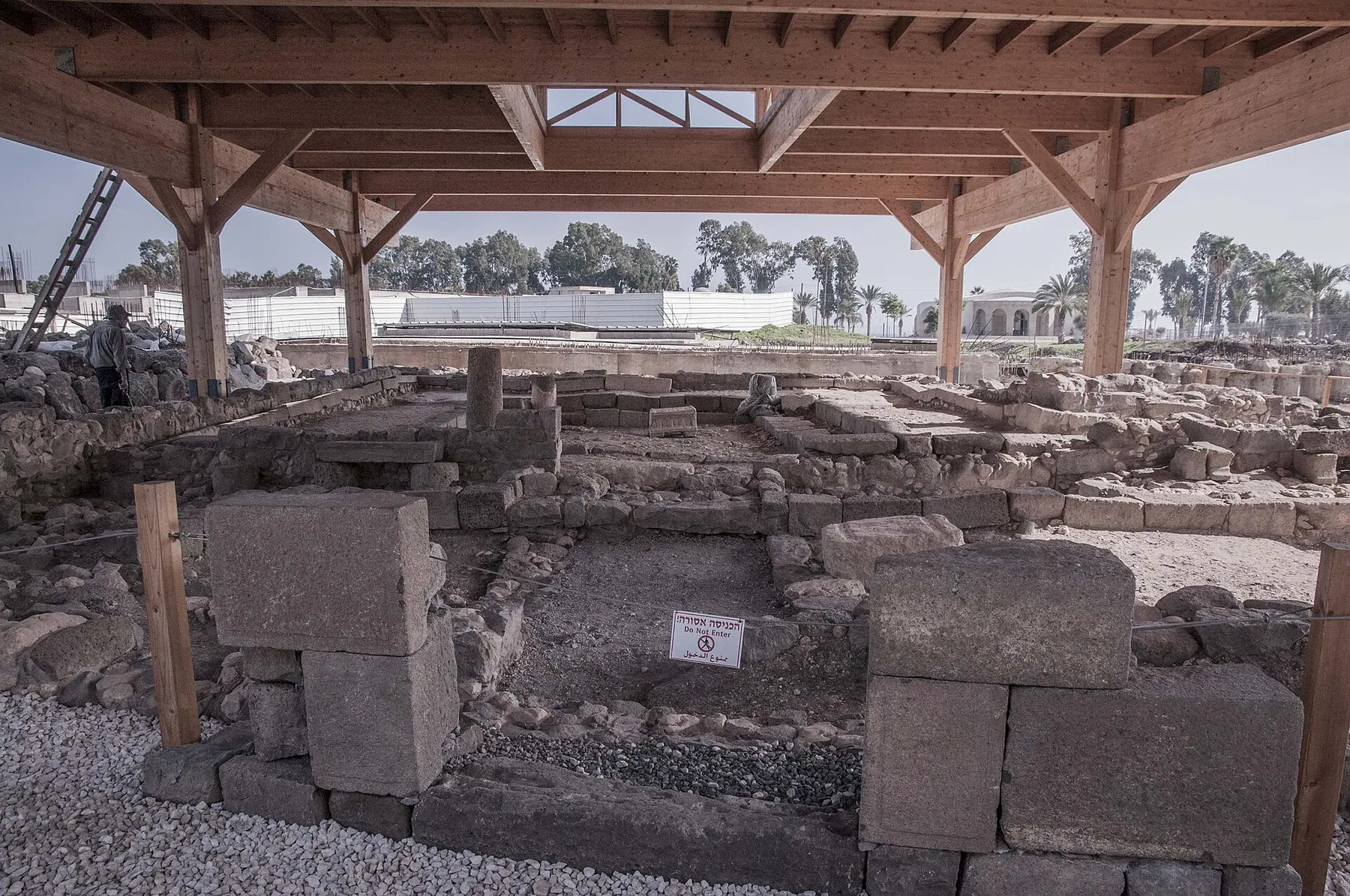
Aviam describes a square hall with a bench around its walls and another around the pillars in the centre, enclosed by a walkway partly paved with mosaic. The Magdala excavators give the room as 36 by 36 feet with a hallway enclosing it, and the Antiquities Authority gives the main hall as about 120 square metres. Fragments of basalt columns were found, and the site panel reconstructs three pairs of columns carrying a roof of wood and pressed earth. Walls and columns were plastered and painted in panels of red, yellow and blue with black and white frames, which Aviam assigns to the second Pompeian style. The mosaic in the eastern walkway has a rosette with meander patterns on either side; Zapata-Meza and Sanz-Rincón note that the mosaics were left largely unfinished. On the west is a second room with benches, read as an entrance hall or small study room, with a square chalk block that may have served as a table. A small mosaic-floored, painted chamber is interpreted as a store for Torah scrolls. Jordan Ryan and Zapata-Meza have since argued that the main entrance may have been on the south.
Życie w synagodze
No text describes a service here, so the use of the building is read from its fittings. Benches on all sides of the hall faced the centre, where the carved limestone block was found on the floor. It measures about 0.6 by 0.5 metres, is 0.4 metres high and stands on four short legs. Its front shows a seven-branched menorah on a pedestal between two jars, and its sides carry arcades of four arches; scholars read the whole as an image of the Jerusalem Temple, carved while the Temple still stood. Aviam argues that it was the base of a table on which the Torah scroll was read, and the site panel says the same; Rina Talgam suggests the imagery gave the synagogue a sacred aura, like a lesser Temple. Avshalom-Gorni, speaking of the second synagogue, described such buildings as places for Torah reading, study and social gatherings. The benched western room may have been a study room like the one at Gamla, and the small painted chamber may have held the scrolls. The congregation's officers, customs and other uses of the building are unknown.
Zniszczenie
Guides often say the synagogue was destroyed in 67 CE. The sources read are less definite about how the building ended. The information panel at the site, which summarises the excavation, states that the synagogue 'was deserted during preparations for the Great Revolt', the Jewish rising against Rome that began in 66 CE. Zapata-Meza and Sanz-Rincón add that the walkway mosaics were left largely unfinished, possibly because of the revolt. Avshalom-Gorni has said the town's synagogues existed until the rebellion in 67 CE. In that year, according to Josephus, the Roman general Vespasian camped between Tiberias and Taricheae, his son Titus led the attack on the town, and a fight on the lake and a massacre followed. That is the basis for the claim that the Roman army destroyed the synagogue. No source read for this entry reports a burnt layer or battle damage inside the building, and Andrea Garza-Díaz notes that the finds do not show how complete the town's destruction was. The excavators' 2013 preliminary report was not read for this entry, so any later dismantling of the building is not described here. Its walls now stand only a few courses high.
Los społeczności
Josephus describes the fall of Taricheae in 67 CE as a slaughter. After Titus entered the town the fighting moved onto the lake, and he writes that 'one might then see the lake all bloody, and full of dead bodies, for not one of them escaped'. His figures for the dead and the enslaved were not checked for this entry. The identification of Taricheae with Magdala is accepted by the excavators but is still disputed by some scholars. Archaeology gives a more gradual picture. A collapse layer of the Second Temple period has been taken to support Josephus, yet Garza-Díaz writes that Magdala was not completely destroyed and that life continued there for many years. Aviam reports that the buildings in the excavated areas were mostly abandoned toward the end of the second century CE, with a minor presence continuing into the third. BibleWalks records that fishing later gave way to a textile trade and that the place was renamed Migdal Tzabaya. Whether the people who used this synagogue fled, were killed or were sold is unknown, and no source read says the building was used as a synagogue again.
Miejsce dzisiaj
The synagogue lies in the Magdala archaeological park at Migdal, on the western shore of the Sea of Galilee, beside the Magdala Center and its Duc in Altum church. The Bornblum synagogue database lists it as a tourist site with an entrance fee. Dated photographs show the remains open to the sky in April 2013 and under a timber roof on posts by March 2014. Under the roof are the low walls, the basalt benches, stumps of columns, the rosette and meander mosaics and patches of painted plaster. A replica of the Magdala Stone stands in the hall; the original was removed for safekeeping and was exhibited in Rome in 2017. The second synagogue, found in 2021 in a salvage excavation at the Migdal junction, is a separate site about 200 metres away.
Czy masz coś do przekazania?
Zdjęcia, dokumenty, historie rodzinne lub wspomnienia o tej synagodze i jej społeczności pomagają zachować jej historię.
- The Migdal Synagogue (on-site information panel, photographed 26 April 2019: File:Magdala-574.jpg)
- Second Temple period synagogue discovered at Magdala (reproducing the Israel Antiquities Authority press release of September 2009)
- The Decorated Stone from the Synagogue at Migdal: A Holistic Interpretation and a Glimpse into the Life of Galilean Jews at the Time of Jesus, Novum Testamentum 55 (2013), 205-220
- Excavating Mary Magdalene's Hometown, Biblical Archaeology Review (file name indicates the May/June 2017 issue)
- Researchers Unearth 2,000-Year-Old Synagogue in Mary Magdalene's Supposed Hometown
- 2nd Temple-period synagogue found where Gospel's Mary Magdalene was born
- Remains of a second synagogue from the Second Temple Period sheds light on Jewish life 2,000 years ago
- The Archaeological Excavations at Magdala
- Magdala's Stone of Contention
- Magdala
- The War of the Jews, Book III, chapter 10
- Migdal
- Magdala stone
- Magdala
- Migdal Synagogue
- Ancient Magdala Publication: Discovering One Chapter at a Time, Part 2
- Magdala synagogue (photo INSGMG03)
- Migdal synagogue (OpenStreetMap node 4312333715, archaeological site)
Share a memory or thought
No comments yet. Be the first to add one.