

La historia de Marienburg Synagogue (Malbork)
The Marienburg Synagogue was the second and last house of worship of the Jewish community of Marienburg in West Prussia, now Malbork in Poland. The town, seat of the Teutonic Order, admitted no permanent Jewish settlement until the early nineteenth century. The community formed from about 1813–14 and first worshipped in a converted granary from around 1826–30.
By the 1890s that building was inadequate, and the community commissioned a new synagogue from the architect Carl Lübke. Built in brick in 1897–98 on Schulgasse at a cost of about 40,000 marks, it was dedicated on 30 August 1898 in the presence of the district administrator, the architect, Rabbi Dr. Blumenthal of Danzig, Rabbi Dr. Silberstein of Elbing and the community president Dr. Pinkus.
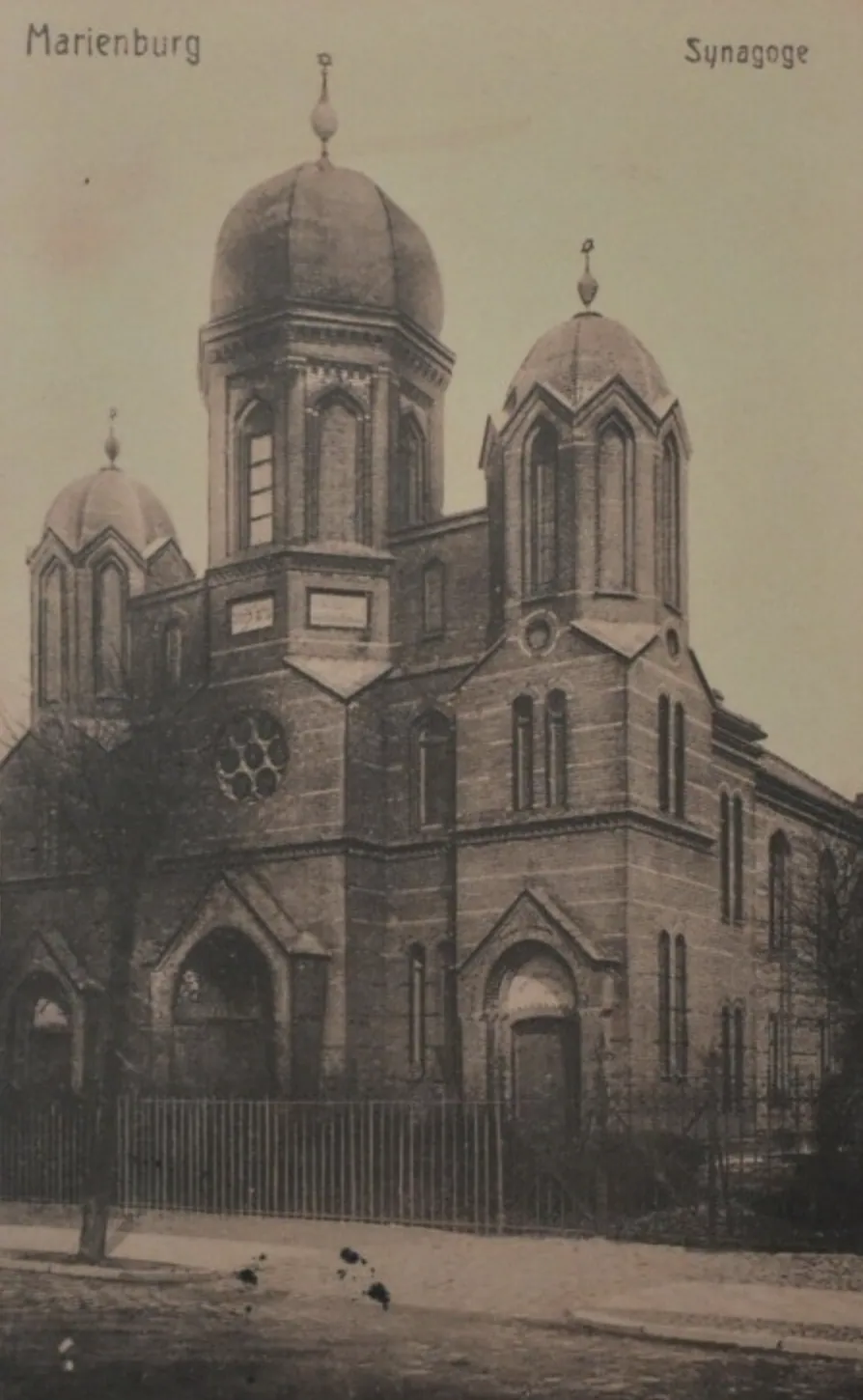
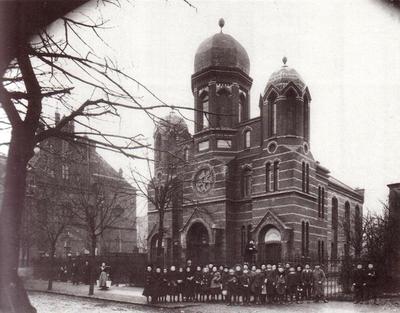
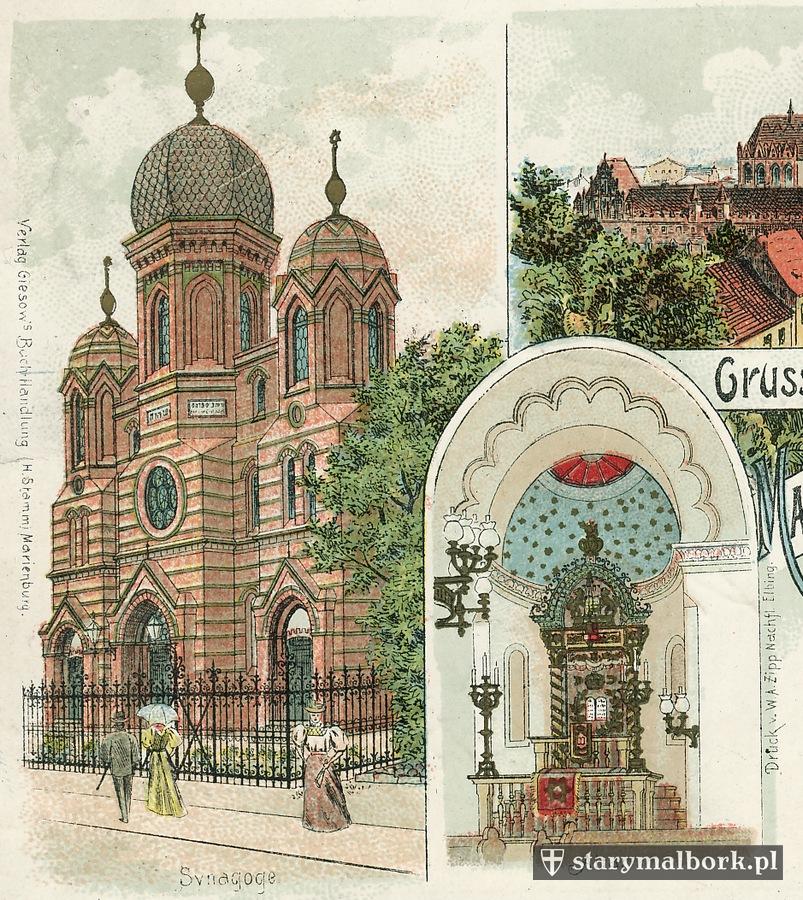
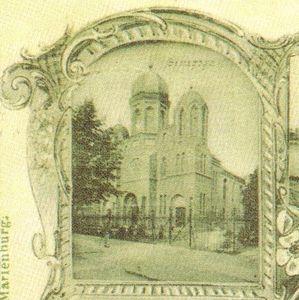
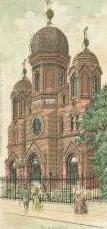
With its three domed towers, horseshoe-arched portals and star-painted ceiling, the building was a small-town example of the Moorish Revival style then popular among German synagogues.
The congregation was already declining when the synagogue opened, from over 300 members in the 1860s–70s to about 180 in 1895. Nazi persecution accelerated emigration. On the morning of 10 November 1938 the synagogue was set on fire during the November Pogrom. By 1940 no Jews remained in the town. The building was not rebuilt, and residential buildings now cover the site.
Where it stood for 40 years
Historic: Schulgasse, Marienburg (plots 95 and 94/11). Present day: ul. 17 Marca / al. Rodła, between the post office and the music school, now residential apartment buildings (around al. Rodła 1). Location approximate.
Abrir mapa ampliado →La comunidad judía
Under the Teutonic Order and later Polish rule, Jews were barred from settling in Marienburg. Permanent settlement began only after Prussian reforms: five or six Jewish families arrived around 1813, and a religious community was formed in 1814. A cemetery was established in 1819.
The community grew quickly through the mid-nineteenth century, from 50 people in 1816 to 151 in 1846 and 317 in 1867, about four percent of the town's population. The first place of worship, from about 1826–30, was a converted granary in the western Old Town, with separate rooms for men and women.
By the 1890s this building no longer met the community's needs, although numbers were already falling as Jews moved to larger cities; the community counted about 180 in 1895. Building a prestigious new synagogue at a cost of 40,000 marks nonetheless shows a congregation confident of its place in civic life, underlined by the presence of the Prussian district administrator at the dedication.
Arquitectura y diseño
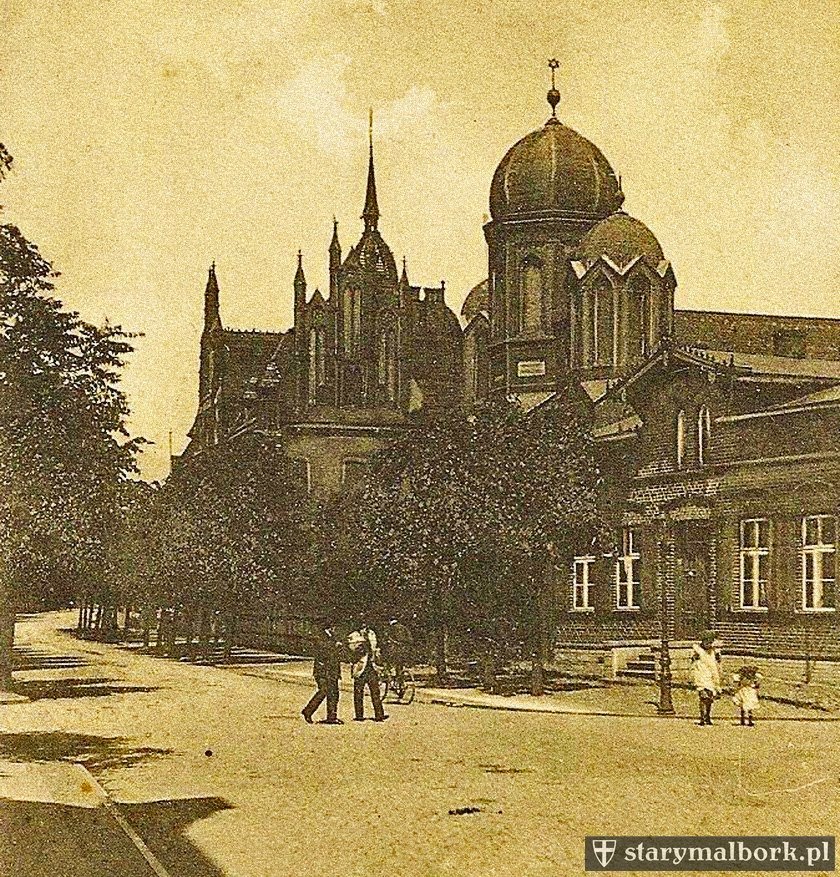
The synagogue was a brick building in the Moorish Revival style designed by Carl Lübke. It had a rectangular plan with a front section wider than the main body, crowned by three towers. The taller central tower had an octagonal drum with rectangular openings and a dome; the flanking towers had octagonal drums and geometrically decorated domes.
The facade had three horseshoe-arched portals on columns. The central portal, below a rose window, led through a vestibule and cloakroom into the men's prayer hall, while the side portals gave stair access to the women's galleries.
Inside, a rectangular prayer hall was surrounded on three sides by wooden women's galleries supported on columns with Moorish-style capitals. The Torah ark stood in an apse in the east wall, with the bimah, enclosed by a wooden balustrade, in front of it. The ceiling was painted blue with stars. Only two interior photographs are known to survive. Seating capacity is not recorded.
La vida dentro de la sinagoga
The synagogue was dedicated at noon on 30 August 1898. Rabbi Dr. Blumenthal of Danzig and Rabbi Dr. Silberstein of Elbing officiated, alongside community president Dr. Pinkus, the architect and the Prussian district administrator von Glasenapp. A young woman, Meta Hammerstein, took part in the ceremony by handing over the keys.
Marienburg appears not to have had its own rabbi during the synagogue's life, though this has not been confirmed. Religious leadership and instruction were carried by the community's lay officers and a teacher-cantor. In 1932 the community board included Ä. Flatauer, Löwenstein and Alexander; Max Gruschka served as teacher and cantor; Wilhelm Reich headed administration and Gustav Stern the education section. Religious instruction then reached 18 children.
The congregation's ritual orientation, including whether it used an organ, is not known. Heinz Galinski, later chairman of the Berlin Jewish community, was born in Marienburg in 1912 and grew up there, though his personal connection to the synagogue is not documented.
Destrucción
The synagogue was destroyed during the November Pogrom of 1938. According to the regional history of the community, it was burned on the morning of 10 November 1938; Polish sources date the burning to the night of 9–10 November. Sources attribute the arson to Nazis or Nazi militia; the specific unit or individuals responsible, are not recorded.
One account notes that the brick structure had been built to resist fire, and the extent to which walls survived the burning is unclear. The Lexikon of the Institute for Culture and History of the Germans in Eastern Europe states that the building was destroyed in 1938 and dismantled after 1945, suggesting that ruins remained standing until after the war. When and by whom the ruins were cleared is not known.
The synagogue stood for barely forty years. It was not rebuilt after 1945, when Marienburg became Polish Malbork and much of the Old Town was destroyed in fighting.
El destino de la comunidad
The congregation was already small when the Nazis came to power: about 170 members in 1932. Persecution drove rapid emigration. By June 1938 about 60 Jews remained (one source gives around 40), and after the November Pogrom the number fell to 33 by May 1939. By 1940 no Jews lived in Marienburg.
The fate of those who left or were deported, including how many were murdered in the Holocaust, has not been verified from a named list. Heinz Galinski, born in Marienburg in 1912, moved away in 1933 and to Berlin in 1938; he was deported to Auschwitz in 1943, survived Buchenwald and Bergen-Belsen, and later led German Jewry.
During the Soviet siege of 1945 the Old Town buildings that had housed Jewish shops were destroyed. The Jewish cemetery was levelled during the war and is barely recognizable today. No Jewish community was re-established in postwar Malbork.
El lugar hoy
Nothing of the synagogue survives. The building was not rebuilt after the war, and its remains are reported to have been dismantled after 1945.
The site lies in central Malbork on the former Schulgasse. Sources differ on the modern street name: Virtual Shtetl places it on ul. 17 Marca, between the post office and the music school; another source gives ul. Szkolna; French Wikipedia states the site is now part of aleja Rodła and occupied by residential apartment buildings.
No memorial marking the synagogue site has been verified. The community's former cemetery survives only as an area barely recognizable as a burial ground.
Nombres destacados
Carl Lübke
Dates unknownArchitectLübke designed the Marienburg synagogue, built in brick in 1897–98 in the Moorish Revival style with three domed towers and horseshoe-arched portals. He attended its dedication on 30 August 1898. His life dates and other works have not been verified.
Biografía o fuente →Dr. Pinkus
Dates unknownPresident (Gemeindevorsteher) of the Jewish communityDr. Pinkus led the Marienburg Jewish community when the synagogue was built and took part in its dedication on 30 August 1898 alongside the visiting rabbis, the architect and the district administrator. His first name and dates have not been verified.
Biografía o fuente →Max Gruschka
Dates unknownTeacher and cantorIn 1932 Gruschka served the Marienburg community as both religious teacher and cantor, the principal religious functionary of a congregation apparently without its own rabbi. He would have led services in the synagogue in its final years; his fate after 1932 has not been verified.
Biografía o fuente →¿Tiene algo que aportar?
Fotografías, documentos, historias familiares o recuerdos de esta sinagoga y su comunidad ayudan a mantener viva su historia.
- Synagoga w Malborku (ul. 17 Marca)
- Historia społeczności - Malbork
- Marienburg (Westpreußen)
- Marienburg/Malbork
- Synagogue de Marienburg (1898-1938)
- Synagoge (Marienburg)
- Pierwsza Synagoga w Malborku
- Heinz Galinski
- Nominatim reverse geocoding (54.0351, 19.0273) and search for Poczta Polska and Państwowa Szkoła Muzyczna, Malbork
Share a memory or thought
No comments yet. Be the first to add one.