
הסיפור של Ma'on Synagogue
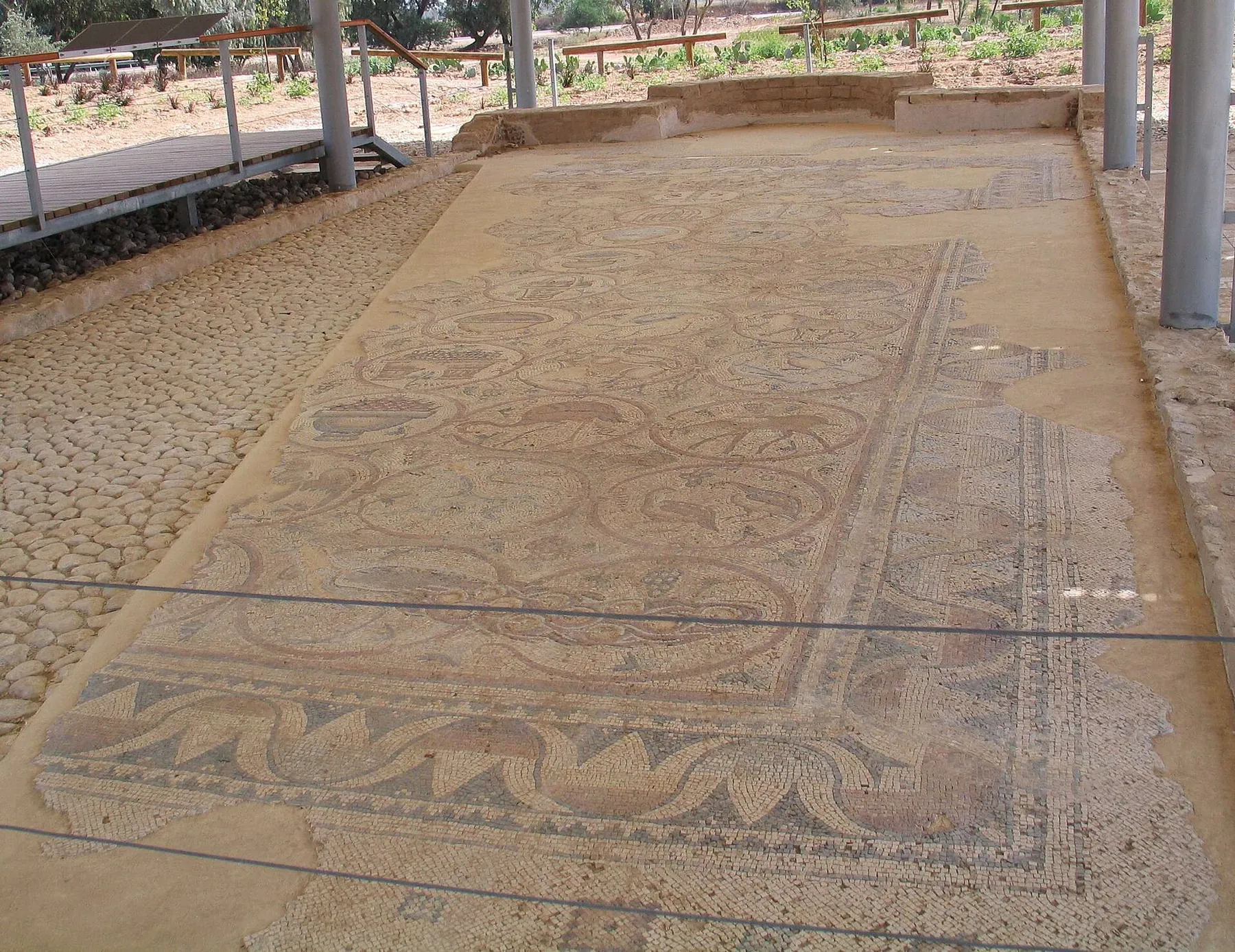
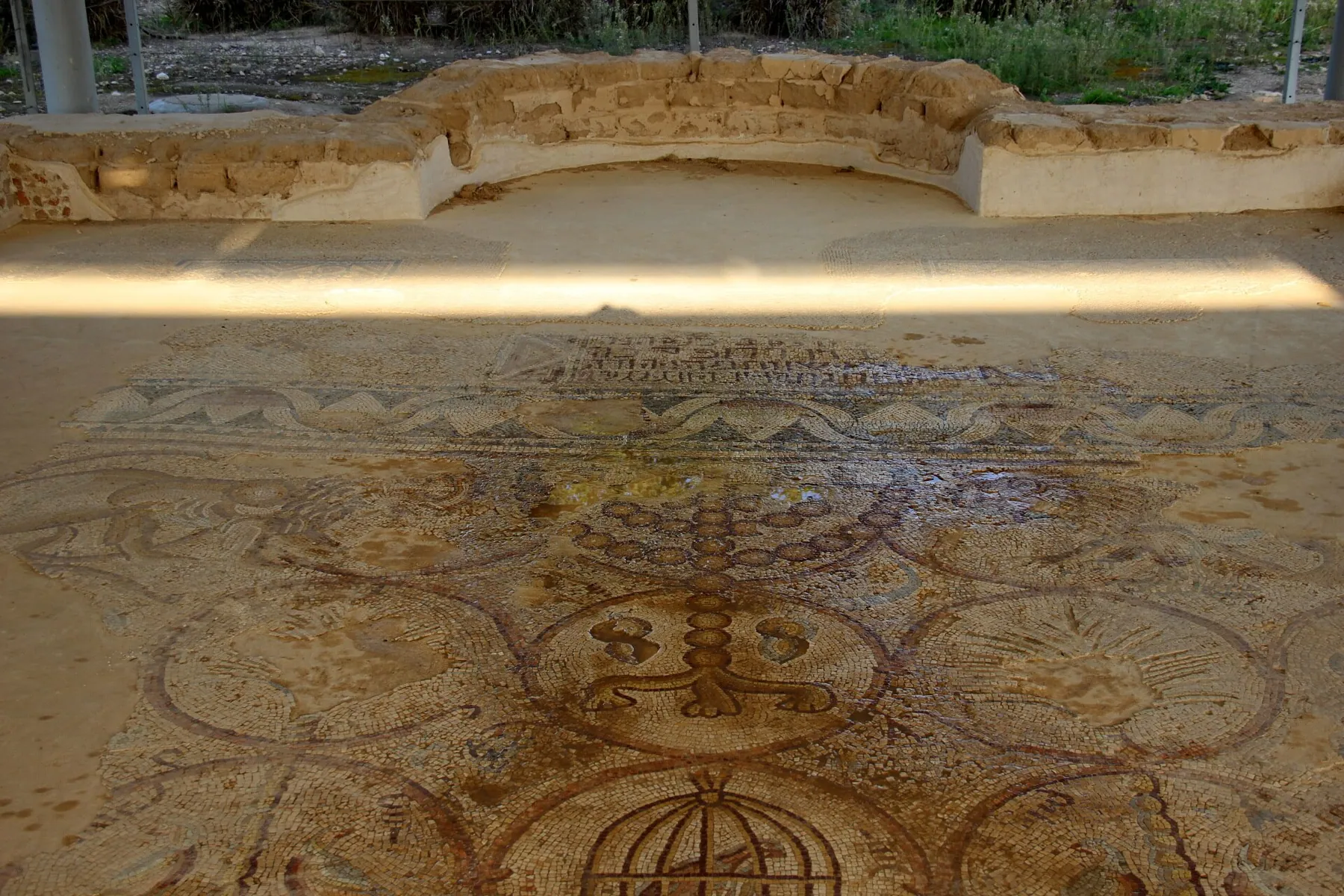
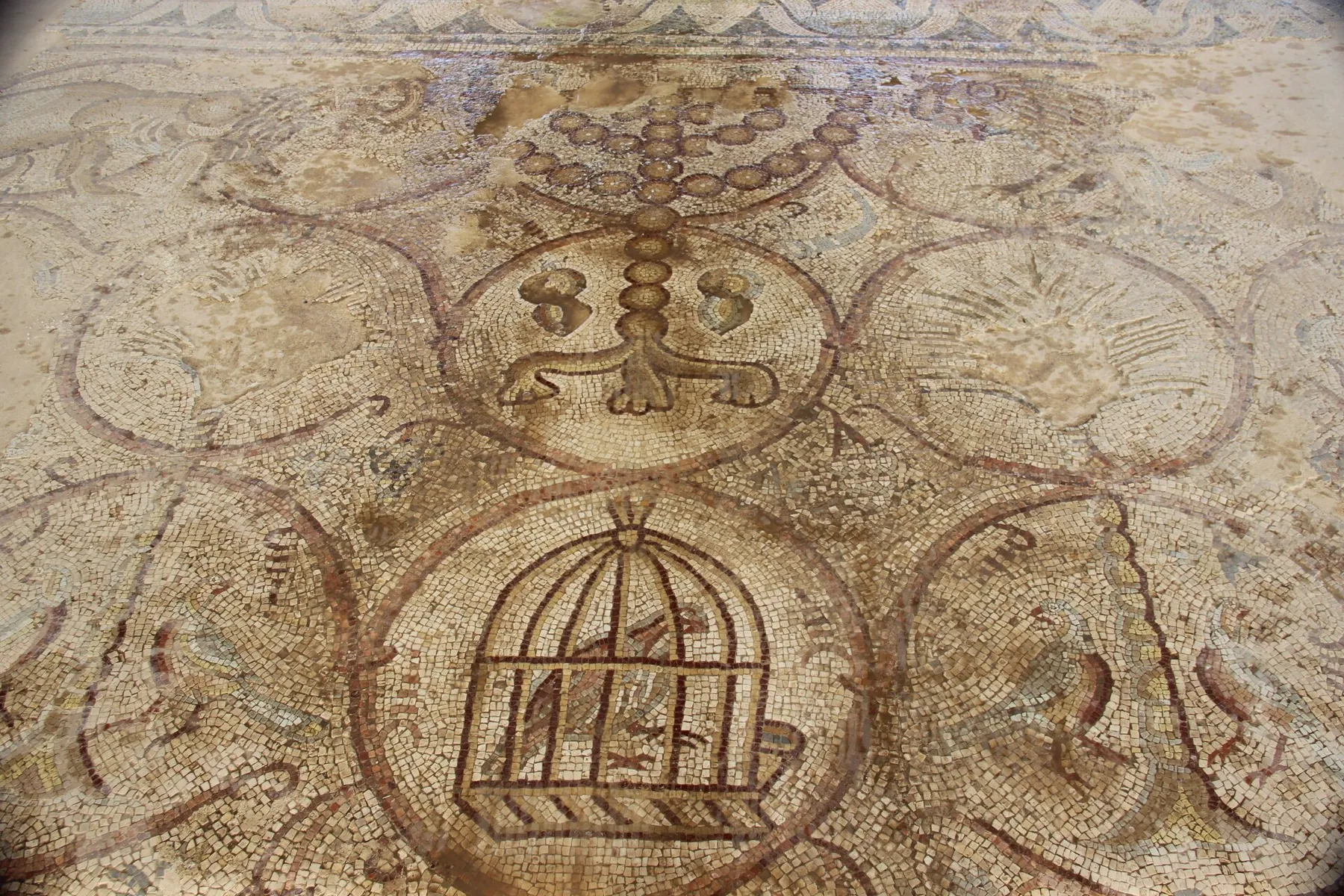
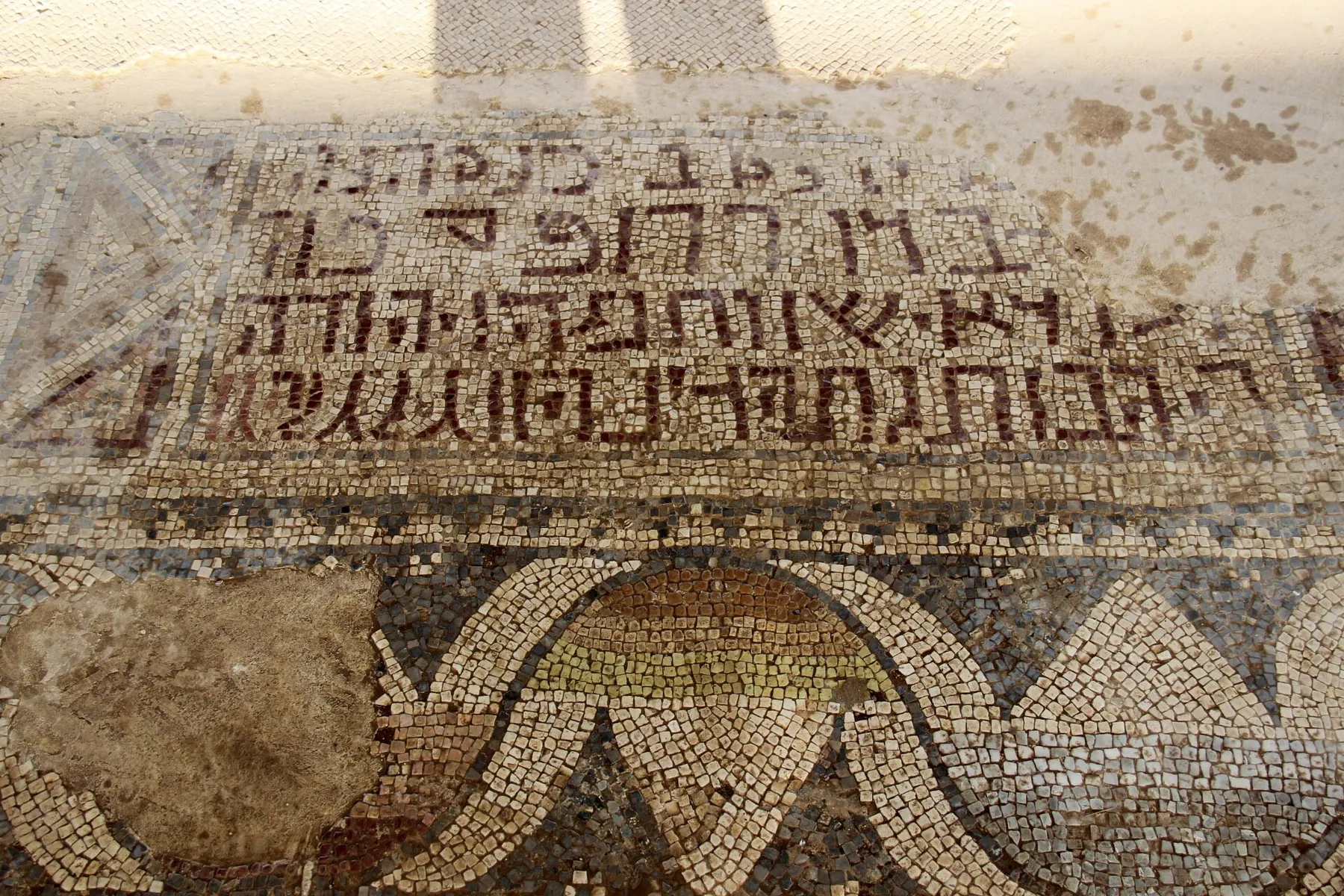
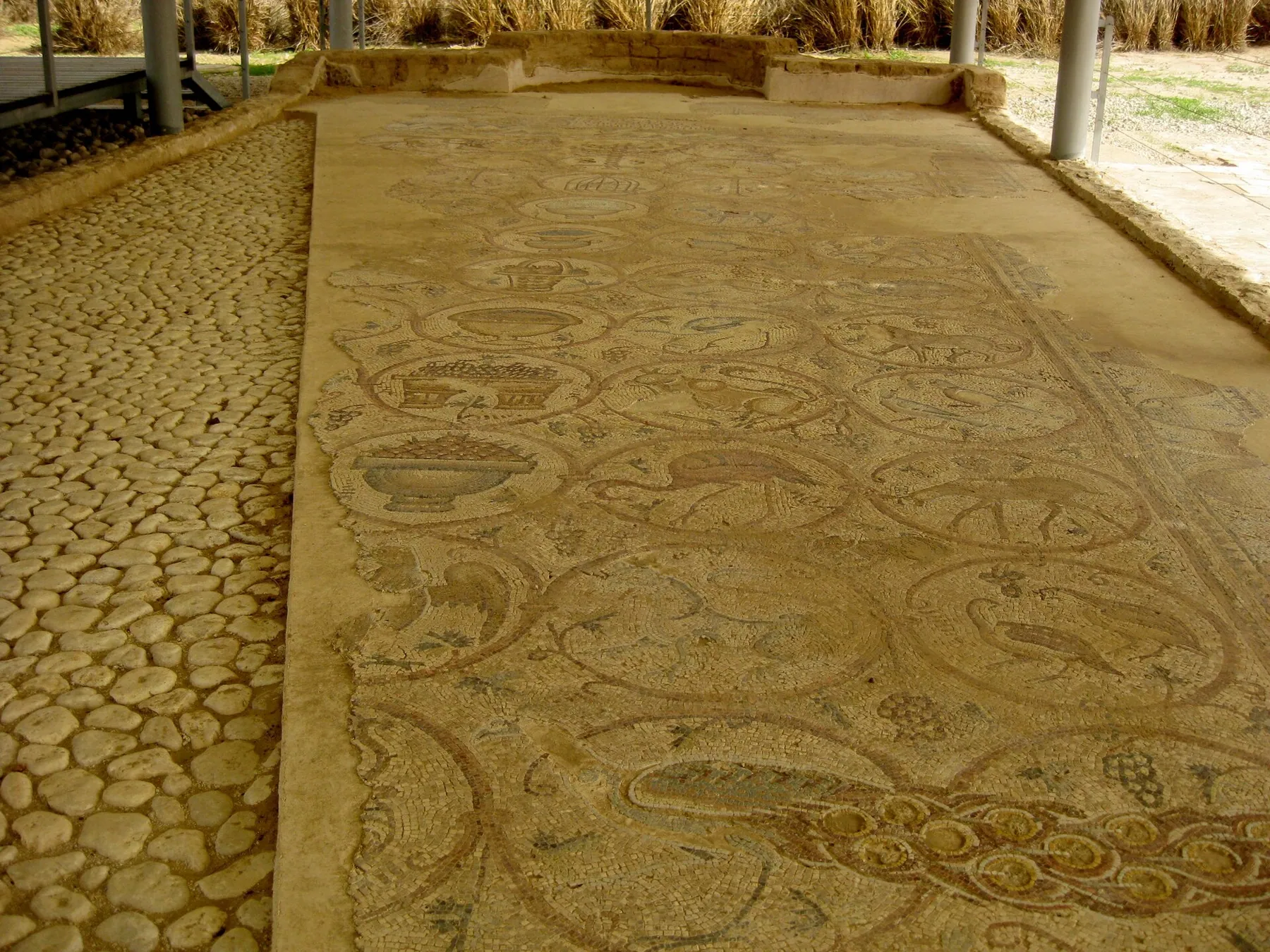
Ma'on (Horvat Ma'on, in Arabic Khirbet el-Ma'in) lies in the western Negev, close to the kibbutzim of Nirim and Nir Oz and about 20 kilometres south-west of Gaza. In the Roman period the place was called Menois. The Encyclopaedia Judaica describes it as the westernmost point of the frontier line of Palestine, named in the Theodosian Code and the Notitia Dignitatum and drawn on the sixth-century Madaba Map, with remains that show an extensive settlement from the fourth century CE onward. Its Jews had a synagogue whose hall measured about 14.8 by 11.8 metres. According to the Israel Antiquities Authority, the north wall was breached in the middle of the sixth century, an apse was built into the gap, the floor was raised and a mosaic was laid in the nave. The mosaic is the reason the building is known: a vine growing from an amphora forms rows of medallions filled with animals, birds and objects, a seven-branched menorah stands between two lions at the top, and an Aramaic inscription in front of the apse blesses the congregation and three donors.
The ruin was struck by road builders in 1957 and excavated for the Department of Antiquities by Shalom Levy. What survives is the floor, stone paving and the low base of the apse. None of the sources read says when the synagogue went out of use or what brought it down. The mosaic was conserved between 2006 and 2009 and is shown on the site under a shelter.
Where it stood
Horvat Ma'on (Khirbet el-Ma'in), beside the road to Kibbutz Nir Oz and near Kibbutz Nirim, Eshkol Regional Council, western Negev, Israel; no street address. Exact: the pin is the position of the excavated synagogue as given by the Kinneret College ancient synagogues database.
פתיחת מפה גדולה ←הקהילה היהודית
Almost nothing is recorded about the Jews of Ma'on beyond what the building itself tells. The place was known in the Roman and Byzantine periods as Menois; a research database at the University of Warsaw describes it as the administrative centre of an imperial estate, the Saltus Constantiniaces, from the fourth century CE, with a garrison of Illyrian cavalry, and classes the synagogue as a rural basilica. The dedicatory inscription, written in Jewish Palestinian Aramaic, asks that the whole congregation be remembered for good, which shows an organised community that paid for the floor collectively, and it singles out three men, Aisu, Thomas and Judah, for their gifts. The same database notes that the name Aisu is unusual among Jews and more typical of Nabataeans, and that Thomas is commoner among Christians. A ritual bath, a cistern and water channels were found beside the building. The size of the community, its occupations and its leaders are unknown. Ma'on is one of three ancient synagogues found in the western Negev.
אדריכלות ועיצוב
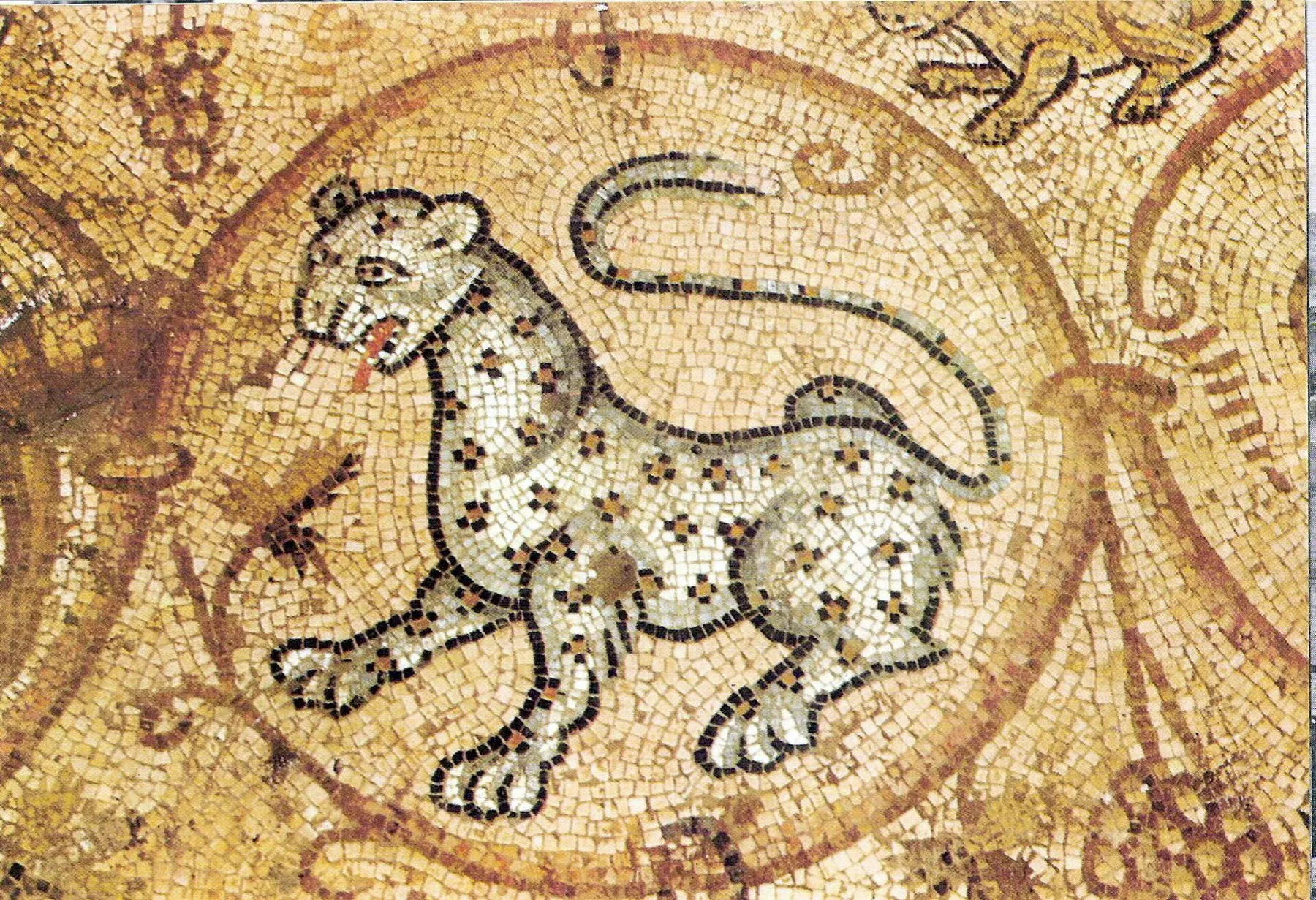
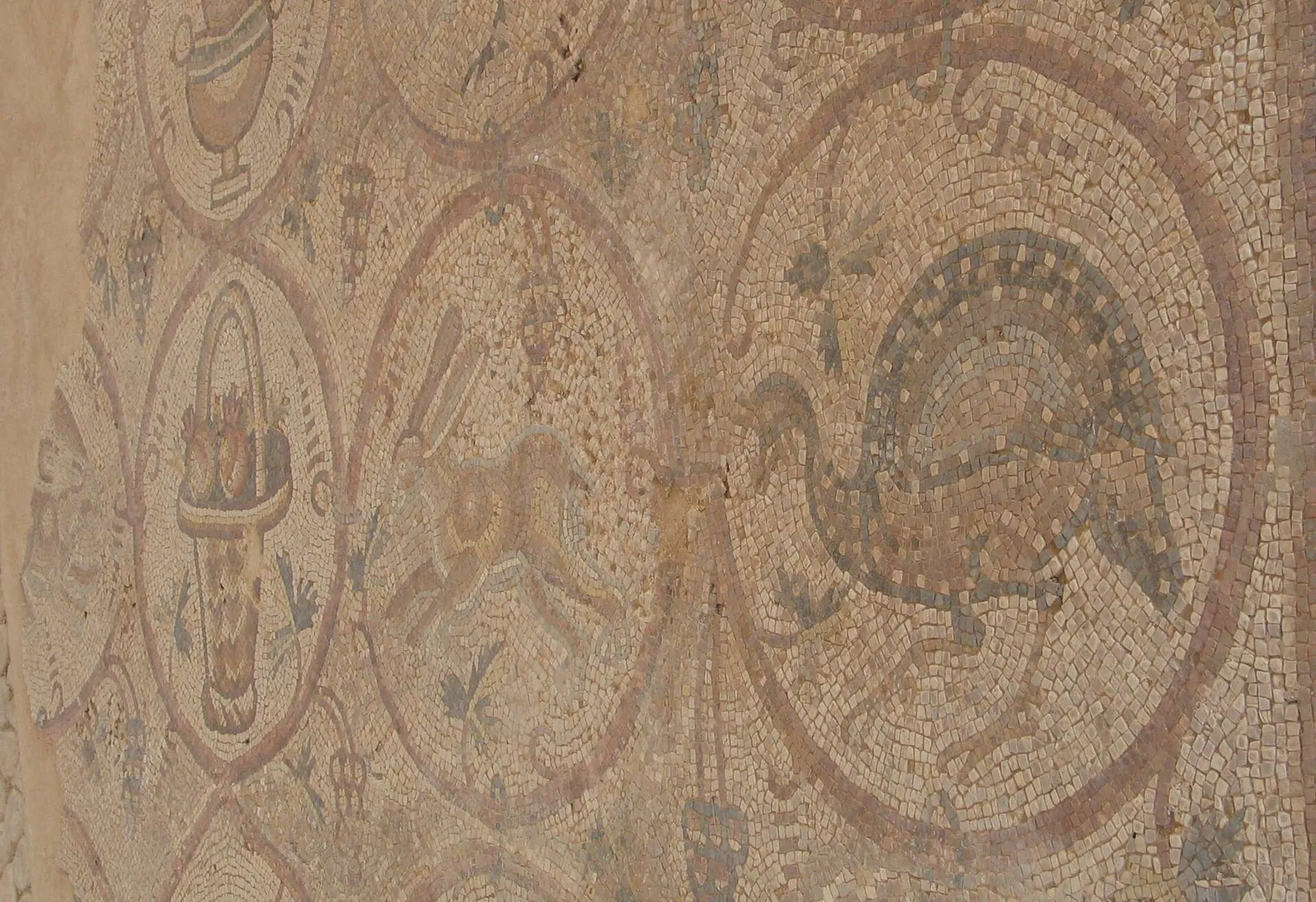
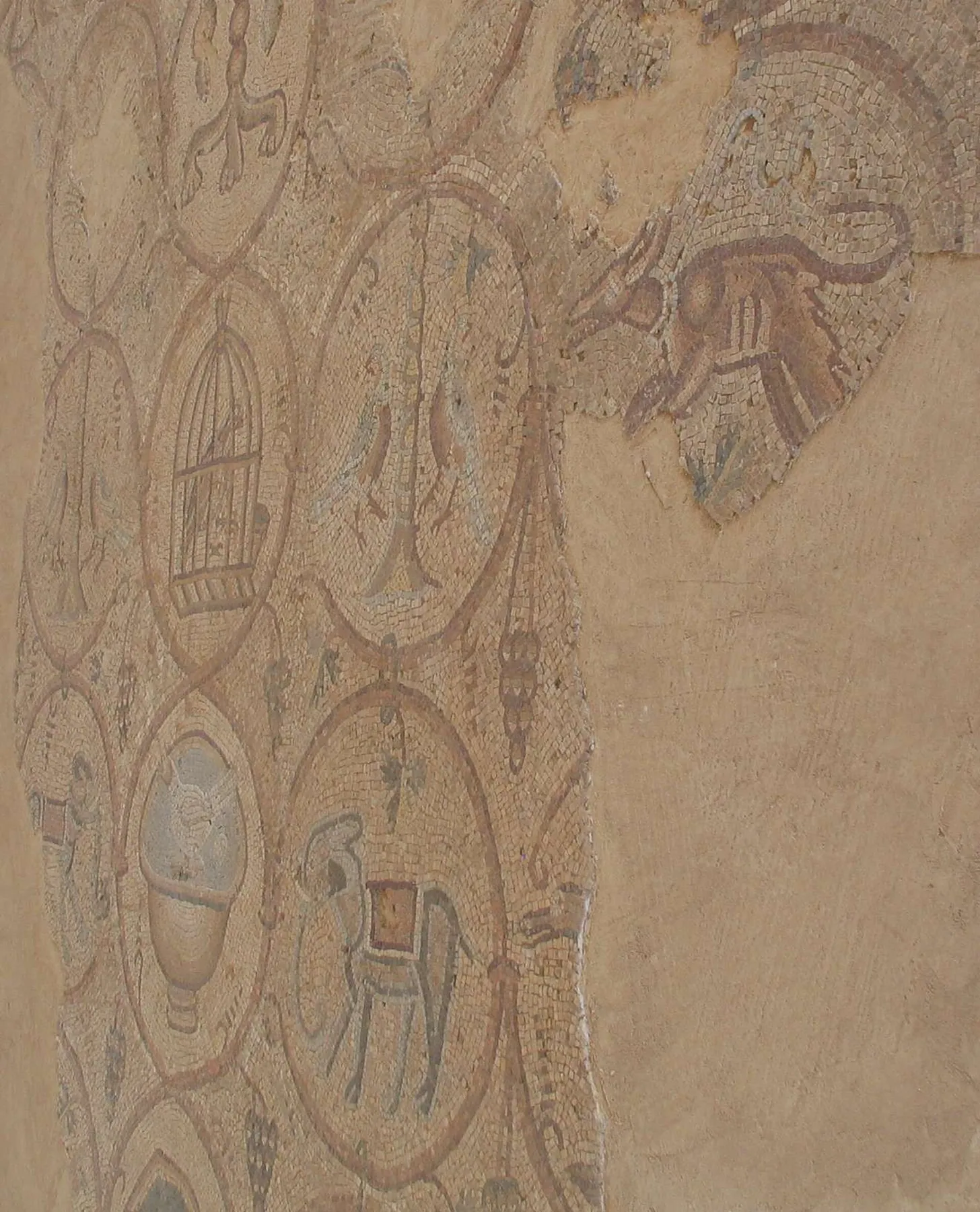
The synagogue was a basilica: a hall of about 14.8 by 11.8 metres divided by two rows of four columns into a nave and two aisles. The Encyclopaedia Judaica gives its orientation as north-east; the Israel Antiquities Authority speaks of the north wall, the one towards Jerusalem, which was opened in the mid-sixth century CE to take a semicircular apse for the Torah ark. In the same rebuilding the floor was raised and marble columns were set up. The aisles and the narthex were paved with stone and ran round the nave like an ambulatory; the roof was of wooden beams and clay. The nave mosaic originally measured 7.80 by 3.70 metres. A vine springs from an amphora flanked by two peacocks and loops into medallions holding animals, birds, baskets of fruit, vessels and a birdcage; a leopard, a hare and an elephant with a saddle cloth can be recognised. Near the apse are two palm trees with doves, and a menorah on three lion-paw feet with etrogim, a shofar and a lulav, flanked by two lions. Michael Avi-Yonah attributed this floor and that of the church at nearby Shellal to one Gaza workshop.
החיים בבית הכנסת
What happened inside is known only from the floor and the small finds. The four-line Aramaic inscription, set in a frame with handles in front of the apse beside the chancel post, reads in translation: remembered for good be the whole congregation who made this mosaic, and also Aisu, Thomas and Judah, who gave three denarii. The Encyclopaedia Judaica understands the gift as one gold dinar from each man. The last line ends in seven or eight illegible signs, which the University of Warsaw database suggests may be magical characters. On the floor in front of the ark niche the excavators found coins, objects of bone and metal thought to belong to the ark and its curtain, and fragments of glass and pottery lamps. Amulets were found in the apse area, nineteen by one count and twenty by another; the Antiquities Authority suggests some belonged to women seeking good health. The chancel post beside the inscription shows that the space before the ark was marked off from the hall. No rabbi, reader or officer of the synagogue is named in any source read.
הרס
No source read for this entry says when the synagogue at Ma'on stopped being used or how the building came down. The Israel Antiquities Authority dates its last known rebuilding, with the apse and the mosaic, to the middle of the sixth century CE, and the Encyclopaedia Judaica dates the pavement to the early sixth century; the building therefore stood after that time, but neither source describes a fire, an earthquake, an attack or a deliberate dismantling, and neither names anyone responsible. The excavation report of 1960 by Shalom Levy and the later studies by Dan Barag and Steven Werlin, which may answer the question, could not be consulted. By the twentieth century the building was a buried ruin. A second, modern episode of damage is documented: in 1957 the paving of the road to Kibbutz Nir Oz cut into the site and damaged the mosaic before a salvage excavation saved the rest, and in the following decades the uncovered floor deteriorated through unsuitable conditions and lack of maintenance, until it was lifted for conservation in 2006.
גורל הקהילה
The fate of the Jews of Ma'on is unknown. The sources read describe the settlement as extensive from the fourth century CE onward and show that the congregation was able to rebuild and decorate its synagogue in the sixth century, but they say nothing about what became of the community afterwards: whether it left, dwindled or stayed on after the building went out of use is not recorded in anything consulted. No later Jewish community at the site is mentioned in these sources. The ruin is known in Arabic as Khirbet el-Ma'in, and according to the Encyclopaedia Judaica a kibbutz named Ma'on was founded near the site in 1949. The three donors named on the floor, Aisu, Thomas and Judah, are the only members of the congregation known by name.
האתר כיום
The remains lie in open country in the Eshkol region of the western Negev, near Kibbutz Nirim and Kibbutz Nir Oz. In 2006 the Israel Antiquities Authority lifted the mosaic, treated it at its conservation laboratories in the Rockefeller Museum in Jerusalem, and relaid it in its original position on a new lime-based bed. The work was a joint project of the Authority, Keren Kayemeth LeIsrael (the Jewish National Fund) and the Eshkol Regional Council, with paths, signs and an entrance from Route 232 paid for by a private donor. The site opened to the public free of charge in 2009. Photographs show the mosaic under an open-sided roof on metal posts, with the stone-paved aisle and the low curved base of the apse beside it.
שמות בולטים
Aisu
6th century CEDonor named in the mosaic inscription of the Ma'on synagogueAisu is the first of three donors named in the Aramaic mosaic inscription in front of the apse of the Ma'on synagogue, dated to the sixth century CE. With Thomas and Judah he gave money, read as three denarii in all or as a gold dinar each, towards the floor. Nothing else is known of him; the name is noted as unusual among Jews and more typical of Nabataeans.
ביוגרפיה או מקור ←Thomas
6th century CEDonor named in the mosaic inscription of the Ma'on synagogueThomas is the second donor named in the mosaic inscription of the Ma'on synagogue, alongside Aisu and Judah, as one of those who gave denarii for the sixth-century floor. He is known only from this inscription. The University of Warsaw epigraphic database remarks that the name is commoner in Christian communities than among Jews.
ביוגרפיה או מקור ←Judah
6th century CEDonor named in the mosaic inscription of the Ma'on synagogueJudah is the third donor named in the Aramaic inscription on the mosaic floor of the Ma'on synagogue. Together with Aisu and Thomas he is thanked, after the blessing on the whole congregation, for a gift of denarii towards the sixth-century pavement. He is known only from this inscription; his family, occupation and standing in the community are unknown.
ביוגרפיה או מקור ←יש לכם משהו לתרום?
תמונות, מסמכים, סיפורי משפחה וזיכרונות מבית הכנסת ומהקהילה שלו עוזרים לשמור על ההיסטוריה שלו בחיים.
- Ma'on (Encyclopaedia Judaica article)
- Spectacular Mosaic Floor on Display in Negev (excerpt of the Israel Antiquities Authority press release of 30 March 2009)
- News report on the unveiling of the restored Ma'on-Nirim mosaic (Hebrew, 1 April 2009)
- Maon Nirim
- Inscription 44: mosaic inscription of the synagogue at Ma'on (Nirim)
- Ma'on Nirim (site record)
- Building 42: synagogue, Ma'on Nirim
- Maon Synagogue
- Mamshit & the Ancient Synagogue of Maon
Share a memory or thought
No comments yet. Be the first to add one.