

La historia de Medieval Synagogue of Marburg
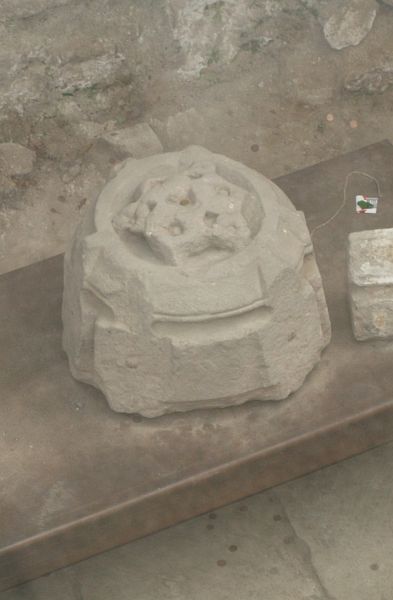
Marburg's first known synagogue stood in the upper town, in the lane called Judengasse until 1933 and Schloßsteig since, at the corner of Mainzer Gasse just above the market place. According to the account published by Alemannia Judaica, it was built about 1280 on the site of an older building and is first named in a document of 1317, which shows an organised community living in a quarter of its own. The town fire of 1319 probably destroyed it, and a new synagogue was raised on the old foundations: a stone hall about seven metres high under a six-ribbed vault, whose keystone is carved with a six-pointed star. The same building probably served the community before and after the persecutions of 1348-49.
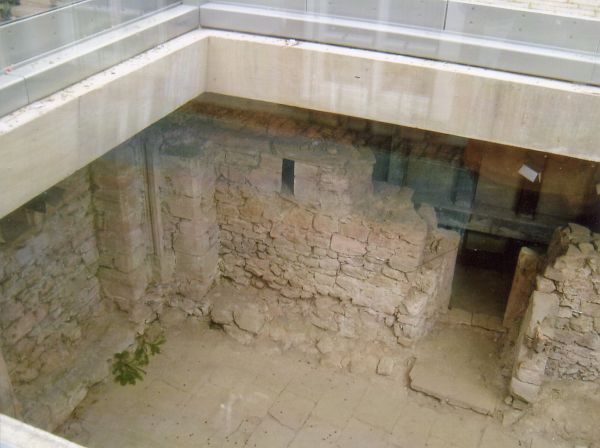
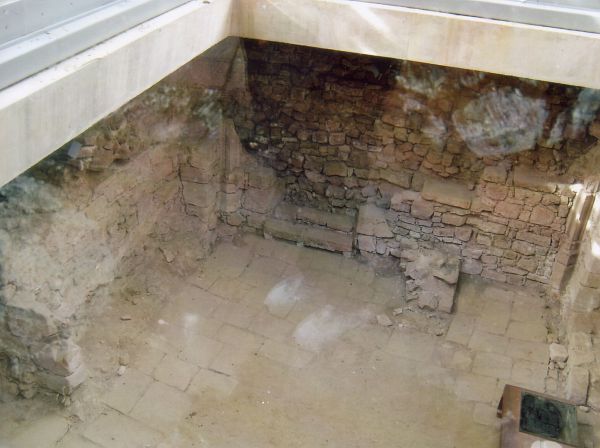
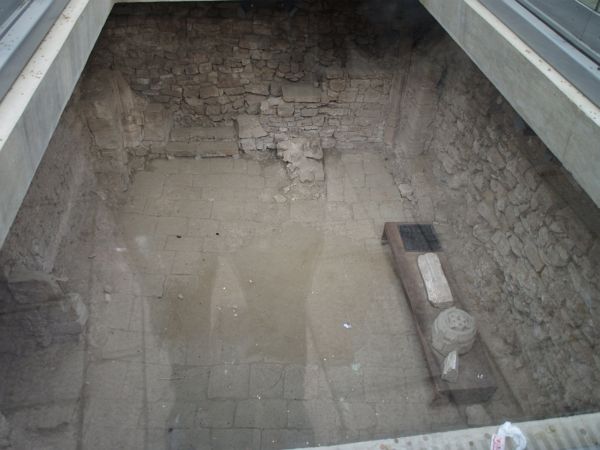
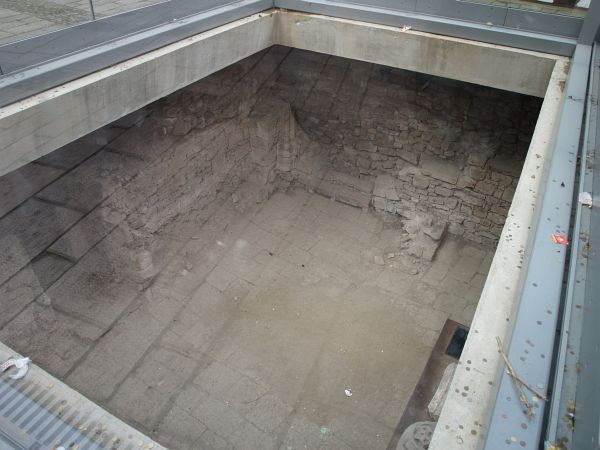
In 1452 the synagogue was wrecked and partly pulled down, and some of its stones went into the wall of the churchyard of St Kilian. The sources read do not say who ordered this; the Jews seem to have been expelled from Marburg at about the same time. The shell was filled with earth and forgotten. A dig for an underground transformer brought it to light in 1993, and it was excavated until 1997. The stone floor, a niche and walls up to four metres high survive, and since September 2002 a glass cube has protected them. A later Marburg synagogue, opened in 1897, was burned by the Nazis in November 1938; it is a different building.
Where it stood for nearly 180 years
Historic: Judengasse (renamed Schloßsteig in 1933), at the corner of Mainzer Gasse, above the market place. Today: the glass-covered excavation on Willy-Sage-Platz at the top of the Markt (Obermarkt), beside Schloßsteig, mapped at Markt 24, 35037 Marburg (exact; the remains are in their original position).
Abrir mapa ampliado →La comunidad judía
When Jews first settled in Marburg is unknown. Alemannia Judaica places the beginnings of the community in the thirteenth century, and the Jewish Encyclopedia of 1906 gives a document of 13 May 1317 as the first to mention Jews in the town; it already shows an organised community with a synagogue and a quarter of its own. A larger Jewish population is certain for the first half of the fourteenth century. Its members lived mainly from moneylending, which is recorded in the court books of Frankfurt, and two physicians are also mentioned. The persecutions of the plague years 1348-49 destroyed the community. Jews were living in Marburg again by 1364, and in the second half of the fourteenth century the records name the Judengasse, the 'Judenschule', as the synagogue was called, and a Jewish cemetery. No figures for the size of the medieval community and no names of its members were found in the sources read; the full excavation report of 2009 and the Germania Judaica volumes, which could not be consulted, may supply them.
Arquitectura y diseño
What is known of the building comes from the excavation of 1993-97. It was a rectangular stone hall, about seven metres high in all, covered by a six-part ribbed vault. Ulrich Klein of the Institute for Architectural Research and Documentation, who studied the ruin, told the Jewish Telegraphic Agency in 1997 that the oldest masonry dates from the twelfth century and that the ribbed vault and its keystone were added after 1250. Alemannia Judaica dates the synagogue to about 1280 and the surviving walls to the rebuilding after the fire of 1319. The keystone is a round boss carved with a six-pointed star; Alemannia Judaica calls it heavily weathered and only possibly a Star of David. In photographs of 2007 and 2008 it rests on a low bench on the floor of the excavation. A niche, probably in the east wall, held the Torah ark. A smaller annex, linked to the hall by a window, was probably the women's room. The floor is of sandstone slabs. The corner piers still stand, and the rubble-stone walls survive up to four metres high. The hall's length and width, its windows and its entrance are not described in the sources read.
La vida dentro de la sinagoga
Nothing written by the medieval congregation itself is known from the sources read, and no rabbi, cantor or warden of the Marburg synagogue is named in them. Records of the second half of the fourteenth century call the building the 'Judenschule' (Jews' school), the name then given to the synagogue, and mention it together with the Judengasse and the Jewish cemetery. The excavated remains give the outline of its use: a single vaulted hall for prayer, with the Torah ark set in a wall niche thought to be on the east side, and a smaller adjoining room that opened into the hall through a window and probably served the women. The building was in use from about 1280 until 1452, with a break after the fire of 1319 and another when the community was destroyed in 1348-49. Whether a ritual bath or other communal rooms stood beside it is not stated in the sources read.
Destrucción
Alemannia Judaica states that in 1452 the synagogue was destroyed and partly pulled down, and that some of its stones were reused, among other places, in the wall of the Christian churchyard of St Kilian. The Jewish Encyclopedia of 1906 likewise says that the synagogue was demolished in 1452 and that the Jewish cemetery passed into Christian hands, and concludes that the Jews must have been expelled from Marburg about that time. None of the sources read names who ordered the expulsion or the demolition, whether the landgrave of Hesse, the town council or someone else, and none gives a reason. The vault and the upper walls are gone; the lower part of the shell, standing up to four metres high, was filled with earth and its existence was forgotten. By the 1990s the spot was a parking area at the top of the market place. The excavators' full report, published in 2009, could not be consulted and may identify who was responsible.
El destino de la comunidad
The medieval community was destroyed twice. The first time was in the persecutions of the plague years 1348-49; Jews were living in Marburg again by 1364. The second end came in the middle of the fifteenth century: the Encyclopaedia Judaica says the Jews were apparently expelled from the town at that time, and in 1452 their synagogue was demolished and their cemetery passed into non-Jewish hands. Where the expelled families went is unknown. In 1524 Landgrave Philipp of Hesse decreed the expulsion of the Jews, and in 1532 he revoked that decree; Alemannia Judaica describes the readmission as temporary. A new community grew up in Marburg in the following centuries and reached 512 people in 1905. Its synagogue of 1897 was set on fire by the Nazis in the night of 9 to 10 November 1938; that building and its congregation are a separate story. A Jewish community exists in Marburg again today and opened a new synagogue in 2005.
El lugar hoy
The remains lie at the upper end of the market place (Obermarkt), on the small square now named Willy-Sage-Platz, beside the steps of Schloßsteig. The town dropped its plan for an underground transformer and held an architectural competition in 1995; a steel canopy on four posts was also considered, and the Jewish community and part of the public at first opposed the glass cube. The cube, more than four metres high, was built in the summer of 2002. Visitors look down through it on to the stone floor, the keystone and walls standing up to four metres high. The Hessian state heritage office has classed the remains as an architectural monument of extraordinary rank. Panels beside the cube explain the find.
¿Tiene algo que aportar?
Fotografías, documentos, historias familiares o recuerdos de esta sinagoga y su comunidad ayudan a mantener viva su historia.
- Marburg (Kreisstadt): Jüdische Geschichte / Synagogen (section 'Die Synagoge des Mittelalters')
- Excavation in German Town Bares Ruin of Medieval Shul
- Marburg (Jewish Encyclopedia, 1906)
- Marburg (Encyclopaedia Judaica, 2nd ed.)
- Bethaus, Schule, Metzgerei
- Die mittelalterliche Synagoge in Marburg. Dokumentation der Ausgrabung (Marburger Stadtschriften zur Geschichte und Kultur 92, 2009), catalogue record
- Marburg800: Alte Synagoge virtuell erleben
- Mittelalterliche Synagoge, Markt 24, Marburg (OpenStreetMap node 3116236971)
Share a memory or thought
No comments yet. Be the first to add one.