
История Martin Synagogue
Martin, called Turčiansky Svätý Martin until 1951 and Turócszentmárton in Hungarian, is the main town of the Turiec basin in northern Slovakia. A synagogue already existed there in 1851, when Elek Fényes listed it among the town's notable buildings and counted 50 Jewish inhabitants. The building recorded in this entry replaced it: according to a local-history article by Marko Salini and a 2021 report in Pravda, it was built in 1875 in the centre of town, on what was then Smrtná ulica and is now Bernolákova and Janka Kráľa streets, next to the Jewish cemetery and close to the present National Cemetery. A fire damaged it in 1881 and it was quickly repaired; a completion date of 1884 that appears in some lists may refer to this rebuilding. The synagogue served the community until the Second World War. After 1945 it was no longer used for worship and became a drying room and grain store. It was demolished in the mid-1970s, and in 2021 two of its cast-iron columns were recovered from a garden in the Ľadoveň district.
Where it stood for nearly 100 years
Historic: Smrtná ulica, Turčiansky Svätý Martin, next to the Jewish cemetery and opposite the National Cemetery. Today: grassy plot by the bus stop at Janka Kráľa street (corner of Bernolákova), Martin; approximate.
Открыть большую карту →Еврейская община
Jews were living in Martin by the early nineteenth century: the JewishGen Cemetery Discovery Project dates the community to about then and the cemetery beside the synagogue to after 1800. Fényes counted 50 Jews in 1851 among a mainly Lutheran Slovak population of about 1,100. Pavel Frankl, chairman of the Jewish Religious Community in Žilina, told Pravda in 2021 that Martin had 604 Jewish residents about thirty years before 1940 and 434 in 1940. The congregation owned the synagogue and the adjoining cemetery, where the last known burial took place about 1934. Its rabbis, cantors and lay leaders are unknown, as is whether it followed the Neolog, Status Quo or Orthodox rite.
Архитектура и дизайн
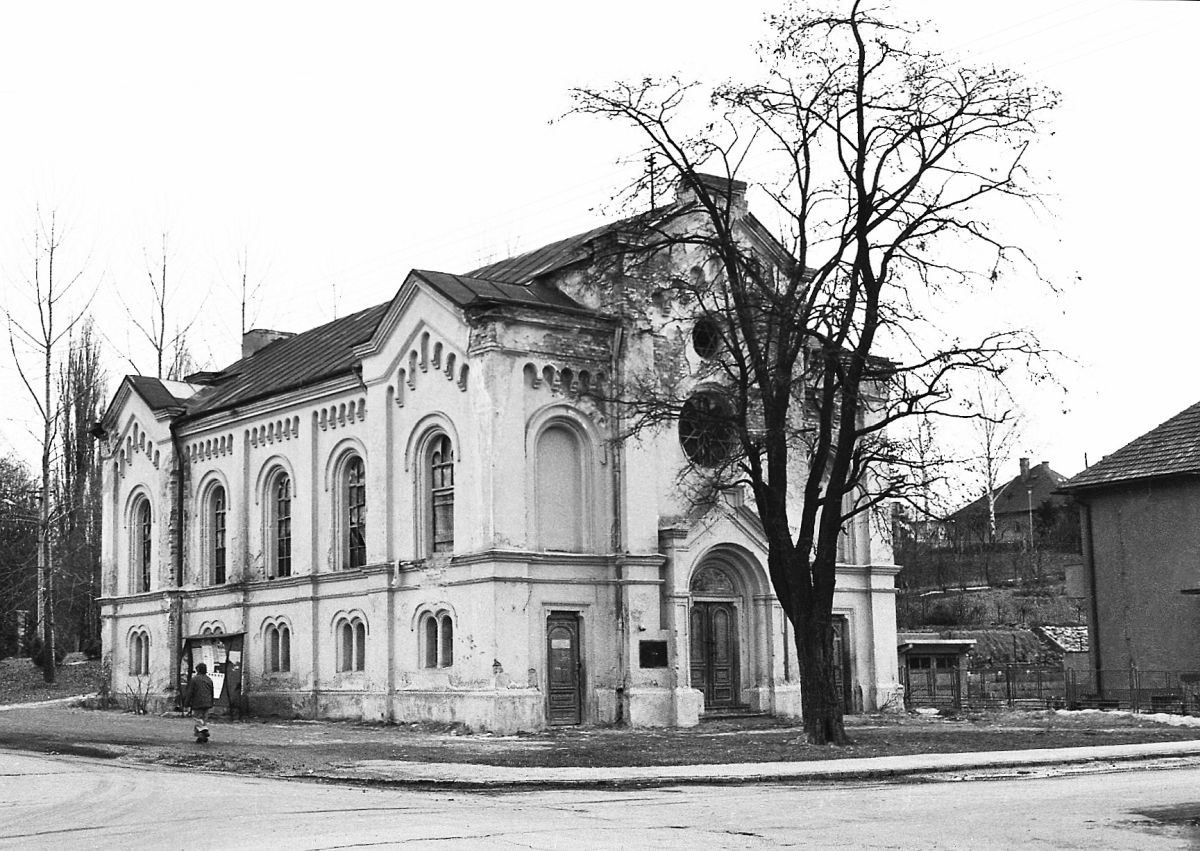
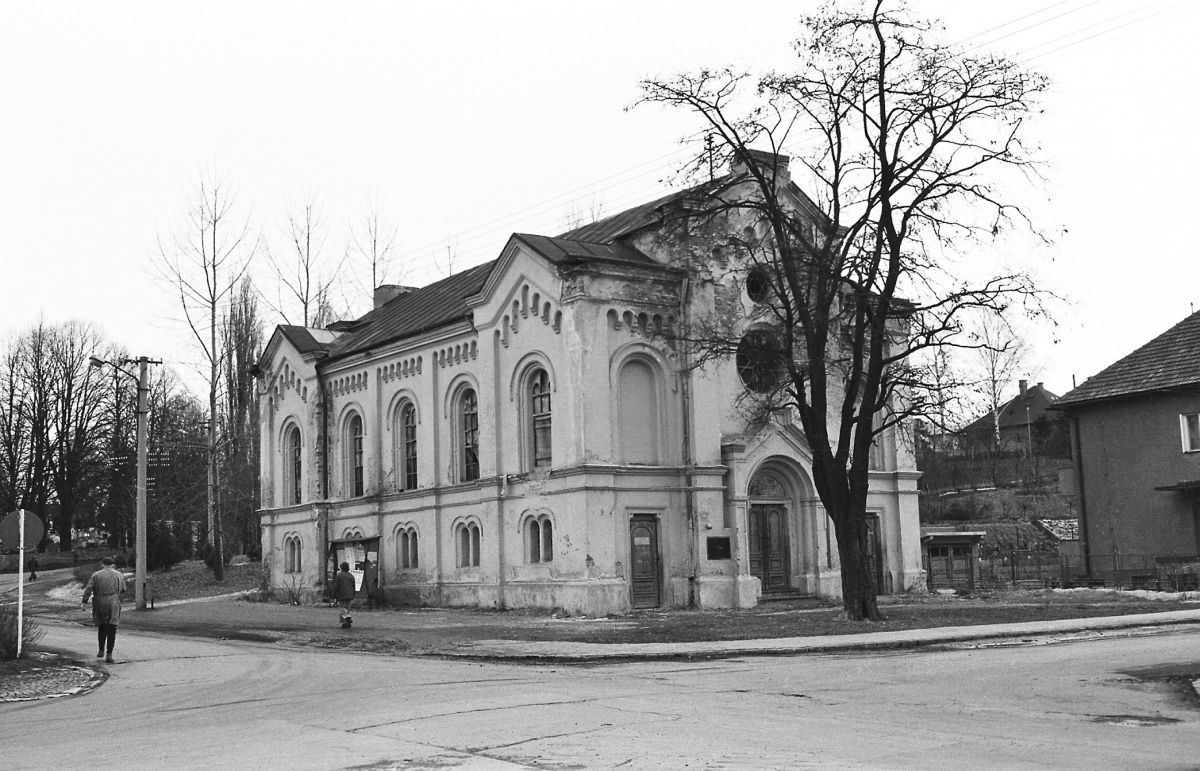
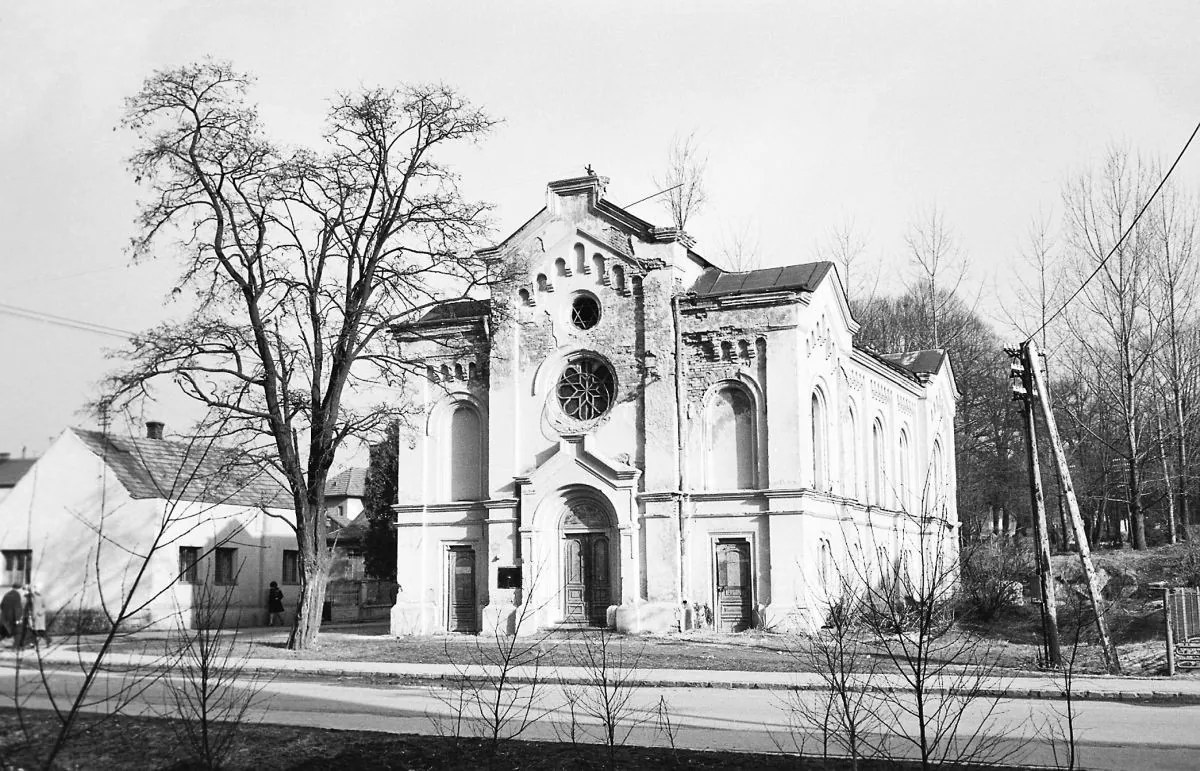
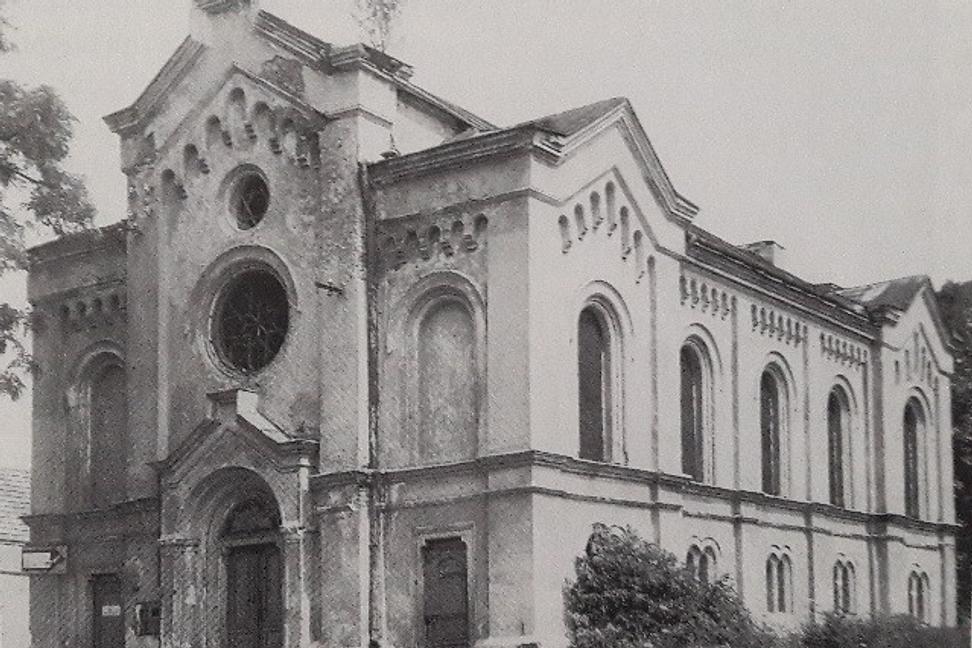
The synagogue was a free-standing rendered hall. The Slovak heritage portal Pamiatky na Slovensku describes it as a hall building with a late-Classicist facade inspired by Romanesque Revival and Oriental buildings; Salini and Pravda call it Moorish. Three photographs taken by Jiří Fiedler in March 1976 and a view published by Salini show the design. The entrance front was a tall gable finished with a stepped corbel frieze and a small round window near the apex, and below it a large rose window. A projecting porch with its own small gable and a round-arched, moulded portal held the main door. The long side walls had two tiers of round-arched windows, tall ones lighting the main hall and small ones at ground level, between pilaster strips, with a corbel frieze under the eaves. A pitched roof covered the hall, and lower side bays with their own doors flanked the front, possibly for stairs to a women's gallery, though no source says so. According to Milan Ftorek, about eight cast-iron supporting columns stood inside, two of which survive. The architect, builder and seating capacity are unknown.
Жизнь в синагоге
Very little is recorded about worship in the building. Salini writes that it served its religious purpose until the Second World War, and Pravda's informants agree. The Slovak Jewish Heritage Center database holds one object from the congregation's communal life: a nickel-silver charity box of the Chevra Kadisha, the burial society of Turčiansky Svätý Martin, made by A.K. & Cie of Vienna and dated 1909 or 1910. The society would have cared for the cemetery that lay directly behind the synagogue, where the last known burial took place about 1934. The cast-iron columns recovered in 2021, with decorated capitals, are the only pieces of the interior known to survive. No photograph of the interior, no description of the Torah ark or seating, and no name of a rabbi or cantor who officiated here has been found in the sources read.
Разрушение
The building survived the Second World War. After 1945 it stood empty of worshippers, and Salini and Pravda both write that it was used for years as a drying room and grain store. The Jewish community of Martin was dissolved in the 1960s, according to Pavel Frankl, and the building, by then dilapidated, was demolished under Communist rule. Salini and Pravda give the year as 1974; Salini publishes a photograph described as taken shortly before demolition in 1974. However, the heritage portal Pamiatky na Slovensku dates Jiří Fiedler's photographs of the standing synagogue to March 1976, so the demolition may have been as late as 1976, the year the adjoining cemetery was liquidated. The decision lay with the Communist-era town authorities: Salini writes that it is not known which town official decided to pull it down, and the owner of the columns told Pravda that she and her husband had to ask the authorities for permission to take remnants. Milan Ftorek of the association Reštart Martina reported a local story that it was removed to hide a dilapidated building before a visit by Soviet officials; this is unconfirmed.
Судьба общины
In 1940 Martin had 434 Jewish residents. Under the Slovak State they were deported with the help of the local Hlinka Guard: Salini dates the first transport to 5 June and the second to 3 July, giving the year as 1941. Several Martin families were exempted and stayed in the town, and Salini writes that some of them later died fighting as partisans in the Slovak National Uprising of 1944. Frankl told Pravda that only 54 Jews lived in Martin in 1948. The organised community was dissolved in the 1960s, and in 2021 a few Holocaust survivors still lived in the town. Where the deportees were taken and how many of them were murdered is not stated in the sources read.
Место сегодня
The synagogue stood on the corner where Bernolákova street meets Janka Kráľa street, opposite the National Cemetery. The site is now a privately owned grassy plot beside a bus stop, between the stop and a three-storey apartment building on Janka Kráľa street. Two boulders mark the place. The Jewish cemetery behind the synagogue was liquidated in 1976 and some of its gravestones were moved to the National Cemetery, where they lie loosely in the grass. In 2021 the association Reštart Martina bought the two surviving cast-iron columns and stored them in a guarded warehouse, intending to set them up as a memorial to Martin's Holocaust victims on the synagogue site or, failing that, in the part of the former cemetery owned by the Jewish community.
Вам есть чем поделиться?
Фотографии, документы, семейные истории и воспоминания об этой синагоге и её общине помогают сохранить её историю.
- Martin - synagóga
- Zabudnutý príbeh martinskej synagógy
- Stĺpy zo synagógy boli zabudnuté v záhrade
- Členovia martinského združenia oživujú už takmer zabudnutý príbeh martinskej synagógy
- Židovský cintorín v Martine
- Martin (Cemetery Discovery Project, yu4)
- List of synagogues in Slovakia (Žilina Region)
- Turócszentmárton
- Martin (mesto na Slovensku)
- Chevra Kadisha (burial society) of Turčiansky Sv. Martin tzedakah (charity) box (item 1098)
- J. Kráľa, Martin (OpenStreetMap way 314659093)
Share a memory or thought
No comments yet. Be the first to add one.